Career Suggestion for Newt: Science Fiction Writer

The Republican reality TV show is basically over.  The biggest difference I see between the “debate”/primary sideshow and American Idol is that I don’t think the winner of Idol is predetermined.

While the rest of us bit our nails once or twice as illusion kicked in and it seemed for a moment like Perry, could conceivably get elected, the men behind the curtain had their moment of fear in South Carolina.  You could almost hear Romney and the Republican honchos mutter, like Apollo Creed in Rocky I, “This guy thinks it’s a real fight!”

Don’t get me wrong – I am not a Gingrich supporter, but I am grateful to him for exposing the farce for exactly what it is.  The moment it seemed like he actually had a shot, the machinery kicked into high gear.  Bob Dole and John McCain got dragged in for endorsements.  Untold amounts of superPAC money flowed in to buy the election for the most qualified candidate, the one who appears to check the polls each week to see what he believes.

So Newt has to face the fact that the game was rigged, the status quo wins, and his political career will soon be over.  BUT, I have good news for him – a far greater opportunity is his if he chooses to seize it – rich and famous science-fiction author!

I used to think of Newt as a loose cannon, until I heard of his plan to colonize the moon.  I was delighted!  In this tapioca pudding election year, to hear a “serious” candidate talk of lunar outposts changed my estimation of him.  This man has too much imagination for politics!  He could be the next Ray Bradbury!  Think of it – he has enough name recognition to guarantee publication.  He could either devote himself to learning the craft or hire a ghostwriter.  Heck, if Sarah Palin can “write” a book…

All of us have known defeat in our lives, and it’s hard, but Newt, if you ever find yourself with enough time on your hands to read this blog, just please give it some thought.  And meanwhile, in the words of a very deep thinker, “Live long and prosper, dude.”

The California Wolf

On December 28, a 2 1/2 year old male wolf crossed the border into California after a 1,000 mile journey south through Oregon.  Wolf OR7, as he is called by Fish and Game, is the first wild wolf in the state in almost 100 years.  A young wolf will leave his pack to search for a mate to start a new one in situations like too many wolves competing for game in a certain region.

Wolf OR7

The new California wolf is a descendant of the 66 Canadian wolves who were relocated to Yellowstone in the mid 90’s.  He is one of an estimated 1600 wolves who now roam free in the Rocky Mountain states, in the southwest, and in Oregon.

According Tim Holt, a freelance writer in Dunsmuir, CA, “local ranchers and a few pandering elected officials have him in their cross hairs, saying he ought to be shot on sight.”   At the same time, “there are wolf advocates who practically worship this predator, seeing the wolf as symbol and martyr of a vanishing wilderness.”

Holt sees another possibility:

The removal of wolves, or their reintroduction, reverberates up and down the food chain. By culling deer and elk, new wolf populations help restore vegetation along streambeds, improving habitat for songbirds, beavers and river otters. And by going after weak and old members of deer and elk populations, they help strengthen their stock. Wolves, in other words, are instinctive wilderness restoration specialists.

So the wolves’ return to this state offers a litmus test of our commitment to the health of our remaining wildlands. But it goes beyond that. Allowing them to reintroduce themselves would be one more sign that we’re moving away from a human-centered view of nature, based on narrow economic interests, and have begun to see ourselves as a part of what might be called the broader economy of nature. http://www.sacbee.com/2012/01/29/4221053/wolf-can-help-us-balance-our-approach.html#storylink=cpy

Somewhere deep within us as well, is a fear of wolves that makes generations of children shiver at Little Red Riding Hood.  That thrilled me when I read Jack London’s stores of wolves battling men.  I didn’t know at the time that London’s stories were pure fiction.  No such incidents ever happened.  During the ’90’s, I volunteered at the Folsom City Zoo because I wanted to interact with the wild canines – the wolves and foxes and coyotes.

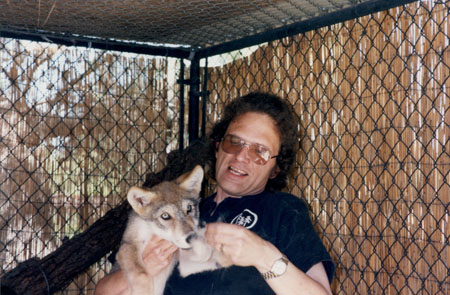
Helping to socialize Redbud, a wolf pup, ca 1995

During the 90’s, all the texts on wolves agreed there were no confirmed cases of a non-rabid wolf attacking a human in North America.  I don’t think that has changed.  A classic account is 50 years old.  Farley Mowat, a Canadian author and conservationist, spent a summer living by himself among wolves.  In his 1963 book, Never Cry Wolf, he wrote:  “We have doomed the wolf not for what it is, but for what we deliberately and mistakenly perceive it to be — the mythological epitome of a savage, ruthless killer — which is, in reality, no more than the reflected image of ourself.”

Never Cry Wolf by Farley Mowat, 1963

The book, and the movie made of it in 1983, deserve much of the credit for reversing public attitudes toward the wolf, and allowing reintroduction to happen at all.

Never Cry Wolf movie, 1983

Gandhi said the character of a nation is revealed in the way it treats its animals.  Let’s hope the way we treat OR7 reveals something compassionate, wise, and generous in us.

Sage, at the Folsom City Zoo, ca. 1995

Of Inflection Points and eBooks

“Inflection point” is an interesting concept.  Originally a term from calculus, it signifies the mathematical point where a curve changes from convex to concave or vice-versa.

When I was at Intel, Andy Grove, the CEO, spoke of inflection points as key moments of transition in the life of a business or industry.  Here is a good definition of that usage from Investopedia:

“An event that results in a significant change in the progress of a company, industry, sector, economy or geopolitical situation. An inflection point can be considered a turning point after which a dramatic change, with either positive or negative results, is expected to result.”   http://www.investopedia.com/terms/i/inflectionpoint.asp#ixzz1kdT0EAcg

I don’t think we can clearly see inflection points until after the fact.  We can sense the importance of an event, but not be sure until we see the results.  Apple’s introduction of the iPod was such an inflection point, but even if Steve Jobs sensed it, the rest of us didn’t how thoroughly the way we listen to music would change.

A sadder inflection point became clear last week when Kodak filed for bankruptcy.  That was the moment, in 1975, when Kodak invented digital photography, but then chose not to purse it.

I spotted something last night that made me even more certain that Amazon’s introduction of the kindle will be seen as such an inflection point.

Last week I wrote about hearing a talk by Mark Coker, founder of Smashwords.  http://wp.me/pYql4-1DD.  Last night I saw that Coker is one of two keynote speakers, and is presenting three workshops, at one of the better writing conferences, the 28th annual San Diego State conference, taking place this weekend.

I attended the SDSU conference in 2007 because I’d met someone who sold her book there.  In 2007, one speaker talked about Print on Demand.  Ebooks were not even mentioned.  This year there are the same number of seminars on traditional publishing as there are on ebook publishing, and this in a conference that draws a lot of agents and editors. http://writersconferences.com/index.htm

I did a rough count of seminar topics, judging their their emphasis as well as I could by the titles:

39 seminars on craft of writing
8 seminars on how become traditionally published
8 seminars on how to e-publish
8 seminars on marketing or other topics
1 seminar on social media

To me, these numbers do not signify an inflection point; they signify an inflection point that has already passed.  Last week I heard an established writer say “the jury on ebooks is still out.”  I don’t think so.  I think the battle is already over.  When new technologies affect traditional media, be it music, photography, or writing, they always carry it toward greater democracy, toward putting ever more powerful tools in everyone’s hands.  This does not appear to be a reversible trend.

We all miss certain artifacts after they’re gone.  Some music lovers swear by the sound of vinyl, and while I don’t miss the darkroom, silver prints could be beautiful, and I love old kodachromes.

I hope we don’t see a day when paper books become collectors items, but nostalgia will not hold back the tide, especially when it’s grounded in both a sense of personal freedom and economic reality.  To paraphrase what a Zen teacher said about change:  we can be okay with it.  Or not be okay with it.  The one thing we cannot do is stop it.

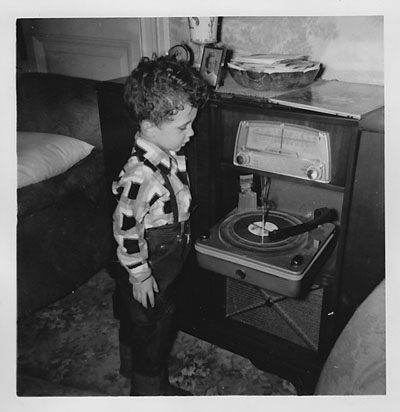
Yep, thats me. How many artifacts of the past can you count?

What Do 20% of Us Have in Common?

Not long ago, I read a Los Angeles Times article saying 20% of Americans suffered from mental illness in 2010.  The article ended with a warning:  “…we need to continue efforts to monitor levels of mental illness in the United States in order to effectively prevent this important public health problem and its negative impact on total health.”  The story did define what was meant by “mental illness.”  Do I have to keep an eye on every fifth guy in the Post Office line?

Not necessarily.

The Times’ source was a January 19 report by SAMSHA, the Substance Abuse and Mental Services Administration, which said 45.9 million Americans suffered from mental illness in 2010.  Their definition of mental illness is, “a diagnosable mental, behavioral, or emotional disorder (excluding developmental and substance use disorders)” in the DSM-IV, the 4th edition of The Diagnostic and Statistical Manual of Mental Disorders (1994).

Here’s how the DSM works: there are numerous schools of psychotherapy that differ in their approach to treating different disorders, but all have agreed to agree on the definitions of those disorders.  One of my psych professors insisted that the DSM says more about our cultural “norms” than about the health of the population.  For instance, in 1987, homosexuality was dropped from the list of disorders.  Prior to 1987, gays and lesbians were “mentally ill.”  After that, they were not.

Anyone who visits a psychotherapist and wants to submit an insurance claim will receive one of these diagnoses, most commonly, “Anxiety,” or “Adjustment Disorder.”  This fits the vast numbers of clients who are able to cope with life, but seek help with problems at work or problems at home or issues of self-actualization.  The SAMSHA report gave no mention of efforts to factor in the seriousness of the diagnosis.  There is no way to know how many of the 45.9 million Americans who are “mentally ill” suffer from anxiety vs. schizophrenia.

To the best of my knowledge, the rise of “insanity” coincided with the Industrial Revolution.  The US Census first noted the incidence of “idiocy/insanity” in 1840.  By 1880, there were seven types of insanity:  mania, melancholia, monomania, paresis, dementia, dipsomania, and epilepsy.

According to my psych professor, the DSM grew out of a research collaboration between the American Psychiatric Association (APA) and the US military between the world wars.  Soldiers in WWI suffered high rates of shell shock.  The military sought screening methods for those who would hold up in combat.  Although the screens later proved not to have the predictive power hoped for, the DSM came from this research.  In other words, our current definition of sanity is based the attributes of a good combat soldier.

Voices were raised in protest, almost from the start, notably by Thomas Szasz in The Myth of Mental Illness (1961) and a 1973 article by David Rosenham, “On Being Sane in Insane Places.”

I am not trying to minimize the suffering of those with mental afflictions that cause them to harm themselves or others.  First, I am questioning a report that excludes all forms of substance abuse from its definition of “mental illness.”  I also question defining “anxiety” as “mental illness,” when anyone who was paying attention in 2010 felt anxious.

I have often been struck, since I studied psychology, that our concept of sanity, modeled on the good soldier, also defines the “productive” member of our consumer culture.  It brings to mind a favorite line from a poem by Theodore Roethke:  What’s madness but nobility of soul at odds with circumstance?:

In a Dark Time

In a dark time, the eye begins to see,
I meet my shadow in the deepening shade;
I hear my echo in the echoing wood–
A lord of nature weeping to a tree,
I live between the heron and the wren,
Beasts of the hill and serpents of the den.

What’s madness but nobility of soul
At odds with circumstance? The day’s on fire!
I know the purity of pure despair,
My shadow pinned against a sweating wall,
That place among the rocks–is it a cave,
Or winding path? The edge is what I have.

A steady storm of correspondences!
A night flowing with birds, a ragged moon,
And in broad day the midnight come again!
A man goes far to find out what he is–
Death of the self in a long, tearless night,
All natural shapes blazing unnatural light.

Dark,dark my light, and darker my desire.
My soul, like some heat-maddened summer fly,
Keeps buzzing at the sill. Which I is I?
A fallen man, I climb out of my fear. 
The mind enters itself, and God the mind,
And one is One, free in the tearing wind.
– Theodore Roethke

Shortwave Memories

When I was twelve, my mother, who claimed she had no luck in contests, won a transistor radio in a raffle and gave it to me. This was a fancy model. With AM, FM, and shortwave bands, a folding antenna, an earphone jack, and a lighted dial, it was perfect for tuning in to exotic locations at night when I was supposed to be sleeping.  Voice of America, BBC, Radio Free Europe, were all within reach.  So was Fresno.  For some reason, I took a shine to a radio evangelist who came on the air every Sunday night at 10:00 from a station in Fresno.

I don’t remember exactly why I liked him.  Perhaps because he was livelier than the minister at the family church – “Can I get a Halleluljah?”  At the same time, he delivered comforting messages.  One night he explained why scripture promised there would not be a nuclear holocaust.  This was a timely message during the Cuban missile crisis.  The guy up the street was digging a fallout shelter in his front yard.  At school we had hydrogen bomb drills (get under your desk and cover your head), but I took it all with calm indulgence.  The worst was not going to happen.  I had it on good authority – the man of God in Fresno guaranteed it.

I spent the next six years deeply engaged with radio.  I got my ham license and was active until I went off to college.  Half a century ago it shrank time and space like the internet does for us now.  I thought of that radio recently when I noticed myself scrolling through international news on my smart phone.  I’ve always loved my gadgets, but I realized the phone lacks the magic of distant stations coming in through the static at night on the glowing radio dial.  It also lacks the assurance I found on that Fresno station on Sunday nights.  Nowadays, most of the people quoting scripture are scary, and for all we can find online, it’s hard to find a convincing voice saying everything will be all right.

Lunch with Ebook Advocate, Mark Coker

According to Time Magazine, in 1812, the year Charles Dickens was born, 66 novels were published in Britain.  Many were written by “Anonymous,” since novels were not very reputable.  No one dreamed of making a living writing them.  Dickens, the first literary celebrity, whose bicentennial we celebrate this year, was instrumental in changing that, but he never could have imagined today’s literary landscape, which his work helped to create.

Mark Coker, guest speaker for January’s California Writer’s Club lunch, described an experience that is emblematic of the challenges faced by new writers today.  Coker and his wife co-wrote a novel.  They went through the revision process, and eventually became clients of a prestigious New York agency.  Two years later, their book remained unsold.  Coker’s solution was Smashwords, an ebook publishing service he started in 2008 that is at the forefront of changes rippling through the industry.

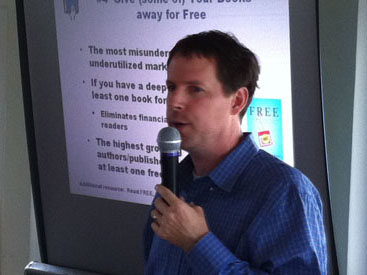
Mark Coker

Coker says that large publishers “look in the rearview mirror” for what has worked in the past.  There is little financial incentive for them to risk new concepts and new authors.  Even an author who wins the publishing game and gets a book on the shelves has no guarantee that a title with slow sales will not be remaindered within a matter of weeks.  That may not be enough time to establish the buzz that drives success.

Publishing on Smashwords is free and fast.  Correctly formatted books are distributed to all the major ebook publishers, and authors receive 85% of the sales.  Books do not go out of print, so there’s time for word of mouth to evolve.  Smashwords usage is growing exponentially.  Authors uploaded 140 books in 2008.  In 2011, the total was 92,000.

Smashwords historical usage, from a chart on their blog

Coker’s talk was animated with a sense of mission.  He said what gets him up in the morning is, “enabling writers to express themselves.”  He never suggested it’s easy, however, and most of the rest of his presentation detailed what is required.

First in importance, of course, is a really good book.  Coker suggested as many revisions and beta readers as necessary, and possibly professional editing.  At stake is the trust of readers, hard to build and easy to lose.

Next in importance are a well designed cover and compelling blurb.  Coker says polls reveal that “discovery” accounts for 50% of ebook sales – in other words, we still buy books by their cover.  This is good news for indie authors.  Only 18% of readers polled reported sticking with authors they know.  This means that for independent authors without design skills, hiring an artist is almost essential to come up with a cover that will capture attention as readers scroll through pages of thumbnails.  An email to list@smashwords.com will generate an auto reply listing 3d party artists and people who handle format.

Coker presented more information than I can cover in one article.  He has free guides to ebook formats and marketing at https://www.smashwords.com/.  Other topics are covered on the Smashwords blog, (referenced on the blogroll here) and at http://www.huffingtonpost.com/mark-coker.

With ebook sales continuing to climb; with Apple’s move into electronic textbooks; with Smashword’s impending foray into library distribution, it becomes increasingly clear that ebooks are where the future of publishing lies.  Mark Coker used the phrase, “democratization,” which again brought to mind the Time article on Dickens I referenced to begin post.

“The flood of books in the 19th century elicited two powerful institutional responses:  the rise of prize culture and the rise of literature as a field of study.  The message (sometimes subliminal, sometimes not) was that the masses needed help figuring out what to read, and the cultural elite…was going to provide it.”  (“Charles in Charge” by Radhika Jones in Time, Jan. 30, 2012)

Noting that such elitism broke down well before the advent of ebooks, (for example, with the rise of Oprah as our great taste-maker), Radhika Jones ends her article with a question that would likely delight Mark Coker and maybe Charles Dickens as well:  “Will the readers of the future find their 21st century Dickens on the Pulitzer roster or the best-seller list or FanFiction.net?”

“The future is in your hands,” said Coker at the end of his talk.  “The power of publishing is shifting to the authors.  Go and serve your readers.”

The Lightning Thief by Rick Riordan: A Book Review

I’ve been less active on my blog this week because of the happy event of finding a book I couldn’t put down. Like most such discoveries, I came to it by word of mouth.  In December, we called my sister-in-law to ask what our fifth grade nephew might want for Christmas.  She said he had really enjoyed  The Lightening Thief by Rick Riordan, the first book in a middle grade series called Percy Jackson and the Olympians.  Without even stopping to read the blurb in that hectic season, we ordered the boxed set on Amazon, had it shipped as a gift, and forgot about it – until this month, when I spotted a display of the series at the local Barnes&Noble.

I was instantly impressed as I realized these books feature the 12 year old son of Poseidon and a mortal woman in a 21st century America where the figures of Greek mythology – and their numerous offspring – are on the loose.  If you remember your Greek myths, you recall that the gods were best avoided by mortals.  There was a lot of collateral damage in the Olympians’ constant bickering.  Think of Troy.

Percy Jackson, our half-blood (aka, demigod) hero, would not wish his fate on anyone.  Dyslexic, diagnosed with ADHD, and a D student, he has been shuffled from school to school six times in six years.  And that was when his life was easy – before one of the furies and the Minotaur try to kill him.  By sheer luck, he finds refuge in Camp Half-Blood, but not for long.  Zeus believes Percy has stolen his thunderbolt thrower.  If Percy does not return it in ten days time, a battle will erupt on earth, “that will make the Trojan war look like a water-balloon fight,” according to Chiron the centaur, Percy’s mentor.

Though this book is aimed at a young audience, it has all the attributes writers are taught to build into their novels:  an engaging protagonist, a unique premise, tension on every page, and ever-rising stakes.  I love the way this story encourages younger readers to explore the classics.  One of the items I saw on display at the Barnes & Noble was an illustrated summary of the figures of Greek myth, presented in contemporary form.  Zeus had shoulder length hair, a pin stripe suit, and the good looks that could land him on the cover of a romance novel.  Dionysus was a pudgy, middle-aged reprobate, given to loud Hawaiian shirts.  Such images make the gods more immediate than the older toga and grape-eating portraits.

I am late to this party.  The Lightning Thief was published in 2005. A movie version was made in 2010. I don’t know if it was ever released, but the Wikipedia summary shows it diverges significantly from the novel.  That makes me wary since I liked the book so much.

Most of the online reviews I read were written by adults who enjoyed Riordan’s stories as much as younger readers. Several mentioned the kind of pleasure they found in Harry Potter.  I can’t say for sure, since I’ve only read the first book, but I know I’m looking forward to reading the others.

Bill Moyers is Back!!!!

On Sunday evening, I was delighted to catch the first episode of the new PBS series, Moyers & Company.  You can view it, and a lot more, on the new website, http://billmoyers.com/.

Moyers interviewed political scientists, Jacob Hacker and Paul Pierson, authors of, Winner-Take-All Politics:  How Washington Made the Rich Richer–and Turned Its Back on the Middle Class.

The conversation startled me, as Hacker and Pierson said they were startled during their research.  They found that the current income gap in this country – greater than in some third world countries like Egypt – was not an inevitable consequence of free market dynamics or trends like globalization.  It was politically engineered over the last 30 years.  Hacker and Pierson argue that the current American leadership more closely resembles a third world oligarchy than the democracy our parents knew.

“Who’s the culprit? “American politics did it– far more than we would have believed when we started this research,” Hacker explains. “What government has done and not done, and the politics that produced it, is really at the heart of the rise of an economy that has showered huge riches on the very, very, very well off.”

Bill considers their book the best he’s seen detailing “how politicians rewrote the rules to create a winner-take-all economy that favors the 1% over everyone else, putting our once and future middle class in peril.” – (from billmoyers.com)

Jacob Hacker and Paul Pierson on Moyers & Company

Winner Take All Politics is going into my already overcrowded book-queue, since it appears to be of critical importance.  The first step in correcting a problem is gaining an accurate understanding of its nature.  The fact that the assault on the middle class was created and not fated is good news, according to Hacker and Pierson.  Something done can be undone.  Along with Moyers, they agree that our current national sense of outrage is a positive sign.

Moyers’ work and website are important to bring up today.  On the website you can find an April, 2010 interview with two African American lawyers, discussing what Dr. King would have made of America today. Lawyer Bryan Stevenson said:

“I think in America, the opposite of poverty is justice. I think there are structures and systems that have created poverty, and have made that poverty so permanent, that until we think in a more just way about how to deal with poverty in this country, we’re never gonna make the progress that Dr. King envisioned.”  http://billmoyers.com/content/bryan-stevenson-and-michelle-alexander/

These are important things to consider, especially today.