A Scientist Talks About Alternate Worlds

I’ve spent the last 30 years deeply engaged in the study of Eastern and Western esoteric world views, so the topic of my last two posts, the legendary realm of Shambhala, does not seem impossible to me.  No more so than astral worlds or Faerie, or any number of things our senses do not perceive.  It’s not so often, however, that you hear a respected scientist support the existence of unseen realms, but I did this morning. Brian Green, a professor of physics and mathematics at Columbia, was nominated for a Nobel Prize for his first book, The Elegant Universe, 1999, a discussion of string theory for laypeople.

Brian Green

I heard him on NPR discussing alternate universes, in a January interview that was rebroadcast on the occasion of the paperback release of his latest book, The Hidden Reality:  Parallel Universes and the Deep Laws of the Cosmos, 2011.  (Link to the NPR Interview: http://www.npr.org/2011/11/04/141931728/exploring-the-hidden-reality-of-parallel-worlds ) According to Green, string theory is an attempt to bridge mathematical conflicts between Einstein’s theory of relativity, which accurately describes the behavior of large objects, and quantum mechanics, which details what is very small.  String theory, however, posits ten physical dimensions – that’s seven that we cannot perceive.

Green says:  “You almost can’t avoid having some version of the multiverse in your studies if you push deeply enough in the mathematical descriptions of the physical universe.  There are many of us thinking of one version of parallel universe theory or another. If it’s all a lot of nonsense, then it’s a lot of wasted effort going into this far-out idea. But if this idea is correct, it is a fantastic upheaval in our understanding.”

In addition to the half-hour NPR interview referenced above, you can check out more of what Green has to say about string theory on The Elegant Universe, a three hour presentation he hosted on Nova:  http://www.pbs.org/wgbh/nova/elegant/

As Mulder and Scully insisted, “The truth is out there.”

The Story of Shambhala

"Song of Shambhala" by Nicholas Roerich, 1943

The fictional earthly paradise of Shangri-La, discussed in my previous post, derives from early Buddhist teachings about Shambhala, a remote realm of advanced spiritual practitioners.  Shambhala is discussed in the Kalachakra Tantra, which Shakyamuni Buddha is said to have taught the Shambhala King, Dawa Sangpo, and 96 lesser rulers, over 2500 years ago.  The King taught all the citizens, since this practice leads to rapid enlightenment, which he hoped would enable them to withstand a threatened invasion.

This is the same “Kalachakra for World Peace,” that the Dalai Lama conferred last July in Washington, DC.  “World Peace,” does not mean it makes one a blessed-out pacifist.  Kalachakra means, “Wheel of Time,” and explores the cycles that affect individuals and the world at large.  It teaches that barbarian hordes periodically invade the civilized world and attempt to eliminate spiritual practice.  Such an invasion, leading to world war, is predicted for the year 2424, at which time, the Kingdom of Shambhala will again manifest in this world to turn the tide.

Kalachraka Mandala

Proponents say that those who take the Kalachakra initiation will be reborn on the victorious side, and the end of this conflict will usher in a new golden age.  (from, Alexander Berzin, Introduction to the Kalachakra Initiation, Snow Lion Publictions, 2010).

In common with the older Hindu epic, The Mahabharata, the warfare described in this teaching has inner and outer dimensions.  To the authors of Kalachakra, “barbarians” were non-Sanskrit speaking people who ate beef, and like Alexander the Great, periodically launched literal invasions.  The authors also understood “barbarians” to mean our own treacherous impulses like greed, hatred, and jealousy, which keep us bound to the wheel of suffering.  This inner war is part of every individual’s spiritual path.

Scholars have located Shambhala near Mount Kailash in the Himalayas, a place sacred to Hindus, Buddhists, and Jains.  They caution that only part of the journey is physical; arrival depends on knowing certain mantras and other spiritual techniques.

Shambhala is said to be near the 22,000' Mt. Kailash

A Western analogy that comes to mind is the Avalon of Marion Zimmer Bradley’s, Mists of Avalon.  When the priestess, Morgaine, falls out of inner harmony, she cannot reach the sanctuary.  In a similar way, some legends say King Arthur is not really dead.  The story says he will rise again at the time of Britain’s greatest need, and numbers of people reported visions of mounted knights during the second world war.

Paramahansa Yogananda (1883 – 1952), born in India, came to this country in 1920.  He was probably the most influential teacher of meditation and Eastern philosophy in America in the first half of the 20th century.  Yogananda predicted a similar time of turmoil, followed by a higher age of spiritual and creative growth.

Eastern concepts of time are cyclical rather than linear.  Yogananda outlined a 24,000 year cycle of four ascending and descending ages, analogous to what the Greeks called, gold, silver, bronze, and iron.  Yogananda’s predictions are eerily similar to what the world is experiencing now:  economic, climactic, and social disruptions.  The good news is that in this view, like that of Kalachakra, we are on the cusp of a higher age.  The bad news is, it’s not going to happen right away – as in, not in our grandchildren’s lifetime.

Still, a well known Tibetan teacher, speaking of our “degenerate” times, reminded his audience of how fortunate we are to live when profound spiritual teachings are available.  If we don’t get to chose all our external circumstances, according to Kalachakra and the teachings of Yogananda, we do get chose how to shape our response and our inner condition.

As Gandalf told Frodo, “All we have to decide is what to do with the time that is given to us.”

Shangri-La in Books, Movies, and Legend

I recently wrote a short story about a group of people trying to find Shangri-La. For decades, the name has stood for an earthly paradise, difficult to attain. The name was so popular in the 30’s and 40’s that before it was renamed Camp David, Franklin D. Roosevelt named the presidential retreat ground, Shangri-La. After my story was finished, I began to research this mythical place about which I realized I knew very little.

The name, “Shangri-La” entered public awareness through a novel and a movie, which I will discuss today. In my next post, I will explore the Tibetan legend of Shambhala from which core elements of the story may derive.

In David Hilton’s 1933 novel, Lost Horizon, Hugh Conway, a world-weary British diplomat and WWI veteran, along with three others refuges from an uprising in India, board a plane that is hijacked to the remote mountains of Tibet. They crash land in the snows and find their pilot dead. The group is rescued by a postulant lama named, Chang, who leads them to the hidden lamasery of Shangri-La, high above a fertile and temperate valley. Here Conway finds peace, the stirrings of love, and a sense of purpose when the High Lama tells him he has been chosen to oversee the mission of Shangri-La – to preserve the best of modern civilization during a world war the lama, (who is 300 years old), has seen in vision.

Did Hilton foresee WWII when he wrote his book in the early 30’s? Perhaps, but he also studied a 1931 National Geographic account of an expedition to the borders Tibet. Unexpectedly temperate valleys lie along the Nepalese border, and Hilton may also have read of the legend of Shambhala, with a similar prophesy of a world war. This prophesy is part of the Kalachakra teaching cycle the Dalai Lama presents, most recently in Washington, DC, last summer.

Lost Horizon won public notice only after Hilton published, Goodbye Mr. Chips, the following year. Because it was later published as Pocketbook #1, Lost Horizon has been mistakenly called the first American paperback.

Frank Capra read Hilton’s book and immediately decided to make the movie version. Production began in 1936, with a budget of $1.25 million, the largest for any film at the time. After a $777,000 cost overrun, Lost Horizon, was released in 1937 to critical acclaim. A New York Times reviewer called it, “a grand adventure film, magnificently staged, beautifully photographed, and capitally played.” It won Oscars for Art Direction and Film Editing, and was nominated for Best Picture.

Both the book and the movie seem dated now. The romantic vision of humans-as-noble-savage will not appeal to our modern sensibility. The idea that people will be good if freed from want echoes both the pacifism that flourished after the first world war and the socialism that grew in response to the hard times of the ’30’s. I believe in the “higher vibration” of certain places, yet when Chang tells Conway the healing properties of Shangri-La have even eliminated human jealousy, it breaks my “suspension of disbelief.”

Even with this kind of flaw, I enjoyed the book and the movie. The specifics of the Lost Horizon’s 75 year old vision may be dated, but the archetypal longing for a golden age and heaven on earth is not. The book and movie tap into this, and the tale of paradise found then lost evokes our longing for the Garden of Eden, Atlantis, Avalon, and Shangri-La. “We are stardust / We are golden / and we’ve got to get ourselves back to the Garden,” sang Joni Mitchell in her song about Woodstock, another manifestation of longing for a world of peace and joy.

This longing will not go away because it expresses our true nature, according to the view that gave birth to the legend of Shangri-La. Next time we’ll look at the legend of Shambhala, which carries predictions that will echo some we have seen in Lost Horizon.

Openings

Recently I was chatting with a group of other writers about the rule of thumb that you have to grab your audience in the first few pages or lose them.  The consensus was that nowadays, you have just the first few lines.  One man said, “And you have to start with action.”

I don’t believe this, and said as much here last year (http://wp.me/pYql4-4b).  For me, character is primary, and I also have a penchant for mystery.  Action for action’s sake usually puts me off – I need to bond with Jake and Elwood before I care about the car chase.

Yet the conversation started me thinking about the kind of books that instantly draw me in.  When I got home, I pulled down some novels with openings I admire to look again at what the authors do.

One of my favorite reads of the year was Suzanne Collins, The Hunger Games, a stunningly original story and beautifully written as well.  It includes one of the best openings I have ever read.

“When I wake up, the other side of the bed is cold.  My fingers stretch out, seeking Prim’s warmth but finding only the rough canvas cover of the mattress.  She must have had bad dreams and climbed in with our mother.  Of course, she did.  This is the day of the reaping.”

In four sentences, we learn a lot about who we’re dealing with:  an articulate girl who notices details, loves her sister, does not have a father or very much money, and soon has to face something ominous called “the reaping.”  We meet an appealing character, two mysteries (where is her father and what is a reaping), and an instant sense of dread.  The opening of this best seller proves that you don’t need action to grab a readers attention:  nothing “happens” except the narrator reaches out and finds her sister is not in bed.

Another memorable book I read this year was The Cypress House by Michael Koryta.  The first two sentences drew me in:  “They’d been on the train for five hours before Arlen Wagner saw the first of the dead men.  To that point it had been a hell of a nice ride.”  Nothing “happens” except one man has a very unusual vision.

A favorite literary novel, Ariel’s Crossing, 2002, by Bradford Morrow starts like this:  “Dona Francisca de Pena never believed in ghosts, and even after she became one herself she couldn’t help but have her doubts.

Maybe its just the season, but half the stories I pulled down featured ghosts.  Here is another, a favorite YA novel, Ghosts I have Been, by Richard Peck, which begins:  “I tell you the world is so full of ghosts, a person wonders if there’s a soul to be found on the Other Side.  Or anybody snug in a quiet grave.  I’ve seen several haunts, and been one myself.”

Such a compelling hook does not happen by accident. Once at a reading, someone asked Richard Peck how many times he revised his opening pages. “Sixty or seventy times on average,” he said.  Because of that focus, you can open almost any one of his more than 30 novels to find an enticing beginning.  On the Wings of Heroes, an historical novel published in 2007, even begins with action, but it is not action for it’s own sake.  It is action crafted to draw in an audience of middle-grade boys:

“Home base was a branch box elder tree in front of the Hisers’ house out by the curb.  We could count on the Hisers not to mind when we pounded in from all directions to tag out on their tree.  We plowed their sod when we skidded home, bled all over their front walk when we collided, knocked loose the latticework under their porch.”

This is admittedly a small sample of books that appeal to my taste, but they prove several points.  Book openings are critical.  It takes real art and sometimes sixty or seventy drafts to draw a reader into a story.  At the same time, it is no more correct to say a book must start with action than to say that it can’t.  There are lots of ways to pique curiosity and interest, and that is what it’s really about.

Interlude on the Oregon Coast

I first explored the Oregon coast as an undergrad when I was studying art and photography at the U of O.  I kept a 4×5 view camera, a sleeping bag, and a coleman stove in the trunk of my ’63 biscayne.  A box of mac and cheese, a few apples, and a jar of instant coffee, and I was ready to spend a weekend poking along the backroads up and down the coast.

One of my favorite spots was the south coast town of Bandon.  With a nice state park, miles of beaches to explore, and expresso and pizza available in town, it was a fairly posh spot for camping.  That was in the mid ’70’s.  Mary and I have travelled there at various times over the years since then, but had not been up for almost a decade.

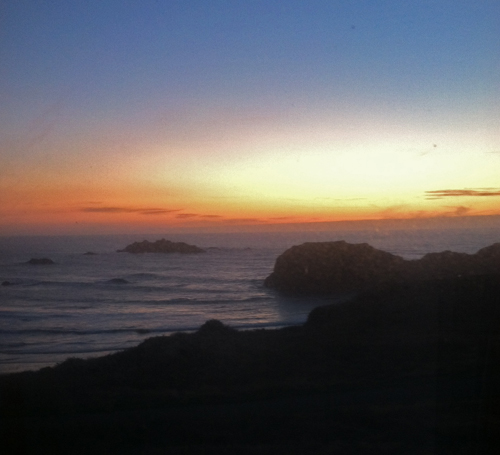
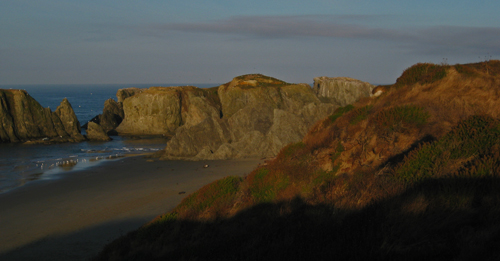
We drove last week to Bandon, and blessed with mild weather, spent some memorable days enjoying the changing leaves and the autumn light on the ocean.

The sound of the waves and the foghorn at night, drifting through an open window, brought T.S. Eliot to mind.  Here are a few photographs, and some of Eliot’s lines from The Four Quartets.

The river is within us, the sea is all about us;
The sea is the land’s edge also, the granite
Into which it reaches, the beaches were it tosses
Its hints of earlier and other creation

It tosses up our losses, the torn seine,
The shattered lobsterpot, the broken oar
And the gear of foreign dead men. The sea has many voices
Many gods and many voices.
The salt is on the briar rose,
The fog is in the fir tree.

The tolling bell
Measures time not our time, rung by the unhurried
Ground swell, a time
Older than the time of chronometers, older
Than time counted by anxious worried women
Lying awake, calculating the future,

Between midnight and dawn, when the past is all deception,
The future futureless, before the morning watch
When time stops and time is never ending;
And the ground swell, that is and was from the beginning,
Clangs
The bell.

If you came this way,
Taking any route, starting from anywhere,
At any time or at any season,
It would always be the same; you would have to put off
Sense and notion. You are not here to verify,
Instruct yourself, or inform curiosity
Or carry report. You are here to kneel
Where prayer has been valid.

A Vote For Ebooks

Last weekend, I attended the monthly meeting of the local branch of the California Writer’s Club. The meetings feature introductions, socializing over a buffet lunch, and a speaker. This month we tried something new. Members were invited to throw out a question or concern. The rest of the group had five minutes to offer suggestions.

A man at my table had finished writing a fantasy novel and was wrestling with whether to try to get it traditionally published or go the self-publishing route in ebook format. Quite a few members weighed in, including unpublished, traditionally published, and self-published writers. Several others present provide marketing and design services for writers. What struck me was that everyone who spoke, without exception, urged the questioner to go the ebook route.

Several people pointed out that nowadays, successful ebook sales are an alternate route to acceptance by traditional publishers, a message we heard at an agent’s workshop last winter, and one that is underscored by the deal Amanda Hocking made with St. Martin’s Press. Others mentioned the amount of time it takes to see one’s work in print even after winning acceptance by one of the big six publishers. This underscored the author’s comment that, “At my age, I don’t have unlimited time.” One of those who provide marketing services for writers emphasized the need for a plan to publicize one’s work regardless of how your book gets published.

Even ten years ago, “self-publishing” was synonymous with “vanity press.” No longer. Not one person in the room raised the issue of “legitimacy,” one of the draws of traditional publishing before the recent spate of ebook success stories. Now, to paraphrase The Godfather, everyone who spoke felt the decision was, “just business.”

The Hamish MacBeth Mysteries, by M.C. Beaton

“I was at a fishing school in Sutherland in the very north of Scotland, and I thought, what a wonderful setting for a classical detective story, 11 people isolated in this Highland wilderness. So Hamish Macbeth was born.” – M.C. Beaton

M.C Beaton is the pen name that Marion Chesney, a prolific Scottish author, uses for her mysteries, which include 28 titles featuring Highland constable, Hamish MacBeth, and 22 staring Agatha Raisin, a retired, middle-aged public relations agent who solves murders in the Cotswolds.

Beaton at her 75th birthday party this year

The first MacBeth mystery appeared in 1985.  Agatha made her debut in 1992.  Beaton, 75, has not slackened her pace; she released new titles in both series this year.

Hamish MacBeth is likable constable in the village of Lochdubh (which means, “black lake,” in Gaelic and is pronounced Lokh-DOO).  Hamish loves the town, raises sheep and chickens, and occasionally poaches salmon.  He has a well earned reputation for laziness, and several times works to avoid promotion which would force him to move to the dreary industrial town of Strathbane.  For this and other reasons, his superior, Chief Inspector Blair, despises him and threatens to close the Lochdubh station.  MacBeth must often work around “proper” channels.  Sometimes he plies Blair’s subordinate, Jimmy Anderson, with whiskey to gain information and help.

In the early books, MacBeth had an on-off relationship with Priscilla Halburton-Smyth, but their engagement ended, and Priscilla, who is more ambitious than Hamish, moved away to become a newscaster.  MacBeth’s love life foundered, and now his closest companions are Lugs the dog (the word means, “ears” in Gaelic), and Sonsie, a “domesticated” wildcat whose name means, “cheeky.”

Robert Carlyle played MacBeth in a BBC Scotland adaptation that ran from 1995-1997

MacBeth solves crimes through intuition, curiosity, and an ability to charm various locals.  There is Angus MacDonald, and old man with a reputation as a seer.  Hamish thinks he’s a fraud, but a useful source of gossip.  Nessie and Jessie Currie, twin sisters and village spinsters are also a sources of gossip, though MacBeth must sit through their strange habit of repeating each other’s phrases – repeating each other’s phrases.

The MacBeth novels are proverbial beach reads, engaging escapism, starring a likable rascal who may poach salmon now and again, but restores the balance of justice to his little world of wild beauty and engaging eccentrics.  These books are perfect for rainy weekends, or any other time when you want to leave the modern world behind and root for a man who knows how to game the system, or at least the pointy-haired bosses within it.

Literary Indigestion

This won’t be the first time I’ve said I love fantasy and have since I was a kid.  During the ’80’s, I read scores of fantasy novels, but the day finally came when I couldn’t anymore.  One too many recycled plots, wise wizards, crusty dwarves, plucky youths, heroic thieves, feisty tavern wenches, and so on.  I developed acute genre indigestion and have only recently started reading adult fantasy again.

History repeats itself.

A dozen years ago, I discovered young adult fantasy and delighted in some of the characters and stories.  Inspired by these, I even wrote my own first novel in just six months, in 2005.  Recently, however, YA fantasy has been “discovered.”  Now I find I can’t read this genre either; bandwagons and the perception of money and names to be made don’t lead to books with much imagination or heart.

A glut of vampire romance was followed by a glut of stories of Faerie and zombies.  After the success of The Hunger Games, “dystopian” tales became the theme du jour.  Now stories of were-beasts are all the rage.  I sometimes wonder if I am a snob or too harsh in my judgements, so I yesterday I took a look at the YA fantasy titles featured on Amazon.  Here are some descriptions I found in the blurbs:

“A lyrical tale of werewolves and first love.”  – I gotta say it, “Awwww!”

“explodes onto the YA scene with a brilliant nail-biter of a dystopian adventure.”  –  Think about the phrase, “YA scene.”

“A kidnapped wolf pup with a rare strain of canine parvovirus tuns regular kids into a crime solving pack.”  –  I’m a sucker for dog stories, and I like wacky superheroes, so this one sounds like the best of the bunch.

“Can a prim young Victorian lady find true love in the arms of a dashing zombie?”  –  I would have said “dashing zombie” is an oxymoron.

“A timeless love story with a unique mythology that captivates the imagination.” – The blurb didn’t say what this unique mythology might be, so you have to take the publicist’s word.

This book is “generating a Twilight-level buzz.”   I’ve never heard of it.

OK, I guess I’m being a little snarky.  It seems that today’s YA represents a successful move by writers and publishers to attract a new demographic of younger readers to what is essentially, romance.  On one hand, this largely excludes me as a reader and writer, because while I think romance is fine, it’s not my thing.   I also find it sad to think that over the near term, we’re going to have zombie love instead of books like A Wrinkle in Time, The Earthsea Trilogy, and The Golden Compass.

So what am I doing about it?  Kicking back with literary comfort food, otherwise known as light detective stories, stories with fun characters you just want to trail along with as they bring justice into the world.  In the past, I’ve devoured stories by Conan Doyle, Agatha Christie, Tony Hillerman, and Elizabeth Peters.  Now, thanks to my wife, I have a new main-man – Hamish MacBeth, the constable of the village of Lochdubh, Scotland, who, with his dog, Lugs, and his cat, Sonsie – and wee dram now and again – excels at solving murders.  Hamish is the creation of M.C. Beaton, the pseudonym used by author, Marion Chesney, for her mystery stories.  Born in Glasgow in 1936, she has also written 100 historical romances under a different names.

M.C. Beaton

My wife has collected a bookshelf full of MacBeth stories, and I’ve only started.  My current read is, Death of a Chimney Sweep.  In one passage, Hamish is driving an author to meet her publisher. He says to her,  “Angela, you’re taking this all to seriously.”

“What would you know?  You haven’t a single ambitious bone in your body.”

“Aye, and I like it that way.”  Hamish suddenly wished the evening was over.

I love these stories!   I will have more to say about Hamish MacBeth in my next post.