The Ballad of Jesse James

It’s easy to see why I was drawn to the Ballad of Jesse James as a kid; the song paints Jesse as an American Robin Hood:

Jesse James was a lad, he killed many a man,
He robbed the Glendale train.
He stole from the rich and he gave to the poor,
He’d a hand, and a heart, and a brain.

Jesse James

Not surprisingly, singers who have covered this ballad include Woodie Guthrie, Pete Seeger, and Bruce Springsteen.  The song also has those elements of mystery I believe are central to stories that take up permanent residence in imagination:

Oh, Jesse had a wife who mourned for his life,
Three children they were brave,
But that dirty little coward, that shot Mr. Howard,
Has laid Jesse James in his grave.

The notes in the book of ballads I found as a kid explained that “Howard” was the alias Jesse James used when he married, settled down, and tried to leave his life of crime behind.  The dirty little coward was Robert Ford a friend of Jesse, who shot him as he straightened a picture on the wall of his home.  Something in us recoils at that and wants to know how Ford could do it.  We know in our bones why Dante assigned traitors to the lowest circle of Hell.  I am not the only one who wonders, for the story has been dramatized several times, most recently in 2007, when Brad Pitt played Jesse in The Assassination of Jesse James by the Coward Robert Ford.

With Jesse James we get to witness a legend in formation, for unlike the Child ballads, this story is just over a hundred years old.  We can see how imagination shapes facts the way the ocean smooths pebbles, and something in us prefers the legend – we want to know who the heroes and villains are and we want them larger than life.  If you are like me, you’ll be disappointed to learn that no historical record shows the James gang ever using its loot to benefit anyone but themselves.

Jesse James, (1847-1882), and his older brother Frank, came of age during an especially bloody phase of the Civil War – the guerilla conflicts that raged across the border state of Missouri.  The James brothers rode with William Quantrill, one of the most notorious guerillas; we would call him a terrorist now.  Sixteen year old Jesse joined Quantrill in 1864, and supposedly took part in the Centralia massacre, where the band killed 22 unarmed Union troops then scalped and dismembered them.

After the war, Missouri freed its slaves, but forbade ex-Confederate soldiers from voting, serving on juries or even preaching from pulpits; it was a fertile ground for outlaws.  The James brothers joined with Cole, John, Jim, and Bob Younger, and went on decade long spree of robberies that spread from Iowa to Texas, and from Kansas to West Virginia.  John Newman Edwards, an editor of the Kansas City Times, published Jesse’s letters and presented him as a symbol of Confederate resistance to Reconstruction.  The James-Younger gang was adept at publicity, often hamming it up before crowds during escapes from stagecoach and bank robberies.  Because they took safes and strongboxes and did not rob passengers, Edwards’s editorials painted Jesse as Robin Hood.
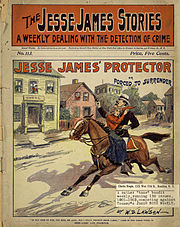
Jesse James dime novel cover

The Pinkerton Detective Agency was hired in 1874 to stop the James-Younger gang, and after numerous setbacks, Allan Pinkerton took on the case as a personal vendetta.  In 1875 he staged a raid on the James homestead and threw an incendiary device into the home.  It exploded, killing Jesse’s half-brother, and blowing off one of his mother’s arms.  This, more than any editorial, won public sympathy for Jesse James.  A bill granting the James and Younger brothers complete amnesty was narrowly defeated in the Missouri legislature.

Jesse married his cousin Zee in 1874, and two of their children survived to adulthood.  The downfall of the gang came in 1876, when they raided the First National Bank in Northfield, Minnesota.  All of the Younger brothers were killed or captured.  Only Frank and Jesse escaped.

Jesse tried to live quietly with his wife after that, in a home near St. Joseph, but he invited Charley Ford, a former gang member, to move in with the family for protection, and Charley brought in his younger brother Bob.  Both Ford brothers had been in contact with the governor of Missouri about his reward for Jesse, dead or alive.    One day, in 1882, as the three men were getting ready to leave for a robbery, as Jesse stopped to clean dust from a picture on the wall, Bob Ford shot him twice in the back of the head.

***

Memory, both individual and collective, is always mixed with imagination, increasingly so with the passage of time.  And if ours is not an era that treats the reputation of heroes well, at least we grasp human complexity.  Could Jesse James have been a loving father and a cold blooded killer and sympathetic to the poor?  Of course.  What was he really like?  We are never going to know, and besides, if there was a simple answer, I would not still be researching the legend and listening to the song.  Here is Pete Seeger’s version:

Memorial Day, 2011

I had a friend at work who was rather vocal about his support for liberal social issues and his disdain for the political landscape during the Bush administration.  In 2007 or 2008, he spent three weeks in Shanghai on business.  On the last morning he was there, the television showed a stadium full of people who had gathered to witness an execution.  Three young men were shot by a firing squad for first time possession of marijuana; no appeals, no clemency.  My work friend said he wanted to kiss the ground when his plane touched down again on American soil.

Memorial Day always pulls me up short like that.  We have 364 other days each year to debate our past and present military engagements.  This is a day when people’s  thoughts turn to the courage and sacrifice of men and women in uniform who have done their best to defend a culture that gives us trial by jury, a constitution that says the punishment must fit the crime, and countless other benefits it is easy to take for granted until they are threatened.

This is a day when I think of my grandfather, Morgan.  At 17, he lied about his age so he could enlist for the war to end all wars.  To his great disappointment, it was over before he made it “over there.”

I think of my father, Howard, who served as a radar technician in WWII.  His old navy manuals fueled my own interest in ham radio, and ultimately led me down my career path.  As a non-combatant, my father avoided the worst physical and emotional scars, and yet even though he looked so young at 23, he and most of his generation always seemed older than their years.

My father in uniform, ca. 1943

Time paints the conflicts of the past with the sepia tones of memory.  The poppies grow in Flanders field, and the last World War I veteran died on May 5 of this year.  At 14 he lied about his age to join the Royal Navy and then lived to be 110.  This is the stuff of historical novels.  Present realities are never as tidy.  Yet this is a day to be thankful for all those who find the courage to serve, even if for the “wrong” reason – like a friend of mine who enlisted for Viet Nam in an alcoholic blackout.

Not long ago, while walking the dogs one Saturday morning, we passed a military honor guard waiting outside a local church.  I thought of the solemn dignity of the honor guard that folded the flag and handed it to me at my father’s memorial service.  Such rituals are very important.  By whatever means we have, these are things we have to remember.

Kung Fu Panda 2: A Movie Review

Figuring that the return of Captain Jack Sparrow was an excuse to venture out to the movies again, I suggested to Mary that we see the latest Pirates of the Caribbean, but she had other ideas.  She showed me the 4-star review of Kung Fu Panda 2.  Ever since Up, 2009 I have been ready to see any animated movie with that kind of review, so off we went.

Here’s my summary:  if you trust any book or movie review I have posted here; if you think there is any chance my opinions align with your own, see this wonderful film.  Take the entire family.  This is an absolute gem.

Po the Panda seems like an unlikely Dragon Warrior – think of Jack Black, who does his voice – but likely or not, there he is with his allies, the Formidable Five, defending the Valley of Peace.  That peace is shattered by Shen, the evil peacock, who has a terrible weapon and the ambition to conquer all of China.

Po has other concerns as well.  His kung fu master tells him he must find inner peace to have any hope of success.  “Inner piece of what?” Po asks.  Memories from his past arise too, drawing Po into the question of who he is and where all the other Pandas have gone.

I didn’t see the first Kung Fu Panda (I plan to now), so I cannot comment on the comparisons between the two movies other bloggers make, but I can say this story was flawlessly paced, the visuals were spectacular, and the 3D did not bother me as it has in the past.  In addition to being marvelous entertainment, I was delighted to see a “family film” pose some very serious spiritual questions and values in a completely non-preachy way:

  • Upon a foundation of inner peace, you can accomplish what needs to be done.
  • “Who am I, really?” is perhaps the most important question we all have to ask.
  • Courage matters, as does loyalty to your friends and a worthy cause.
As I left the theater, I thought of one of my heroes.  Recently I said on this blog that I didn’t have any heroes, but that was not correct – Jim Henson (1936-1990) has always been a hero of mine, and I thought of his breakthrough animated movie, Dark Crystal.  Anyone who harbors a lingering notion that animation is somehow “less than” other sorts of films should check out this pioneering effort, made in 1982.  I like to think how much Henson, who died tragically at 53, would have loved the newest developments in animated filmmaking, and how much he would have enjoyed this offering.

Barbara Allen – Mysteries in a Ballad

When I was six years old, my mother’s cousin, Junie, got married.  The two had been lifelong friends, and for the service, I was chosen to be the ring-bearer, and my sister, the flower girl.  That summer we drove from our home in upstate New York, to Kalamazoo, where Junie lived.  I’m happy to say that recently, Mary and I travelled to Oregon to celebrate Junie’s 50th anniversary.

Junie’s father, the uncle who later taught me to play poker, was a renowned surgeon and they had a beautiful house with a separate guest cottage on a bluff above Lake Michigan.  There were lots of adventures along the shore of the lake, like capturing a snapping turtle I recognized as such from my Pocket Guide to Reptiles and Amphibians, but one that stayed with me to the present day involved discovering a treasure trove of ballads.

The guest cottage had a box of old 78 recordings, and a book of lyrics and sheet music for a collection of American ballads.  There were two I listened to again and again because they haunted me with questions I didn’t understand then, and still can’t answer now.  The two were, “The Ballad of Barbara Allen,” and “The Ballad of Jessie James.”

Barbara Allen, which exists in as many as 92 versions, was first mentioned as “a little Scottish song” in 1666.  It came to our shores with the first settlers and was almost certainly popular well before the first printed versions appeared in England in 1750 and in America in 1836.  Barbara Allen is classified as Child Ballad 84.

In most versions, Sweet William lies on his death bed and sends his servant to fetch Barbara Allen, who reluctantly comes and says, “Young man, I think you’re dying.”  He says he is dying of love for her, but she will not have him, often because he bought a round of drinks for all the girls at the tavern a week before but not for her.  Sweet William dies of love for Barbara, and she dies the next day of sorrow.  Out of William’s heart there grows a rose and out of Barbara’s, a briar.  They grow and grow and finally form a lover’s knot above the graves.

The first thing you notice about this ballad is the lovely melody.  Then the haunting and tragic lyrics.  And then you realize it makes no sense.

Why is Barbara so cruel, I wondered as a kid and I wonder now.  Over a drink in the tavern?  Really?  I mean, really?  Even if, in that day and age, these kids were 14 or 15, and Barbara was a high school prima-donna, I’m not fully satisfied, and I bet you aren’t either.

And then you wonder, if William liked her so much, why did he buy drinks for all the girls except Barbara?  As in, “Dude, isn’t that playing a little too hard-to-get?”

There is also the mystery of Barbara’s change of heart and her subsequent death of sorrow.  I also wonder what real event or pair of star-crossed lovers might have inspired the song.

The supreme question, of course – and I chewed on this when I first heard the song at age six, is whether people really die of love?  Could it happen in the past, in simpler times, before eHarmony?   Especially for those like the Celts, who possess a genius for melancholy?

As a kid, I thought no.  Later, as a morose teenager, (I used to read Thomas Hardy for “fun”), I would have said yes, pining away is not that hard to believe.  As an adult, my response would have been, “Come on, William, get a grip.”  Now, from the Buddhist perspective of the ultimate power of mind, I would say, if you really believe you can’t live without a particular person, sooner or later it will come to pass.

This or that answer is not the point – the point is the questions.  I’ve recently been mulling over stories I have loved all my life, and so far I think they possess one of two qualities (or both) – one is characters I love so much they seem like a part of me, like Ratty and Mole.  The other is mysteries or questions I cannot solve.

Not surprisingly, I have collected quite a few versions of “Barbara Allen,” and this, by Emmy Lou Harris, I think is the best:

A Job From Hell by Jayde Scott: A Book Review

Several weeks ago, a young author from London, Jayde Scott, emailed and asked me to review her ebook, A Job From Hell.  She sent the link to her Smashwords page, which can serve as a model of how to present an ebook; the cover, description, and the montage of images and music in the trailer are very professional and lend a clear sense of what the book is about.  Have a look:  http://www.smashwords.com/books/view/56864

A Job From Hell is a paranormal romance featuring vampires, but what separates it from similar stories is the tongue in cheek tone set by the protagonist, seventeen-year-old, Amber, who takes a summer housekeeping job on a  remote estate in Scotland where the cab driver will not take her after dark – not a promising omen, but Amber needs the money for college.  Amber is a teenage Bridget Jones and a refreshing change from so many breathlessly serious YA heroines who are princess material and/or destined to save the world.

Amber stumbles all over herself when she meets her new boss, the hunky Aidan, who never appears by day, but before she can puzzle out what that means, she accidentally wins a competition for otherworld creatures, held only once every five-hundred years.  The prize, five hundred years of second sight and the ability to see the dead, is nothing she wants but also proves to be nothing she can give back, even when legions of other supernatural creatures take an unwanted interest in her.  It is shocking enough when Aidan, leader of the local vampire clan, informs Amber that she is destined to be his mate for eternity, and only gets worse when the Shadows, sworn enemies of vampires, spirit Amber away to their hidden lair and tell her she will have to stay there.

More than the various thrills and chills, it was the cast of characters who kept me turning the pages.  In addition to Amber, we have Kieran, who is Aidan’s snarky brother and drives his SUV like a maniac.  There is Angel, a lonely Shadow who wants to be Ambers BFF, and my favorite, the delightfully irreverent  Cassandra, who is Lucifer’s daughter and notorious for her hellishly bad fashion sense.

The one major character who didn’t quite fit the Buffy-like tone of the story was Aidan.  Although he was “turned” into a vampire at 18, he’s had five hundred years of living experience, and I found myself wanting a bit more reserve or wisdom from him, something to set him a little apart from “the gang.”  Even so, it was the gang that made A Job From Hell appealing, and now that I’m done, I find I miss them.  No fear on that score, however, as this is just the first title in Ms. Scott’s Ancient Legends, series.  A Smashwords reviewer says the next book is due out June 1, and at a cost of $0.99, you can hardly go wrong.

Bill Moyers Journal: The Conversation Continues

“Democracy cannot survive without disinterested people to speak truth to power.”  –  Bill Moyers on NPR, May 23, 1011

I interrupt my previous thought train (unforgettable stories) to suggest that everyone listen to an unforgettable journalist who I happened to catch on “Talk of the Nation” on NPR yesterday:  http://www.npr.org/2011/05/23/136583949/bill-moyers-shares-favorite-journal-interviews.  This was a compelling conversation with a man of high ideals, who isn’t afraid to speak uncomfortable truths.

We like to think of ourselves as democracy, Moyers said, but the word “oligarchy” better describes our government – rule by a few people of wealth and power, who do things like deregulate banking and finance, which guarantees that events like our recent financial disaster will happen again, since nothing structural has changed.  Few significant differences remain between Republicans and Democrats, Moyers added, and neither party really cares for he interests of working people.  Yet Moyers’ voice was animated and full of joy and hope.  As well as current events, Moyers talked of his love for poetry and the inspiration he and millions of PBS viewers found in his conversations with Joseph Campbell.

This interview celebrated the publication of Moyers collection of 47 interview with “independent thinkers,” taken from his PBS probram, “Bill Moyers Journal,” that ran from 2007-2010.  This isn’t the sort of book I usually read, but Moyers is one of those rare talents, like Ken Burns, who I will listen to no matter where he chooses to go.  I downloaded the book to my kindle, and after listening to the radio interview, you may just do the same.

A Childhood Story I Have Never Forgotten: The Death of Balder

Like many children, I read to be scared witless, to be less lonely, to believe in other possibilities.” – Amy Tan

When I was young, I spent hours devouring a ten volume set of stories and poems called, Journeys Through Bookland:  A New and Original Plan for Reading Applied to the World’s Best Literature for Children , 1939.  

The illustrations alone could transport you to other worlds, and the world I most liked to visit was that of the Norse gods.  Interesting choice for a kid, since this was a world that was destined to end badly.  At Rangarok, the last battle, the forces of chaos and darkness would win the day.  No doubt this mythic cycle influenced Tolkien’s Silmarillion, and just like our mortal lives or a fleeting sunset, the certainty of an ending lends these northern stories a haunting beauty.  Within that canon, there is one story that fascinated me more than others and pops into mind whenever I think of the root stories of my life.

The Death of Balder:

Balder, the god of light and summer, was the second son of Odin and Frigg and beloved of mortals and gods alike.  Because he was associated with truth, his mother worried when he was plagued with nightmares of his own death.  Frigg travelled the nine worlds, extracting vows from humans, immortals, plants, and metals not to hurt her son.  Because Balder was popular, every creature agreed – except the mistletoe, which Frigg considered too insignificant to ask. ( Oops!!!!! )

Now Loki was the trickster and the most fascinating and multi-faceted character of the lot.  He wasn’t one of the ruling family of gods, though sometimes humans prayed to him and he helped.  As a sower of chaos, he kept things in motion.  Coyote did the same for Native Americans, but Loki was much darker and proved deadly to Balder.

Loki and Rhinemaidens, by Arthur Rackham, 1910

Balder was asking for trouble the day he stood before the gods and challenged them to throw their spears and weapons at him.  “Gimme your best shot!”  In a color plate in Journey’s Through Bookland, there he was, the curly-haired golden boy, strutting his stuff like a star quarter back.  Ten years later, reading the Illiad in college, I would learn the word, hubris, but even without the vocabulary, I knew he was asking for trouble.  I knew I was supposed to like him, but I honestly thought him a moron.  You wanted to slap Balder – and Loki did worse that that.

Balder’s blind brother, Hodr wanted to join the fun, so Loki, in the shape of Thokk, a giantess, offered to help.  Did I mention Loki was a shapeshifter?  Loki/Thokk handed Hodr a dart made of mistletoe and guided his throw so it pierced Balder’s heart.  Thokk also refused to weep at Balder’s funeral, thus preventing him from returning from Hel.

The gods caught Loki and his punishment was terrible:  he was chained beneath the earth with a serpent above him dripping searing venom on his face and there he will stay until the bones of the earth are shattered at Ragnarok.  Sometimes the pain is so fierce, Loki writhes in agony and the earth shakes.  Without the god of light, the final battle draws near, and Fenris the Wolf, strains against the chains he will break at the start of Ragnarok.

Odin battles Fenris at Ragnarok

So why did the story fascinate me so?  When I was younger and imagined myself to be wiser, I might have tried to concoct some plausible explanation, but now I agree with Heraclitus (as quoted by James Hillman) who observed that one can never plumb the depths of the soul or be certain of its shifting landscapes and cast of characters.  But I am certain that one thing that keeps this story alive for me in imagination is mystery:  all the questions I cannot answer.

  • Why was Balder such a jerk?  Well over the years I sort of got a handle on this with the understanding that mythological gods are do not have well-rounded personalities.  It is a function of the god of summer to die – though most often in annual cycles.
  • Why, in spite of my best efforts, did I secretly identify with Loki even as I feared and loathed him?  I have no clear idea, except now I suspect that is a common reaction.  Somehow it is necessary, and we know it in our bones.
  • Why such a cruel and unusual punishment for Loki?  Isn’t it out of proportion to the crime?  I remember I thought so as a kid.
  • Why did I enjoy a story and illustrations that frightened me out of my wits?  That too, I think, is necessary.  That’s why we like Stephen King and Mary Shelley and why I’m betting Bram Stoker will outlive Twilight.  I believe well meaning people who would clean up fairy tales for children have it all wrong – life itself will sometimes be more scary than any story, and the old tales are like inoculations.
Ultimately, “The Death of Balder” just leaves me wondering – wondering about all kinds of things.  About the kind of people who would tell such a story.  About how they found their courage in a cosmology in which their gods were doomed to go down in defeat in the end.  Wondering if they really believed that or if, like the classical Greeks, they told these as beautiful wisdom tales without thinking they were literally true?

My wondering about a story like this could go on forever, which is probably why it still lives and breathes for me all these decades later.

NEXT:  Two ballads that keep me wondering.

Notes on Stories by Amy Tan

In my previous post, I spoke of Stephen King’s editorial intro to the 2007 edition of Best American Short Stories.  Today, while excavating (cleaning is too mild a word) the junk in the back room, I found three volumes I had picked up last fall from the used bookstore up the street.  These were Best American Short Stories from 1999 and 2005 as well as Best Mystery Stories of 2002.  I flipped through the three, looked at the intros, titles of stories, and a a few first pages, and then sat down with a cup of coffee and the 1999 stories, which were edited by Amy Tan.  She truly seems like someone you’d like to have coffee with.

Tan’s introduction reveals the depth of her love of stories, and she gets very personal about early events that made them as important to her as air.  She had lots of things to worry about as a child, events like seeing a playmate in a coffin and hearing her mother say that is what happens to children who disregard their mothers.  Small wonder that Tan was attracted to fairy tales and Bible stories, which she found very similar:  both had “gory images, gut-clenching danger, magical places, and a sense that things are never as they first appear.”   Straw-into-gold sounded very much like turning three  loaves into a thousand, she says.  Amy Tan gives us these personal memories after saying she always wants to know personal details about people who presume to act as critics or decide which stories are good and which are bad:

“What are their tastes based on?  What are their biases?…What movies would they watch twice?  Do they make clever and snide remarks , mostly about people who are doing better than they?…What are their most frequent complaints in life?  What do they tend to exaggerate?…Do they think little dogs are adorable or appetizers for big dogs?…In other words, if you ran into this person at a party, would you even like him or her?”

I had been feeling like taking a break or simply doing a post or two here just for fun, and Amy Tan’s comments gave me an excuse; they sent me daydreaming about some of the stories that fascinated me as a kid, ones I still think about now.  I never felt quite as shell-shocked during my first decade as Amy Tan, though we moved a lot too, and one of my childhood playmates died.  The stories and ballads that captured my attention as a young reader were like koans, or life itself – you could chew on them for decades and still not understand all that is going on.

This will be the subject for my next post – stories and ballads I have never forgotten.  It will have to be another post, since one of the stories is from Wales and I need to go dig up the spellings.  Stay tuned!