Ship of Fools

Ship of Fools, German woodcut, 1549

While sitting with friends the other day, I heard a woman describe her extended family as “all about issues.”  At holidays and picnics, arguments erupt over politics, gender, economics, and all the social concerns du jour – right-to-life vs. right-to-choose, and who can and should get married.  The woman shook her head and said, “I think I want to live a life without issues.”

That phrase really clicked with me, and the more I thought about it, the more it explained certain “issue oriented” posts that I started recently but never finished.  I’d wondered if it was summer laziness, or if I needed a break from blogging, but no – I saw it in a flash – I need a break from issues!  Not an ostrich move, but an issue fast.

A voice in my head objected – “But…but…but…now that the presidential race is really on, aren’t these issues more important than ever?  Doesn’t the future of the Republic and who knows what else hang in the balance?”  One thought led to another, and the phrase, “ship of fools” came to mind.   I found myself humming The Grateful Dead’s, “Ship of Fools.”  I cranked it up when I got home and logged in to explore the theme.  What follows is just a hint of the history of the image and its vast metaphoric possibilities.

And yes, there’s a nice Grateful Dead clip at the end of the post you can listen to while you read…

Hieronymus Bosh, “Ship of Fools,” c. 1490-1500, detail

Wikipedia says, “The ship of fools is an allegory that has long been a fixture in Western literature and art. The allegory depicts a vessel populated by human inhabitants who are deranged, frivolous, or oblivious passengers aboard a ship without a pilot, and seemingly ignorant of their own direction.

It’s surprising that the Ship of Fools/Ship of State analogy has yet to be picked up this year, with its “deranged, frivolous, or oblivious passengers,” but there’s more than allegory bound up with the phrase.  The same Wikipedia entry details the origin of the image:

“Renaissance men developed a delightful, yet horrible way of dealing with their mad denizens: they were put on a ship and entrusted to mariners because folly, water, and sea, as everyone then ‘knew’, had an affinity for each other. Thus, ‘Ship of Fools’ crisscrossed the sea and canals of Europe with their comic and pathetic cargo of souls. Some of them found pleasure and even a cure in the changing surroundings, in the isolation of being cast off, while others withdrew further, became worse, or died alone and away from their families. The cities and villages which had thus rid themselves of their crazed and crazy, could now take pleasure in watching the exciting sideshow when a ship full of foreign lunatics would dock at their harbors.” – Jose Barchilon’s introduction to Madness and Civilization, by Michel Foucault.

On the literal level, this “delightful, yet horrible” custom is not entirely a thing of the past.  We can think of New York City in 2009, with it’s offer to homeless people of free one-way tickets to anywhere else.  The same thing happens here, when overworked neighboring social service agencies “dump” their homeless in Sacramento county.

As an imaginal image, The Fool still evokes powerful responses of fear and fascination in the Western psyche.  The Fool is the first card of the Major Arcana in the Tarot, evoking “beginner’s mind,” that mix of wisdom and naiveté with which we begin the spiritual path, or depending on your belief system, each new incarnation in the world (or both).

From his studies of Irish folklore, Yeats learned that among the fairies, the Queen and the Fool each share tremendous power.  A mortal may survive a “stroke” given by one of the other fairies, but nothing in heaven or earth can save you if you get on the wrong side of the Fool or the Queen.

While Europeans consigned them to ships, and later to institutions like Bedlam, some native American tribes considered their “fools” as sacred, for they had clearly been touched by the spirits.  I’m reminded of Theodore Roethke’s poem, In a Dark Time, when he says, “What’s madness but nobility of soul at odds with circumstance?”

The image of the Ship of Fools turns up in movies, music and books, most recently in Ship of Fools, 2009, by Fintan O’Toole, an Irish journalist who uses the metaphor to describe “the Irish political establishment and their self-deception regarding the economic situation in the country.”

This wanders into dangerous territory for someone on an issue-fast – it cuts too close to certain Americans seeking office – “deranged, frivolous, or oblivious passengers aboard a ship without a pilot, and seemingly ignorant of their own direction.”

So let’s adjourn to the Grateful Dead!  “Ship of Fools,” by Jerry Garcia and Robert Hunter, was first performed in 1974.  Here is an excellent clip from the 1989 summer solstice show at Shoreline Amphitheater.  Enjoy!

Went to see the captain
strangest I could find
Laid my proposition down
Laid it on the line;
I won’t slave for beggar’s pay
likewise gold and jewels
but I would slave to learn the way
to sink your ship of fools.

RIP Maurice Sendak

If you haven’t heard, Maurice died today of a stroke, at age 83.  Here is a nice five minute interview he gave in 2002 that ran on the PBS Newshour tonight.  It’s illuminating to hear him say, “I don’t know how to write for children.  I don’t think anyone knows how to write for children, and those that say they do are frauds.”

He goes on to say, “I write for me,” and adds that it isn’t always easy to be driven by something internally that is “riotous and strange.” What a great gift he gave to riotous strangers!

http://www.pbs.org/newshour/bb/entertainment/jan-june12/wildthings_05-08.html

Imagine by Jonah Lehrer: A Book Review

Update, July 31, 2012.

On July 30, author Jonah Lehrer admitted fabricating quotes in Imagine. He resigned his position as staff writer for The New Yorker, and Houghton Mifflin suspended sales of the book. You can read my full post on the topic here, which contains a link to the newspaper story. http://wp.me/pYql4-2hg

It is with much sadness that I’ve decided to remove the text of my review. Some of Lehrer’s observations on creativity remain insightful. At the same time, I think it is vital to stand up for ethics wherever we can find it in public life.

The Muppets Get Their Star

On March 20, the first day of spring, The Muppets received the 2466th star on Hollywood’s Walk of Fame.  The cast, which has charmed TV and movie viewers for 50 years, now joins a select group of “fictional” stars, which includes Mickey Mouse, Godzilla, Shrek, and The Simpsons.  Miss Piggy pointed out during the news conference, however, that all movie stars are fictional.

Photo by Frazer Harrison / Getty Images

Lisa Henson, CEO of Jim Henson Enterprises remarked that The Muppet’s star, in front of the El Capitan Theater, is very close to her father’s.  Henson created Muppet prototypes in 1955, for a show called Sam and Friends, which ran for six years on WRC-TV in Washington, DC.

Jim and Jane Henson with the cast of "Sam and Friends"

Henson died in 1990, at the age of 53, of complications from a severe strep throat infection.  Associates and family say he was so busy working, he didn’t seek medical help until it was too late.

During the last year of his life, Henson negotiated to sell the Muppets to Disney. The sale was finalized in 2004. The latest Muppet movie was released to DVD yesterday too, a seemingly successful effort to revitalize the cast and introduce Walter, a new character, who was present at the dedication ceremony.

Kermit received his own Walk of Fame star in 2002, but Henson’s little frog would be the first to say The Muppets are a group effort. The group finally has the recognition it deserves.

The Wasteland

One of the books I treasure is a battered old trade paperback with yellowing pages.  I value the book,  Creative Mythology, because of the author’s inscription: “For Morgan with all my good wishes. Joseph Campbell, 3/13/79.”  

joseph_campbell_4

You could say Campbell’s  four day lecture series that spring did much to open the path my imagination has followed ever since.  None of the stories Campbell unpacked in his lectures or books affected me more than Parzifal (or Parsifal) and his quest for the holy grail. The version of the grail story Campbell recounts is by Wolfram Von Eshenbach (1170 – 1220).  Wolfram was a German knight and poet, and his Parzivalis regarded as one of the finest medieval German epics.  Campbell looks to this version because it’s roots reach deeper than later Christianized versions where only the pious and chaste Galahad can attain the grail.  What matters for this post are those echoes we can see in the tale of the ancient legends of sacred kingship, and the ways an unfit or weakened king can blight the land.

Wolfram Von Eshenbach from Codex Manasse

Sometimes in youth we receive a vision or powerful experience that shapes much of the rest of our lives.  So it is with Parzival who finds his way to the mystical Grail Castle and meets its wounded king, Anfortas,  who is also known as The Fisher King.  As a young knight, a spear pierced the Fisher King’s “thighs” – a euphemism for testicles according to Campbell.  In ancient times, the virility of the king and the fertility of the land were one.  In the grail stories, Fisher King could not be healed and couldn’t die.  All the realm was barren.

Robin Williams as the Fisher King in the 1991 movie of that name, a contemporary retelling of the story

While in the castle, during a mysterious ritual, Parzival has a vision of the grail, which is described as a stone, though its shape isn’t fixed, and it brings everyone “what their heart most desires.”  Though he is intensely curious, Parzival does not ask the meaning of what he sees.  In the morning, the castle is empty.  All traces of life are gone.  He rides away, and when he tells his story, listeners turn away in disgust.  If Parzival had asked the right question, he would have healed the king and restored the land.    The young knight wanders the blighted realm for 20 year, enduring hardships and contemplating his failure.  Just like us, he watches time turn his youthful dreams of glory to ashes.

“Parsifal” by Odilon Redon

At last, one cold Christmas Eve, Parzival encounters a hermit, tells his tale, and learns the question he should have asked. After that, he achieves the castle again.  When the ritual ends, Parzival asks, “Whom does the grail serve?”   Everything hinges on asking the right question.  Anfortas is healed, spring returns, and Parzival becomes the new Grail King.

***

Hearing this old tale, we have to ask how the story plays forward.  “Wasteland” clearly describes the state of the world we read about in the papers, and “impotent” seems an apt description of most of the world’s governments.  This perception is not even new, for T.S. Eliot named it ninety years ago in his poem, The Wasteland:

What are the roots that clutch, what branches grow Out of this stony rubbish? Son of man, You cannot say, or guess, for you know only A heap of broken images, where the sun beats, And the dead tree gives no shelter, the cricket no relief, And the dry stone no sound of water.

Giving mythical weight to our latest headlines, storyteller and mythologist, Michael Meade says: “Like Parsifal, the modern world has awakened from a deep sleep to find that the castle of abundance has disappeared, that the financial markets are in ruins, that blind religious beliefs are once again producing mindless crusades, and that great nature itself threatens to become a barren wilderness. Like Parsifal, we failed to ask the right questions when surrounded by abundance.” From “Parsifal, the Pathless Path, and the Secret of Abundance,” first published in Parabola, Fall 2009.  http://www.mosaicvoices.org/index.php?option=com_content&view=article&id=72:essay4parsifal&catid=53:essays&Itemid=68

This has happened before, again and again, Meade reminds us – beginnings and endings, decay and renewal.  The castle of abundance waits for us, individually and collectively, somewhere in the wilderness, but old pathways won’t take us there.  There’s a time to do as Parsifal did – drop the reins and let the horse, an image of our instinctive wisdom, pick its way through the forest. The old stories were told in the winter, when the nights were long and the fires warm.  This winter, I am drawn to look at some of these tales, to see what they are still whispering to our souls, for they are wiser than the daily ephemera that passes for wisdom but is really the source of our confusion.

As Michael Meade puts it: “Despite the current confusions of dogmatic religions and the literalism common to modern attitudes, the earthly world has always been a manifestation of the divine. Call it the Grail Castle, the Kingdom of Heaven, Nirvana, the Otherworld; it has many names and each is a representation of the eternal realm that secretly sustains the visible world. When time seems to be running out it is not simply more time that is needed, rather it is the touch of the eternal that can heal all time’s wounds and renew life from its source.”

Robinson Jeffers: An American Stonecutter

My previous post, on the restoration of a medieval Chapter House, reminded me of two renowned people who worked in other fields but turned to stonework for renewal.  One was the great Psychoanalyst, Carl Jung, who viewed stone as a symbol of the True Self, and carved stone as a means of self-discovery.

Jung’s Bollingen Stone

The other was the renowned poet, Robinson Jeffers (1887 – 1962), who studied geology in college, and worked in stone all his life.  In 1914, Jeffers and his new wife, Uma, moved from Los Angeles to Carmel, CA.  To build a home, Jeffers first hired a local builder and then worked alongside the man, learning the art of stonemasonry.  By 1919, Jeffers was hauling  boulders up from the beach, shaping them, and using them to add rooms to the home, which he named Tor House.  Later, he built the four story, Hawk Tower, as a gift for his wife, who loved Irish literature and stone towers.

Tor House and Hawk Tower, built by Robinson Jeffers in Carmel

The tower was named for a hawk that appeared while Jeffers worked on the structure, and disappeared the day it was finished.  After his death, Jeffers’ oldest son finished the construction then deeded the buildings to the Tor House Foundation, which was formed by Ansel Adams for their preservation.  The Foundation maintains the grounds and offers excellent guided tours.  You can even climb by a secret stairway to the very top of the tower.  There’s a wealth of information on Jeffers and Tor House at the Foundation website, where you can also schedule tours in advance:  http://www.torhouse.org/.

Jeffers work with stone is central to his austere poetic vision of a human spirit that longs to fly like a hawk and find something that lasts, but must finally acknowledge that in this life, it can do neither.

***

To the Stonecutters
by Robinson Jeffers.

Stone-cutters fighting time with marble, you fore-defeated
Challengers of oblivion
Eat cynical earnings, knowing rock splits, records fall down,
The square-limbed Roman letters
Scale in the thaws, wear in the rain. The poet as well
Builds his monument mockingly:
For man will be blotted out, the blithe earth dies, the brave sun
Die blind, his heart blackening:
Yet stones have stood for a thousand years, and pained thoughts found
The honey peace in old poems.

***

Robinson Jeffers

***

Rock and Hawk
by Robinson Jeffers

Here is a symbol in which
Many high tragic thoughts
Watch their own eyes.

This gray rock, standing tall
On the headland, where the sea-wind
Lets no tree grow,

Earthquake-proved, and signatured
By ages of storms: on its peak
A falcon has perched.

I think, here is your emblem
To hang in the future sky;
Not the cross, not the hive,

But this; bright power, dark peace;
Fierce consciousness joined with final
Disinterestedness;

Life with calm death; the falcon’s
Realist eyes and act
Married to the massive

Mysticism of stone,
Which failure cannot cast down
Nor success make proud.

***

Hawk Tower

Sacred Stones in Northern California

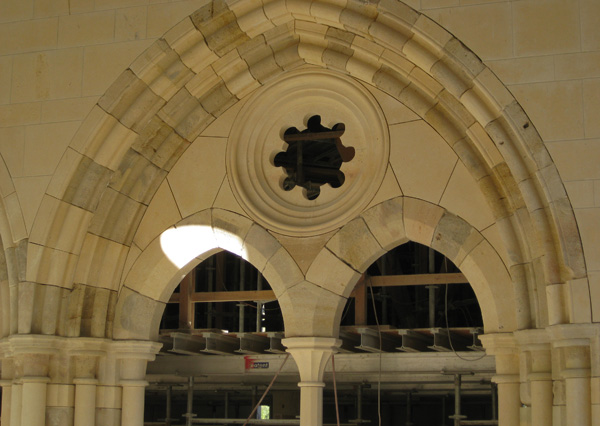
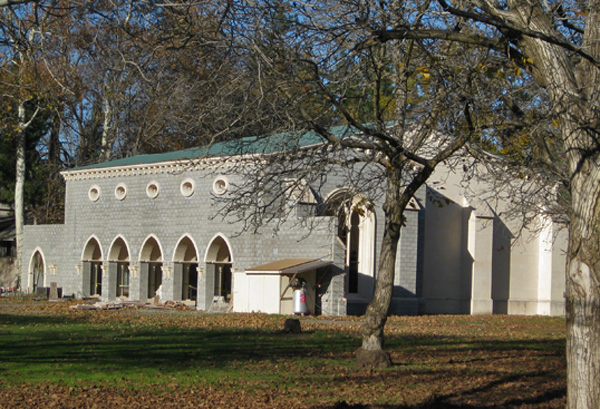
There are only two medieval structures in North America. Now a third is nearing the end of restoration in the small agricultural town of Vina, California, 100 miles north of Sacramento. It’s the 12th century Chapter House of Santa Maria de Oliva, a Spanish monastery that stood near Madrid. This building’s round the world journey makes an interesting tale.

The monks began their day in the Chapter House, where a chapter of the Rule of St. Benedict, an ancient guide to monastic living, was read and interpreted. This went on through the centuries until 1835, when the Spanish government closed all small monasteries and seized their lands. Santa Maria de Oliva was sold to a wealthy family that used the Chapter House to store farm equipment.

In 1931, William Randolpf Hearst bought the Chapter House for $285,000, intending to use the stones in the interior of a house he planned near Mt. Shasta. All the stones were marked for reassembly, and sent to California on 11 separate ships. The depression and WWII delayed Hearst’s plan, and in the end he donated the stones to the City of San Francisco to erect a Medieval museum in Golden Gate Park. This never happened and the stones lay outdoors in the park. Many were damaged, lost, or used for other projects

Meanwhile, the Cistercian Abbey of New Clarvaux was founded in Vina in 1955, and the first abbot began to make inquiries. In 1994, the Fine Arts Museums of San Francisco gave the stones to New Clarvaux with the stipulation that reconstruction begin in 10 years and the completed Chapter House be open to the public.

I first went to New Clarivaux in 1998 to stay for a few days at their retreat facilities. It’s an amazing place to unwind, and I have been there a number of times, so I saw the foundation of the Chapter House laid in 2001.

Section of New Clairvaux guest rooms

I had not been there recently, however, so when I drove up this past weekend, I found the structure was almost done – almost meaning another 18 months in a 10 year effort. Only 40% of the original stones were usable. The rest had to be repaired or replaced by stonemasons the abbey employed (they’ve raised $6.3 million to date, largely through small donations from across the country).

Master stonemason, Frank Helmholz, left Vina in November, bound for Luxor, Egypt, where he will spend the winter restoring a 3,400 year old temple. He plans to return to Vina next May. In an interview for the abbey newsletter, Helmholz said:

“In this modern age when everything is done fast and often doesn’t last long and serves no higher purpose, carving stones is a bit of a refuge. To create something that takes patience, dedication, and is lasting is very rewarding. And serving the monks in their spiritual lives gives a greater sense of meaning that is rare nowadays…to be part of something that has a higher purpose than one’s own comfort is inspiring in whatever form it takes.”

The abbey newsletter points out another significant point in the life of the Chapter House. It was built by Cistercians in Spain. Now it stands in another Cistercian abbey in the land that once was called New Spain. The stones have finally come home.

I have only alluded to the retreat facilities at New Clairvaux. In addition to nut crops and a vineyard, it’s one of the ways the monks earn their living, and it’s a marvelous place to spend some time apart. I will post about it later, but meanwhile, you can follow the link below for a summary.

www.sacredstones.org

www.newclairvaux.org

Handmade books

Recently, I came across an estimate of the number of ebooks that will be published next year. I think it was 3 million, but I don’t really remember, and I cannot recall if that was in the US or worldwide. Funny that such a huge number of books was such a non-event for my brain – or maybe it isn’t funny.  Maybe it’s very natural.  Add to that, say, 780,000, the number I remember for traditionally published books last year, and you get, 3,780,000 / 365 = 10,356.16 books per day in 2012.  Even if I am high by an order of magnitude, that’s still more books  being published in one day than I will read in ten years.

Of that total number, I’m guessing a dozen or so will matter to me.  The others will be non-events.  These reflections led me to recall when I was in art school, and there was a large revival of handmade paper as art and craft.  One thing people did with handmade paper was make books by hand.

Books!  Do you remember the sense of wonder books can evoke?  Remember how mysterious they were as when you were just learning to read?  The books you carried everywhere, as a kid and as an adult?  The books that opened new worlds to you or opened new ways of looking at this one?  Have you ever prowled used bookstores, remember stories of people just like you who discover hidden books on magic or other forgotten lore?

It must be this kind of love and fasciation that inspires the artists I picked at random while searching for “handmade books.”  There is nothing comprehensive about these choices .  There are far too many wonderful people making books these days for that.  Hopefully these few pictures will give an idea of what’s possible.  Check the links for further information.

Wooden Book by Barbara Yates

Barbara Yates is an environmental artist who recycles dead trees into art for parks and retreat centers

History of Western Europe by Brian Dettmer

Brian Dettmer’s work reminds me of a dream I’ve had on several occasions, where I am reading a book but cannot decipher the key passages.  Here is the link for his work and Barbara Yates’s:  http://mywiki.ws/The_Most_Unusual_Books_of_the_World

***

Handmade book by Geraldine Newfry

Check out the section on handmade books on Geraldine Newfry’s blog, The Creative Life Unfolds: http://newfry.typepad.com/newfry/handmade_books/

***

Handmade book by Lauren Evatt Finley

There are a number of step-by-step photos of the binding process in the handmade book archive section of Ms Finley’s blog, The Disarranged Studio:   http://laurenfinley.wordpress.com/category/handmade-books/

***

A tintype journal

Website for this tintype journal: http://www.thisnext.com/tag/handmade-books/

***

Handmade book by Carol Roemer

Carol Roemer is an artist whose primary medium for the last ten years has been handmade books. This is her website:  http://www.carolroemer.com/handmadebooks.html

***

This is the cover of a scrapbook “Garbonzobeenz1” made for Christmas photos of her first Christmas in a new house, with her first grandchild.

The website where I found this illustration, twopeasinabucket.com, is an extensive site devoted to scrapbooking, using traditional and digital tools. It should be of interest to anyone who won wants to explore this craft. http://www.twopeasinabucket.com/gallery/member/18824-garbonzobeenz1/1253837-christmas-magic-handmade-book/

***

And finally, here is an electronic pop-up book made by Jie Qi, a grad student in the MIT lab’s Hi-Low Tech group:

***

It’s interesting that many people who recognize the magical and iconic nature of books are visual artists and craftspeople.  It wouldn’t be the first time “outsiders” bring a fresh perspective to a discipline.  I’m not suggesting a fuzzy nostalgia for the old days:  I no more want to trade WordPress for a Gutenberg press than I want to exchange my mac air for an eniac.

What I am suggesting is that the work of these artists leads me to a deeper appreciation of the wonder of what we book creators are doing.