Mad Mouse by Chris Grabenstein

mad_mouse

Officer Danny Boyle is excited.  After his efforts in solving the tilt a whirl murder, it’s an open secret that he will be offered a full time position on the Sea Haven, NJ police force.  During the week before Labor Day, Danny is celebrating with a few close friends on the beach late at night when a phosphorescent paintball slams into his ribs.  His friends are spattered, and one of them, Becca, is hit in the eye.

A frantic call to 911 brings an ambulance, which rushes her to a hospital, and summons Danny’s partner, John Ceepak, the quintessential detective, who had been home listening to his scanner, one of his hobbies when he’s not watching forensic shows on the Discovery Channel.

The next day, Doyle and Ceepak discover paintball vandalism on a mural outside a popular restaurant.  And as Danny and a waitress friend leave a dinner with the Chief of Police in honor of his promotion, both are hit again with paintballs, but this time there’s something more – a near miss from a rifle bullet that Ceepak identifies as the type favored by military snipers.  In the next attack, the sniper doesn’t miss; a shot to the chest sends Danny’s love interest to the hospital, unconscious and barely alive.  Clearly, it’s personal.

The shooter has been leaving trading cards at his sniper positions, all referencing the year 1996:  a card advertising The Phantom, a movie released in 1996; rookie cards for Derek Jeter whose debut year with the Yankees was 1996.  At scene of the first fatal shooting, one of the cards bears a note for Danny:  “You will never remember.  I will never forget.”

Danny was 15 in 1996.  He has only a few days to remember what he did then to trigger a killing spree ten years later.  Labor Day is approaching, and the Sea Haven Chamber of Commerce is hosting a “Sunny, Funderful Beach Party Boogaloo” concert, expected to draw 50,000 tourists.  Just like in Jaws, the mayor refuses to cancel the event; Danny and Ceepak must catch the sniper before he has 50,000 targets to choose from.

Mad Mouse, 2006 is the second book in Chris Grabenstein’s Boyle/Ceepak detective series set on the Jersey shore.  John Ceepak, ex-military, is highly disciplined and always plays by the rules.  Under the tutelage of his older partner, Danny is beginning to learn the virtues of discipline and rules.

Grabenstein’s mysteries are well plotted and avoid the middle-chapter slog that often plagues detective novels.  The author’s humor and irony, channeled through Danny’s narration, finds ample scope everywhere in the resort town setting and in his descriptions even of passing characters:  “He has this receding hairline coupled with wavy swept-back hair that makes him look like he might sing country music, only he’s wearing clunky glasses with a paper clip pinned through one hinge, and country stars seldom do that.”

The combination of compelling detectives, a setting where there is always more to see, and a well imagined and written crime made Mad Mouse a pleasure to read.  I’ve already started the third book in Grabenstein’s Sea Haven series.

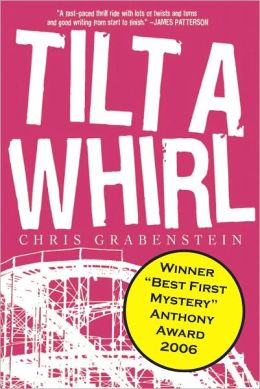
Tilt A Whirl by Chris Grabenstein: a book review

tilt a whirl

A recent detective novel recommendation from Amazon sent me to Chris Grabenstein’s website.  What caught my attention was Grabenstein’s series of mysteries set on the Jersey Shore, in a town called Sea Haven, a thinly veiled reference to Beach Haven, where my family vacationed during three summers when I was a kid and we lived in upstate New York.  To this day, I have fond memories of those trips.

The second thing that attracted me was Grabenstein’s writing credits.  He won two Anthony and three Agatha awards in seven years, and wrote for The Muppet Show, a truly impressive credential in my estimation.

I decided to start with the first book in the series, Tilt A Whirl, 2006, both because I loved the seedy amusement park in Beach Haven as a kid, and because the kindle edition cost $0.99.

John Ceepak and Danny Boyle, two Sea Haven cops, are breakfasting at the Pancake Palace, discussing a tricycle theft – the usual sort of summer crime in town – when a 12 year old girl runs up the street in a bloody dress screaming that someone killed her father, Reginald Hart.  Someone emptied a 9mm clip into Hart as he sat beside his daughter on a tilt a whirl car in the Sunnyside Playland before it was open.  Hart was a billionaire real estate tycoon though many called him a slumlord.

Ashley Hart describes the shooter as a local vagrant and drug user known as Squeegee because he sometimes works for tips at Cap’n Scrubby’s Car Wash.  But that night, when Ashley is kidnapped from her mother’s gated mansion, Ceepak and Boyle realize there is a military precision to the crimes far beyond the capacity of an aging hippie who is missing too many brain cells.  The puzzle twists and turns and had me guessing right up to the epilogue.

Puzzling mysteries alone are not that rare.  The best detective stories also have settings that fascinate and sleuths we love to hang out with:  221B Baker Street with Holmes and Watson; the Navajo reservation with Chee and Leaphorn;  St. Mary Mead with Miss Marple or the Orient Express with Hercule Poirot.

I enjoy Grabenstein’s Sea Haven, for I share his love of Americana – of ice cream shops called “Do Me A Flavor,” or the “Scoop Sloop,” in a town “best pictured on one of those perky placemat maps dotted with squiggly cartoons of buildings like The Shore Store, Santa’s Sea Shanty, and King Putt Golf.”

Chris Grabenstein and Fred

Chris Grabenstein and Fred

His detectives are a study in contrasts and yet a complimentary pair.  Danny Boyle, the narrator, grew up in Sea Haven.  He’s a part time summer cop, in large measure because it gives him an edge with vacationing college girls in the pubs on Saturday night.  John Ceepak is new in town, fresh from a 12 year stint as an MP in the army that ended after a tour of Iraq.  The son of an abusive alcoholic father, Ceepak lives by “a Code” that his partner, Boyle admires but doesn’t fully understand:  serve and protect; never lie, cheat, or steal – ever.

The two men are bound together by a growing mutual admiration and a love of Bruce Springsteen.  By the end of the Hart affair, Danny Boyle decides to apply for full time duty.

Tilt A Whirl reminded me of a couple of chick-lit detective novels I’ve read.  I think that’s due to the humor and irony of Boyle’s first person narration.  His upbeat, “lemme tell you what happened” tone makes you want to buy him a beer at The Sand Bar and hear all about his latest case.  A lot of Danny’s humor is couched in food references, as when he describes a witness as “a few fries short of a Happy Meal,” or when, after a break in the case, he says, “I’m feeling kind of jazzed, like you do after chugging two cans of Red Bull and snarfing down some Hostess Ding-Dongs.”  I think that’s what the male equivalent of chick-lit would sound like.

The author researching beach food at Beach Haven, NJ

The author researching beach food at Beach Haven, NJ

Danny Boyle has a thoughtful edge as pronounced as his irreverence.  In a key thematic passage, he quotes a math teacher who once explained Chaos Theory in terms of a tilt a whirl:  “if the operator keeps the whole thing going at the proper speed of 6.5 revolutions per minute, it’s practically impossible to predict what will happen next…The teacher called it ‘mind-jangling unpredictability.’ Chaos Theory in action,’  for two tickets a ride.” 

Tilt A Whirl was a page-turning mystery that was also a lot of fun.  I downloaded the next book in the series, Mad Mouse, also published in 2006.  Stay tuned for an update on that.

The English Girl by Daniel Silva: an audiobook review

I’ve mentioned before that I’m a big fan of audio books. When recently faced with several commutes to the bay area, I wanted a story to listen to.  I picked a contemporary spy novel, The English Girl, by Daniel Silva, rated as one of Amazon’s “Best Books for July,” last month when it was published.

This was my first encounter with Silva’s work but the 13th in his spy thriller series featuring Gabriel Allon, an art restorer and master spy for the Israeli Secret Service.  Few audio books are exciting enough to make me regret arriving at my destination, but this was one.

A beautiful woman, with a promising career in the British government, is kidnapped during a holiday on the island of Corsica.  A month later, a message arrives at 10 Downing Street with a ransom demand and a recording of the girl confessing to an affair with the Prime Minister.  “You have seven days,” the message says, “or the girl dies and the video goes public.”

British Intelligence contacts Gabriel Allon, the best man they know for the job.  Hours later, Allon and a British ex-patriot assassin are plowing through the Corsican and French underworlds, trying to find the girl while there’s still time.

The affair goes horribly wrong, but not everything is as it seems.  Allon discovers that North Sea oil drilling rights lie behind the kidnapping, along with trechery at the highest levels of British Government.

“If you go to the City of Heretics (Moscow), you will die,” an elderly Corsican sooth-sayer tells Allon, but that is his next destination, with a strike team out for revenge and the truth.  The truth they discover is more than even Allon expected, one that will shake the highest levels of British government – if his team can make it out of Russia alive.

Some reviewers call Daniel Silva the greatest spy novelist of his generation.  I don’t know the genre well enough to be sure, but based on The English Girl, it’s a claim that could be true.

Daniel Silva

Daniel Silva

It’s mostly insubstantial

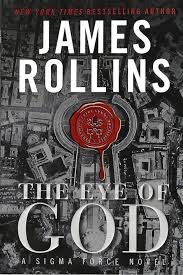
This morning, on friend and author Amy Rogers’ website, Sciencethrillers.com, I found the link to a great article by New York Times bestselling author James Rollins.  Rollins writes science thrillers, and the article, Turning Science Into Fiction, details a tour he took of Fermilab, near Chicago, the conversations he had with physicists there, and how he turns such information into riveting stories like his most recent novel, The Eye of God.

The Eye of God

The article holds points of interest for writers of all sorts.  When Rollins sat down with a group of Fermilab physicists, his question was, “Tell me what scares you about your research, what keeps you up at night?”  Not only did the answers become central to The Eye of God, but they hold great interest to me as a student of Eastern thought.

All religions hold that the world we perceive with our senses hides much of what is really real, but according to Rollins, his conversation with these scientists centered on “the insubstantiality of the physical world.”  He gives this quote he discovered after his visit:

“If you remove all the space within the atoms making up the human body, every person that’s ever lived would fit inside a baseball.” – Brian Greene, physicist

Beyond such ultimate pondering, Rollins’ article is full of details on his research which should be of interest to any novelist who wonders how much one needs to learn of an esoteric topic to be able to tell a convincing story.

I highly recommend this article, and for more of the same, Sciencethrillers.com, which you will find in the link above and on my blogroll.

Two views of the hero myth

In a recent post, I discussed heroes and anti-heroes in spy movies and westerns.  This is the followup post I promised, but I’m going to leave the realm of popular heroes – those of fiction, entertainment, sports, and all who wear masks and tights.  I’m going to discuss the heroes of myth, especially the “monomyth” as Joseph Campbell summarized it in The Hero With a Thousand Faces:

“A hero ventures forth from the world of common day into a region of supernatural wonder: fabulous forces are there encountered and a decisive victory is won: the hero comes back from this mysterious adventure with the power to bestow boons on his fellow man.”

Here is a graphic that makes the elements of this type of story clearer:

Heroesjourney

I can’t think of heroes without remembering James Hillman, (1926-2011), the father of archetypal psychology and one of the most creative thinkers of our time.  The two differing views of the mythic hero announced in the title of this post are Hillman’s own.  He never shied away from ambiguity; “I don’t have answers, I have questions,” he said.

James Hillman

James Hillman

Hillman often railed at the negative effects he saw flowing from the hero archetype, which he saw as ego enshrined as narrow self-interest, both individually and collectively.  For Hillman, the “heroic ego” was often a source of evil and mischief.  Noting that heroes slay dragons, and earlier generations of Jungians wrote of dragons as “the mother,” Hillman claimed that heroes like Hercules in Greek mythology were emblematic of the modern world’s subjugation of women, “the feminine,” and “mother nature.”  On another occasion he said, “Killing the dragon in the hero myth is nothing less than killing the imagination.”

Yet a recently published collection of Hillman’s work (Mythic Figures, 2012) includes a chapter on Joseph Campbell, compiled from talks he gave in 2004 in which he spoke at length of the positive hero.  He put his earlier negative comments in context:

“A mistake in my attacks on the hero has been to locate this archetypal figure within our secular history after the gods had all been banished.  When the gods have fled or were declared dead, the hero serves only the secular ego.  The force that prompts action, kills dragons, and leads progress becomes the Western ‘strong ego’ – capitalist entrepreneur, colonial ruler, property developer, a tough guy with heroic ambitions on the road to success.”

When Hillman used terms like “soul” and “the gods,” his concern was religious, but not in the way of the literal truths of most organized religions.  For Hillman, such literalism was the enemy of soul.  He spoke only and always of the truth of the psyche because it precedes every other kind of truth:  “Every notion in our minds, each perception of the world and sensation in ourselves must go through a psychic organization in order to ‘happen’ at all.” (Revisioning Psychology, 1977).

This understanding of the true hero in service to a Power greater ego prompted Hillman to revise his understanding of the “Father/Dragon/Ogre/King” the hero slays:

“A civilization requires the Ogre to be slain.  Who is the Ogre?  The reactionary aspect of the senex who promotes fear, poverty, and imprisonment; who tempts the young and devours them to increase his own importance.  The Ogre is the paranoid King who must have an enemy.  He is the deceitful, suspicious, illegitimate King whose Nobles of the Court [have] committed themselves to the enclosed asylum of security where they nourish their world-devouring megalomania.”
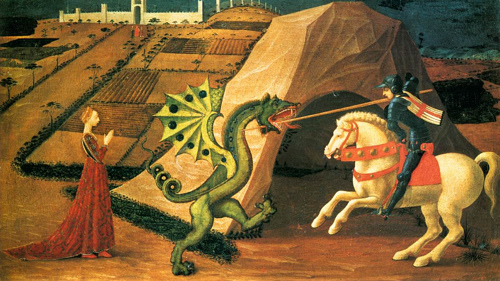
St. George and the Dragon by Paolo Uccello, ca. 1458

St. George and the Dragon by Paolo Uccello, ca. 1458

I think we know what he meant in 2004 by speaking of “paranoid kings” whose nobles live in “the enclosed asylum of security.”  It has only gotten worse. How desperate the Ogre is to quash any budding heroes was revealed in a piece on August 19 on Time.com, “School Has Become too Hostile to Boys,” by Christina Hoff Summers.  Three seven year old boys, in Virginia, Maryland, and Colorado, were recently suspended from school for the following acts:

  1. Using a pencil to “shoot” a “bad guy.”
  2. Nibbling a pop-tart into the shape of a gun.
  3. Throwing an imaginary hand grenade at “bad guys” in order to “save the world.”

The rationale for these suspensions were “zero tolerance for firearms” policies.  Punishing pop-tart weapons in a culture that went on a gun buying binge in the wake of the Sandy Hook shootings seems too ludicrous to believe unless you see it from Hillman’s perspective – another step in the dragon’s war on imagination, in this case, the male imagination, the perspective from which most of our current hero myths derive.  Along with banning snack food guns, such schools have renamed “tug of war” games as “tug of peace,” and halted dodge ball as too violent.

Fortunately, as Christina Hoff notes, such efforts to “re-engineer imagination” are doomed to fail – all they will do is “send a clear and unmistakable message to millions of schoolboys: You are not welcome in school.”

In We’ve Had a Hundred Years of Psychotherapy and the World is Getting Worse, 1993, Hillman made clear his belief that pathology lies in cultures as well as individuals, and we deprive the world of something when we take our rage and our grief exclusively to the therapist.  Hillman never shied away from critiques of the world at large.  Depression is “an appropriate response” to the world we live in, he said.

Yet stronger than the Ogre, said Hillman, is the myth of the Hero – not this or that particular hero, but the heroic pattern itself that Joseph Campbell restored for our times, which renews culture “by revivifying the archetypal imagination displayed by peoples the world over…The panoply of materials that Campbell catalogued shows that the hero wears a thousand faces and cannot be reduced to the modern ego.  Especially important in recognizing him is recognizing the heroic liberating function of myth – that it speaks truth to power, even the Ogre’s power.”

We know from history and the nightly news how much suffering the decay of empires involve as paranoid kings strive desperately to hold on to power.  We also have the examples of James Hillman and Joseph Campbell, who spent their lives pointing toward soul, psyche, and the language of myth and imagination.  That is where we must look to find the larger truth – the hero brings the gift of renewal as surely as spring returns after the darkest time of the year.

Notes on spies, cowboys, and heroes.

I’ve done some car travel recently, and that is my favorite time to listen to audio books.  This time I picked a spy novel by a popular author I hadn’t read before.  I’ll discuss the specifics when I finish the story, but it sparked some new thoughts on a subject that I’ve written about before:  heroes, antiheroes, and how they change with the times.

As a teenager, I loved reading James Bond novels and probably finished all 11 books that Ian Fleming wrote between 1952 and his death in 1964.  In the novels and early movies, 007 was confident and competent in every area of life, including protecting a world in which good and evil were clearly defined.  That wasn’t just the fantasy of an adolescent male; Fleming’s huge popularity suggests that Bond embodied much of the cultural dream of the early cold war era.

Sean Connery and Ursula Andress in "Dr. No," the first Bond movie, 1962

Sean Connery and Ursula Andress in “Dr. No,” the first Bond movie, 1962

Fleming’s first novel, Casino Royale, was published in 1952, just seven years after the end of World War II, a conflict in which the author served as a naval intelligence officer.  There was little moral ambiguity in Fleming’s world or in his novels.  How different that is from the latest Bond movie, Skyfall, 2012, where moral clarity is scarce, and the adversary of British Intelligence is one of their own, gone rogue.

skyfall4

Daniel Craig makes a good Bond but has little time to exhibit all of Sean Connery’s gentlemanly skills.  This 21st century Bond is too busy killing people to worry about whether his drinks are stirred or shaken.

I’ve watched more westerns than spy movies, so that’s where I’ve seen the changing dynamic of heroes with greatest clarity.  Yet I begin to sense a parallel progression in both genres.   Using westerns as examples, I think we can identify three types of protagonists:

The Hero:  He (it’s always “he” in this kind of western) fights for a righteous cause, greater than himself.  In John Ford’s classic Fort Apache, John Wayne may feel for the Apaches, and thrash the corrupt trader who sold them whisky, but they still have to go back to the reservation.  It’s manifest destiny – the American way.

Fort Apache, 1948

Fort Apache, 1948

The Anti-hero:  Though the term dates from the 18th century, Clint Eastwood’ westerns pushed it into the popular lexicon.  There are no grand causes in these movies, just the gritty play of good and evil, but there is still room for the stranger – or in one of my favorites, Pale Rider, 1985, “the Preacher” –  to lend his aid, and especially his skill as a gunfighter, to those he finds deserving.

Clint Eastwood as Preacher in "Pale Rider."

Clint Eastwood as Preacher in “Pale Rider.”

The Non-hero:  This protagonist may be sympathetic, but should not bear the title of “hero,” with its implication of honor.  He’s the winner who gets to write the history, and that may be his only claim to moral high ground.  In Unforgiven, 1992, Clint Eastwood plays William Munny, a widower who has tried to give up killing and drinking.

"Deserving's got nothing to do with it," says  Munny in "Unforgiven

“Deserving’s got nothing to do with it,” says Munny in “Unforgiven”

Unfortunately, he’s failing in his new trade as a pig farmer, so to raise money to support his kids, he takes one more job as a hired killer: to take revenge on two cowboys who disfigured a prostitute.  The body count is a higher than two when the movie ends with an epilogue saying Munny is rumored to be in San Francisco and prospering in the dry goods trade.

***

So why does this matter?  I’ll have more to say on this in my next post, but for now, a couple of ideas that come to mind are:

– In the movies I’ve highlighted, we see the concern of characters shrinking from the common good to narrow self-interest.  This is a trend we see echoed in headlines every day.

– What do we mean when we call someone a “hero?”  Do we actually bestow the name, or is it most often done for us by various outside agencies, usually of the government or the entertainment industry?

– When is the last time we heard the great story that Joseph Campbell identified as the “monomyth?”   “A hero ventures forth from the world of common day into a region of supernatural wonder: fabulous forces are there encountered and a decisive victory is won: the hero comes back from this mysterious adventure with the power to bestow boons on his fellow man.”

I’ll have other reflections to add to this in the next post.

The Ocean at the End of the Lane by Neil Gaiman

ocean

I’ve loved fantasy since my earliest childhood days of hearing stories read aloud.  Growing up I lived on The Wind in the Willows, Godzilla, Norse mythology, science fiction, Frankenstein and the folklore of many cultures.  In college, I discovered Tolkien, The Odyssey, C.S. Lewis, as well as Jung and Campbell, who served as guides to the often trackless realms of the other worlds.

If you follow fantasy literature for any length of time, you notice that authors who bring forth new visions are often followed by scores of knockoffs by writers looking for bandwagons to ride.  Neil Gaiman is an exception to that rule; he sows his unique personal visions across traditional genres in a manner that can’t be imitated.

How would you follow the Hugo and Nebula award winning American Gods, 2001, a dark, modern day Iliad that pits old gods like Mr. Wednesday (Odin) against new deities like Media, the goddess of television?  A year later, Gaiman published Coraline, sometimes compared to Alice in Wonderland for its unflinching look at the terrors of childhood and winner of Hugo and Nebula awards for best novella.

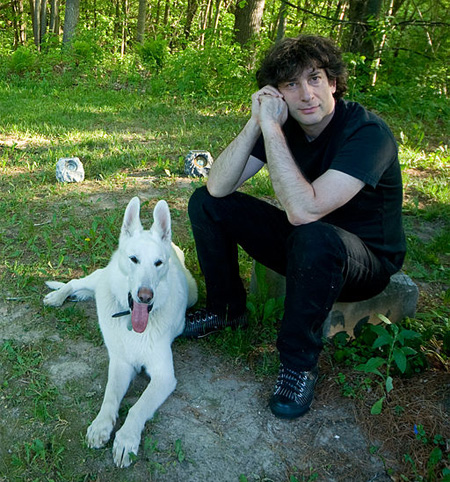
Neil Gaiman, 2009, by Kyle Cassidy.  CC-BY-SA-3.0

Neil Gaiman, 2009, by Kyle Cassidy. CC-BY-SA-3.0

In June, Gaiman released The Ocean at the End of the Lane, which he called “the most serious, dark, weird and personal thing I’ve ever written” in an interview called “The Illusionist” in the June 24, 2013, issue of Time.     

Illusionist is the only possible title for the creator of Ocean, which began as a short story and grew.  You reach the end of a nail biting ride with a man recalling a summer of terror and beauty that happened (or probably happened) when he was seven, and you realize that although you have been in his head and his heart for 180 pages, you don’t even know his name.  You know the name of Lettie Hempstock, who lives at the end of the lane, an 11 year old girl who claims that her duck pond is really an ocean.  You know Lettie’s name, but you don’t know what she is, and when you ask how long she has been 11, she gives you a smile but no answer.

Like Dr. Who’s TARDIS (Gaiman wrote an episode this year), Lettie’s ocean is bigger inside than it appears from without.  When he ventures in, Gaiman’s protagonist says, “I saw the world I had walked from my birth and I understood how fragile it was, that the reality I knew was a thin layer of icing on a great dark birthday cake writhing with grubs and nightmares and hunger.  I saw the world from above and below.  I saw that there were patterns and gates and paths beyond the real.  I saw all these things and understood them and they filled me, just as the waters of the ocean filled me.”

One of Gaiman’s numerous strengths is his ability to remember “extremes of horror and ecstasy that children experience.”  He read books as a child and realized the adult writers had forgotten.  He vowed not to, and The Ocean at the End of Lane proves that he has not.

Gaiman resists “fantasy” as a label, but for convenience I will use it to say this is one of the finest fantasies I have ever read.  In the Time interview he also said, “I’m now more famous than I’m comfortable being.”  Though I understand his concern, I have to say, “Dude, you brought it on yourself – learn to deal with it.”

Your Own Damn Life: an interview with Michael Meade in The Sun

Michael Meade is an author, storyteller, and a passionate advocate of soul values in a world that increasingly ignores them; I’ve written about Meade or mentioned him in half a dozen posts.

In The Water of Life (revised, 2006) he shares his discovery that stories can be a matter of life and death.  As a teen in New York, when confronted by gang members from a rival neighborhood, Meade didn’t just lie his way out of serious injury or worse – he storied his way out, with an elaborate made-up tale that won over the assailants long enough for him to make his escape.  Readers of my recent posts will recognize a thriving trickster in Meade when he was just a kid!

I recently found an interview between Michael Meade and John Malkin in the The Sun that is as timely today, or more so, than in November, 2011, when it was published.  In the interview, “Your Own Damn Life,” Meade quotes an African proverb, “When death finds you, may it find you alive.”  Alive, he goes on to say, “means living your own damn life, not the life that your parents wanted, or the life some cultural group or political party wanted, but the life that your own soul wants to live.”

In the past, meaningful stories could guide soul evolution, but now, with the culture and the natural world both in crisis, Meade points to our lack of coherent, guiding tales.  A culture falls apart, he says, when youthful imagination and energy are stunted and when the traditional wisdom of elders is forgotten.  At one extreme, “You’re not supposed to be worrying about the end of the world as a teenager; you’re supposed to be bringing your dream to it. The world seems old and troubled now, and the young are no longer allowed to be as young as they should be.”  At the other extreme, we have a lot of “olders” but not many wise “elders.”

When traditional stories collapse, Meade says, the guiding and healing stories must come from within.  “That means going to the core of your own life and finding the story seeded within.”  Meade has tried to facilitate such explorations through his writings and talks, which first became known in the 80’s when he, James Hillman, and Robert Bly hosted a series of men’s conferences.

Meade continues to teach, write, and offer a variety of community services through the non-profit Mosaic Foundation he founded in Seattle where he lives.  If you’ve read this far, you will find Meade’s interview in The Sun and the Mosaic page hightly rewarding and likely sources for new ideas.