Gone For Good by Harlan Coben

A few posts ago I said I was going to read six books straight through for pleasure, and then cycle back and analyze the ones with plot features I admire.  Book number two on my list was Harlan Coben’s Gone For Good, 2003.  Donald Maass had good things to say about this title in his Writing the Breakout Novel Workbook.  He said it takes a mystery cliche – a detective haunted by the murder of his wife or girlfriend – and turns it inside out by layering the plot and adding twists and turns.  I cannot recall a thriller with more surprising twists packed into its pages.

Will Klein’s mother tells him a few days before her death that his beloved older brother Ken is still alive. Ken disappeared eleven years earlier, wanted for the murder of Will’s former girlfriend. The family believes Ken is innocent but assumes he is dead – could he really be alive and in hiding? The day after his mother’s funeral, Will’s girlfriend, Sheila disappears. The next day at work, two FBI agents ask for Sheila’s whereabouts, and inform Will that her fingerprints were found at the scene of a double homicide in New Mexico. Meanwhile we meet two former classmate’s of Will’s older brother, one a gangster and one a sociopathic master-assassain known as “The Ghost,” and both have a keen interest in Will.

Got all that?  You need to, since this is just the basic setup of Gone For Good.  When Will sets out with his friend, Squares, to try to discover what is really going on, Squares warns him he may not like the answers.  “The ugliest truth, in the end, was still better than the prettiest of lies,” Will says, a sentiment that will be tested as the story progresses.

Perhaps the greatest take-away for me as a writer is the way questions can keep us turning pages as effectively as tension.  From the initial, “What’s going on?”, “Is my brother alive?”, “Where is my girlfriend?” mysteries, Will must face issues that cut deeper and deeper into the basic assumptions of his life and the people he loves.

This is not a perfect book.  During the second half, I found my attention wandering.  In part, the plot twists were coming with such frequency they felt expected and lost a little of their power to shock.  So I think when I review Gone For Good in greater detail, I am going to discover that for a large section of Act II, the stakes and the pacing of the revelations stayed somewhat constant.

Also, the most menacing character, The Ghost, was not fleshed out until the end of the book.  It is hard to write a convincing, three-dimensional, psychopathic killer.  It is the humanizing details that make them come alive.  Hannibal Lektor valued good manners and hated rude people.  The killer in No Country for Old Men had certain personal values – keeping his promises, for one.  Such quirks make them more believable than an apparently flawless killing machine.  The Ghost, we learn at the end of the book, is driven by a complex and unexpected sense of loyalty and fair play, but I think we would have found him more “real” and more frightening if we had known some of the details earlier.

As I now understand it, the whole point of this exercise – reading and then rereading six books to try to look under the hood – is to look deeply into what works in six unique approaches.  Having just finished a complex novel like this, I have several other opinions and hunches but I need to review them further.

I was reminded though, of the very first post I made on this blog at the end of last June.  I quoted Neil Gaiman’s comment as editor of Stories, that the measure of a storyteller’s success are the four words we all want to hear – “And then what happened?”  By that measure, Harlan Coben deserves the acclaim Gone For Good has won.

The Hunger Games by Suzanne Collins

What if there was a trend and I wasn’t paying attention?

I actually did notice The Hunger Games when it came out in 2008, but I did not read it then for two reasons.  First, though I love the genre, I am wary of reviews of fantasy literature, with words like “Breathtaking,” or “Original,” because I’ve been burned too many times.  In addition, when I read the synopsis, although The Hunger Games did sound original, but we had just had a round of serious layoffs at work, and I wasn’t in the mood for a story of hard times in the not-so-distant-future.

Last weekend, at the SCBWI conference, I heard repeated praise of The Hunger Games from sources I trust.  Later, one of the speakers cautioned the audience not to write a story just because it is trendy.  He cited a current mass of “dystopian fiction” as an example.

Looking again at reviews, and watching the the trailer of the movie that is “Coming Soon,” I realized The Hunger Games must have sparked the trend.  I downloaded the ebook and to my surprise and delight, could not put it down.  I devoured it this week.  It seems strange that in the fantasy genre, real originality is so rare, but this book has it.  It isn’t perfect.  I thought that at a key moment, Suzanne Collins held true greatness in her hand and let it slip away.  Still, The Hunger Games is one of the very best reads I recall in YA fantasy.

Katniss

I didn’t just read this book for pleasure.  It is one of a half-dozen new books I plan to read once for pleasure, and again with an eye to look under the hood and try to see how the author creates the magic.  Observation one – Suzanne Collins takes all the time she needs to introduce us to Katniss Everdeen, 16, and let us bond with her.  We rise with Katniss, learn that she loves her 12 year old sister Prim but despises her cat.  Very human stuff like that.  We learn that times are hard.  We learn that to get into the woods to hunt for squirrels to eat or trade on the black market, she has to pass through an electrified fence, which isn’t really that dangerous, because the power is seldom on.  We aren’t in Kansas anymore!  We meet Katniss’ best friend and hunting partner, Gale, who despises The Capitol, which runs things, and we learn he could be killed by the Peacekeepers if such talk is overheard.  We learn this is the day of “The Reaping” and that does not sound good.

Panem

Panem rose from the ruins of America.  Katniss’ District 12 used to be called Appalachia.  The Capitol is totalitarian, and attempts to flee result in death or slavery.  Earlier worlds of this sort, like 1984, reflected the cold war mentality, while Panem is firmly lodged in 21st century fears.  Large chunks of the coastline are gone.  There have been famines and other ecological disasters.  The Peacekeepers bring to mind Homeland Security, and the iffy electricity has an eerie resonance to what is happening right now in Japan.

But all that is nothing compared to the Hunger Games and what happens if you are selected as a “Tribute” at the “Reaping.”

As punishment and a warning to the 12 surviving Districts that unsuccessfully tried to revolt, the Capitol demands a boy and a girl between the ages of 12 and 18, to be chosen by lottery once a year.  The are trained and pitted against one another in a huge outdoor arena as gladiators.  One victor will be set up for life.  Twenty-three others will die for the amusement and “instruction” of the population, which is forced to watch – there is always enough electricity to televise the Hunger Games.

The Games

When her baby sister, Prim, is chosen, Katniss rushes forward to volunteer to take her place.  We had come to like her before, and now we love her.  Her chances do not seem very good.  Her fellow District 12 tribute, Peeta, is a baker’s boy, who doesn’t seem much of a warrior.  To make things worse, Peeta once saved her life with the gift of a loaf of bread, and both know they will eventually have to fight to the death to survive.

By now, of course, we are really into the story, and incredibly, as their training unfolds, we begin to think Katniss and Peeta may stand a chance.  As a strategy to deceive the others, they feign love for one another – except Peeta may not be pretending.  Katniss wins the affection of the crowds and the all-important sponsors.  The odds-makers give her good marks for her skill with a bow.  Their trainer, a past winner and a drunk goes on the wagon and dedicates himself to their survival.

Then the games begin and all hell breaks loose – literally.

Rue

Lets face it, we know Katniss will survive, but to her credit, Collins keeps up the nail-biting doubt.  The most poignant moment comes when Katniss teams up with Rue, a twelve year-old slip of a girl, who reminds Katniss of her sister.  They bond in a hurry, and Katniss briefly basks in the luxury of not feeling alone – never mind that they will have to fight each other later.  But after a daring raid on another team’s food supply, Rue is mortally wounded.  Katniss sings her a lullaby as she dies, for her greatest love had been music.  And then, as the greatest protest she dares, Katniss covers her friend’s body with wildflowers as the hidden camera’s broadcast the image all through the land.  Gladiators are not supposed to care for each other – it is the closest thing to open defiance Katniss can imagine.

At this moment, The Hunger Games transcends genre and reaches the level of tragedy – that which is grave and constant in human affairs.  In particular, it reminded me of that heartrending day, Dec. 25, 1914, that we now call the Christmas Truce.  Two armies of young men defied the old men who sent them to kill each other, by celebrating the birth of Christ with friendship.  The generals promised a firing squad to any who tried it again.

How It Ends

Things tapered off from there, perhaps inevitably so, for how could such a moment be sustained?  Still, the genetically mutated zombie-werewolves who end the contest were over the top – they seemed like an add-on, a patch to ramp up adrenalin by borrowing from the horror genre.  For me, it had the opposite effect.

The book also ends with romantic teasers.  Katniss went out of her way to save the badly injured Peeta, but until now, she had been a hard-luck tomboy, fond of him and grateful, but not in love.  Her last moment inner conflict does not seem to grow “organically” from her earlier thoughts about her friendship with two young men – maybe I am too cynical, but I took it as a carrot to get the masses of Twilight readers to buy the next book of the trilogy.  Club Peeta or Club Gale?

Still, I plan to read and enjoy the final two books of the trilogy.  Even if the series comes off as an “ordinary” romance and battle of good guys against an evil empire, if that’s the worst thing we can say of The Hunger Games, it is still in very good company.  Suzanne Collins has given us a vividly imagined and wonderfully crafted story.

The Tassajara Bread Book

Three decades ago, I stumbled into a three year period in my working life where I had time to pursue all the extra-cirricular activities I desired.  Through a spectacular right place/right time moment, I landed a part time teaching job.  We lived in a small but cozy and affordable house in Chico, California where we could walk to the market and downtown.  We got by with one car, a Beetle that I maintained with the help of the Idiot’s Volkswagen book.  We grew veggies, and somewhere along the line, I started making bread, not just to save a few pennies, but because I found it satisfying and delicious.  That was one of several things that went by the wayside when I joined the high-tech workforce – until two days ago.

In a recent post I wrote of attending a retreat with Edward Brown, a long-time Zen student, teacher, chef, and the author of The Tassajara Cookbook and The Tassajara Bread Book.  I purchased both books.  This was not an impulse buy – I attended a workshop with Edward a year ago and almost bought the books then, but worried that I didn’t have enough time.  This year I decided to make time, with the results you can see above.  The loaves taste as good as they look.

I’d show you the Orange Whole Wheat Pancakes, but unlike the bread, they did not have to cool before eating, so they didn’t last long enough for snapshots.

The directions in the Breadbook are clear and lively.  Brown takes the time to explain why you do things this way and not that, a feature lacking in many cookbooks.  There is something elementally satisfying in baking one’s “daily bread,” and I cannot think of a better book on how to do it.

Young Adult vs. Middle Grade Fantasy

I know a sure-fire way to depress myself – visit the young adult section of the local Barnes & Noble.  I should explain.  None of my favorite authors or books like the ones I want to write are out on the shelves; everything is far too market researched, too hip, slick, and cool for the likes of moi.

I made my semi-annual visit recently, and went through my usual chain of thoughts.  Should I take a pseudonym and try my hand at vampire romance?  Should I do like Marcel Duchamp and spend the rest of my life playing chess?

Sooner or later – in this case, the same day – I come to a solution that works.  I stopped by the local library and went to the “middle-grade” stacks.  For readers in this range, roughly older grade school through middle school, fantasy never goes out of style.  Reading these books is like dipping into the fiction that really made me love fiction.

The YA/middle grade distinction is anything but exact.  Harry Potter is usually found in the middle grade section, and in thinking about that, a few differences became clear.  There is less introspection and more action, of course, but there is also a different quality to the characters’ introspection.

A middle grade hero like Harry worries that he is not adequate to take on Voldemort.  A young adult hero worries that he is not adequate.  They are just on different spots of the whole arc of coming of age, which I don’t think anyone ever fully outgrows.  I’m sure that is one reason why people of all ages love Harry.

Here is a brief synopsis of three middle grade fantasies I have thoroughly enjoyed, and which you may as well.

The Sisters Grimm: The Fairy-Tale Detectives by Michael Buckley

Two years ago I drove to a nearby Borders to hear Michael Buckley discuss his popular middle grade fantasy series, The Sisters Grimm. Buckley was snowed in on the east coast and forced to cancel, but interestingly, there were five adults and two seventh grade girls waiting when the news came.  The girls told us how disappointed they were, and gave a synopsis of the series.  Both said they liked these books better than Harry Potter.  When articulate young readers tell me they like something better than Harry Potter, I pay attention; I brought home the first three books of what has grown to an eight book series.

In book one, after their parents mysteriously disappear, Sabrina and Daphne Grimm are sent to live with their Granny Relda in the Hudson River town of Ferryport Landing.  Suspicious Sabrina has no patience with the tall tale this “grandmother” spins – that the sisters are descendants of the famous Brothers Grimm, whose fairytales were actually case files of the activities of “The Everafters.”  These strange and sometimes dangerous creatures of story actually exist in Ferryport Landing, where they were brought and contained by Wilhelm Grimm to ensure their survival.  When Sabrina sees Granny Relda taken by a giant who almost catches her and Daphne, she can no longer doubt.  The sisters must team up with Puck and Jack the Giant Killer to dodge the town police (the three little pigs), rescue Granny Relda, and get to the bottom of a shady real estate deal engineered by the foppish Prince Charming, the mayor of Ferryport landing.


Inkheart by Cornelia Funke

When she is twelve, Meggie Folchart discovers that her father, Mo, is a “Silver Tongue,” a person with a dangerous gift.  When he reads a tale aloud, characters from the book are drawn into our world, while people from our world disappear into the the story.  Meggie learns that her mother, Resa, vanished when Mo read from a rare book, Inkheart, while the evil Capricorn came here from the story.  He has since found his own Silver Tongue to read his henchman into this world, even as he seeks to destroy all other editions of the book, so that Mo cannot send them back.

Mo, desperate to rescue Resa, seeks out the author of Inkheart who still has one copy of the manuscript.  Mo, Maggie, and the author, are captured by Capricorn, whose personal Silver Tongue is of the poorest quality.  When Meggie proves to have the gift, Capricorn threatens to kill her mother unless she reads “The Shadow,” the ultimate evil, into this world.

Inkheart was made into a fun movie in 2009, starring Brendan Frazer, Helen Mirren, and Eliza Bennet as Meggie.  There are two additional titles in this series.  I have not read them, but a friend says each book is better than its predecessor.

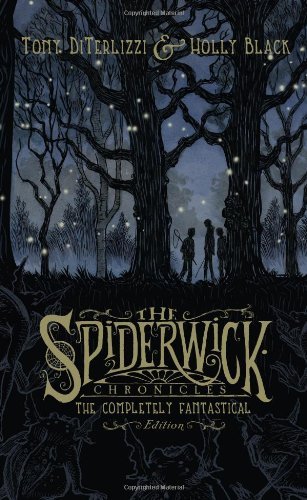
The Spiderwick Chronicles by Tony DiTerlizzi and Holly Black

After his parents split up, Jared Grace, his mother, his twin brother Simon, and his older sister Mallory, find themselves in the broken down Spiderwick Estate.  It’s a dump, and even worse, right on the edge of Faerie.  When the Grace siblings find a mysterious Field-Guide to the nice and not so nice denizens of this other world, some very unsavory creatures are determined to get it back.  At first, poor Jared, with a history of anger issues after the divorce, is blamed for the mischief.  Later  the whole family joins together in a fight for survival.

The Spiderwick Chronicles consist of five thin books.  The edition pictured above contains all of them, because you won’t be able to read just one.  I started the books after seeing an enjoyable movie version in 2008.

What I am reading Next:

I love libraries, where I am free to choose a book by its cover, or in this case, by its title.  Next in my middle-grade book queue is The Faceless Fiend:  Being the Tale of a Criminal Mastermind, His Masked Minions, and a Princess with a Butter Knife, Involving Explosives and a Certain Amount of Pushing and Shoving, by Howard Whitehouse.  I’ll let you know how I like it.

The Cypress House by Michael Koryta

Arlen Wagner, son of a West Virginia undertaker, knows about death, but nothing prepares him for that midnight in the Belleau Wood when he sees a squadron of skeletons marching toward his position and understands that every one of those men is going to die. In the years after the first world war, Arlen relies on whisky and manual labor to try to live with his unwanted “talent” for seeing death before it strikes.

In the summer of 1935, as Arlen and 19 year old Paul Brickhill, travel to a CCC camp in the Florida Keys, everyone on the train suddenly appears as a dead man. At the next stop, only Paul heeds Arlen’s warning to wait for the next train, and only Paul survives.

After that, things get strange…

That comment is not just meant to be facetious but points to one of the tactics Koryta uses to weave supernatural elements into his tale in a seamless fashion that is too often missing from the “urban fantasy” sub-genre that I once enjoyed but which soon became predictable.  Koryta is a master of mood who plants the vision of dead men on a train among a wealth of ordinary details:  the ever present heat, the smell of unwashed bodies, the cigarette smoke, the card games, and Arlen’s surreptitious sips from his flask.  In the next moment, he can make a simple walk down an empty road in the dark of the tropical night burst with menace.

He delivers on the promise of menace – and secrets.  Everyone has secrets – layers of them.

Arlen and Paul catch a ride with a man who takes them to The Cypress House, a roadhouse in the middle of nowhere, owned by a stunningly beautiful woman.  A few minutes after their arrival, the man who gave them a ride tries to slip away, but is incinerated when a bomb explodes in his car.  Why?  Why are Arlen and Paul arrested for the crime?  What secrets hide in the Cypress House – cypress house – another name for a coffin, Arlen remembers his father saying.  The very best kind of coffin, the coffin of choice for ancient kings and for popes.  Arlen’s father, who claimed he could talk to the dead.  He was insane – wasn’t he?

Michael Koryta, author of five mystery novels, charted a new direction by introducing supernatural elements into So Cold the River, which I praised on this blog last summer.  The Cypress House just came out.  Like its predecessor, this is one of those rare books I could not put down.

The Forgotten Garden by Kate Morton

I choose new books in a variety of ways. Over the last year, I drove frequent round trips to the bay area and became a big fan of audiobooks. Earlier this month, while roaming iTunes, I came across this description of  The Forgotten Garden:

A foundling, an old book of dark fairy tales, a secret garden, a maze, an aristocratic family, a love denied, a mystery – The Forgotten Garden is a captivating, atmospheric, and a compulsive listen about the past, ghosts, family, and memories…

Ghosts, memories, identity – these are hot-buttton themes for me lately, and I did the download. As I got into the story, I wanted to study certain passages in detail, so being a newly-equipped Kindle wonk, I downloaded the eBook.

In 1913 London, a mysterious woman, “the authoress,” leaves a four-year-old girl aboard a ship bound for Australia, with strict instructions to wait for her on the deck.  The authoress never returns.  The child, who hits her head during the voyage, lands with no idea who she is.

A dockmaster takes her home, and he and his wife name her Nell.  On her twenty-first birthday, the dockmaster tells Nell the story, plunging her into a search to learn who she truly is:

Pa’s secret had changed everything.  His words had tossed the book that was her life into the air and the pages had been blown into disarray, and could never be put back together to tell the same story…This person she was, or thought she was, did not really exist.  There was no Nell O’Connor.

Nell never quite unravels the mystery, but when she dies in 2005, with “The authoress…I was supposed to wait,” on her lips, her granddaughter, Cassandra takes up the search.

The book spans over a century, largely focusing on the years 1913, 1975 when Nell travels to England to search for her past, 2005 when Cassandra does the same, and the turn of the century, when we meet the authoress, the mysterious Eliza Makepeace, as an impoverished child in the London of Jack the Ripper.  Eliza lives with her brother Sammy, a changeling….

A what???  A changeling – one of the strange creatures the fairies leave behind when they take a human child.

Some reviewers fault The Forgotten Garden for it’s slow buildup, its rambling style, its sheer length and focus on detail, but I think those very elements may add to the subtle strength of a story that can smoothly fuse what we think is real with what we think is not.  This is not your typical urban fantasy, in the way that Buffy is urban fantasy.  There are still places in Britain where you can walk outside on a moonless night and understand why people believe in other worlds.  Cornwall, where Nell lived as a child, is one of them, and Morton brings this into her story.

It is often the custom these days, for books and movies to open with white-knuckle action.  Perhaps that’s why I like audiobooks so much.  Something about the speaking voice, its rhythms and pauses, slows us down enough to allow the teller to weave the tale.  The point is magic, after all, and there are many ways to get there, some of them in danger of being forgotten.

Kate Morton - Authoress

Kate Morton’s website:  http://www.katemorton.com/

Rebel Buddha: On the Road to Freedom by Dzogchen Ponlop

If I’d had any idea how good this book is, I would have read it much earlier. I have never come across a better introduction to Buddhism, one that is neither too esoteric nor too simplistic.  The author aims to present the core teachings, independent of custom, convention and eastern cultural trappings.  Some of his conclusions may seem surprising.  For instance, he clearly states that practicing Buddhism as a religion is fine, but it isn’t essential, because the Buddha’s central teaching is simply the importance of exploring the mind, including thought, sensation, and emotion, for that is where our suffering happens and where we experience it.

Dzogchen Ponlop’s experience as an easterner transplanted to the west makes him uniquely qualified to speak of this eastern tradition transplanted to the same soil.  When instructors at Columbia University asked him to introduce himself, he was at a loss.  Born of Tibetan parents in exile in India, and emigrating to New York City, he wasn’t sure who or what he was.

Dzogchen Ponlop Rinpoche

Such disorientation as a prelude to an unexpected opening of awareness parallels the realization of selflessness, which is central in Ponlop’s exposition of the Dharma or teachings.  We look in our body and mind for the “self,” and when we finally realize we cannot find it, thinking may stop, allowing us to experience a moment of pure, unconditioned awareness.  This, he says, is “our fundamental being, our basic, open and spacious awareness.  Imagine a clear blue sky filled with light.”

The fundamental cause of our suffering is clinging to a sense of self that is not only illusory, but divides ultimate and indivisible reality into a minefield of pleasures and pains, friends and foes, of the ego.  The Buddha’s terms “emptiness,” and “selflessness” have negative connotations in the west, but Ponlop explains that the actual experience of these states is anything but heavy or depressing.  “When we have a genuine experience of emptiness, it actually feels good…It’s not a vacuous place where everybody is desolate and moaning about something – that’s our ordinary life.”

***

Ponlop’s title, Rebel Buddha very naturally references the historical Prince Siddhartha, who abandoned all the privileges and responsibilities of a crown prince in his search for spiritual truth.  The title also calls to the indestructible potential for true freedom in each of us.  The rebel buddha within is that unconditioned awareness, “a trouble-maker of heroic proportions,” that will accept nothing less for us than the freedom that all the historical Buddhas discovered.  The actual word, “buddha,” does not refer to a few people only, but means, “awakened,” and is part of our own nature.  Even the willingness to investigate whether this is true can be enough to set our feet on the path.

Ponlop quotes from a famous teaching the historical Buddha gave to the citizens of a town who were confused by the conflicting teachings they had received from a number of itinerant preachers – not so different from what can happen to any seeker now who takes a few workshops an buys a few books on spiritual topics.  Buddha advised the citizens not to take the word of any authority or scripture, and not even to take his word, but to put the various teachings into practice, and “after observation and analysis, when you find that anything agrees with reason and is conducive to the good and benefit of one and all, then accept it and live up to it.”

There’s a lot of that in this book of Dzogchen Ponlop, a spiritual master who writes as a fellow traveller on the road.

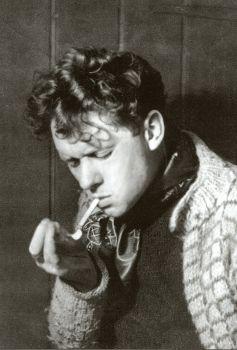
A Child’s Christmas in Wales by Dylan Thomas

My best friend gave me Dylan Thomas’ incredible prose poem back in high school. In whatever form – which now include recordings and at least one TV adaptation – it has been a part of every Christmas since then. I pass it on now, with best wishes for the holiday:

One Christmas was so much like another, in those years around the sea-town corner now and out of all sound except the distant speaking of the voices I sometimes hear a moment before sleep, that I can never remember whether it snowed for six days and six nights when I was twelve or whether it snowed for twelve days and twelve nights when I was six……

http://www.bfsmedia.com/MAS/Dylan/Christmas.html

Dylan Thomas

…Always on Christmas night there was music. An uncle played the fiddle, a cousin sang “Cherry Ripe,” and another uncle sang “Drake’s Drum.” It was very warm in the little house. Auntie Hannah, who had got on to the parsnip wine, sang a song about Bleeding Hearts and Death, and then another in which she said her heart was like a Bird’s Nest; and then everybody laughed again; and then I went to bed. Looking through my bedroom window, out into the moonlight and the unending smoke-colored snow, I could see the lights in the windows of all the other houses on our hill and hear the music rising from them up the long, steady falling night. I turned the gas down, I got into bed. I said some words to the close and holy darkness, and then I slept.