The Story of Shambhala

"Song of Shambhala" by Nicholas Roerich, 1943

The fictional earthly paradise of Shangri-La, discussed in my previous post, derives from early Buddhist teachings about Shambhala, a remote realm of advanced spiritual practitioners.  Shambhala is discussed in the Kalachakra Tantra, which Shakyamuni Buddha is said to have taught the Shambhala King, Dawa Sangpo, and 96 lesser rulers, over 2500 years ago.  The King taught all the citizens, since this practice leads to rapid enlightenment, which he hoped would enable them to withstand a threatened invasion.

This is the same “Kalachakra for World Peace,” that the Dalai Lama conferred last July in Washington, DC.  “World Peace,” does not mean it makes one a blessed-out pacifist.  Kalachakra means, “Wheel of Time,” and explores the cycles that affect individuals and the world at large.  It teaches that barbarian hordes periodically invade the civilized world and attempt to eliminate spiritual practice.  Such an invasion, leading to world war, is predicted for the year 2424, at which time, the Kingdom of Shambhala will again manifest in this world to turn the tide.

Kalachraka Mandala

Proponents say that those who take the Kalachakra initiation will be reborn on the victorious side, and the end of this conflict will usher in a new golden age.  (from, Alexander Berzin, Introduction to the Kalachakra Initiation, Snow Lion Publictions, 2010).

In common with the older Hindu epic, The Mahabharata, the warfare described in this teaching has inner and outer dimensions.  To the authors of Kalachakra, “barbarians” were non-Sanskrit speaking people who ate beef, and like Alexander the Great, periodically launched literal invasions.  The authors also understood “barbarians” to mean our own treacherous impulses like greed, hatred, and jealousy, which keep us bound to the wheel of suffering.  This inner war is part of every individual’s spiritual path.

Scholars have located Shambhala near Mount Kailash in the Himalayas, a place sacred to Hindus, Buddhists, and Jains.  They caution that only part of the journey is physical; arrival depends on knowing certain mantras and other spiritual techniques.

Shambhala is said to be near the 22,000' Mt. Kailash

A Western analogy that comes to mind is the Avalon of Marion Zimmer Bradley’s, Mists of Avalon.  When the priestess, Morgaine, falls out of inner harmony, she cannot reach the sanctuary.  In a similar way, some legends say King Arthur is not really dead.  The story says he will rise again at the time of Britain’s greatest need, and numbers of people reported visions of mounted knights during the second world war.

Paramahansa Yogananda (1883 – 1952), born in India, came to this country in 1920.  He was probably the most influential teacher of meditation and Eastern philosophy in America in the first half of the 20th century.  Yogananda predicted a similar time of turmoil, followed by a higher age of spiritual and creative growth.

Eastern concepts of time are cyclical rather than linear.  Yogananda outlined a 24,000 year cycle of four ascending and descending ages, analogous to what the Greeks called, gold, silver, bronze, and iron.  Yogananda’s predictions are eerily similar to what the world is experiencing now:  economic, climactic, and social disruptions.  The good news is that in this view, like that of Kalachakra, we are on the cusp of a higher age.  The bad news is, it’s not going to happen right away – as in, not in our grandchildren’s lifetime.

Still, a well known Tibetan teacher, speaking of our “degenerate” times, reminded his audience of how fortunate we are to live when profound spiritual teachings are available.  If we don’t get to chose all our external circumstances, according to Kalachakra and the teachings of Yogananda, we do get chose how to shape our response and our inner condition.

As Gandalf told Frodo, “All we have to decide is what to do with the time that is given to us.”

Shangri-La in Books, Movies, and Legend

I recently wrote a short story about a group of people trying to find Shangri-La. For decades, the name has stood for an earthly paradise, difficult to attain. The name was so popular in the 30’s and 40’s that before it was renamed Camp David, Franklin D. Roosevelt named the presidential retreat ground, Shangri-La. After my story was finished, I began to research this mythical place about which I realized I knew very little.

The name, “Shangri-La” entered public awareness through a novel and a movie, which I will discuss today. In my next post, I will explore the Tibetan legend of Shambhala from which core elements of the story may derive.

In David Hilton’s 1933 novel, Lost Horizon, Hugh Conway, a world-weary British diplomat and WWI veteran, along with three others refuges from an uprising in India, board a plane that is hijacked to the remote mountains of Tibet. They crash land in the snows and find their pilot dead. The group is rescued by a postulant lama named, Chang, who leads them to the hidden lamasery of Shangri-La, high above a fertile and temperate valley. Here Conway finds peace, the stirrings of love, and a sense of purpose when the High Lama tells him he has been chosen to oversee the mission of Shangri-La – to preserve the best of modern civilization during a world war the lama, (who is 300 years old), has seen in vision.

Did Hilton foresee WWII when he wrote his book in the early 30’s? Perhaps, but he also studied a 1931 National Geographic account of an expedition to the borders Tibet. Unexpectedly temperate valleys lie along the Nepalese border, and Hilton may also have read of the legend of Shambhala, with a similar prophesy of a world war. This prophesy is part of the Kalachakra teaching cycle the Dalai Lama presents, most recently in Washington, DC, last summer.

Lost Horizon won public notice only after Hilton published, Goodbye Mr. Chips, the following year. Because it was later published as Pocketbook #1, Lost Horizon has been mistakenly called the first American paperback.

Frank Capra read Hilton’s book and immediately decided to make the movie version. Production began in 1936, with a budget of $1.25 million, the largest for any film at the time. After a $777,000 cost overrun, Lost Horizon, was released in 1937 to critical acclaim. A New York Times reviewer called it, “a grand adventure film, magnificently staged, beautifully photographed, and capitally played.” It won Oscars for Art Direction and Film Editing, and was nominated for Best Picture.

Both the book and the movie seem dated now. The romantic vision of humans-as-noble-savage will not appeal to our modern sensibility. The idea that people will be good if freed from want echoes both the pacifism that flourished after the first world war and the socialism that grew in response to the hard times of the ’30’s. I believe in the “higher vibration” of certain places, yet when Chang tells Conway the healing properties of Shangri-La have even eliminated human jealousy, it breaks my “suspension of disbelief.”

Even with this kind of flaw, I enjoyed the book and the movie. The specifics of the Lost Horizon’s 75 year old vision may be dated, but the archetypal longing for a golden age and heaven on earth is not. The book and movie tap into this, and the tale of paradise found then lost evokes our longing for the Garden of Eden, Atlantis, Avalon, and Shangri-La. “We are stardust / We are golden / and we’ve got to get ourselves back to the Garden,” sang Joni Mitchell in her song about Woodstock, another manifestation of longing for a world of peace and joy.

This longing will not go away because it expresses our true nature, according to the view that gave birth to the legend of Shangri-La. Next time we’ll look at the legend of Shambhala, which carries predictions that will echo some we have seen in Lost Horizon.

Notes on Worldly Success

Yesterday afternoon I sat for a while on the back porch, watching the rain and admiring my neighbor’s and my handiwork.  Over the weekend, we shored up the fence and gate in preparation for winter.  My neighbor knows a lot about carpentry.  I don’t, and because of that, I felt a huge sense of satisfaction, as much or more than I did a few weeks ago, when I finished a pretty good short story for the Writer’s Digest contest.  I guess with that attitude, I’m not likely to get my face on the cover of Time, either for carpentry or for writing, even though both can bring me a great deal of satisfaction.  Sitting on the porch, I started thinking of various examples of success and failure.

***

I’ve been reading a lot about Steve Jobs in recently published tributes.  Viewing the whole sweep of his life, he seems to have had great self-confidence and an unerring instinct for doing the right thing. Much of that impression comes from his 2005 graduation speech, the reflections of a mature man, sobered by a serious brush with mortality.  I found myself wondering how he dealt with setbacks when he was young and first starting to make his way?  Lives written in history books and obituaries often leave out the messiness, the dark nights of the soul, the nights we wake up a 3:00am wondering what to do.

Somehow the story of Jobs’s trek to India leads me to think he connected with his heart and intuition – as he talked about in his speech – at a pretty young age.  You don’t venture to a strange continent, in search of something you aren’t sure of, unless you are confident enough to live with uncertainty and believe you can find the answers.  Unlike many creative people, Jobs’s passion aligned with his livelihood, but that did not prevent the devastation of getting fired at 30 from the company he had founded.   He had enough wealth to retire from active life and never know want again, but failure prodded Jobs to come back and reinvent himself – and animated films while he was at it.

Rule for success:  Find a way to believe in yourself.
Another rule of success:  Never give up.
A useful tip:  Love what you do, if possible.

There are clear parallels in the life of Thomas Edison, 1847-1931, to whom Jobs is often compared.  Edison ran numerous unsuccessful experiments (estimates range from 700 to 10,000) before discovering tungsten as a workable filament for electric lights.  Edison said, “Many of life’s failures are people who did not realize how close they were to success when they gave up.”  Did Edison ever come close to giving up?  Did he ever know dark nights of the soul?

"Genius is one percent inspiration and ninety-nine percent perspiration" - Thomas Edison, 1903

Several of the pithy statements he made in maturity sound like things Jobs might have said:  “I never did a day’s work in my life. It was all fun.”   Like Jobs, Edison never dreamed of resting on his laurels:  “Show me a thoroughly satisfied man, and I will show you a failure.”  Perhaps my favorite Edison quote is this one:  “To invent, you need a good imagination and a pile of junk.”  Might that include a pile 2×4’s and fence boards?

Tip for success:  A sense of humor and a sense of play are marvelous attributes.

***

The list of Abraham Lincoln’s failures is often used to motivate people, because he had so many of them.  Here’s a more balanced chronology of his victories as well as losses.  He won some and lost some, just like everyone else, and like Jobs and Edison, he kept on trying.  http://showcase.netins.net/web/creative/lincoln/education/failures.htm

Lincoln believed that he was an agent of destiny and spoke of “the chorus of Union” that would sound when touched by “the better angels of our nature.”  This sense of calling may have made his task possible but didn’t make it easy:  I’ve heard that he wept at the casualty counts from the last battles of the Civil War.  Like Jobs, he was aware of his own mortality:  a week before he was shot, Lincoln dreamed of lying in state in Capitol rotunda, but just like the men he ordered into battle, fear of death could not deter him.

Close to Lincoln during the last years of his life was another future president, Ulysses S. Grant, who may have been the only northern general able to win the war, but whose life outside the military reads like a litany of failure.  Born, Hiram Ulysses Grant, he discovered when he entered West Point that he had been registered as, Ulysses Simpson Grant.  He never bothered to change the name, and in a similar vein, gained a reputation as a sloppy cadet.  Though he served with distinction during the Mexican War, afterwards he failed as a businessman and a farmer.

As president, Grant was noted for enforcing civil rights and fighting the Ku Klux Klan, but his administration was was rocked by scandal and inept handling of the Panic of 1873, a world-wide financial crisis.  He left office on a note of failure, went into business with a man who cheated him, and died in debt and in great pain from throat cancer.  By force of will, he finished his memoirs before he died, which saved his wife from bankruptcy.

Like so many before and after, Grant was a poster-boy for another truth:  Worldly success is no guarantee of happiness.  This realization raises the critical question of what we really mean by success.  The purpose of life is finding happiness and sharing it with as many others as we can, according to the Dalai Lama, in The Art of Happiness, a book I will have more to say about later.

In the meantime, I come around again to the thought of fixing fences with my neighbor.  When measured by the creation of and sharing of happiness, it may have been even more important than I imagined.

Seven Year Cycles, Part Deux

While reviewing my previous post on seven-year cycles, two other writings came to mind.  In their own ways, both hint that our concepts of time, and and things like cycles, are just that – concepts.

The first of these writings comes from T.S. Eliot’s epic poem, The Four Quartets.

T.S. Eliot

You cannot face it steadily, but this thing is sure,
That time is no healer: the patient is no longer here.
When the train starts, and the passengers are settled
To fruit, periodicals and business letters
(And those who saw them off have left the platform)
Their faces relax from grief into relief,
To the sleepy rhythm of a hundred hours.
Fare forward, travelers! not escaping from the past
Into different lives, or into any future;
You are not the same people who left that station
Or who will arrive at any terminus,

***

Rodney Smith says something similar in Stepping Our of Self-Deception:  The Buddha’s Liberating Teaching of No-Self (2010).   Smith founded the Seattle Insight Meditation Society and is the author of, Lessons from the Dying which grew out of his years of hospice work.

Rodney Smith

He says, “future and past have no reality outside thought…no true authenticity other than the validity we give an idea or image.”   Smith does not deny our experience of past and future, but suggests that it’s not what we usually imagine.  Past and future, he says, are ideas we entertain in the present moment:  how could they be anything else?

His comments remind me of crossing one state into another.  The sign says, “Welcome to Oregon,” but you find no lines on the earth as there are on the map: one instance of the difference between a concept and the experience made visible.

Kalachakra For World Peace: In Washington, DC and in Sacramento

Did you know that the Dalai Lama is currently engaged in an 11 day ceremony in Washington DC, called  “The Kalachakra for World Peace?” Did you know that a Sacramento organization, the Lion’s Roar Dharma Center is giving a parallel ceremony from July 23, to July 30?  Please read on for the details.

Kalachakra Sand Mandala

Kalachakra, meaning Wheel of Time, is philosophy and set of practices that “revolve around the concept of cycles and time from the cycles of the planets, to the cycles of human breathing.  It teaches the practice of working with the most subtle energies within one’s body on the path to enlightenment.”  Kalachakra also refers to a Tibetan Yidam or meditational deity, who represents a Buddha.  http://en.wikipedia.org/wiki/Kalachakra

Yidam practice is complex and widely misunderstood, but here is a quick analogy: a kid who pretends to be Luke or Leah or Yoda is doing something similar – invoking a figure who represents and inspires bravery and wisdom.  Perhaps the child experiences an inflow of those qualities – except it is not really an inflow because it is already there, in seed form, inside all of us.  Imagination can awaken these latent potentials in a child and in a practitioner of Tibetan Buddhism.

I used to pretend to be Davy Crockett for the same reason.  There was never any real confusion, although my mother looked at me strangely the day I asked her to pick up some bear meat the next time she went shopping – but I digress.

Kalachakra is one of the most advanced Tibetan practices, but because of his perception of the urgent need for non-violence in the world, the Dalai Lama opened this series of teachings to anyone who was interested.  A Tibetan Sangha in Sacramento, the Lion’s Roar Dharma Center, is offering a similar series of classes, beginning with an introductory lecture, July 23, from 7:00-9:00pm, followed by classes and empowerments from July 24-July 30. http://events.r20.constantcontact.com/register/event?llr=rnxs8gcab&oeidk=a07e3puot1u6e5e5f26

Finally, here is a description of the ceremony by , a Tibetan nun who has been working in Washington since May, 2010 to prepare for the Dalai Lama’s performance of this ritual, which is now in progress.

http://www.npr.org/2011/07/14/137848121/in-washington-a-ritual-for-world-peace?ft=1&f=1003

The Freedom Index

Actually, there is no Freedom Index, except in my possibly fevered imagination.  The idea came from reading the WordPress Daily Post, “What Does Freedom Mean?”  That’s a good question to think about.  It is very hard to answer, which makes it interesting.

All of the obvious answers lead you in circles.  Millions of people in these troubled times long for the freedom that work brings, but that reminds me of all the five dollar bills I tossed into lottery pools at work.  I’m guessing that nearly all working stiffs sometimes dream of winning the lottery and achieving that sort of freedom – even though lots of studies show that a year later, most winners are no higher on the Happiness Index (which really exists).

News reports are always full of threats to our freedom, often couched in words of blame for someone else.  Still, on a hypothetical Public Freedom Index, things could be a lot worse.    We can watch fireworks if we choose – or not, since we don’t have mandated public celebrations.  The explosions tonight will be for fun; we live free of the threat of real bombs.  We can can blog and tweet to our heart’s content, and Google on a staggering array of topics.

Personal Freedom is always a little more dicey.  We are still guaranteed “the pursuit of happiness,” but you have to wonder how most people would answer the Dr. Phil question:  “How’s that working for you?”

The Dalai Lama says all of us desire happiness and an end to suffering, but we really don’t know how to go about it.  Many of our choices lead to the opposite result.  Perhaps the freedom to ask – really ask – where our real happiness lies, is one of the greatest freedoms of all.  That and Freedom of Information which allows us to follow the trail where ever it leads.

Here is Buddhist blessing/prayer, known as The Four Immeasurables:

May all beings have happiness and the causes of happiness.
May all beings be free from suffering and the causes of suffering.
May all beings know the supreme happiness that is beyond suffering.
May all beings rest in equanimity, free from attachment and free from aversion.

Happy Fourth of July!

A Year of Blogging

Snoopy writing

During high school and college, I tried to keep journals, because that’s what writers are supposed to do, but I never got too much traction writing only for myself.

Far more important were the letters I wrote to several close friends during that time.  You could say I learned to write because of them, for they really encouraged me, and an appreciative audience was all it took to turn on an incredible flow of words.  I wrote page after page, jotting down ideas as I tried them on for size, and things that just came to me in mid-sentence.  What kept me going was the thrill of knowing someone wanted to read what I had to say.

I think you can see where I am going with this…

Fast forward a few decades and in June, 2010, I signed up for a day long blogging workshop because these days, “building a platform,” is what writers are supposed to do.  I had and have some fairly cynical thoughts on that proposition (for writers of fiction that is), but that is beside the point.  I simply would not have kept at it if blogging was nothing more than a means to an end.

Almost immediately, this endeavor took on a life of its own.  It continues to surprise me.  If I had to sum up what blogging means to me, I would say, “discovery.”  Not only because of all the things I get to research and learn about, but because I continuously surprise myself by finding things in the psyche I don’t know are there until I see them on the screen.

So I want to sincerely thank everyone who stops here and reads a post, and maybe even takes a moment to leave a comment.  You keep me going and I appreciate you very much

I’ve learned many things this year, chief among them, the seemingly inexhaustible way the mind generates ideas.  I don’t know how many times I’ve posted something and gotten up thinking, “Well, that’s it.  It was a nice run while it lasted, but I’m finally out of things to say.”  The experience is so common, that I get to see, at least once or twice a week, that if I just go do something else, the next idea will appear in it’s own time.

Ideas are common – they come and go, but once in a while one sinks deep, resonates, and even changes some aspect of your life.  Something stated very simply this spring by Edward Espe Brown, who I posted about at the time, had that effect.  It crystalizing themes that had been on the back burner for a very long time:

Are you going to be a rule follower or are you just going to be you? – Edward Espe Brown

Brown made the comment in the context of spiritual practice, but it has a much wider scope.  It certainly does in the field of writing.  Here’s a confession:  some two years ago, a critique group buddy said, “I’ve heard that editors don’t like colons.”  I am ashamed to admit that I went home and rewrote several sentences.  Blogging has sharpened my perception of the absurdity of pronouncements like that, and something else that Brown said cuts at the very motive for heeding “advice” of that sort:

What is precious in us doesn’t come, doesn’t go, and it does not depend on performance.

Edward Espe Brown

I am very fortunate indeed to have a forum like this where I get to pass along things of value like that when I come upon them.  And as for what’s coming up in the next year – I promise I’ll let you know as soon as I do.  Meanwhile, I very much hope you will stay tuned.

A Retreat with Anam Thubten Rinpoche

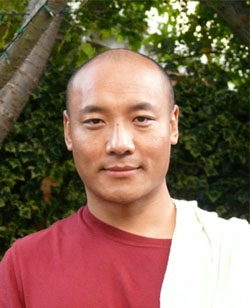
I recently heard the results of a poll that I found surprising: 50% of Americans report having had a “spiritual experience,” but of that group, 80% say they never want to have another. That was exactly the opposite of the 70 or 80 people who gathered on Saturday for a daylong retreat with Anam Thubten Rinpoche, sponsored by the Sacramento Buddhist Meditation Group.

Anam Thubten Rinpoche

Rinpoche is a Tibetan word meaning, “precious one,” and is usually only applied to those recognized as reincarnations of spiritual leaders or teachers of the past, most famously, the current 14th Dalai Lama.

I first attended a retreat with Anam Thubten in December, 2005 and have been fortunate enough to get to a half-dozen more since then, for his home and teaching center, the  Dharmata Foundation in Point Richmond, CA, is not far away.  In the years since I first heard him, the clarity, resonance, and joy contained in his teachings have brought him greater renown:  his book, No Self, No Problem, originally published by the Dharmata Foundation, has been picked up by Snow Lion Press (a self-publishing success story!), and he was chosen to kick off the ongoing series of online retreats at Tricycle.com

In my own efforts to write of the concept of no-self last December, I quoted Anam Thubten for his simple, experiential way of presenting the concept:  “this ‘I’ is a fictitious entity that is always ready to whither away the moment we stop sustaining it.  We don’t have to go to a holy place to experience this.  All we have to do is simply sit and pay attention to our breath, allowing ourselves to let go of all our fantasies and mental images”

It should be clear that any culture like Tibet, that believes in Rinpoches, is not using the concept of “no-self” to tell us we don’t exist or that life does not continue after death.  In Anam Thubten’s vision, “no-self” means an end to the painful illusion of seperation, an end to isolation, an end to living in a friend-or-foe, fight-or-flight world.

Yet although he mentioned this concept, which first drew me to his teachings, on Saturday he had a different focus, “Primordial Mind,” the unconditioned and indefinable base of what we are, prior to concepts, prior to ego, prior to all delusions.  The experience of this spacious mind is surprisingly near if we are willing to let go of fixed concepts, and practice a simple meditation technique, and if we are motivated by devotion, by longing for union with the absolute the way a thirsty man longs for water.

Anam Thubten’s book elaborates the concepts we need to let go  of as well as his favorite meditation practice – the simple but difficult art of learning to relax and let go of effort, even the effort to meditate “well.”  This longing – for God or the guru or Buddha; for oneness, or emptiness or, selflessness, or enlightenment – however we conceive of the ultimate good, is finally a longing for love, he said, and this is what remains when our fixed ideas break down.  In Anam Thubten’s teaching, God is love, or Buddha Nature is love, as it is in the words of many other spiritual masters.

My description is close to being new-agey, which is why Anam Thubten is the teacher and I am not.  He didn’t gloss over the difficulty and struggles involved in a serious spiritual search, and in his quiet and understated way he noted that if one is not receptive, “this talk will be very strange.”

In the end, it is the person of the teacher himself that does the convincing.  Is this person really what he seems – genuinely centered, full of peace and compassion?  I believe Anam Thubten really is a man of peace and joy and I trust his message that what he has found is accessible to anyone willing to look and make the effort.   More information and his teaching schedule can be found at the Dharmata Foundation website,  http://www.dharmatafoundation.com/

Dharmata is a word that means, “the way things truly are.”