Of Greensleeves and Christmas Carol Karma

Regular readers will recall that at the start of the  season, I posted a wee diatribe on how much I hate what passes for Christmas music in most of the stores. http://wp.me/pYql4-1tv

Here’s where karma part comes in:  Mary is organizing a Christmas dinner for a large number of people at a local church.  I already volunteered to help with food prep, but the other day she gave me a further assignment.   “I need you to make a three hour playlist of Christmas music, and it has to be respectful.”

That actually is not a problem.  I love Christmas music – if I didn’t, the stuff in the stores wouldn’t bother me.  As I started to rummage through what I have on iTunes, I got caught up in listening to various versions of “Greensleeves,” and wondering – even though I love the song – what it has to do with Christmas.  Tracking its origins was not unlike researching a folktale.  I also found that everyone from Homer Simpson to John Coltrane has covered it, so I invite you to have a listen as I share a bit of what I learned about this haunting song.  Let’s begin with Homer (relax – his clip is only 14 seconds long).

Greensleeves is a traditional English folksong, of the sort known as a “romanesca.”  A broadside ballad of this name was registered at the London Stationer’s Company in Sept., 1580, as “A New Northern Dittye of the Lady Greene Sleeves”.  A broadside was a ballad or poem, printed on one side of a cheap sheet of paper and common between the 15th and 19th centuries.  Here is a traditional version, sung by Méav Ní Mhaolchatha’s on the Celtic Woman tour:

There’s a persistant rumor that Henry VIII wrote the song while courting Anne Boleyn, since at first she apparently “cast [him] off discourteously,” but music experts dismiss the legend.  Greensleeves is an Elizabethan song, composed in an Italianate style that did not reach England until after Henry’s death.

Another common interpretation is that the song refers to a promiscuous woman or a prostitute.  At the time, the color green had sexual connotations.  One translator of Chaucer notes that in the Canterbury Tales, green “was the colour of lightness in love.”  I tend to agree with this interpretation based on what I know of pre-Christian nature religion in the British isles, and the Pan-like “Green Man,” whose face still peeks out at worshipers in many British churches and cathedrals:

Green Man at Dore Abbey, Herefordshire

A reference to Greensleeves in The Merry Wives of Windsor, 1602, suggests both the popularity of the song, and coming from Falstaff, a bawdy interpretation.  The popularity of the song has continued unbroken to the present day.  Here my favorite modern interpretation, by Jethro Tull:

In 1865, William Chatterton Dix wrote “What Child is This,” to the tune of Greensleeves, which made both songs popular during the Christmas season.  Here is the version I’m going to use for the Christmas dinner project.  Josh Groban knows how to stir the soul, and that is something we really need this year.  Elizabethan renditions of Greensleeves have historical interest but tend to be slow and even lugubrious.  Much as I love ballads of trials and woe, this year we need all the hope we can get and the kind of music that can awaken it.

***

I wish each and every one of you a joyous holiday in whatever way you celebrate it.  I’m going to take a blogging break for a week or so, to walk, to read, to meditate, to catch some of the great year end movies, and in general, to simply kick back for R&R.  I will be back right around the new year.

Peace to all of you!
The King and the Corpse by Heinrich Zimmer: A Book Review, Part Two

If you haven’t already read it, please begin with Part 1 of this review:  http://wp.me/pYql4-1vt

We left the young king in a most unusual and disconcerting situation – carrying the corpse of a hanged man across a charnel ground.  The corpse was possessed by a spirit who asked the king a riddle and said that if he knew the answer but didn’t speak, his head would explode.

"The King and the Corpse," from a presentation at the Red Arrow Gallery, Joshua Tree, CA, Sept. 2011

The king answered the question and immediately, the body flew back to the tree and the king had to return and cut it down again.  Another walk, another story, another answer and the corpse again disappeared. The king, whose name meant, “Rich in Patience,” needed all he could muster, for the gruesome routine went on and on and on. If the ruler had been thoughtless as a youth, the corpse now gave him riddles worthy of Solomon.  He solved all of them except the 24th, which went like this:

“A chief and his son were hunting in the hills.  The king was a widower and the son unmarried, so they were intrigued to find the footsteps of two women, one older, one younger.  The feet were shapely and the gait suggested refinement.  “A queen and her daughter, I think,” said the father.  They set out in pursuit and agreed that if the women were willing, the father would marry the one with the larger feet – presumably the mother, and the son would marry the other.  The women were indeed a queen and her daughter, fleeing danger, but, the daughter’s feet were larger.  Holding to their vows, the king married the daughter, and the son married her mother.  When both women gave birth to sons, how were the babies related?”

When the king kept silent, the corpse said how pleased he was with the monarch’s courage and wisdom.  He warned him that the sorcerer was a necromancer who planned to use the corpse and the king’s blood – after killing him – in a black magic rite that would give him power over the spirits of the dead.  He told the king how to slay the sorcerer, and when he did, the ghost in the corpse revealed himself as the great god, Shiva, who honored the king, and asked him to name his reward.

The king asked that the 24 riddles should always be remembered and should be told all over the earth.  Shiva assented, and indeed, the story has travelled the world since 50 BC, the time of the Hindu king, Vikramaditya (“The Sun of Valor”), the hero of this and many other legends.  The great god promised that ghosts and demons would never have power wherever the tales were told, and “whoever recites, with sincere devotion, even one of the stories shall be free from sin.”  Shiva also promised the the king dominion during his life and gave him an invincible sword.  Far more important, he opened the monarch’s eyes of spiritual illumination, and so his earthly reign was a model of “virtue and glory.”

When the story opens, the king is young, handsome, rich, and rather heedless since he accepts the beggar’s fruits as if they are his due, without thinking very much about them.  According to the wisdom of the east, he is like a sleeping man whose house is on fire, since nothing – not fruit, nor youth, nor jewels, nor life itself will last.  Also, naiveté doesn’t work too well in this world,  It draws betrayal the way a magnet draws iron.  The “holy man” has been weaving the king’s undoing for ten long years.  Where is the king going to come up with that kind of cunning, and in a hurry?

He finds it as all the heroes and heroines of folklore do, in an unlikely place, from the voice of a being the “wise” would despise.  Stories tell us that is where our guiding spirits often hide at first, as if to test our ability to see beyond appearances.  In fairytales from around the world, it’s the ugly crone, the dwarf, the wild animal, or in this case, in the body of an executed criminal who serve as our spiritual guides  Stories remind us that when we are truly stuck, doing what we have always done will not help.

When life and happiness depend on spinning straw into gold, on finding the water of life, on “going I know not whither and bringing back I know not what,” we need the guidance of our better angels, our guardian spirits, our daemons, as the Greeks called them.  Or in the case of our king, in our tutelary deity, who hides in a corpse to test his student’s faith, courage, and willingness to trust his own experience.

The saving spirit is one of the key themes that Heinrich Zimmer ponders in the stories of  The King and the Corpse, for as Zimmer tells us, “the hidden magician who projects both the ego and its mirror world can do more than any exterior force to unravel by night the web that has been spun by day.”

I consider this an essential book in the library of anyone who wants to hear the voices of wisdom that hide in the old tales that people cannot stop telling.

The King and the Corpse by Heinrich Zimmer: A Book Review – Part One

Heinrich Zimmer (1890 – 1943) was a Sanskrit scholar, an Asian art historian, and an expert in Indian philosophy and spirituality.  After the Nazis dismissed him from Heidelberg University in 1938, he made his way to the US where he taught at Columbia as a visiting professor.  The young Joseph Campbell attended some of his lectures and became a close friend.  Zimmer died of pneumonia in 1943, and Campbell spent the next 12 years editing and publishing some of his papers.  Campbell finished Zimmer’s book on folklore, The King and the Corpse, in 1948.

I discovered Zimmer’s writing as a freshman in college at the same time as I discovered Jung.  The two men, in fact, were long time friends, but their writings on myth and folklore were different.  Jung and his circle largely used story to expand and validate their theories, while Zimmer, and Campbell after him, sought to find the living essence of ancient tales that will speak to us now if we learn to listen.

In his introduction to The King and the Corpse, Zimmer called himself a “dilettante,” from the Italian verb, dilettare, “to take delight in.”   The essays in the book he said, “are for those who take delight in symbols, in conversing with them, and enjoy living with them continually in the mind.”   When I read Heinrich Zimmer, I discovered I was that sort of person.

Heinrich Zimmer, 1933

The King and the Corpse is collection of tales from around the world presented, along with Zimmer’s personal meditations, in a style of exposition later popularized by Campbell.  There’s a story from the Arabian Nights, four stories from the Arthurian cycle, and the rest come from India. The one that has always stayed with me is the title story, “The King and the Corpse.”

For ten years, every day, as a king sat in his audience chamber, an ascetic beggar appeared and wordlessly gave  him a piece of fruit.  Thinking little of it, the king gave the gift to his treasurer who tossed it over the wall into the treasure house.  One day a monkey got loose and hopped onto the king’s lap.  Playfully, the monarch gave him the fruit.  The monkey bit into it and a jewel fell out and rolled across the floor.  The king and treasurer hurried to look in the treasure house, where they found glittering jewels in the pile of rotten fruit.

It had been years since I read this tale, but I’ve seen this motif in other stories, and this time, its power jumped out at me.  The king’s attitude toward the fruit mirrors my own attitude toward health and youth in younger days, when these gifts arrived every day, with little effort on my part, almost as if life owed them to me, and there was no end in sight.  In his essay, Zimmer takes a larger perspective, suggesting each day we are given is like a piece of fruit hiding a jewel that we might discover if we only stopped to look.

The next day, when the ascetic arrived, the king demanded an interview before he would accept the gift.  The beggar said he needed a brave man, a hero, to help in a work of magic.  He asked the king to meet him at midnight on the night of the next full moon, in the funeral ground, where the dead were cremated and criminals hanged.  On the appointed night, the king strapped on his sword and strode through the smoke and flames of the funeral pyres, ignoring the clamor of ghosts and ghouls.  He found the ascetic, in sorcerer’s robes, drawing a magic circle on the ground.  “What can I do for you?” the king asked.  The magician told him to cross to a certain tree, cut down the body of a hanged man, and bring it to him.

This too, according to Zimmer, is a sign of the king’s youth and naiveté.  The realm depended on him, but without a thought, he agreed to meet a magician that he didn’t know, by himself, at the dark of the moon, at the witching hour on dangerous ground.  Yet the king was nothing if not brave.  He cut down the hanged man and hoisted the body onto his shoulder, but as he did, the corpse began to laugh.  “What is it?” the king asked.  The corpse said the way was long and offered to shorten the king’s journey by telling a story.  When the king did not reply, the corpse began.  He told the king a complex tale, filled with moral ambiguity, and then asked which character in the tale had been right.  “And by the way,” the corpse added, “If you know the answer but do not tell me, your skull will explode.”

To Be Continued.

Structure in Folktales, continued

Red Riding Hood, by Gustave Dore

In my last post, I said I was going to review some folktales to see if any conventions of the “three act structure,” used in contemporary fiction and cinema, apply.  Lest I be accused of hubris, I did not say I was going to be systematic about this.  My qualifications are simply a lifetime of love for this stuff.  Here are a few random observations.

The first thing I noticed – and I should have expected this – was the apples and oranges nature of my comparison between long fiction and short, between modern novels and screenplays and the kinds of tales you find in Grimm and other folklore collections.

Some longer epics do mesh with the three act structure.  In Homer’s Iliad, plot point #1 is Paris taking Helen to Troy, and plot point #2 is the Trojans wheeling the horse into the city – this is how the 2004 movie, Troy, is structured too.  It seems the three act structure only really fits longer fiction.  This leads to the question of whether the concepts apply to short fiction at all and to folktales in particular.

Every one of the folktales I reviewed has what Syd Fields called, an “inciting incident,” an event or situation that sets the action in motion.  The king is sick, the princess is missing, a dragon is loose on the land.  Often this is right where the tale begins, without any other preamble.

In terms of the major plot points, most of the folktales I looked at only have one.  Some have two and a few do not have any.  Are there any plot points, in the sense of a major crossroad, in the tale of Red Riding Hood?  Not really.  The unfortunate girl obeys her mother – “Take this basket to grandmother” – and events roll on to their unfortunate conclusion.

Cinderella has a single plot point.  The fairy godmother asks, “Do you want to go to the ball?”  When Cinderella says yes, her happy fate unrolls like destiny.

Cinderella by Edmund Dulac

Another common folktale set up has just one decision point:  three brothers or three sisters set off on quest.  Each of them meets an “insignificant” or repellant creature as they set out.  The older siblings are arrogant and come to an unfortunate end.  The younger sibling behaves with respect, and the creature’s advice and boons are key to fulfilling the quest and often finding love and riches as well.

A Grimm’s fairytale, “The Water of Life,” is a good example.  The king is sick and only the water of life will heal him.  Two brothers set out, but disparage an “ugly little dwarf” who offers advice.  They wind up stuck – literally – in a mountain pass.  The youngest brother, who is open to help, receives it in abundance, both for the immediate quest and in overcoming the treachery of his brothers later on.  Although the action is rather complex, the only real decision the brothers face is whether or not to befriend the little man at the side of the road.  That choice determines their fate.

Beauty and the Beast by Warwick Goble

Some stories with two plot points echo the three act structure.  An example is, “The Pedlar of Swaffham,” which I discussed here a year ago:  http://wp.me/pYql4-85.  A poor pedlar in the English village of Swaffham dreams he will find gold if he travels to London Bridge.  Unlike most people who do not act on their dreams, he decides to go (plot point #1).  He spends three days waiting fruitlessly.  His decision to stick it out, to believe in his dream, is the second key plot point and is rewarded when a shopkeeper asks what he’s doing.  When the pedlar tells him, the shopkeeper says dreams are a lot of foolishness:  “Why just last night I dreamed of a bag of gold under the peddlar’s oak in the village of Swaffham, wherever that is, but you don’t see me running all over the countryside, do you?” 

A story like this seems so modern in it’s emphasis on trusting oneself and following dreams, it may be surprising to know that Rumi recorded the first version 900 years ago.  In other variations, the poor man travels to Baghdad, Jerusalem, or Krakow.  Still, in conforming (sort of) to the three act structure, “The Pedlar of Swaffham” is the exception and not the rule.

*** 

Every story has a beginning, middle, and end.  How long the sections are and how we move between them is the province of structure.  If you’ve ever heard a good storyteller, you’ve seen them adjust the pacing to match the mood of the audience.  You’ve seen gesture, expression, and silence used to enhance the tale in ways a written transcription can never capture.

It’s easier to gain an intuitive sense of how to tell a story aloud than to write one, and easier to structure a short story than a novel or screenplay.  Some people may gain a sense of how to structure a novel by reading them, but for the rest of us, constructions like the three act structure form a useful skeleton to build a story.  It isn’t the secret of what makes a novel or movie compelling, but I find it a useful bridge to that destination.

In a similar way, structure alone does not explain the magic in my favorite folktales.  For that I will have to slow down and consider each one more closely.  And there is a topic for more than one future post!

Puss In Boots by Gustave Dore

Structure in Folktales

I found a great post on story and movie structure on one of the blogs I follow, Albert Berg’s Unsanity Files.  http://unsanityfiles.wordpress.com/2011/10/28/building-on-the-bones-or-why-structure-doesnt-have-to-be-boring/

Despite Mr. Berg’s caution that discussions of structure has been known to cause some Californian’s heads to explode, I suffered no ill effects (well, maybe a facial tic or two, but I’m still perfectly normal…honest!).

Actually, I credit a Californian, Syd Field, a hugely influential teacher of screenwriting, with formalizing the three act structure as we know it in movies and novels.  You hear Field’s book, Screenplay, recommended at writer’s workshops and conferences.  It is one of the best references I know on plot and structure. For anyone interested in writing, the “Three Act Structure” is required learning.  Even to rebel against it, you need to know what it is. Here is a simple diagram:

This, of course, is a variation on Aristotle’s observation that every story has a beginning, middle, and end.  In modern usage, it has become more formal than that.  The length of the acts in movies and in books is not arbitrary:  it’s 25%, 50%, 25% by default.  These numbers are sometimes even spelled out in screenplay contracts, and they are quoted in numerous other books on writing.

In a similar way, the plot points are not just ordinary troubles:   they are sometimes called, “doorways of no return.”  Examples of Plot Point 1, the first doorway, are when Luke leaves with Obiwan, when Frodo agrees to carry the ring, and when Louise pulls the trigger.  After a character steps through the first doorway, plot point #1, their old lives are gone, no longer an option.  Plot point two is when the last battle is joined.  When Frodo and Sam gaze down into Mordor, they still have an option to cut and run.  That choice disappears once they continue.   Once they reach the valley, their only options are victory or death.

If you know the running time and have a watch, you can spot these plot points occurring right on time in recent movies.  One thing I like to do, because I love old films, is try to see when and if they occur in the classics on TCM.  I watched for this recently as I viewed Lost Horizon, and sure enough, this structure was there.  I’ve come to the realization before, that Syd Field was not creating something new, as much as clarifying and codifying something successful screenwriters had already been using because because it works.

Which finally brings me around to the point of this post:

I was paging through some Google search results on “three act structure” and saw one author claim it was “fundamental to storytelling.”  As someone who spent 20 years in the Sacramento Storyteller’s Guild, I thought, “Wait a minute.  If you want to get ‘fundamental’ you aren’t going to do it with written fiction.  Fundamental storytelling means our worldwide oral tradition.

You find it in collections of folklore, the older the better:  in epics and fireside tales and sacred stories from all cultures:  in recordings of storytellers from library archives or recent storytelling festivals.

It also means stories we can hear at this years Tellabration, a day of storytelling that will happen around the world this year on November, 19.  http://www.tellabration.org/

What I am going to do is informally browse and listen to some of my favorite folktales to see what relationship they may or may not have to the three act structure as it has evolved in our literary and cinematic arenas.

We know that every story has a beginning, middle, and end – if it doesn’t, it may be a vignette or a character portrait, but it is not a story. We also know that the progression of folklore and myth tends to be “simple” rather than “complex.” In other words, you aren’t going to find a lot of twists and reversals.

What else?  That is what I am going to explore for next time.

The Ballad of Jesse James

It’s easy to see why I was drawn to the Ballad of Jesse James as a kid; the song paints Jesse as an American Robin Hood:

Jesse James was a lad, he killed many a man,
He robbed the Glendale train.
He stole from the rich and he gave to the poor,
He’d a hand, and a heart, and a brain.

Jesse James

Not surprisingly, singers who have covered this ballad include Woodie Guthrie, Pete Seeger, and Bruce Springsteen.  The song also has those elements of mystery I believe are central to stories that take up permanent residence in imagination:

Oh, Jesse had a wife who mourned for his life,
Three children they were brave,
But that dirty little coward, that shot Mr. Howard,
Has laid Jesse James in his grave.

The notes in the book of ballads I found as a kid explained that “Howard” was the alias Jesse James used when he married, settled down, and tried to leave his life of crime behind.  The dirty little coward was Robert Ford a friend of Jesse, who shot him as he straightened a picture on the wall of his home.  Something in us recoils at that and wants to know how Ford could do it.  We know in our bones why Dante assigned traitors to the lowest circle of Hell.  I am not the only one who wonders, for the story has been dramatized several times, most recently in 2007, when Brad Pitt played Jesse in The Assassination of Jesse James by the Coward Robert Ford.

With Jesse James we get to witness a legend in formation, for unlike the Child ballads, this story is just over a hundred years old.  We can see how imagination shapes facts the way the ocean smooths pebbles, and something in us prefers the legend – we want to know who the heroes and villains are and we want them larger than life.  If you are like me, you’ll be disappointed to learn that no historical record shows the James gang ever using its loot to benefit anyone but themselves.

Jesse James, (1847-1882), and his older brother Frank, came of age during an especially bloody phase of the Civil War – the guerilla conflicts that raged across the border state of Missouri.  The James brothers rode with William Quantrill, one of the most notorious guerillas; we would call him a terrorist now.  Sixteen year old Jesse joined Quantrill in 1864, and supposedly took part in the Centralia massacre, where the band killed 22 unarmed Union troops then scalped and dismembered them.

After the war, Missouri freed its slaves, but forbade ex-Confederate soldiers from voting, serving on juries or even preaching from pulpits; it was a fertile ground for outlaws.  The James brothers joined with Cole, John, Jim, and Bob Younger, and went on decade long spree of robberies that spread from Iowa to Texas, and from Kansas to West Virginia.  John Newman Edwards, an editor of the Kansas City Times, published Jesse’s letters and presented him as a symbol of Confederate resistance to Reconstruction.  The James-Younger gang was adept at publicity, often hamming it up before crowds during escapes from stagecoach and bank robberies.  Because they took safes and strongboxes and did not rob passengers, Edwards’s editorials painted Jesse as Robin Hood.

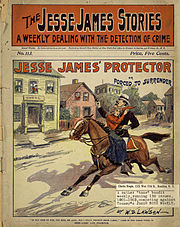
Jesse James dime novel cover

The Pinkerton Detective Agency was hired in 1874 to stop the James-Younger gang, and after numerous setbacks, Allan Pinkerton took on the case as a personal vendetta.  In 1875 he staged a raid on the James homestead and threw an incendiary device into the home.  It exploded, killing Jesse’s half-brother, and blowing off one of his mother’s arms.  This, more than any editorial, won public sympathy for Jesse James.  A bill granting the James and Younger brothers complete amnesty was narrowly defeated in the Missouri legislature.

Jesse married his cousin Zee in 1874, and two of their children survived to adulthood.  The downfall of the gang came in 1876, when they raided the First National Bank in Northfield, Minnesota.  All of the Younger brothers were killed or captured.  Only Frank and Jesse escaped.

Jesse tried to live quietly with his wife after that, in a home near St. Joseph, but he invited Charley Ford, a former gang member, to move in with the family for protection, and Charley brought in his younger brother Bob.  Both Ford brothers had been in contact with the governor of Missouri about his reward for Jesse, dead or alive.    One day, in 1882, as the three men were getting ready to leave for a robbery, as Jesse stopped to clean dust from a picture on the wall, Bob Ford shot him twice in the back of the head.

***

Memory, both individual and collective, is always mixed with imagination, increasingly so with the passage of time.  And if ours is not an era that treats the reputation of heroes well, at least we grasp human complexity.  Could Jesse James have been a loving father and a cold blooded killer and sympathetic to the poor?  Of course.  What was he really like?  We are never going to know, and besides, if there was a simple answer, I would not still be researching the legend and listening to the song.  Here is Pete Seeger’s version:

Barbara Allen – Mysteries in a Ballad

When I was six years old, my mother’s cousin, Junie, got married.  The two had been lifelong friends, and for the service, I was chosen to be the ring-bearer, and my sister, the flower girl.  That summer we drove from our home in upstate New York, to Kalamazoo, where Junie lived.  I’m happy to say that recently, Mary and I travelled to Oregon to celebrate Junie’s 50th anniversary.

Junie’s father, the uncle who later taught me to play poker, was a renowned surgeon and they had a beautiful house with a separate guest cottage on a bluff above Lake Michigan.  There were lots of adventures along the shore of the lake, like capturing a snapping turtle I recognized as such from my Pocket Guide to Reptiles and Amphibians, but one that stayed with me to the present day involved discovering a treasure trove of ballads.

The guest cottage had a box of old 78 recordings, and a book of lyrics and sheet music for a collection of American ballads.  There were two I listened to again and again because they haunted me with questions I didn’t understand then, and still can’t answer now.  The two were, “The Ballad of Barbara Allen,” and “The Ballad of Jessie James.”

Barbara Allen, which exists in as many as 92 versions, was first mentioned as “a little Scottish song” in 1666.  It came to our shores with the first settlers and was almost certainly popular well before the first printed versions appeared in England in 1750 and in America in 1836.  Barbara Allen is classified as Child Ballad 84.

In most versions, Sweet William lies on his death bed and sends his servant to fetch Barbara Allen, who reluctantly comes and says, “Young man, I think you’re dying.”  He says he is dying of love for her, but she will not have him, often because he bought a round of drinks for all the girls at the tavern a week before but not for her.  Sweet William dies of love for Barbara, and she dies the next day of sorrow.  Out of William’s heart there grows a rose and out of Barbara’s, a briar.  They grow and grow and finally form a lover’s knot above the graves.

The first thing you notice about this ballad is the lovely melody.  Then the haunting and tragic lyrics.  And then you realize it makes no sense.

Why is Barbara so cruel, I wondered as a kid and I wonder now.  Over a drink in the tavern?  Really?  I mean, really?  Even if, in that day and age, these kids were 14 or 15, and Barbara was a high school prima-donna, I’m not fully satisfied, and I bet you aren’t either.

And then you wonder, if William liked her so much, why did he buy drinks for all the girls except Barbara?  As in, “Dude, isn’t that playing a little too hard-to-get?”

There is also the mystery of Barbara’s change of heart and her subsequent death of sorrow.  I also wonder what real event or pair of star-crossed lovers might have inspired the song.

The supreme question, of course – and I chewed on this when I first heard the song at age six, is whether people really die of love?  Could it happen in the past, in simpler times, before eHarmony?   Especially for those like the Celts, who possess a genius for melancholy?

As a kid, I thought no.  Later, as a morose teenager, (I used to read Thomas Hardy for “fun”), I would have said yes, pining away is not that hard to believe.  As an adult, my response would have been, “Come on, William, get a grip.”  Now, from the Buddhist perspective of the ultimate power of mind, I would say, if you really believe you can’t live without a particular person, sooner or later it will come to pass.

This or that answer is not the point – the point is the questions.  I’ve recently been mulling over stories I have loved all my life, and so far I think they possess one of two qualities (or both) – one is characters I love so much they seem like a part of me, like Ratty and Mole.  The other is mysteries or questions I cannot solve.

Not surprisingly, I have collected quite a few versions of “Barbara Allen,” and this, by Emmy Lou Harris, I think is the best:

On Fairy-Stories by J.R.R Tolkien

Once in a while, I worry that I have said everything I have to say, that I have nothing left to blog about.  The mood hit yesterday, after I hit the “Publish” button, and it lasted a good 20 minutes.

Then I remembered that for the last three years or so, my battered and yellowing copy of The Tolkien Reader has been stashed in the software cabinet, along with CD’s for Office, Photo-Shop, and Quicken.  I have no idea why I put it there, but that’s where it stayed because I knew where it is was and it seemed as good a place as any.

When I say yellowing, I mean the pages of this book are really yellow:  it must be at least twenty-five years since I opened it, but I remembered Tolkien’s essay, “On Fairy-Stories” and had a look.

It was downright eerie to see how certain passages I had underlined decades ago are relevant to my present writing interests and concerns.  For instance, those who followed this blog in February will remember a three-part series I wrote on shape-shifters.  “The trouble with the real folk of Faerie is that they do not always look like what they are,” says Tolkien.

Tolkien asks what a fairy story really is and notes that it is not just a story about fairies.  It is also not a story for children, a connection he dismisses as a cultural quirk.  Fairy stories are, he says, “stories about…Faerie, the realm or state in which fairies have their being.”

Faerie lies beyond this world, in an intermediate realm, between the extremes of heaven and hell.  Tolkien quotes the ballad of “Thomas the Rhymer (Child #37) where the Fairy Queen shows Thomas three paths.  They will take the third, which winds into the unknown hills:

O see ye not yon narrow road,
So thick beset wi’ thorns and briers?
That is the Path of Righteousness,
Though after it but few inquires.

‘And see ye not yon braid, braid road,
That lies across the lily leven?
That is the Path of Wickedness,
Though some call it the Road to Heaven.

‘And see ye not yon bonny road
That winds about the fernie brae?
That is the Road to fair Elfland,
Where thou and I this night maun gae.

Analogies jump to mind:  the imaginal realm of Archetypal Psychology, the place of soul, between the physical world and the formless world of transcendent spirit.  The astral world of Hindu cosmology, described in detail in Paramahansa Yogananda’s Autobiography of a Yogi, which is far more subtle than physical reality, and far more dense than the realm of spirit.  I am not just being scholarly here, but trying to point to a key fact:  Faerie is analogous to the place of dreams and nightmares, of angels and demons, in old and new traditions around the world.  I could cite a lot more examples.

According to Tolkien, some our most primal desires lie in our fascination with tales of Faerie:  the desire for “the realization, independent of the conceiving mind, of imagined wonder.”  Another is “the desire of men to hold communion with other living things.”  And finally, we look to “the land of the ever young” in our longing to escape death.  And though we can’t pull that off in physical reality, Tolkien says that “fully realized” or “complete” fairy tales end with “imaginative satisfaction” of some of our deep desires.  They give us “a fleeting glimpse of Joy, Joy beyond the walls of the world, poignant as grief.”

I’d recommend this essay, written in 1939, especially to writers of fantasy literature, but to writers in general, for Tolkien has much to say about another primal desire, the desire to be a creator of worlds – “sub-creator” is the phrase he uses.

***

And finally I will end with some unexpected good news for Tolkien fans.  Today’s Sacramento Bee reported that filming of The Hobbit has started after numerous delays.  This will be a two year, two film project, directed by Peter Jackson, staring Martin Freeman as Bilbo, and also featuring Elijah Wood, Ian McKellan, Cate Blanchett, and Orlando Bloom.   Release of film number one is expected in late 2012.  Something else to look forward to for those who love to explore the world that Tolkien created.