James Hillman on world change and political polarization

James Hillman, 1926-2011

James Hillman, 1926-2011

For decades, James Hillman brought us unique observations on modern life from the perspective of a depth psychology that embraced soul as its highest value.  Recently, I’ve wished I could hear his take on our current climate of political divisiveness, but Hillman, who died two years ago at the age of 85, wasn’t here to watch our most recent shenanigans.  Happily, I recently stumbled upon a pair of interviews in which Hillman discussed this very subject and set it in a context of massive cultural change.

Author and journalist Pythia Peay published the first interview on The Huffington Post in February, 2011 (Jungian Analyst Explains the Psychology of Political Polarization).  The occasion for their talk was the mass shooting in Tucson, which had happened a month earlier.  The most prominent victim was Representative Gabrielle Giffords.

Tragically, memory of that event, just two and a half years ago, has been lost in the wake of more recent carnage, including the Nevada school shooting earlier this week.  Though Hillman’s comments focused on the role of political divisiveness in the attempt to kill a congresswoman, his additional statements now seem eerily relevant to the 12 year old in Sparks who was so alienated that he ended his life with murder and suicide.

Hillman began with a general discussion of polarized thinking.  “Polarity,” he reminds us, is an electrical engineering term.  Batteries have poles; the psyche is far more nuanced than that, dwelling in shades of gray rather than black or white.  Ideological extremes subvert our ability to judge individual issues on their merit.

When asked if violently polarized politics caused the shootings, Hillman changed the focus to another kind of cultural rigidity and its effect on the Tucson shooter:

“I think that this kid was made a loner by an American educational system in which there is no room for the weird or the odd…We need to have an educational system that’s able to embrace all sorts of minds, and where a student doesn’t have to fit into a certain mold of learning. Our educational system has become so narrowed to a certain formula, that if you go through a weird phase, you’re dropped out — often at the age of schizophrenia, 19-23 — and that’s the danger.”

Arguments in the wake of gun violence bog down in specifics, like background checks and how many bullets a magazine should hold – we don’t ask why and how we’re producing more and more people prone to mass violence.  In the end, says Hillman, for a culture that pays so much lip service to “the individual,” we are terrified of real individuality, and attempt to stamp it out.

In the second interview, America and the Shift in Ages, Hillman suggests that much of that rigidity has to do with futile attempts to shore up outmoded systems and institutions during a period of massive change.  Not just one but “three or four” myths that are central to our culture are collapsing.

Everything we fear has already happened said Hillman:  “The fragility of capitalism, which we don’t want to admit; the loss of the empire of the United States; and American exceptionalism. In fact, American exceptionalism is that we are exceptionally backward in about fifteen different categories, from education to infrastructure. But we’re in a stage of denial.”  Other beliefs and structures are crumbling as well, he said.  White supremacy, male supremacy, the influence of monotheistic religions, and the belief that we are “the good people.”

If such institutions do not appear to be in decay, it’s because they are so staunchly defended, and that, Hillman says, is a sign of their lack of vitality — “If they were vital they wouldn’t need to be defended. And the fanaticism we’re witnessing goes along with the deterioration of the vitality of these myths.”

Many of our fundamental beliefs are under scrutiny and need to be.  Hillman mentions the meaning of “freedom.”  For many, freedom means, “I can do any goddamn thing I want on my property; that I am my own boss and don’t want government interference; that I don’t want anybody telling me what I can and can’t do.”  This, he says, is the freedom of an adolescent boy.  What of the different kinds of freedom, such as “freedom from the compulsions to have and to own and to be someone?”  What of the freedom Nelson Mandela found in prison?

Hillman cites economic assumptions that need to be questioned as well.  Falling demand needs to be stimulated, according to current assumptions, but from an ecological point of view, that’s exactly what the world needs at this time.  Sustainability models, which may be our hope for the future, terrify those in positions of power.

Many of our current fears, says Hillman – from fear of immigrants crossing our borders, to fear of failing education, to fear of cancer, to economic insecurity, terrorists, and of course fear of “the other” political party, results from the lack of a wider framework in which to understand the massive shifts that are already underway.

There is no going back, but as obsolete structures crumble, we can glimpse, if we look, new forms emerging.  Hillman gave the example of a “Bioneers” conference he attended where Paul Hawken showed a film that was simply the names of individuals and organizations involved in trying to innovate ways of building communities, economic systems, and ways of dealing with the natural world.  Hawken said there were thousands of names, and the film could roll for weeks.

Hillman said it’s important not to try to fit emerging structures into the patterns of the past.  For our peace of mind, a new kind of faith is required:   “I think it’s a matter of being free-wheeling, and trusting that the emerging cosmos will come out on its own, and shape itself as it comes. That means living in a certain open space — and that’s freedom.”

Dawn over Oostende, Belgium, 2007.  Photo by Hans Hillewaert, CC-BY-SA-3.0

Dawn over Oostende, Belgium, 2007. Photo by Hans Hillewaert, CC-BY-SA-3.0

Such words are a fitting conclusion to the lifework of a man who lived in defense of Anima Mundi, the World Soul and who taught that animals, trees, and rivers are intelligent and alive, and that at some deep level of the psyche, we can hear their voices.  In Hillman’s life work, observation of the modern psyche led to conclusions that mesh with the myths of the ancestors.

A thousand years from now, people will read of our times and shudder, as we do in contemplating the rigors of life in the middle ages.  A few visionaries stood out from the rest, those like Saint Francis, Dante, and Leonardo, who pointed toward a more benevolent and expansive future.

We cannot write our own history, but we can wonder how it will look to those in the future.  I am convinced that James Hillman will be remembered when most of what passes for news on TV is blessedly forgotten.


Dreaming with animals

Bobcat, Folsom City Zoo Sanctuary - M.Mussell

Bobcat, Folsom City Zoo Sanctuary – M. Mussell

“What is the single greatest predictor of a hero’s success in folktales around the world?”

A professor who had studied the subject at length once posed that question in a psychology class. The answer, he said, was finding an animal helper. More than any other human or supernatural guide, an animal ally can lead the hero or heroine through trials and dangers to the end of their quest.

The professor was a friend and colleague of James Hillman (1926-2011) who loved animals and began collecting animal dreams in 1956.  Toward the end of his life, Hillman helped compile and update five decades of essays and lecture transcripts for a ten volume collection of his work.  Five volumes have been published to date, including Animal Presences, 2012, which I am currently reading.

Vixen the fox, Folsom City Zoo Sanctuary - M. Mussell

Vixen the fox, Folsom City Zoo Sanctuary – M. Mussell

After serving in the US Navy, Hillman studied at the Sorbonne, at Trinity College, Dublin, and in Zurich, where he received a PhD from the University of Zurich and an analyst’s diploma from the C.G. Jung Institute where he served as Director of Studies until 1969.  Versed in Jungian psychology, he charted his own path which he named “Archetypal Psychology.”  His first major work, Revisioning Psychology, 1975, was nominated for a Pulitzer Prize.

With 18 volumes in Jung’s Collected Works, and 10 in Hillman’s, it is clearly beyond the scope of a blog post to compare and contrast these two complex approaches to the depth psychology.  That said, several broad generalizations are possible:

Jung’s psychology can be characterized as “monotheistic,” aiming at a realization of the “Self,” as the supreme archetypal principle.  Jung understood the Self as “the God image within.”  Hillman, by contrast, called the psyche “polytheistic,” and considered the Self as simply one of many psychic centers within us.  Our nature, as we experience it moment by moment, is more like a pantheon of many gods than the kingdom of single inner supreme being.

As a corollary to these differing models of the psyche, development for Jung was often imagined as an ascent, a kind of upward climb toward spiritual clarity.  For Hillman, growth was often a descent, leading to contact with the “Soul,” which for him was more like the “soul” of a blues musician or an artist than the “immortal soul” of organized religion.

Hillman was also concerned with anima mundi, the soul of the world.  How can people be healthy when the world is ailing?  Hillman had little patience with ego psychologies that pretend human health is possible when our cities are blighted and we work in sterile, windowless offices bathed in florescent light?  As a result, his method of approaching dream and fantasy was unique.  He shunned methodologies that seek to aggrandize ego by asking what the figures of dream mean.  He insisted we treat the beings who visit us nightly with the same courtesy we would show to a guest in the waking world.

“the animals are right here. You have to be careful you don’t say something stupid because the animals are listening. You can’t interpret them; you can’t symbolize them; you can’t do something that is only human about them.”

Sage the wolf, Folsom City Zoo Sanctuary - M. Mussell

Sage the wolf, Folsom City Zoo Sanctuary – M. Mussell

“the image is the teacher. We have to endure a laboriously slow method of dreamwork…A dream brings with it a terrible urge for understanding. We want dreams decoded for their meanings. But the dream, like the animal in it, is a living phenomenon. It goes on displaying itself, pointing beyond itself to ever further interiority if we can hold back the hermeneutical desire so that the image can elaborate itself.”

“I am suggesting that the dream animal can be amplified as much by a visit to the zoo as by a symbol dictionary.”

Something within us mourns the animals missing from our lives.  We wear their pictures on t-shirts and sometimes collect little animal figurines.  We cherish domestic pets in ways that might seem bizarre to earlier generations who weren’t as estranged from the natural world.  We thrill at the sight of Coyote or Deer moving through twilight woods at the edge of the housing tract, and we mourn them dead on the road as we drive to work.

Sly the Fox, Folsom City Zoo Sanctuary - M. Mussell

Sly the Fox, Folsom City Zoo Sanctuary – M. Mussell

We are energized when animals visit our dreams – sometimes.  We’d rather they weren’t fierce, threatening, or slimy.  We prefer majestic and noble: an eagle, a dolphin, or wolf will do nicely. We’re not so fond of ants or mice, pigs or slugs, skunks or rats.

With the natural world in tatters, however, anima mundi is not dreaming of Disney creatures and love and light.  That’s all right.  Black Elk said the Lakota people knew every being has it’s place in the medicine wheel.  And if we don’t know what’s broken in ourselves and in the world, said Hillman, we don’t have the slightest idea of who and what and where we are.

Aiko the bobcat, Folsom City Zoo Sanctuary - M. Mussell

Aiko the bobcat, Folsom City Zoo Sanctuary – M. Mussell

What animals have recently come to your dreams?  What did they seem to want? Don’t remember any animal dreams? Just ask. If you mean it, if you are truly interested and repeat the suggestion until it brings results; if you prime the pump by leaving a notebook and pen you your bed stand, the creatures will visit.

They want to be heard and are looking for those who will listen.

Two views of the hero myth

In a recent post, I discussed heroes and anti-heroes in spy movies and westerns.  This is the followup post I promised, but I’m going to leave the realm of popular heroes – those of fiction, entertainment, sports, and all who wear masks and tights.  I’m going to discuss the heroes of myth, especially the “monomyth” as Joseph Campbell summarized it in The Hero With a Thousand Faces:

“A hero ventures forth from the world of common day into a region of supernatural wonder: fabulous forces are there encountered and a decisive victory is won: the hero comes back from this mysterious adventure with the power to bestow boons on his fellow man.”

Here is a graphic that makes the elements of this type of story clearer:

Heroesjourney

I can’t think of heroes without remembering James Hillman, (1926-2011), the father of archetypal psychology and one of the most creative thinkers of our time.  The two differing views of the mythic hero announced in the title of this post are Hillman’s own.  He never shied away from ambiguity; “I don’t have answers, I have questions,” he said.

James Hillman

James Hillman

Hillman often railed at the negative effects he saw flowing from the hero archetype, which he saw as ego enshrined as narrow self-interest, both individually and collectively.  For Hillman, the “heroic ego” was often a source of evil and mischief.  Noting that heroes slay dragons, and earlier generations of Jungians wrote of dragons as “the mother,” Hillman claimed that heroes like Hercules in Greek mythology were emblematic of the modern world’s subjugation of women, “the feminine,” and “mother nature.”  On another occasion he said, “Killing the dragon in the hero myth is nothing less than killing the imagination.”

Yet a recently published collection of Hillman’s work (Mythic Figures, 2012) includes a chapter on Joseph Campbell, compiled from talks he gave in 2004 in which he spoke at length of the positive hero.  He put his earlier negative comments in context:

“A mistake in my attacks on the hero has been to locate this archetypal figure within our secular history after the gods had all been banished.  When the gods have fled or were declared dead, the hero serves only the secular ego.  The force that prompts action, kills dragons, and leads progress becomes the Western ‘strong ego’ – capitalist entrepreneur, colonial ruler, property developer, a tough guy with heroic ambitions on the road to success.”

When Hillman used terms like “soul” and “the gods,” his concern was religious, but not in the way of the literal truths of most organized religions.  For Hillman, such literalism was the enemy of soul.  He spoke only and always of the truth of the psyche because it precedes every other kind of truth:  “Every notion in our minds, each perception of the world and sensation in ourselves must go through a psychic organization in order to ‘happen’ at all.” (Revisioning Psychology, 1977).

This understanding of the true hero in service to a Power greater ego prompted Hillman to revise his understanding of the “Father/Dragon/Ogre/King” the hero slays:

“A civilization requires the Ogre to be slain.  Who is the Ogre?  The reactionary aspect of the senex who promotes fear, poverty, and imprisonment; who tempts the young and devours them to increase his own importance.  The Ogre is the paranoid King who must have an enemy.  He is the deceitful, suspicious, illegitimate King whose Nobles of the Court [have] committed themselves to the enclosed asylum of security where they nourish their world-devouring megalomania.”

St. George and the Dragon by Paolo Uccello, ca. 1458

St. George and the Dragon by Paolo Uccello, ca. 1458

I think we know what he meant in 2004 by speaking of “paranoid kings” whose nobles live in “the enclosed asylum of security.”  It has only gotten worse. How desperate the Ogre is to quash any budding heroes was revealed in a piece on August 19 on Time.com, “School Has Become too Hostile to Boys,” by Christina Hoff Summers.  Three seven year old boys, in Virginia, Maryland, and Colorado, were recently suspended from school for the following acts:

  1. Using a pencil to “shoot” a “bad guy.”
  2. Nibbling a pop-tart into the shape of a gun.
  3. Throwing an imaginary hand grenade at “bad guys” in order to “save the world.”

The rationale for these suspensions were “zero tolerance for firearms” policies.  Punishing pop-tart weapons in a culture that went on a gun buying binge in the wake of the Sandy Hook shootings seems too ludicrous to believe unless you see it from Hillman’s perspective – another step in the dragon’s war on imagination, in this case, the male imagination, the perspective from which most of our current hero myths derive.  Along with banning snack food guns, such schools have renamed “tug of war” games as “tug of peace,” and halted dodge ball as too violent.

Fortunately, as Christina Hoff notes, such efforts to “re-engineer imagination” are doomed to fail – all they will do is “send a clear and unmistakable message to millions of schoolboys: You are not welcome in school.”

In We’ve Had a Hundred Years of Psychotherapy and the World is Getting Worse, 1993, Hillman made clear his belief that pathology lies in cultures as well as individuals, and we deprive the world of something when we take our rage and our grief exclusively to the therapist.  Hillman never shied away from critiques of the world at large.  Depression is “an appropriate response” to the world we live in, he said.

Yet stronger than the Ogre, said Hillman, is the myth of the Hero – not this or that particular hero, but the heroic pattern itself that Joseph Campbell restored for our times, which renews culture “by revivifying the archetypal imagination displayed by peoples the world over…The panoply of materials that Campbell catalogued shows that the hero wears a thousand faces and cannot be reduced to the modern ego.  Especially important in recognizing him is recognizing the heroic liberating function of myth – that it speaks truth to power, even the Ogre’s power.”

We know from history and the nightly news how much suffering the decay of empires involve as paranoid kings strive desperately to hold on to power.  We also have the examples of James Hillman and Joseph Campbell, who spent their lives pointing toward soul, psyche, and the language of myth and imagination.  That is where we must look to find the larger truth – the hero brings the gift of renewal as surely as spring returns after the darkest time of the year.

Some blog reflections and an anniversary

830434-snoopy_large

I posted my first article here three years ago today – I thought it was the 30th until I looked it up a little while ago. There are more pressing dates to remember in June – our wedding anniversary for one, and the dog birthdays, but this occasion brings to mind some things I discovered that first summer of blogging.

A few days before my first post, I attended an all day blogging seminar hosted by the local branch of the California Writer’s Club. The teacher had an unusual qualification – he actually made a good living as a blogger.  He did this by running eight different blogs on eight different topics which gained him 50,000 – 80,000 hits a month.

Beyond passing along the mechanics of WordPress, the seminar was geared toward his approach, which aimed at drawing advertisers and eyeballs.  At first I tried to follow his rules, ones like “Posts should run between 150-250 words in length.”  I still mostly aim for the 150 minimum – I trust his research suggesting that Google’s search algorithms favor messages at least that long, but I’ve tossed almost all his other rules.  I did so because something unexpected began to happen  – blogging took on a life of its own.

I’d taken the seminar for the worst of reasons.  I had finished one novel and started another, and I fell prey to the notion, passed around in writing groups and magazines, that aspiring writers should migrate to social media “to build their platforms.”

From the start, this advice reminded me of something annoying that periodically happened in my technology day job.  During cyclical downturns, when vertical mobility dried up, upper management would dream up busy-work tasks, like “write a five year career plan.”  Given the dizzying pace of technological change, almost any kind of five year plan seemed like a joke.  Fortunately, my supervisor agreed, so I’d email him something like, “My plan is to still have a job in five years,” and he’d mark it “Done.”

Once the blogging door started to open, I did something similar with the concept of “platform:” borrowing the tech concept of “just-in-time inventory,” I decided to wait until I needed one!

That may be a long wait, as it turns out, because the “blogging door” was a new entryway into writing-as-a-way-to-discover-things.”  That was a door I’d let close on my fiction, because of inexperience more than anything else.

When I started my first novel, during a sabbatical from work, I would sometimes jump up at 5:30am, wide awake.  “I wonder what’s going to happen today?”  Later I realized the first novel was a mess, though I loved every minute of writing it.  I joined groups, attended seminars, and devoured how-to-articles.  Somewhere along the line, my stories stopped being mine.  Once I knew what was going to happen on any particular day, I was no longer interested.

The blogging door remains open.  Here I make new discoveries, surprising myself, and never know for sure where it’s going today.  I also get to share the amazing discoveries of others, like the post I re-blogged last week in which Kristen Lamb presents a simple but powerful way of keeping the doors of discovery open in fiction (Write FAST and Furious).

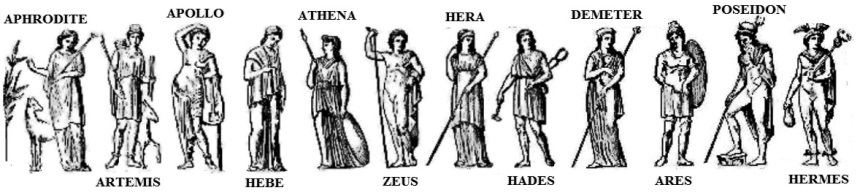
I enjoy many blogs that have a singular focus, and this week of milestones, I found myself recalling the words of that first blogging teacher, who advised that this is the only way to go.  I entertained the notion for maybe 60 seconds.  It simply wouldn’t work for me, a poster boy for the late James Hillman’s concept of “the polytheistic psyche.”

Hillman often used the Greek pantheon to illustrate his concept of the "polytheistic psyche"

Hillman often used the Greek pantheon to illustrate his concept of the “polytheistic psyche”

As Michael Ventura, a journalist and friend of Hillman’s put it:  “For too long Western thought has mistaken the impulse to unify for the entity itself (the psyche) that needs such an impulse because of it’s very multiplicity.”  

Ventura also said, “If you are the only one in the room, it is still a crowded room.”

***

In the beginning, I called this blog, “thefirstgate,” singular.  I discuss the source of the name, the opening of T.S. Eliot’s The Four Quartets, in my About page.  Then, as I discovered there are other interesting “first gates,” I made the name plural, and even registered the domain name, firstgates.com.

In the Spring of 2012, I received a notice that a similar domain name, thefirstgate.com (singular) had become available, and I could buy it.  I did so, and since then, I’ve played with the notion of changing the name to emphasize my original inspiration.

I began this post, intending to announce a change to the singular form.  Then I came upon this passage in Michael Ventura’s Shadow Dancing in the USA, 1985 (out of print).  Here he describes the theory of “the polytheistic psyche:”

“…the notion that we have not a single center, but several centers; that each of these centers may act independently of each other; and that each center has in turn various active aspects, or shadings; and that all these centers are unified more by an atmosphere, an overall mood and rhythm, than by anything as solid as…an ego.”

No way, after reading that, could I surrender an ounce of multiplicity!  So on the occasion of this anniversary, I will predict more of the same – not knowing quite what I’m going to say when I sit down to write.  False starts and dead ends on occasion, but hopefully, ongoing and interesting surprises for all of us.

One Nation Under Stress

The title of this post comes from a new book reviewed on NPR, One Nation Under Stress:  The Trouble With Stress as an Idea, by Dana Becker, PhD.

According to Dr. Becker, “stress” is a recent concept.  The first article on stress in the New York Times was published in 1976.  The first diagnoses of “nervous disorders” or “neurasthenia,” came from the work of Dr. George Beard ca 1869.  In the NPR interview, Becker says that physicians of the time considered “American nervousness” to come from outside factors, related to the increasing pace of life after the civil war.  “Stress,” as we understand it today, is the polar opposite.

Now we have internalized stress, focusing on the risks to our health and the ways we should cope with it, through diet, exercise, yoga, and so on.  Our experience of stress derives from our ideas of stress, Becker says.  The internal emphasis on health is necessary, but we let it divert us from questioning the external causes of stress.  She gives an example in the NPR interview: many articles are written to help working mothers cope with stress – far fewer are written about the need for affordable daycare.  We may eat kale and do yoga to survive the 24/7 world, but we seldom ask why this is the norm and what the alternatives are.

This argument echoes a major concern of James Hillman, who I frequently write about here.  Though he was once Director of Studies at the Jung Institute in Zurich, in 1992 he co-authored a book called We’ve Had a Hundred Years of Psychotherapy and the World is Getting Worse.  In it, he said:

“Every time we try to deal with our outrage over the freeway, our misery over the office and the lighting and the crappy furniture, and the crime in the streets, whatever – every time we try to deal with that by going to therapy with our rage and our fear, we deprive the political world of something.”

In her NPR interview, Dana Becker presented a balanced view of stress – it’s fine to treat the symptoms, which are personal, as long as we don’t gloss over the underlying causes, many of which are not.  The promise of new view of a modern ailment is enough to put One Nation Under Stress near the top of my “to read” list.

Scott Fenstermaker’s blog, “People-Triggers,” aims to “Understand what makes us do what we do.” In a fine article called, “The Personal Myth,” Scott explores some recent research on the importance of the stories we tell ourselves in shaping and creating our experience of self and world. “People who come out of psychotherapy testing higher on well-being indicators tend to tell similar personal stories with themes of conquered demons and redemption.The newer story may be no more factually true than the old, because all personal stories are fables, but the newer version is healthier.” In 1983, James Hillman wrote Healing Fictions, a book with a similar argument. This article quotes and links to some up-to-date research emphasizes the importance of the “screenplays” we’re always composing in our heads.

peopletriggers's avatarPeople-triggers

“It ain’t so much the things we don’t know that get us into trouble, it’s the things we do know that just ain’t so.” —Mark Twain

MythsSome (very reputable) psychologists are absolutely convinced that DNA is destiny. Other (very reputable) psychologists are convinced that your personality is shaped by what happens to you as an infant – or perhaps even in the first few minutes of life. This is what I love about psychology: the theories are all over the map and yet somehow everyone is still credible.

One very interesting dimension to personality has to do with the stories that we tell ourselves. Research has increasingly revealed that our personal life stories – our mental self-narratives – contribute substantially to our personalities and behaviors. An excellent New York Times article from 2007 summarizes much of this current research.

As the interpreter of our world, the mind is very…

View original post 707 more words

Notes on Imagination and James Hillman

Here’s my dilemma:  it’s impossible for me to write about imagination without mentioning James Hillman.  Yet every time I’ve started a post on Hillman, I’ve given it up because the scope of his thought and writing, over almost 50 years, is just too vast.  Hillman died last October at 85 and a two volume work on his life and thought is underway.  Two volumes might not be enough.  So what can a blog post accomplish?  We are about to find out.

James Hillman

Three days after Hillman’s funeral, his friend, Thomas Moore, wrote, “James’s many books and essays, in my view, represent the best and most original thought of our times. I expect that it will take many decades before he is truly discovered and appreciated.  He changed my life by being more than a mentor and a steady, caring friend. If I had to sum up his life, I would say that he lived in the lofty realm of thought and yet also like one of the animals he loved so much. He was always close to his passions and appetites and lived with a fullness of vitality I have never seen elsewhere. To me, he taught more in his lifestyle and in his conversation than in his writing, and yet his books and articles are the most precious objects I have around me.”

Hillman, who served as Director of Studies at the C.G. Jung Institute in Zurich, will be remembered with Freud and Jung as one of the most original psychological thinkers of the 20th century, yet his appeal may be greater outside that discipline than it is with traditionalists in it.  He never pulled his punches.  In 1992 he co-authored, We’ve Had a Hundred Years of Psychotherapy and the World is Getting Worse.  In an interview published a year earlier, he said:

“By removing the soul from the world and not recognizing that the soul is also in the world, psychotherapy can’t do its job anymore. The buildings are sick, the institutions are sick, the banking system’s sick, the schools, the streets – the sickness is out there. … The world has become toxic. … There is a decline in political sense. No sensitivity to the real issues. Why are the intelligent people – at least among the white middle class – so passive now? Why? Because the sensitive, intelligent people are in therapy! …Every time we try to deal with our outrage … by going to therapy with our rage and fear, we’re depriving the political world of something. And therapy, in its crazy way, by emphasizing the inner soul and ignoring the outer soul, supports the decline of the actual world.”

Let me say it again:  those statements were made in 1991.

During the late 80’s, Hillman joined Robert Bly and Michael Meade in presenting a series of conferences exploring the myths and archetypes of the male psyche.  Bly’s, Iron John came out of that work, as did Hillman’s and  Meade’s concern with the genius within, (see my previous post).  This was the subject of Hillman’s, The Soul’s Code, 1997, the first and only one of his books to become a bestseller.  In it, he suggested we come into the world with a calling or destiny, the way an acorn carries the pattern of a mature oak.  Our mission in life is to realize this deeper purpose.

***

An editor once rejected an articles of Hillman’s, saying it would set psychology back three-hundred years.  Hillman said that was exactly what he was trying to do.  Soul and soul-making were his constant concerns, but not as the words are used in modern terms.  He often quoted Keats who said, “Call the world if you please, ‘The vale of Soul-making.’  Then you will find out the use of the world…”  He also repeated a fragment of Heraclitus, “You could not discover the limits of the soul, even if you traveled every road to do so; such is the depth of it’s meaning.”

Hillman did more than offer poetic metaphor; his goal was nothing less than a return to an earlier, three part formulation  of the human person, embraced by the ancients but lost to modernity.  People in earlier times conceived of soul as an intermediate faculty that inhabits an imaginal realm between the physical world of body and the disembodied heights of pure spirit.  Imaginal not imaginary, a disparaging term which suggests that soul, vision, dream, and myth are not real.  In his key work, Revisioning Psychology, 1975, he said:

“First, ‘soul’ refers to the deepening of events into experiences; second, the significance soul makes possible, whether in love or in religious concern, derives from its special relation with death.  And third, by ‘soul’ I mean the imaginative possibility in our natures, the experiencing through reflective speculation, dream, image and fantasy – that mode which recognizes all realities as primarily symbolic or metaphorical.”    

Another key point Hillman makes is the primacy of image in the life of the psyche:  Speaking of Jung he says:

“He considered the fantasy images that run through our daydreams and night dreams, which are present unconsciously in all our consciousness, to be the primary data of the psyche.  Everything we know and feel and every statement we make are all fantasy-based, that is, they derive from psychic images….Every notion in our minds, each perception of the world and sensation in ourselves must go through a psychic organization in order to ‘happen’ at all.  Every single feeling or observation occurs as a psychic event by first forming a fantasy-image.” 

***

At the start of this post, I wondered what I could say in a brief article about a prolific and protean thinker like James Hillman.  Inspire someone to learn more, I hope.  A good place to begin is A Blue Fire, a collection of key writings, edited by his friend, Thomas Moore.

Here are some noteworthy links:

The New York Times obituary:  http://www.nytimes.com/2011/10/28/health/james-hillman-therapist-in-mens-movement-dies-at-85.html?_r=1

“On Soul, Character, and Calling” by Scott Landon, published in The Sun, July, 2012: http://www.scottlondon.com/interviews/hillman.html

A tribute by his friend, Michael Ventura, a journalist, who asks, “What do you say about an intellectual genius who learned to tap dance in his 60s?”   http://www.austinchronicle.com/columns/2012-01-13/letters-at-3am-james-hillman-1926-2011/

A remembrance by Thomas Moore: http://www.huffingtonpost.com/thomas-moore/james-hillman-death_b_1067046.html

I have more to say, but this is enough for now.  I’ll end with a message Hillman sent to his friends during the last few weeks of his life, when he finally became too ill to work:   

“I am dying, yet in fact, I could not be more engaged in living. One thing I’m learning is how impossible it is to lay out a border between so-called ‘living’ and ‘dying’.” 

I think Moore is right – it will take decades to fully appreciate the scope of Hillman’s life and work, but there’s no reason not to begin right now.

Go I Know Not Whither, Bring Back I Know Not What – Part 2

We left Fedot standing outside a tall mountain at the end of the world.  The ancient frog who had been his companion couldn’t carry him further, but she was able to tell him how to proceed.  She advised him to enter a cavern, hide himself, wait for two men to appear, and do exactly what they did.

Everything happened as the frog foretold.  Two old men entered the cavern and called out, “Shmat Razum!  Come and feed us.”  Light blazed from candelabras, a feast appeared at the table, and the two men ate their fill.  When they were done, they cried, “Shmat Razum, take it all away.”  The feast disappeared and the lights went out.

When the men left, Fedot called “Shamat Razum, give me some food.”  Instantly a feast appeared.  Then Fedot did something exceptional.  He said, “Shamat Razum, come, brother, and sit down with me, let us eat and drink together. I can’t stand eating alone.”

The spirit – for that is what he was – thanked the hunter and told him the old men had never once asked him to share a meal in the 30 years he had served them.  Fedot said, “Come and serve me.”  Shamat Razum agreed and they left the cave together.

All along, Fedot has shown two attributes that will save him, qualities that are keys to success in many fairy tales.  Courage and conventional strength are not enough.  First in importance, Fedot is willing to listen to all “the spirits,” all the creatures who offer help and advice.  He also treats them courteously, as welcome guests and friends.  It makes little difference whether we call them spirits or archetypes.   Through his long career, James Hillman, the post-Jungian founder of Archetypal Psychology insisted we treat the figures in our dreams and fantasies with the same respect we would show to any flesh and blood visitor.

In modern terms, Fedot’s journey leads him steadily into the deeper layers of psyche.  His dove-woman wife is closer to the human realm than her mother, and her mother is closer  than the frog.  More distant from everyday life than any of them is Shamat Razum, a spirit whose nature and shape we never know, even though Fedot calls him, “brother.”  These are the critical characters of the story – the only two who are named.  Shamat Razum is the “I know not what” of the story’s title.  Through the rest of the tale, Shamat Razum manifests many qualities.  He is prophetic, he is a spirit of wind and air, and above all, he is a trickster.  The myths of many indigenous groups begins with a trickster who is their world creator.  For some Native American tribes, history begins when Coyote dives into the ocean to bring up the soil to make land.  No spirit is more fundamental.

Fedot and Shamat Razum leave the frog with the mother-in-law and journey on toward Fedot’s home.  When the hunter says he’s too tired to walk, his spirit brother picks him up like a strong wind and carries him through the air.  Shamat Razum finally stops at a small island where he lays out a scam to steal some magical implements.

“Three merchant vessels will sail by and stop at the islet,” he says.  “Thou must invite the merchants hither, hospitably entertain them, and exchange me for three wondrous things which the merchants will bring with them. In due time I will return to thee again.”

The two of them pull off their con job, reminding one of Hermes / Mercury, the classical trickster god, who is also the god of thieves.  We’re not in a world of classical heroes – no knights in shining armor.  Fedot’s life depends on letting go of illusions like that.  Shamat Razum has foreseen that the king will meet him with treachery, so he helps Fedot cheat the merchants out of objects that allow him to raise an army and navy.  In the final battle, Fedot’s kills the king and scatters his troops.  The people choose Fedot and his wife, who was hiding in the forest as a dove, to be their king and queen.  Together they rule the land with “wisdom, peace and grace.”

<

p style=”text-align:center;”>***

James Hillman once said, “If we had more stories when we were young, we’d need fewer therapists as adults.”  In his PBS series on myth, Joseph Campbell showed millions of viewers the treasures of wisdom that hide in old tales.  So what do we make of  Go I know not wither?

I think we have to approach interpretation with something like the courtesy with which Fedot meets the spirits.  In stories that are alive for us, we don’t start by asking what things mean.  We don’t ask what hobbits signify, or what part of the psyche orcs represent.  If someone has written a dissertation on Batman and the Riddler, I’m in no hurry to read it.  Older tales, like this one, are far enough removed in time and space that they’re not alive for us in that sense.  I think it makes sense to ask what it means – carefully.  Everyone has a right to their own answers.  Here are some of mine.

I look at this tale from the point of view of transition points in our lives.  When life and excitement drain from what we are doing, what then?  I believe this story suggests we listen to the small creatures of dreams and fantasy.  That we ponder the little impulse, the little whisper, the voice that says, “Wouldn’t it be nice to…?”  It means not giving in right away to our “rational” voices, the ones that say we have no time for such nonsense.

In speaking of “voices” we’re not talking of taking these things literally.  James Hillman insisted that literalism is the enemy of a soul-centered life, and Fedot does not wind up on a street corner, talking to imaginary friends.  According to St. Paul, the ability to “distinguishing between spirits,” is a gift from God ( 1 Cor 12:10), yet one that people like Campbell suggest we can learn to some degree.  Simply exploring and thinking about old stories, or keeping a dream journal, are ways to begin.

It’s a good bet that the answers we find, the paths we are shown, will not be ones we expect.  Shamat Razum, the way-shower, is a trickster, as hard to pin down as the wind.  If the answers to the turning points in life we’re easy to find, stories like this one would not have told for generations.  Carl Jung once said, “We make all the important decisions in life on the basis of insufficient information.”   Hearing the old tales and listening to imaginal voices may be one more way of getting a clue.

I welcome the comments of anyone who has read this far.  What did you make of this story, and what of you make of old tales in general?  Do you have any favorite collections or authors on the subject?  Please take a moment to post them and leave your impressions.