The Golden Raspberry Awards

I enjoyed the Academy Awards on Sunday night. The nominations and the winners made sense.  On Monday morning, however, I read the rather sad story of a once-celebrated director’s fall from grace.

The night before the Oscars, the Golden Raspberry Foundation announced its Razzie awards for the “worst of” filmmaking in 2010.  Making a pretty complete sweep was M. Night Shyamalan, who was singled out as worst director of the worst movie, The Last Airbender, based on the worst screenplay, which he wrote.

Shyamalan wowed audiences and received six Oscar nominations, including Best Picture and Best Director in 1999,  for The Sixth Sense, starring Bruce Willis as a psychiatrist who, in the course of the movie, discovers he was murdered.  Willis plays opposite Haley Joel Osment, the boy who famously says, “I see dead people.”  The following year, Shyamalan worked with Willis again, and with Samuel L. Jackson, to make Unbreakable, which also received positive reviews.

The director’s career has gone downhill from there, both in terms of critical reviews, and in my own reaction to the two other movies of his I have seen.  What went wrong?

The next Shyamalan movie I saw, The Village, 2004, begins with an engaging premise:  the people in an isolated 19th century village live in fear of a race of beasts that roam the surrounding forest.  After a child dies, Lucius Hunt (Joaquin Phoenix) asks the village elders for permission to pass through the forest to “the towns” for medical supplies, but his request is denied.  The beasts paint the doors of village cabins with blood as a threat and warning after Lucius makes a short foray into the forest.

The beautiful Ivy Walker (Bryce Dallas Howard), blind daughter of the chief elder, becomes engaged to Lucius.  When he is stabbed by a rival, the prognosis is dire:  Lucius will die without medicine.  Ivy begs her father, Edward Walker (John Hurt), to allow her to go to the towns.  He agrees, against the wishes of the other elders.  Before she leaves, he reveals a secret:  the monsters do not exist.  They are a fabrication created by the elders to frighten children so they will not enter the forest.  Yet when Ivy ventures into the woods alone, a beast attacks her.
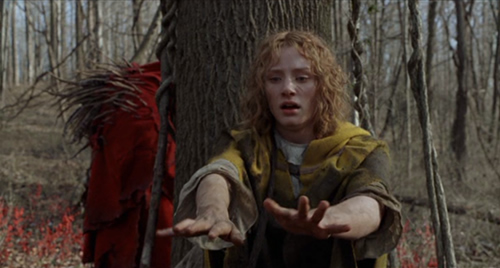
Ivy Walker and monster in The Village

So far so good. We are well into the movie and gripping our seats, but then, Shyamalan’s penchant for twists runs amok. Ivy manages to escape the beast, who turns out to be the boy who had stabbed Lucas, wearing a monster suit.  Ivy comes to a concrete wall, finds a handy ladder nearby, climbs up and over and winds up at the edge of a highway where a ranger in an SUV picks her up, looks at the list of needed medicine her father had written out, gets it for her (they have a bit of trouble), then helps her back over the wall with a warning to be careful.

We learn that the village elders are actually refugees from the culture of violence in America, who bet their lives and livelihoods on the grand experiment of trying to raise a peaceful generation in a peaceful agrarian culture.

You can check out the theme and logic behind the events at http://en.wikipedia.org/wiki/The_Village_(2004_film), but from my perspective, these elements were buried in a flawed story, one that would never ever, ever, ever, ever – as in, no way – have gotten past the the two writing critique groups I sit with.  In other words, not even the least experienced among us would get away with the plot flaws that pepper Shyamalan’s screenplay.

That, I believe, is the key to the disappointing trend of this director’s movies.  He tries to do it all – write the screenplay and direct the movie, and his early success must have isolated him from, or deafened him to, the collaborative voices that could have asked questions that should have been posed before the first scene was shot.

Questions like why Ivy’s father, a seemingly decent and caring man, would let his blind daughter brave the woods and the modern world alone?  And if simple antibiotics could save his future son-in-law, the town golden boy, why wouldn’t he just go out and get some.  And no matter how large his personal fortunre, (see the wikipedia page), who on earth is going to believe he could have bought secrecy for an entire village?  We’re supposed to believe that Homeland Security hasn’t studied the satellite photos in a post 9/11 world?

Contemplating this set of Razzies, I was struck with a deep appreciation for the members of my critique groups and all of their comments – those that seem pertinent and those that don’t.  They help keep me honest.  These are not the “discouraging words” I mentioned in my previous post.

Discouraging words sound like this:  You can’t.

Good criticism from people who value each other’s efforts sounds very different:  You can, and here are some ideas on how to proceed.

And The Winner Is: Some Excellent Oscar-Related Resources

Here are some very neat Academy Award links for writers, thanks to the folks at the Gotham Writer’s Workshop, http://www.writingclasses.com/mailing.php?id=2008.  There are hoopla links to articles in Variety and the New York Times, links on books compiling the history (and “secret history”) of the Academy Awards, as well as info on Gotham’s online courses in screenwriting and writing for TV.  (Note:  I have not taken any of their courses so I cannot comment on them one way or another).

What I appreciated most is the list of Academy Award winning screenplays from 1928 to the present.  Quite a few have links to PDF files you can click on and study:  http://www.simplyscripts.com/oscar_winners.html.  Those who have followed this blog know I am a huge fan of screen-writing, and though I do not (yet) aspire to do it, I can think of few better places to study plot structure.

Speaking of which, I happened on a great quote on the difference between story and plot from E.M. Forster’s, Aspects of the Novel:

A story is a narrative of events arranged in their time sequence.  A plot is also a narrative of events, the emphasis falling on causality.  “The king died, and then the queen died” is a story.  “The king died and the queen died of grief” is a plot.

I’ll be out of town for much of Sunday, but I hope to make it back in time for the awards.  This year in particular, I’m interested in some of the movies, writers and actors.

The King’s Speech

I confess that despite the academy award nominations and four-star reviews, I wasn’t really looking forward to The King’s Speech.  In the back of my mind was the thought – “Come on – a full length movie about stuttering?”  The first two minutes of the film changed all that as the genius of Colin Firth and Helena Bonham-Carter pulled me into the pain this affliction brings to sufferers.  There are certain expressions you never forget in the movies, but I cannot recall such expressiveness, such anguish conveyed with so much restraint.  For an actor of the calibre of Firth, a glance or a momentary twist of the mouth can speak volumes.

Firth plays Prince Albert, the Duke of York, second son of King George V, and father of the current Queen Elizabeth.  As the film unfolds we glimpse the life-long pain “Bertie” has experienced – the badgering of his father and brother, and the failure he experiences at every “minor” address he cannot avoid.

Out of sheer desperation, Bertie seeks the help of Australian speech therapist, Lionel Logue (Geoffrey Rush) – and none too soon, for history is about to raise the stakes to a higher level than most of us ever have to experience.  His father’s death and his brother’s abdication leave Albert no choice but to ascend to the throne as King George IV.

“I am not a king, I am not a king,” Bertie cries again and again in the most moving scene of the film.  “I’m just a naval officer!”  But a king he must become in a hurry.  In the climactic scene of the film, he has to address his subjects all over the world when war breaks out with Germany.

Bertie and Logue on their long walk to the radio room made me think of Frodo and Sam on their final ascent to Mt. Doom, and why not?  Both are stories of people who feel completely inadequate to the demands of their fate, but who find the strength to act for their own salvation and that of their nation.  The difference, of course, is that these events really happened.

Camelot and the Wild West

Last Sunday, after the Bears lost, I was working on one of my western movie posts. Mary switched channels and I looked up to catch the conclusion of First Knight, starring Sean Connery as King Arthur and Richard Gere as Lancelot. Several thousand light bulbs went on as I watched and realized the old west and Arthur’s Britain are territories of legend with much in common.

Duel to the Death by N.C. Wyeth

Both the old west and the Arthurian forests are places where legend fills in all we do not know.  Where there be dragons, there also is imagination.  We populate these realms with our angels and demons, and yet the settings are of this world, as opposed to outer space or Middle Earth.  You can visit Tombstone or Glastonbury.  Most historians agree there really was an Arthur of Britain who held off the Saxon invaders after the Roman legions left.  We know that Wyatt Earp, George Custer, and Calamity Jane were as real in their time as we are now.

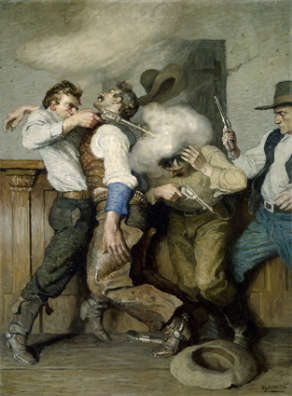
Gunfight by N.C. Wyeth

I suspect that most of the tales we love of both knights and cowboys are hero journeys, in the classic sense outlined by Joseph Campbell. In his PBS series, The Power of Myth, Campbell said that when they left to search for the Holy Grail, each knight picked his own place to enter the forest – to follow the path of another would have been shameful.

That same ethic frames a number of westerns, and is historical fact in the case of the the mountain men.  Several kept articulate journals describing the yearning that moved them leave “civilization” behind to see what lay beyond the next ridge.

I do not want to belabor the point, but Pothos, the yearning for the unobtainable, was actively cultivated as a virtue in the courtly love ethic celebrated by the troubadors and in the stories of Cretien de Troyes.  Just like modern film directors, Cretien was writing about an era that was gone in his time, but inspired dreams we still share today.  Be it John Ford or Peckinpah, I’m a sucker for a good western, just as I love stories of the knights of old, from Mallory to Monty Python.

***

There is one huge difference between the world of Arthurian legend, and the world of the western – and by extension, the 21st century world we all inhabit.  When the knights entered the forest on their solitary quest, they knew what they were trying to save – Camelot – and they knew what they were trying to find – The Holy Grail.  These legends grew from a world that in reality was probably more brutal than the west of any of Sam Peckinpah’s westerns, and yet from all accounts I have read, this was a world where ultimate certainties were not in doubt.

For us the entrance into the forest or desert is a little darker, for we don’t even start with the same certainty that what we are after exists.  Still, in one account Joseph Campbell quoted, the Holy Grail, was never the same for any two people.  It changed to give each what their heart desired.  A very contemporary Grail!  If we don’t start out with a clear idea of what we are looking for, well I don’t think the knights of legend really did, or the people who climbed onto a covered wagon.

***

And finally, though lists always leave something to be desired, here is a pretty decent NPR list of classic and important westerns, from Stagecoach to Brokeback Mountain, to the new True Grit.  Happy Trails!

http://www.npr.org/blogs/monkeysee/2011/01/13/132905247/git-along-little-dogies-a-western-starter-kit/

McCabe and Mrs. Miller

I had planned to discuss Robert Altman’s McCabe and Mrs. Miller (1971), in the same vein as my earlier discussion of True Grit and Pat Garrett and Billy the Kid, but after wrestling with the post for two days, I realized this film does not fit both of the characteristics I was trying to understand in the others, characteristics I said made them memorable beyond the confines of genre.

Awareness of the nearness of death is there all right – in fact there are few movies in any genre where life is cheaper, as shown in the scene where a hired killer shoots a naive cowboy for target practice.

What is missing is that yearning-for-what-we-cannot-name, an unrequited longing that I called by its Greek name, Pothos.  The characters in McCabe never get that far.  They can’t even satisfy their basic yearnings for livelihood, dignity, love, and survival.

Warren Beatty and Julie Christie in McCabe and Mrs. Miller

Some of the modern directors who brought us the western anti-hero and a new and darker vision – people like Sam Peckinpah, Sergio Leone, and Clint Eastwood – nonetheless loved the genre and set about transforming it rather than trashing it.

Altman sought to use the western genre to make a point.  The year before, 1970, he had used the setting of the Korean war in MASH to reveal the damage modern warfare does to the human soul.  In McCabe and Mrs. Miller, he uses the western genre to make a similar statement about large corporations and unbridled capitalism.  He called the movie an anti-western and set out to dismantle the myths.

John McCabe (Warren Beatty) is a gambler and would-be entrepreneur with an undeserved reputation as a gunfighter.  Constance Miller (Julie Christie) is an opium addicted madam.  They form a business and later a romantic partnership to open a high class brothel in Presbyterian Church, a mining camp named for its largest and least used building.

The brothel is so successful that representatives of the Harrison Shaughnessy mining company arrive to buy the pair out.  Not understanding that this is “an offer he can’t refuse,” McCabe holds out for more.  The company sends three hired killers to get rid of him.

Terrified, McCabe is able to shoot two of the men in the back from hiding (remember, this was 1971, the Bonanza era, the middle-of-the-street, “Draw, padnah,” era of fairplay in gunfights).  He kills the third man but is mortally wounded.  In the final scene, McCabe lies dying in the snow while Christie lies in a haze of smoke in an opium den.

That’s it.

I tried for two days to find something moving and uplifting in the film, and there is really nothing except the lyrics of three Leonard Cohen songs on the soundtrack.  In the opening scene, as McCabe rides into town, Cohen sings, “He was just some Joseph looking for a manger.” If true, that would have lifted McCabe’s story to the level of tragedy, offering some form of  catharsis, some purging of our emotions by terror and pity, but I don’t think it happens here.  Nothing is purged.  Our negative emotions stay with us as they do after a bad episode of the six o’clock news.

McCabe and Mrs. Miller is an important western in the history of the genre.  It is an unforgettable western and a haunting western, but not for the same reasons as the others I have been considering.

NEXT:  A Meditation on the Wild West and Camelot


Pothos in Westerns 2: Pat Garret and Billy the Kid

Sam Peckinpah was 48 when he directed Pat Garrett and Billy the Kid. His health was failing after too many years of drug and alcohol abuse; a documentary I saw showed the crew carrying him from one scene to another on a stretcher. He was also battling the studio for artistic control of  the project, a fight that he lost.  Critics panned the production release of the movie, though 10 years later, when the director’s cut was available, they praised it as one of his finest.

Peckinpah poured his heart and soul into this tale of a rebel who died too young.  It isn’t hard to see the connection. Maximilian Le Cain, a filmmaker living in Ireland, says:

[Peckinpah’s] finest works are permeated with an intensely haunting atmosphere of melancholy, loss, and displacement. His heroes are exiles, men out of step with their dehumanised times, alienated from love or domesticity, yearning for a redemption that they seem able to find only in self-destruction. It is a dark but intensely romantic vision. If for nothing else, Peckinpah admires his heroes for their staunch individualism in the face of a world that is changing for the worse, eroding under the blindly ruthless power of money. http://archive.sensesofcinema.com/contents/01/13/garrett.html

One summer saturday afternoon in 1973, I went to see Pat Garrett and Billy the Kid. I walked out of the theater stunned, went home and got my sister, and saw the movie again.  In the months and years that followed, I read everything I could about Billy the Kid.  I made a series of prints called, “Homage to Billy the Kid”  (the one that survives is shown below).  Two years later, my wife and I explored Lincoln County, New Mexico, where the key events of William Bonney’s life played out.

Homage to Billy the Kid, color etching by Morgan Mussell, 1973

It isn’t hard to understand why I resonated with Billy the Kid’s story.  “Billy, they don’t want you to be so free,” sings Bob Dylan in the title song.  I was an art student, stuck that summer in a western New York factory town, longing for the southwestern deserts where the skies and vistas are so open they don’t seem real.  Times were hard; the sixties were over; just as in the late 19th century, the price of being “out of step” had gone up.

Some biographies paint William Bonney as an engaging rebel, and others as a psychopathic killer.  I doubt that there is any chance of extracting the “real” William Bonney from legend, but one thing appears to be historical fact:  Billy the kid would not have been declared an outlaw if he had fought on the winning side of “the Lincoln County War,” a bloody open-range type conflict that culminated in a pitched battle on the streets of Lincoln.  There were no angels in that fight; no one deserved a white hat.

Not only is Pothos, the unrequited longing for “something more,” beautifully evoked by Kris Kristofferson’s portrayal of Billy, it permeates the New Mexico landscape and sky, which is like another character in the movie:  it mirrors the Kid’s doomed quest to “live free” with an extraordinary beauty that we glimpse but can never grasp and hold.

Perhaps the best known artifact of Pat Garrett and Billy the Kid is Bob Dylan’s elegy, “Knocking on Heaven’s Door,” which sets the tone for the whole movie in its most haunting scene:

Knocking on Heaven's Door in Peckenpah's "Pat Garrett and Billy the Kid"

Knocking on Heaven’s Door in Peckenpah’s “Pat Garrett and Billy the Kid”

In an effort to find the Kid, Garrett seeks out another town’s sherif, Colin Baker (Slim Pickens), a man so disillusioned he has to ask his wife where he left his badge.  He is building a boat in his yard – a pathetic dingy – so he can “drift out of this damn territory.”  Baker, his wife, and Garrett raid the hideout of a former member of Billy’s gang, and Baker is mortally wounded.  He stumbles over to die by the little creek he hoped to sail away on, and we see it is too shallow to float anything larger than a paper boat.

Sam Peckinpah grew up outside Fresno and used to cut school to cowboy on a relative’s ranch.  According to Maximilian Le Cain (citation above), he did his best to live the myth of the hard living, hard drinking, womanizing, knife-throwing free spirits whose stories he tells.  Cain believes that when Peckinpah started Pat Garrett, he understood and set out to reveal the emptiness of this way of life – its inability to satisfy the hunger within.  He says:

Pat Garrett presents us with a country full of men without a future…If the Western is fundamentally about a struggle for survival in the face of a hostile wilderness, Pat Garrett is about people just waiting around to die. If the West is a wide-open country, Peckinpah’s sees it as a prison from which almost every decent person is trying to escape.

Quite a few movies came out debunking the myth of the west in the decade after that optimistic western epic, How the West Was Won (1962).  Many of these films were politically motivated in an era when, if the body count from Viet Nam was too depressing, you could flip to the ironclad righteousness of the Cartwright boys on Bonanza.

Superficially, Pat Garrett, appears to fit into this group of largely forgotten movies, but it is more.  What lifts it above the myth-busting movies, according to Maximilian le Cain, is Peckinpah’s love of the genre:

Unlike the revisionists, [Peckinpah’s] best films were at least partially self-portraits as opposed to ‘issue’ movies. He exposed the emptiness at the heart of the myth from the inside with the same anguish that he might feel in disclosing a fatal disease from which he was suffering. It is this depth of feeling that really sets this film apart from its contemporaries and has ensured its survival in the face of time.

True Grit, Pothos, and Westerns that Stick With You

Not just Americans, but people around the world understand that some westerns completely transcend genre. Their stories stay with you; like the greatest drama (to paraphrase Joyce) they arrest the mind in the presence of what is grave and constant in human suffering and unite the mind with the sufferer.

Rooster and Maddie in True Grit 2010

I think the stunning remake of True Grit may prove to be one of these.  It has the two elements I believe are at the core of unforgettable westerns – great unrequited longing and an open-eyed view of the nearness of death.

The westerns I cannot forget – and I’m going to discuss three of them – have in common, a longing that goes beyond anything specific, but is best described by the wonderful Greek word, Pothos:  an insatiable longing for what lies over the horizon, for what is ever out of reach.  Pothos means desire, longing for, regret, want….It is [a] painful restlesness. That quote comes from a website, pothos.org,  devoted to Alexander the Great, the man who conquered the world but was never satisfied.  http://www.pothos.org/content/index.php?page=pothos-2

Like any good story, True Grit begins with an appealing character, Maddie Ross, who has a compelling need:  she is determined to bring the man who killed her father to justice.  The initial motive is overshadowed as Maddie’s relationship with federal marshal, Rooster Cogburn, develops.  My friend and writing buddy, Rosi Hollinbeck nails it on her blog:  it’s a love story   http://rosihollinbeckthewritestuff.blogspot.com/2011/01/book-for-readers-and-writers.html

The key thing is, you sort of know the nature of the love between them, but can’t quite say what it is, and the characters don’t quite know what it is either, so they inevitably drift apart, though the final scene suggests this may have been the most important connection in both of their lives.

The nearness of life and death is the constant minor chord that opens the movie and is present under the stormy sky at the close.   The best westerns are not about special effects and high body counts for their own sake, and they are not about the cavalry charges of childhood saturday matinees.  To some degree, they are meditations that remind us that a life with all its hopes and dreams is a very fragile thing; it can end in an instant.

The one other thing my favorite westerns have in common are haunting soundtracks.  I downloaded Carter Burwell’s soundtack as soon as I got home from the theater.  It’s a solemn and stately musical play with the melody of a great old hymn, “Leaning on the Everlasting Arms,” here captured by Iris Dement, whose voice itself resonates with the pothos evoked by the words.

TO BE CONTINUED:  In my next post, considerations of Pat Garrett and Billy the Kid, and McCabe and Mrs. Miller.

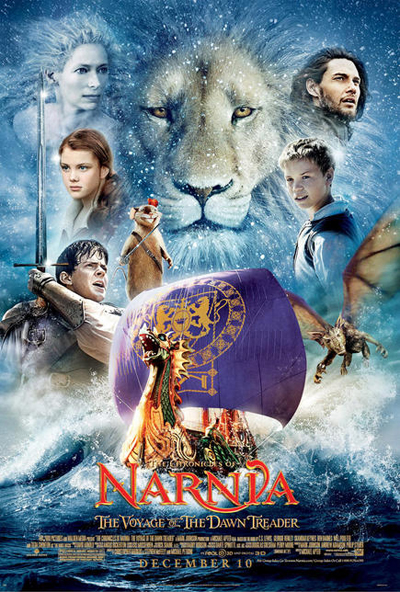
The Chronicles of Narnia: The Voyage of the Dawn Treader

Okay, once again I waited until nearly the end of a theatrical run to see a popular movie. I don’t know if there is a name for my condition: an almost pathological fear of seeing new releases in crowded theaters that harks back to the trauma we suffered when first attempting to see Star Wars. The theater sold overbooked tickets, just like an airline, and we had to leave just as Darth Vader appeared.

Voyage of the Dawn Treader is the third book of C.S. Lewis’s Chronicles of Narnia, and this movie is the first produced by Fox after Disney let go of the franchise when Prince Caspian, the second film, posted disappointing returns.

I can understand that to a degree. I’ve read the first Narnian chronicle, The Lion, The Witch, and the Wardrobe, many times; not so the others. The first book has things guaranteed to enchant the dreamer in all of us: a magical world in a clothes closet, filled with talking animals, where children become kings and queens, and defeat a great evil with the help of a lion who is a thinly disguised Christ figure.

I do not propose to outline the series for those who are not familiar with it, but pose a question the movie raised. What do we make of a film that is more compelling than the book because of the director and screenwriter have added elements the author did not?

Blasphemous as this may sound, I found Peter Jackson’s film treatment of Tolkien’s Lord of the Rings more compelling than the book, but those movies remained scrupulously faithful to the text.

In Dawn Treader, the two youngest Pevensie children, Lucy and Edmond, and their obnoxious cousin Eustace, are transported to Narnia to help King Caspian on his voyage to the east to find seven missing lords of Narnia.  I remember the book as a series of episodes that were not connected thematically except through the characters’ battles with temptation:  Lucy’s desire for Beauty, Edmond’s desire for Power, and Eustace’s Greed which causes his temporary transformation into a dragon.

Let’s just say that when the first of this series of movies came out in 2006, I set out to reread the seven books, and gave up in the middle of this one.

In Dawn Treader, the final test that is overcome is a dark island where dreams come true.  Lewis alludes to, but doesn’t dwell on the possibilities of a world where truth and illusion are indistinguishable; with Aslan’s help, the crew rescues the final lord and makes their escape.

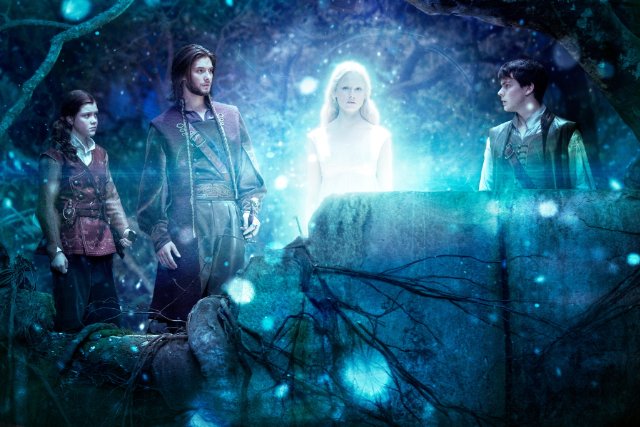
Director Michael Apted makes this dark island central to the story:  the crew and all of Narnia are threatened by a great evil that can take any shape – it mirrors each individual’s hopes and fears.  This is a very personal darkness, a tailor-made evil, a Satanic force that Christian theology imagines, but which Lewis did not in the third book of his series.

This force is also Mara, the demon lord of Buddhist theology who evoked the most piercing desires and fears in an effort to overcome Prince Siddartha on the night of his enlightenment.

“Value added,” is a business term I first heard in the 90’s applied to Intel, which takes silicon, one of the most common elements on earth, and transforms it into microprocessors.

“Value added” is also what Michael Apted did in fleshing out the unrealized potential of C.S. Lewis’s book, to portray each individual’s unique path of heroism.  In the words of the magician, Coriakin, “You cannot hope to overcome the darkness without until you subdue the darkness within.”