Nights of shooting stars

I wasn’t even thinking of the Perseid meteor showers when I posted my review of Stardust, a movie in which a shooting star is central to the story.  Since then I’vs spotted news articles which reminded me that the annual peak time to see shooting stars is upon us!

Nasa photo: public domain

Every August for the last 2000 years, we have been treated to meteor showers as the earth passes by remnants of the Swift-Tuttle comet.  This year, because light from the waning crescent moon will be dim, the celestial light show should be especially dramatic.

The meteors will be visible from now through August 24, peaking this weekend, on the 11th and 12th.  NASA estimates we could see as many as 80-100 shooting stars per hour on those nights.  Best viewing will naturally be in places away from city lights, but in past years, I’ve seen the Perseids from the back yard, where there is plenty of ambient light.

This is really worth checking out if you get the chance.  No matter how many other distractions we face, celestial events like this can stop us in our tracks, open our eyes of wonder, and remind us again of the things that really matter.

Light and Shadow

Light and Shadow 6 blog

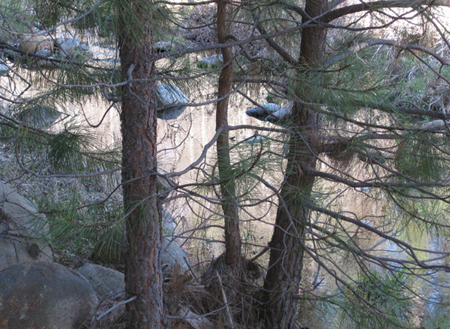
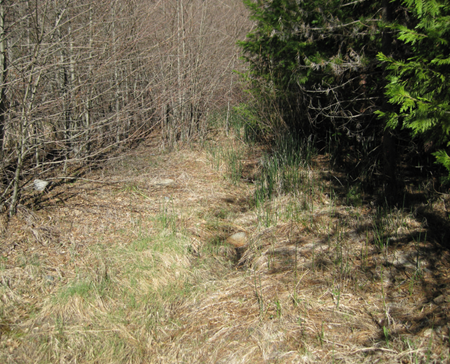
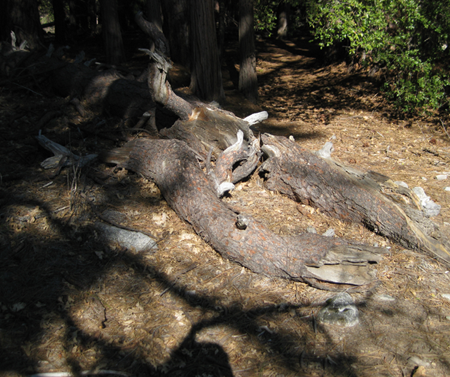
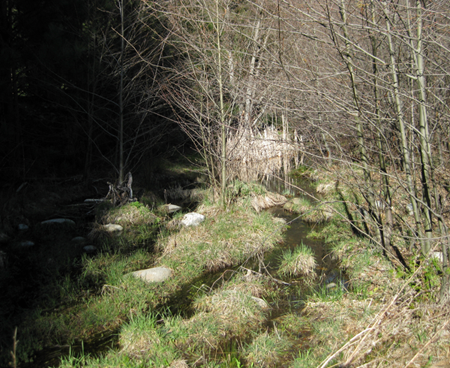
These photographs were taken in Wawona, just inside the south entrance to Yosemite National Park.

Light and Shadow 4 blog


Light and Shadow 5 blog

April is warm this year.  Mornings in the 30’s, daytime temperatures sometimes reaching the 70’s.  A few days ago it snowed, though all traces are gone.

Light and Shadow 8 blog


Light and shadow 1 blog

I think of the Summer King and the Winter King in Celtic folklore.  Their battle for ascendency never ends.  The King of Summer is winning now, but they’ll meet again in autumn.

Light and Shadow 2 blog


Light and shadow 3 blog

The sun is so bright and the shadows so deep they stop you.  Their interweaving patterns, stirring in the breeze, shift from moment to moment.

Light and Shadows 7 blog

The world changes before our eyes. Always the same and never the same.

The Life of Pi: A movie review

What you’ve heard about this movie is true: it’s the tale of a boy who winds up in a lifeboat in the Pacific with a Bengal tiger. It’s also true that most critics have praised The Life of Pi. I’m with them; this is a magical film.

Pi Patel livess an idyllic childhood in Pondicherry, India.  His father owns a zoo, and Pi develops a love for the animals as well as a spirituality that embraces the Hindu gods, Jesus, and Allah.

As he tries to practice all three faiths, his father, convinced of the supremacy of reason, warns that “If you believe in everything, you will end up not believing in anything at all.”  Pi’s father also demonstrates graphically that tigers are not your friend, a lesson that shakes Pi’s trust in nature.  The real blow falls after economic hardship forces Pi’s family to relinquish the zoo.  They sail for Canada with all the animals on a freighter, but a storm sinks the vessel, and Pi is the only human to survive.

What god do you pray to and what do say when your way of life and your family are suddenly gone, and you’re alone in a lifeboat with a zebra, an orangutan, a hyena, and a tiger named Richard Parker?  Initially, there is little time for prayer in the struggle to survive.  Soon it’s just Richard Parker and Pi.  There are cans of water and boxes of biscuits for 30 aboard the lifeboat, as well as a book on survival and a pencil that Pi uses to journal in the margins.

An optimist, Pi’s spirituality returns with expressions of gratitude and surrender as the ocean moves through her various phases, with deadly storms, cornucopias of fish and rain, and scenes of unearthly beauty.

Einstein once said the only important question is whether or not the universe is a friendly place. The adult Pi, who narrates the tale, believes it is. Was his ocean a friendly place or not? Both and neither, his story seems to say; it’s far more vast than that.

The western fantasy of objective truth leads us to believe there are true stories and false ones. The eastern view, shared at least in part by novelists and movie makers, is that our stories create our realities.

What does your heart say?  What does it lead you to believe?  That’s the question the grown-up Pi seems to asks us with his story and a half smile on his face.  It’s the same enigma the ocean and Robert Parker put to him.

The 2012 Ig Nobel Prizes

There’s still time to get tickets for the September 20 Ig Nobel Prize award ceremony at Harvard, where ten researchers will receive recognition for unusual discoveries.  The prizes are the brainchild of Marc Abrahams, editor and co-founder of “The Annals of Improbable Research” and author of a new book, This is Improbable: Cheese String Theory, Magnetic Chickens and Other WTF Research.

The ten Ig Nobel winners, whose identity has not been revealed, will receive their certificates from “real” Nobel laureates.  According to Abrahams, some dedicated scientists hold awards in both categories.  He cites Andre Geim  and Michael Berry, two UK physicists, who won an Ig Nobel in 2000 for using magnets to levitate a frog.  Ten years later, Geim and a student won a Nobel prize for producing graphene (two-dimensional carbon) in sufficient quantities to study.

Dr. Elena Bodnar, with her Ig Nobel prize winning bra that quickly converts to a protective face mask.

Past Ig Nobel winners who plan to attend this years ceremony include Dr. Bodnar, pictured above, as well as:

  • L. Mahadevan, a Harvard professor, for a “mathematico-physics analysis of how sheets get wrinkled.”
  • Dr. Richard Gustafson for research: “The failure of self-administered automobile-engine-supplied-electric-shock treatment for rattlesnake envenomation resulting from patient’s pet rattlesnake biting the patient on the lip.
  • Dr. Francis Fesmire, for an article in The Annals of Emergency Medicine entitled, “Digital rectal massage as a cure for intractable hiccups.”

Basile Audoly and Sebastien Neukirch won a 2006 Ig Nobel for research on why spaghetti, when broken, often splits into more than two pieces.

  • Dan Mayer for an article on the medical effects of sword swallowing.
  • John Perry of Stanford for his “Theory of Structured Procrastination.”
  • Don Featherstone, creator of the pink plastic flamenco.
  • Glenda Browne of Blaxland, Australia, for her study of the word “the” and the problems it creates for people who try to alphabetize things.

Marc Abrahams

Marc Abrahams says the Ig Nobel committee is looking for research and inventions that make people laugh and then make them think.  “We also hope to spur people’s curiosity, and to raise the question: How do you decide what’s important and what’s not, and what’s real and what’s not — in science and everywhere else?”

A very good question! To learn more about this year’s prizes, check here: http://www.improbable.com/ig/2012/

People and the Planet: A Report by the Royal Society

On April 26, The Royal Society, the UK’s 350 year old academy of science, released the results of a 21 month study of patterns of population and consumption.  Sir John Sulston, chair of the working group, put it very simply:

“The world now has a very clear choice.  We can choose to address the twin issues of population and consumption.  We can choose to rebalance the use of resources to a more egalitarian pattern of consumption, to reframe our economic values to truly reflect what our consumption means for our planet and to help individuals around the world to make informed and free reproductive choices.  Or we can choose to do nothing and to drift into a downward vortex of economic, socio-political and environmental ills, leading to a more unequal and inhospitable future.”  http://royalsociety.org/news/Royal-Society-calls-for-a-more-equitable-future-for-humanity/

The Society issued a 132 page report that makes several key recommendations  http://royalsociety.org/policy/projects/people-planet/report/:

  1. The international community must bring the 1.3 billion people living on less than $1.25 per day out of absolute poverty, and reduce the inequality that persists in the world today. This will require focused efforts in key policy areas including economic development, education, family planning and health.
  2. The most developed and the emerging economies must stabilise and then reduce material consumption levels through: dramatic improvements in resource use efficiency, including: reducing waste; investment in sustainable resources, technologies and infrastructures; and systematically decoupling economic activity from environmental impact.
  3. Reproductive health and voluntary family planning programmes urgently require political leadership and financial commitment, both nationally and internationally. This is needed to continue the downward trajectory of fertility rates, especially in countries where the unmet need for contraception is high.
  4. Population and the environment should not be considered as two separate issues. Demographic changes, and the influences on them, should be factored into economic and environmental debate and planning at international meetings, such as the Rio+20 Conference on Sustainable Development and subsequent meetings.

Please look at this video clip of Sulston summarizing the findings of the report, which he will present at the United Nations on May 1, ahead of the Rio+20 conference.

Of special interest to me was Sulston’s critique of GDP as the key measure of economic wellbeing for nations.  GDP, he says, drives growth to levels that cannot be sustained.  Michael Meade once observed that unbridled growth in the body is cancer, and unbridled growth in the body politic is a parallel ill.

Growth is such an ingrained measure of wellbeing that re-imagining global socio-economics will not be simple or easy.  One tactic, according to the working group, is to factor in real costs:  what are the real costs of disappearing forests and species?  What is the real cost of water when the study predicts that 1.8 billion people will live with severe water scarcity by 2025?

The issue of water brings to mind my previous post, “Another Regulation Conundrum,” http://wp.me/pYql4-21e, which describes a couple’s 40 year effort to create an self-sustaining and non-polluting homestead.  One of their projects was recycling household “gray water.”  The county building codes have no provision for such experimental ways of doing things, and the couple has racked up large fines and an eviction notice.  In a very real sense, the status quo is the problem.  According to the Royal Society, not only our building codes but the mindset behind them must change or the quality of life for everyone will continue its spiral of decline.

One parting thought:  the study was released on Thursday.  Why haven’t we heard it mentioned on any US media?

Another Regulation Conundrum

My previous post centered on regulations to force bloggers to disclose seemingly small-fry issues, like whether they were comped with an ebook for reviewing independently published authors.

Thursday’s paper ran a story from the New York Times on a more weighty and poignant regulatory issue.  The article, “Marin County battles hippie holdout,” tells of David Lee Hoffman, an entrepreneur of artisan teas, who designed and built 30 structures during the 40 years he lived on a rural hillside.  Inspired by youthful treks through Tibet and Nepal, Hoffman, 67, and his wife, Ratchanee, have tried to create a sustainable, non-polluting, homestead.  In the process, by ignoring repeated notices of violations of county building codes, they racked up $200,000 in fines and have just been ordered to vacate their home until the violations are fixed. The case is now before a judge.  http://www.sacbee.com/2012/04/26/4443307/hippie-askldj-flaksj-dfklaj-sdlfkj.html

photo by Jim Wilson, New York Times

The Hoffman homestead contains such fanciful structures as the Worm Palace, a Solar Power Shower Tower, and a moat, which is integral to recycling household water.  One of the county’s chief concerns is their method for disposing of human waste, which uses worm colonies to help turn human waste into humus.  Composting toilets are not legal in Marin.  The county also says it’s worried about an excess of rain, which could flood the moat and send the gray water into nearby creeks.

Hoffman says, “I did what I felt was right.  My love of the planet is greater than my fear of the law.”

***

There’s nothing simple about the regulations that govern our lives, and many of them serve us well.  I like clean water and knowing the content of the food I eat.  I want pure aspirin when I have a headache, and I want to trust the odometer when I shop for a used car.  If I buy a hot dog during a ballgame, I don’t want to have to think , of Upton Sinclair’s, The Jungle.  And I might not want to live downstream from the night soil in the Hoffmans’ garden.

And yet…

Most of us know, in the corners of our awareness, that many of our problems are beyond the capacity of our current institutions.  We know that business as usual is part of the problem.  That regulators do not create solutions.  As Einstein said, “One cannot alter a condition with the same mind that created it in the first place.”

How do we enable people like the Hoffmans, willing to devote their lives to imagining new ways of living?  If we fine and evict people for living their dreams, pretty soon we’re going to run short of dreamers.

The California Wolf

On December 28, a 2 1/2 year old male wolf crossed the border into California after a 1,000 mile journey south through Oregon.  Wolf OR7, as he is called by Fish and Game, is the first wild wolf in the state in almost 100 years.  A young wolf will leave his pack to search for a mate to start a new one in situations like too many wolves competing for game in a certain region.

Wolf OR7

The new California wolf is a descendant of the 66 Canadian wolves who were relocated to Yellowstone in the mid 90’s.  He is one of an estimated 1600 wolves who now roam free in the Rocky Mountain states, in the southwest, and in Oregon.

According Tim Holt, a freelance writer in Dunsmuir, CA, “local ranchers and a few pandering elected officials have him in their cross hairs, saying he ought to be shot on sight.”   At the same time, “there are wolf advocates who practically worship this predator, seeing the wolf as symbol and martyr of a vanishing wilderness.”

Holt sees another possibility:

The removal of wolves, or their reintroduction, reverberates up and down the food chain. By culling deer and elk, new wolf populations help restore vegetation along streambeds, improving habitat for songbirds, beavers and river otters. And by going after weak and old members of deer and elk populations, they help strengthen their stock. Wolves, in other words, are instinctive wilderness restoration specialists.

So the wolves’ return to this state offers a litmus test of our commitment to the health of our remaining wildlands. But it goes beyond that. Allowing them to reintroduce themselves would be one more sign that we’re moving away from a human-centered view of nature, based on narrow economic interests, and have begun to see ourselves as a part of what might be called the broader economy of nature. http://www.sacbee.com/2012/01/29/4221053/wolf-can-help-us-balance-our-approach.html#storylink=cpy

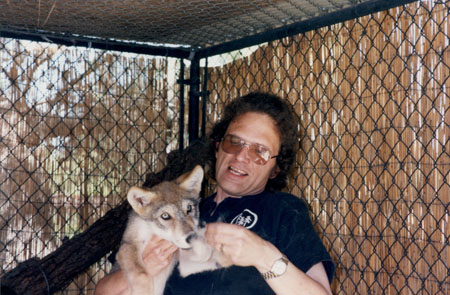
Somewhere deep within us as well, is a fear of wolves that makes generations of children shiver at Little Red Riding Hood.  That thrilled me when I read Jack London’s stores of wolves battling men.  I didn’t know at the time that London’s stories were pure fiction.  No such incidents ever happened.  During the ’90’s, I volunteered at the Folsom City Zoo because I wanted to interact with the wild canines – the wolves and foxes and coyotes.

Helping to socialize Redbud, a wolf pup, ca 1995

During the 90’s, all the texts on wolves agreed there were no confirmed cases of a non-rabid wolf attacking a human in North America.  I don’t think that has changed.  A classic account is 50 years old.  Farley Mowat, a Canadian author and conservationist, spent a summer living by himself among wolves.  In his 1963 book, Never Cry Wolf, he wrote:  “We have doomed the wolf not for what it is, but for what we deliberately and mistakenly perceive it to be — the mythological epitome of a savage, ruthless killer — which is, in reality, no more than the reflected image of ourself.”

Never Cry Wolf by Farley Mowat, 1963

The book, and the movie made of it in 1983, deserve much of the credit for reversing public attitudes toward the wolf, and allowing reintroduction to happen at all.

Never Cry Wolf movie, 1983

Gandhi said the character of a nation is revealed in the way it treats its animals.  Let’s hope the way we treat OR7 reveals something compassionate, wise, and generous in us.
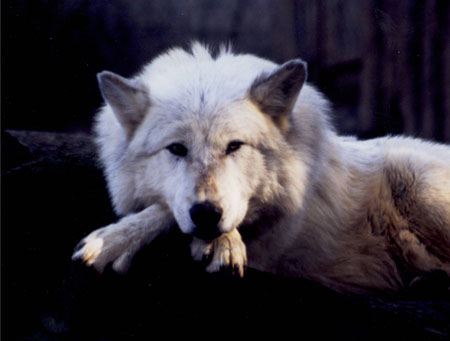
Sage, at the Folsom City Zoo, ca. 1995