Philip Levine: America’s New Poet Laureate

Philip Levine - Poet Laureate of the United States

Philip Levine was born in Detroit in 1928 and started writing poetry at 13.  He hated the “prissy” stuff he learned in school and modeled the language of his early work on preachers heard on the radio.  Levine wrote many of the poems that fill his 16 books in the evenings, after working by day in the auto plants. He has been called the “poet of the proletariat.”

In announcing Levine’s appointment, James H. Billington, of the Library of Congress, called Levine

“one of America’s great narrative poets. His plainspoken lyricism has, for half a century, championed the art of telling ‘The Simple Truth’—about working in a Detroit auto factory, as he has, and about the hard work we do to make sense of our lives.”  http://www.npr.org/blogs/thetwo-way/2011/08/10/139348573/philip-levine-named-as-americas-new-poet-laureate

Levine’s collection of poetry, The Simple Truth won a Pulitzer Prize in 1995.

Here is the title poem:

The Simple Truth by Philip Levine

I bought a dollar and a half’s worth of small red potatoes,
took them home, boiled them in their jackets
and ate them for dinner with a little butter and salt.
Then I walked through the dried fields
on the edge of town. In middle June the light
hung on in the dark furrows at my feet,
and in the mountain oaks overhead the birds
were gathering for the night, the jays and mockers
squawking back and forth, the finches still darting
into the dusty light. The woman who sold me
the potatoes was from Poland; she was someone
out of my childhood in a pink spangled sweater and sunglasses
praising the perfection of all her fruits and vegetables
at the road-side stand and urging me to taste
even the pale, raw sweet corn trucked all the way,
she swore, from New Jersey. “Eat,” she said,
“even if you don’t I’ll say you did.”
Some things
you know all your life. They are so simple and true
they must be said without elegance, meter and rhyme,
they must be laid on the table beside the salt shaker,
the glass of water, the absence of light gathering
in the shadows of picture frames, they must be
naked and alone, they must stand for themselves.
My friend Henri and I arrived at this together in 1965
before I went away, before he began to kill himself,
and the two of us to betray our love. Can you taste
what I’m saying? It is onions or potatoes, a pinch
of simple salt, the wealth of melting butter, it is obvious,
it stays in the back of your throat like a truth
you never uttered because the time was always wrong,
it stays there for the rest of your life, unspoken,
made of that dirt we call earth, the metal we call salt,
in a form we have no words for, and you live on it.

When he first heard of the appointment, Levine was skeptical.  “I’m fairly irreverent,” he said, “and an old union man.”  In the end he realized this was his chance to reach a wider audience than he has had in years, and he accepted.  Levine will hold the office of Poet Laureate for the coming year.

***

Learning of Levine’s appointment was not just exciting in the sense of finding a new author to read, but exciting because the central passage of “The Simple Truth,” contains a compelling challenge.  What are those things, the poem seems to ask, in my life and in yours, that are so simple and true they can stand by themselves, unadorned, beside the salt shaker and a glass of water in evening light as it falls across the table:

Some things
you know all your life. They are so simple and true
they must be said without elegance, meter and rhyme,
they must be laid on the table beside the salt shaker,
the glass of water, the absence of light gathering
in the shadows of picture frames, they must be
naked and alone, they must stand for themselves.

Thank You

I usually think of summer as the laid back season, but not this year.  The last few weeks have been a blur of major construction projects around the home, remedial training for our two rescue dogs, and unwanted interuptions such as the seeming immanent failure of Mary’s hard drive.  There hasn’t been a lot of time for quiet reflection, so I was all the more surprised and grateful when the good people at WordPress chose a recent post of mine to be Freshly Pressed:  https://thefirstgates.com/2011/06/27/a-year-of-blogging/.  I appreciate everyone who stopped by to look and those who left a comment.  I spent some wonderful hours reading and responding to comments and looking at blogs I had never seen before.

The comments that moved me most came from other bloggers, some just starting out, who said they found encouragement in what I had written.  No feedback I have ever gotten for writing means more to me than that.  A few said they were dipping their toes in the water, afraid their writing wasn’t good enough.  I think every writer feels like that on occasion.  Here is what T.S. Eliot, my favorite 20th century poet, had to say on the matter:

So here I am, in the middle way, having had twenty-years –
Twenty years largely wasted, the years of
l’entre deux guerres
Trying to learn to use words, and every attempt
Is a wholly new start, and a different kind of failure
Because one has only learnt to get the better of words
For the thing one no longer has to say, or the way in which
One is no longer disposed to say it.

But Eliot doesn’t stop there, and neither should we.  He goes on to say,  For us, there is only the trying.  The rest is not our business.  Elsewhere he said, Take no thought for the harvest, but only for the proper sowing. 

 At 18, in my first semester of college, I saw a phrase that has never left me:  the invocation at the start of Homer’s OdysseySing in me muse, and through me tell the story…  I remember and sometimes use that phrase because it reminds me that the ego, the small self of “me” and “mine” that worries about results is not the self that can bring them about.

Does anyone else find there is something impersonal about creativity?  It feels very much as if a muse or spirit of inspiration is there to take over the keyboard, if I can just get “me” out of the chair.  Carl Jung said it another way:  “I realized my thoughts were not really my own, but were more like animals I encountered on a walk through the forest.”

One summer when I did some freewriting every day I made a startling discovery – if I allow myself to be lousy, I seldom am.  This doesn’t mean there won’t be editing afterward if I find that one of my seed ideas is worth expanding.  It just means that while I am writing, everything goes better if I’m not looking over my own shoulder.

Several people who commented here said the same thing – their blogging took off when they realized they didn’t need to be perfect.  Thanks again to everyone who stopped by to encourage my imperfect progress!

Two Poems by Rumi

I don’t know why, but I seem to think of Rumi in July.  In my second post, just over a year ago, I used his poem, “Story Water,” as a way of reminding myself of what I thought I was up to on this blog.  https://thefirstgates.com/2010/07/01/story-water/

In “Story Water,” this 13th century Persian poet, whose language leaves you speechless, suggests that most of the time we cannot apprehend truth directly – we need stories and poems as intermediaries.  They serve as messengers that both hide and reveal.  Here are two more of my favorite poems by Rumi.

***

“Love Dogs” speaks of the dark nights that contemplatives of all faiths experience in the quest to move beyond other people’s truths to direct experience.  Here it is in two forms – in the text, from the definitive translation by Coleman Barks, and read aloud by Barks to music – the way poetry was originally meant to be experienced.

The Essential Rumi - trans. by Coleman Barks with John Moyne

Love Dogs” by Rumi.  Translated by Coleman Barks

One night a man was crying,
“Allah, Allah!”
His lips grew sweet with the praising,
until a cynic said,
“So! I have heard you
calling out, but have you ever
gotten any response?”
The man had no answer for that.
He quit praying and fell into a confused sleep.
He dreamed he saw Khidr, the guide of souls,
in a thick, green foliage,
“Why did you stop praising?”
“Because I’ve never heard anything back.”
“This longing you express
is the return message.”
The grief you cry out from
draws you toward union.
Your pure sadness that wants help
is the secret cup.
Listen to the moan of a dog for its master.
That whining is the connection.
There are love dogs no one knows the names of.
Give your life to be one of them.

***

“The Seed Market,” defies almost any attempt to describe it.  I can’t think of anything else in all of literature that paints such a sweeping truth in such simple, everyday language.  Solemn and joyous at once, I read “The Seed Market” when I gave a eulogy at my father’s memorial service, and yet this poem never makes me sad.  Quite the contrary.

“The Seed Market” by Rumi.  Translated by Coleman Barks

Can you find another market like this?

Where,
with your one rose
you can buy hundreds of rose gardens?

Where,
for one seed
you get a whole wilderness?

For one weak breath,
the divine wind?

You’ve been fearful
of being absorbed in the ground,
or drawn up by the air.

Now, your waterbead lets go
and drops into the ocean,
where it came from.

It no longer has the form it had,
but it’s still water.
The essence is the same.

This giving up is not a repenting.
It’s a deep honoring of yourself.

When the ocean comes to you as a lover,
marry, at once, quickly,
for God’s sake!

Don’t postpone it!
Existence has no better gift.

No amount of searching 
will find this.

A perfect falcon, for no reason,
has landed on your shoulder,
and become yours.

One More By William Stafford

I really wanted to include this poem in my discussion of William Stafford yesterday, but I didn’t because the post threatened to get too long.  Several appreciative comments persuaded me to send it out today.  This selection is available in The Way It Is, the collection of Stafford’s poetry I referenced, with a link, at the bottom of yesterday’s post.  This, along with other William Stafford poems, can also be found on various poetry websites.  It was first published in a 1960 collection called, West of Your City.  Enjoy.

A Ritual To Read To Each Other

If you don’t know the kind of person I am
and I don’t know the kind of person you are
a pattern that others made may prevail in the world
and following the wrong god home we may miss our star.

For there is many a small betrayal in the mind,
a shrug that lets the fragile sequence break
sending with shouts the horrible errors of childhood
storming out to play through the broken dyke.

And as elephants parade holding each elephant’s tail,
but if one wanders the circus won’t find the park,
I call it cruel and maybe the root of all cruelty
to know what occurs but not recognize the fact.

And so I appeal to a voice, to something shadowy,
a remote important region in all who talk:
though we could fool each other, we should consider–
lest the parade of our mutual life get lost in the dark.

For it is important that awake people be awake,
or a breaking line may discourage them back to sleep;
the signals we give–yes or no, or maybe–
should be clear: the darkness around us is deep.

Notes On William Stafford

Now, more than ever, I’ve come to trust ideas that are unexpected.  That’s one reason I like to get up early, when the mind of fixed ideas is still half-asleep.  It’s a good time to sit in the meditation room.  Or work on a chapter that’s giving me trouble.  Or simply take a cup of coffee out to the back porch and watch.

I had something in mind to write about for today.  Over coffee on the back porch I came up with topic two.  I gave them both up a moment ago when I went to look up something by William Stafford.

William Stafford, 1914-1993

Yesterday afternoon, I pruned a branch from the apple tree that would have broken under the weight of even one apple.  I carried the branch and its blossom inside and put it in a little vase of the greenish kind of glass you see on old telephone insulators.  How startling it was!  How unexpected that something so simple should resonate so deeply in its silence.  One day the Buddha was scheduled to give a sermon, and all he did was hold up a flower.  That is like the experience of William Stafford’s poetry.

This is the poem I went to look up, one I have read again and again.  Stafford wrote it on August 2, 1993, three weeks before he died:

The Way It Is

There’s a thread you follow.  It goes among
things that change. But it doesn’t change.
People wonder what you are pursuing.
You have to explain about the thread.
But it is hard for others to see.
While you hold it you can’t get lost.
Tragedies happen; people get hurt
or die; and you suffer and get old.
Nothing you do can stop time’s unfolding.
You don’t ever let go of the thread.

Stafford was born in Kansas, started publishing late in life, taught Creative Writing at Lewis and Clark College, and was named Poet Laureate of Oregon in 1975.  I feel like skipping over the biographical details in favor of letting Stafford’s poetry speak for itself, but thanks to Google I did come up with one gem, an excerpt from a 1990 interview where Stafford talks of the connection between poetry and listening  http://www.npr.org/templates/story/story.php?storyId=9859873

The image in the interview – Stafford and his father listening to coyotes on the banks of the Arkansas bring to mind this poem:

A Story That Could Be True

If you were exchanged in the cradle and
your real mother died
without ever telling the story
then no one knows your name,
and somewhere in the world
your father is lost and needs you
but you are far away.

He can never find
how true you are, how ready.
When the great wind comes
and the robberies of the rain
you stand on the corner shivering.
The people who go by-
you wonder at their calm.

They miss the whisper that runs
any day in your mind,
“Who are you really, wanderer?” –
and the answer you have to give
no matter how dark and cold
the world around you is:
“Maybe I’m a king.”

There are several other poems by William Stafford that are important to me that I’d like to quote, but I think it will be enought to end with a passage that brings me back to the apple blossom.  This is the last stanza of the poem Stafford wrote on the morning of Aug. 28, 1993, the day he died:

You can’t tell when strange things with meaning
will happen. I’m [still] here writing it down
just the way it was. “You don’t have to
prove anything,” my mother said. “Just be ready
for what God sends.” I listened and put my hand
out in the sun again. It was all easy.


Notes on T.S. Eliot

Here is what the man I consider the greatest english language poet of the 20th century had to say about his own work:

So here I am, in the middle way, having had twenty years-
Twenty years largely wasted, the years of l’entre deux guerres-
Trying to learn to use words, and every attempt
Is a wholly new start, and a different kind of failure
Because one has only learnt to get the better of words
For the thing one no longer has to say, or the way in which
One is no longer disposed to say it. (The Four Quartets)


Thomas Stearns Eliot, 1888-1965

Eliot was a modernist who believed that a new poetic language was needed to address the complexities of a new century.  It takes a bit of effort now to understand that he offended the literary establishment of his day the way Picasso offended the art establishment.  The first poem in his first published book, “The Love Song of J. Alfred Prufrock,” (1917) begins:

Let us go then, you and I,
When the evening is spread out against the sky
Like a patient etherised upon a table;

The literary world was still immersed in the 19th century sensibility; to describe the sky with such a simile was as shocking as a cubist landscape.   At the same time, Eliot alienated the bohemian crowd:  he became a devout Anglican, wore three-piece suits, worked in a bank, and spoke in the most precise possible manner.  He went his own way in everything but kept enough humor to describe himself in this way:

How unpleasant to meet Mr. Eliot!
With his features of clerical cut,
And his brow so grim
And his mouth so prim
And his conversation, so nicely
Restricted to What Precisely
And If and Perhaps and But.
…………………………………….
How unpleasant to meet Mr. Eliot!
(Whether his mouth be open or shut).

I read poems like “Prufrock” and “The Wasteland” in high school.  They were cool enough that as a sophomore in college, I signed up for a class called, “Yeats and Eliot.”  It probably had a more lasting effect than any other college class, since forty years later I still read T.S. Eliot often, usually from “The Four Quartets,” the capstone of his poetic career.  The four sections were written and released separately over six years, and first published together in 1943.  After the Quartets, he wrote, “Old Possum’s Book of Practical Cats,” which inspired the musical, “Cats,” and spent the rest of his life writing plays and literary criticism.  Eliot was awarded a Nobel Prize in 1948.

The title of this blog came from an opening line in “The Four Quartets:”  Through the first gate, Into our first world, shall we follow the deception of the thrush?

As I said, I have been reading this poem for forty years, always finding something new in Eliot’s rendering of the human longing for the ineffable (among many other themes).  George Orwell dismissed the poem for it’s “religiosity,” though I find that a shallow reading.  A passage like the following uses religious symbols, not in the service of preachiness, but to invoke an experience that is perhaps as common as it is difficult to name:

I sometimes wonder if that is what Krishna meant –
Among other things-or one way of putting the same thing:
That the future is a faded song, a Royal Rose or a lavender spray
Of wistful regret for those who are not yet here to regret,
Pressed between the yellow leaves of a book that has never been opened.

Here is another such passage which I still see quoted from time to time by spiritual authors:

I said to my soul, be still, and wait without hope
For hope would be hope for the wrong thing; wait without love
For love would be love of the wrong thing; there is yet faith
But the faith and the love and the hope are all in the waiting.
Wait without thought, for you are not ready for thought:
So the darkness shall be the light, and the stillness the dancing.

No single blog post could be more than an introduction to the life and work of a poet like T.S. Eliot, but if these notes inspire anyone to read “The Four Quartets,”  http://www.ubriaco.com/fq.html I will be more than satisfied.

Let me end with the end of the passage I began with.  After the poet tells us “success” is forever out of reach, he says:

And what there is to conquer
By strength and submission, has already been discovered
Once or twice, or several times, by men whom one cannot hope
To emulate-but there is no competition-
There is only the fight to recover what has been lost
And found and lost again and again:  and now, under conditions
That seem unpropitious. But perhaps neither gain nor loss.
For us, there is only the trying. The rest is not our business.

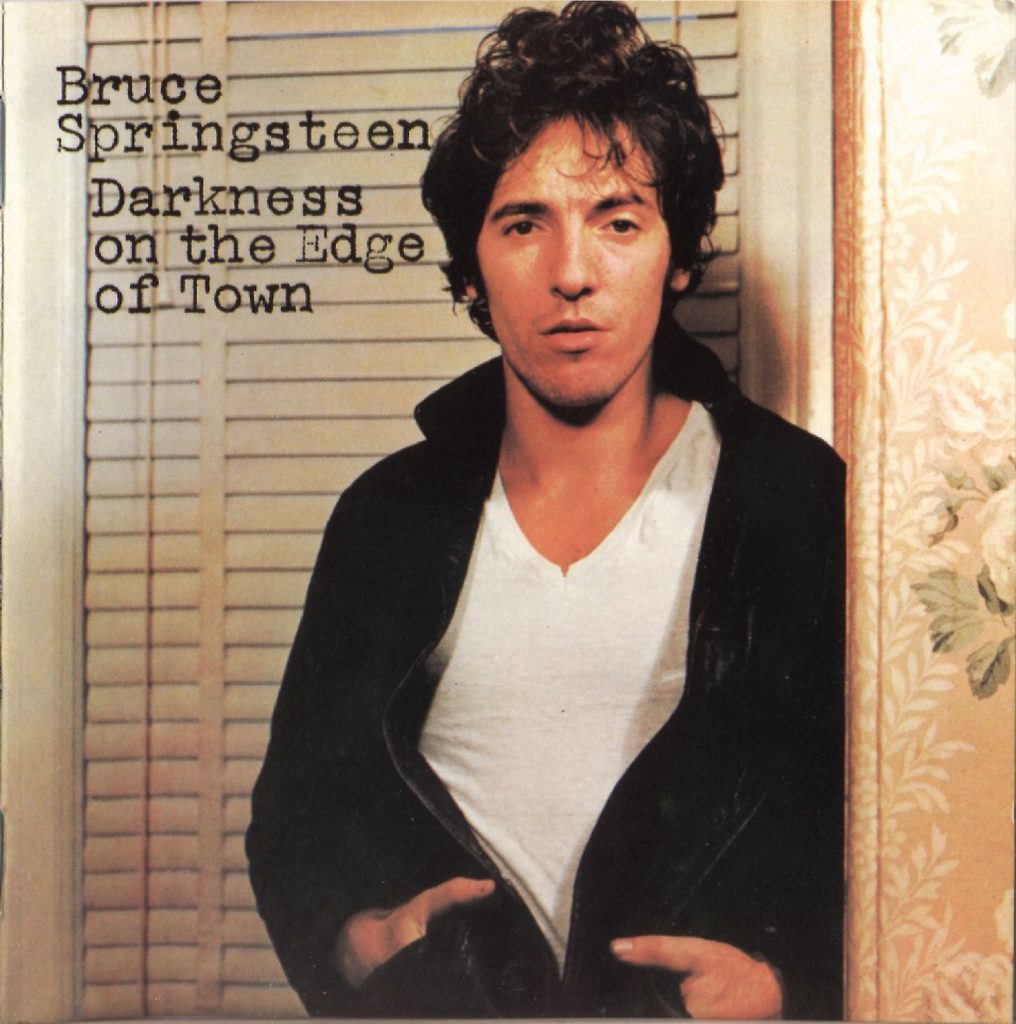
Darkness on the Edge of Town: Homage to The Boss


This post started as something completely different, but it swung like a compass needle toward something I truly love – the music of Bruce Springsteen.

I blog about all sorts of things that interest me, that I enjoy, that make me laugh. I sometimes write about ambitions and guiding philosophies, which are very important, but strangely, I have neglected how much music means to me.

I’ve been a huge Springsteen fan since I first picked up Greetings From Asbury Park in 1973. The man should be Poet Laureate of America, for as someone observed, who else can make you feel nostalgia for New Jersey?

***

I started the morning intending to post on two very significant articles I read in the last two days on structural, rather than cyclical, unemployment in this country.  This is something I think about often because my career in technology spanned the revolution that made it so easy to “offshore” and eliminate so many vocations.  Show of hands, how many are reading this on a computer that was assembled in the US?  As I thought, not a one.

The following are very good articles, that point out that we have a real problem that cannot even be addressed until it is acknowledged, which politicians have yet to do:

“Where the Jobs Aren’t:  Grappling With Structural Unemployment,” by Zachary Karabell, Time, January 17, 1011.
http://www.time.com/time/business/article/0,8599,2040966,00.html/

“Many Jobs Gone Forever Despite Onset of Recovery,” by Darry Sragow, The Sacramento Bee, Jan. 8, 2011,
http://www.sacbee.com/2011/01/08/3308378/many-jobs-gone-forever-despite.html/

As usual, however, poets see things before others, and Springsteen has been telling us since 1978 that we have a darkness at the edge of town.

***

What follows is a blatant excuse to upload some really good music – kind of like a Blues Brothers movie, where anything resembling a plot is secondary.

Here is an anthem everyone loves, perhaps because so few of us live in the place where we grew up.  Yet “My Hometown,” 1984, explicitly laid out the issue of “structural unemployment” a quarter of a century ago:

Now Main Street’s whitewashed windows and vacant stores
Seems like there ain’t nobody wants to come down here no more
They’re closing down the textile mill across the railroad tracks
Foreman says these jobs are going boys and they ain’t coming back


A poet will also recognize how work is much more than balance sheets and GDP; it touches every aspect of individual and family life.  From “The River,” 1980, live at Glastonbury:

I remember us riding in my brother’s car
Her body tan and wet down at the reservoir
At night on them banks I’d lie awake
And pull her close just to feel each breath she’d take
Now those memories come back to haunt me
they haunt me like a curse
Is a dream a lie if it don’t come true
Or is it something worse…


And finally, two more recent favorites, from the 1995 album, “The Ghost of Tom Joad.  They are self-explanatory.

Hot soup on a campfire under the bridge
Shelter line stretchin’ round the corner
Welcome to the new world order
Families sleepin’ in their cars in the southwest
No home no job no peace no rest

The highway is alive tonight
But nobody’s kiddin’ nobody about where it goes
I’m sittin’ down here in the campfire light
Searchin’ for the ghost of Tom Joad


And from the same album, “Youngstown,” performed in Youngstown, Ohio:

From the Monongaleh valley
To the Mesabi iron range
To the coal mines of Appalacchia
The story’s always the same
Seven-hundred tons of metal a day
Now sir you tell me the world’s changed
Once I made you rich enough
Rich enough to forget my name

And finally, to end on an upbeat note, a favorite recent Springsteen cut, performed live in London, 2007 I believe.  This is “The Sessions Band,” assembled for “The Seeger Sessions,” a CD tribute to the music of Pete Seeger on the occasion of his 90th birthday.  That recording, and “Live in Dublin,” are a can’t-sit-still mix of folk, rock, gospel, and jazz music.

God gave Noah the rainbow sign
“No more water but fire next time”
Pharaoh’s army got drownded
O Mary don’t you weep


If this appeals, be sure to check out The Boss’s web page: http://www.brucespringsteen.net/news/index.html
http://www.brucespringsteen.net/news/index.html

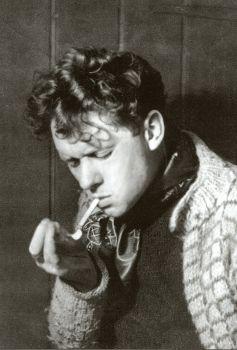
A Child’s Christmas in Wales by Dylan Thomas

My best friend gave me Dylan Thomas’ incredible prose poem back in high school. In whatever form – which now include recordings and at least one TV adaptation – it has been a part of every Christmas since then. I pass it on now, with best wishes for the holiday:

One Christmas was so much like another, in those years around the sea-town corner now and out of all sound except the distant speaking of the voices I sometimes hear a moment before sleep, that I can never remember whether it snowed for six days and six nights when I was twelve or whether it snowed for twelve days and twelve nights when I was six……

http://www.bfsmedia.com/MAS/Dylan/Christmas.html

Dylan Thomas

…Always on Christmas night there was music. An uncle played the fiddle, a cousin sang “Cherry Ripe,” and another uncle sang “Drake’s Drum.” It was very warm in the little house. Auntie Hannah, who had got on to the parsnip wine, sang a song about Bleeding Hearts and Death, and then another in which she said her heart was like a Bird’s Nest; and then everybody laughed again; and then I went to bed. Looking through my bedroom window, out into the moonlight and the unending smoke-colored snow, I could see the lights in the windows of all the other houses on our hill and hear the music rising from them up the long, steady falling night. I turned the gas down, I got into bed. I said some words to the close and holy darkness, and then I slept.