How to Fail at Almost Everything and Still Win Big by Scott Adams

How to Fail

“Don’t let reality control your imagination. Let your imagination be the user interface to steer your reality.” – Scott Adams.

How to Fail at Almost Everything is a quirky, funny, irreverent, and often inspiring “sort of autobiography” from the creator of Dilbert, that quirky, funny, irreverent, and often inspiring comic strip that lays out the truth of working in the trenches cubicles of corporate America.

This is not another collection of Dilbert cartoons or Dilbert philosophy.  It’s more of a Dilbert origin story.  We know we’re in for a different kind of kind of how-to-book when Adams begins by advising us to make sure our bullshit detectors are working before we take advice from a cartoonist.

He dismantles many self-help cliches in order to clear the way for fresh perspectives.  “Goals are for losers,” he says, and recommends strategy instead.  “I will finish my first novel,” is a goal. “I will write for an hour a day,” is a strategy.  Every day we don’t attain a goal is slightly depressing, he says, and soon after we reach it, the “what next?” question arises.  A strategy, on the other hand, brings a daily sense of satisfaction as we move in the right direction.

“I tried a lot of different ventures, stayed optimistic, put in the energy, prepared myself by learning as much as I could, and stayed in the game long enough for luck to find me…with Dilbert it did.” – Scott Adams

Adams gives a chronology of his many failed careers and entrepreneurial ventures. Shining through the story is a positive attitude that allowed him to find key lessons and life experience in every failure.  His optimism is gold, and he spends a lot of time writing of health, especially, diet and exercise, although he cautions that there is a “non-zero chance” that health advice from a cartoonist could be fatal.

“I’m here to tell you that the primary culprit in your bad moods is a deficit in one of the big five: flexible schedule, imagination, sleep, diet and exercise.”  The “big five” benefit mood, which builds personal energy, which is the driver of aspiration and effort.

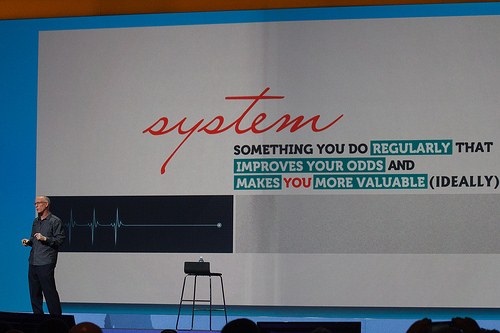
Scott Adams shares his ideas at IBM Connect 2014.  Photo by Greyhawk68, CC BY-NC-ND 2.0

Scott Adams shares his ideas at IBM Connect 2014. Photo by Greyhawk68, CC BY-NC-ND 2.0

Adams packs an abundance of topics into his book. Not every one resonated, and several dragged for me, but much of my copy is highlighted and underlined, and I’ve reread several chapters already.  If you like Dilbert, you will value this story of the life twists and turns of his creator, and you will benefit from the lessons he learned along the way.

by all means by Edward Espe Brown

by all means A ZEN CAUTIONARY TALE

by all means A ZEN CAUTIONARY TALE

“Growing up meant you were competent and stayed out of trouble…When you hit the wall, who or what would see you through?”

Traditional Zen practice is both very simple and very formal.  Think of classic Japanese brush painting.  In Zen, there are prescribed ways of bowing, walking, holding the hands in meditation, and so on.

At the end of by all means A ZEN CAUTIONARY TALE, Zen abbot, Edward Espe Brown, includes a photograph of himself, in full Zen regalia, with a stern expression on his face, and a pig puppet on a cushion beside him.  Traditional Zen masters don’t give dharma talks with pig puppets any more than traditional authors use upper and lower case in their titles like Brown does here.  by all means lies outside traditional book categories, which ironically, makes it very Zen.

When Edward, as an adult, rescues Ponce (two syllables) the Pig puppet from a cat named Turtle (not a puppet), his affection for Ponce allows him to explore many issues, especially those of abandonment:  how others abandon us, how we abandon them and ourselves, and all the things we do to try to compensate:

“A lot of things that Edward did were very important because it was important to him to be doing important things and not just wasting his time.  Otherwise how could he have any respect for himself? And wasn’t it important to be self-respecting? Because if you left it to the others, there didn’t seem to be a lot of respect going around, and you weren’t likely to get much.”

We learn how Edward lived in an orphanage after his mother died when he was three.  We learn how he turned his anger on the stuffed animals he had as a kid after he got out.  We see how childhood issues live on inside the adult and how Ponce the Pig reacts at a critical moment, when Edward abandons him.  At first Ponce weeps, but then he closes his eyes to meditate (the pig is a dedicated Dharma practitioner):

“He found his heart swelling even though nothing changed outwardly. The space within was like that: vast and expansive, warm and tender without dimensions.  All of his friends were gathering just as fast as he could think of them. A burst of astonishment flashed through Ponce.  Left without any capacity for thinking about what was happening, he was one with everything, and everything was a part of him.  No separation could be found.  Dazzling!  What was there to think about?  Nothing needed figuring out…”  Edward learns his lesson and reconciles with Ponce in the end because it’s that kind of a book.

I enjoyed by all means, but it’s not for every reader. It is not an instruction manual in Zen or a book of eastern philosophy.  If you have no interest in Zen or have not spent time talking to puppets as I have, the book might not appeal.

If you are in doubt, I suggest you check out some of the Dharma talks Edward has made available on his website.  If you like them, you’ll probably like the book.  The talks, like this book, are simply another way that Edward, with abundant humor and compassion, tells his truths, using all means. 

Posts I haven’t yet written

Quite a few of my posts begin with ideas that rattle around until research or mulling them over generates enough interest to get me writing.  Time for contemplation and research have been in short supply recently and are likely to be for the next week, so grabbing this moment, I decided to mention a few things I am working on that may or may not get posts of their own in the future.

Water

With the drought on everyone’s mind, I was tempted to write a piece on the symbolism of water.  The problem is, (1) the subject is huge, (2) it’s already been done, and (3) a Star Trek episode keeps me from starting.  Every time I remember the silicon creatures who called humans, “ugly bags of mostly water,” all my attempts to stay focused and serious fail.  According to Mr. Data, it’s an accurate description of our species.  Thanks, dude.

There’s another approach to discussing water in California that centers on economics and politics.  I could discuss the millions of gallons we pour into fracking wells.  Or I could mention the president’s three hour visit to Fresno, complete with a photo-op in a dry field before jetting off to Rancho Mirage, but I don’t think I will.  If I want to get depressed over water, it’s easier just to rent Chinatown.

I’m writing a letter

Not just any letter.  I’m writing a letter of condolence to someone whose dog recently died.  It’s one paragraph forward and two back.  Those who have lost a beloved pet will understand how this letter is siphoning off most of the emotional energy I’m willing to invest in writing at this time.

Too many choices

A chain of associations based on some of my own experiences led to a fascinating but huge subject, the difficulty of having too many choices.

photo by Alexander Acker, 2010, CC BY-ND-2.0

photo by Alexander Acker, 2010, CC BY-ND-2.0

In his 2004 book, The Paradox of Choice – Why More is Less, psychologist Barry Schwartz writes that seeking the “perfect” choice is “a recipe for misery.”  Other researchers say, “The current abundance of choice often leads to depression and feelings of loneliness,” and “Americans are paying for increased affluence and freedom with a substantial decrease in the quality and quantity of community.”

This kind of subject deserves elaboration, but if you don’t want to wait for me to get around to it, just Google on “too many choices” and see what you find.

I’m learning Spanish

Yup, I started last summer on Rosetta stone, for a variety of reasons, including (but not limited to, or necessarily in order of importance):

  1. It seemed like a good idea at the time.
  2. Languages are supposed to be good for the brain.
  3. One night, flipping through the TV listing, it seemed like it would be fun to watch El Codico DaVinci on the Spanish station.

One of my Facebook friends who knew me back when, reminded me that in 7th grade Spanish, I was a class clown.  The reason was simple.  I believed I was “no good at languages,” and it became a self-fulfilling prophecy.  There’s a lot of satisfaction in erasing that misperception.  I came upon the Spanish version of book I have in English yesterday and flipped through it before deciding I’d better start in the children’s section.  I wonder if they have cartoons on Saturday morning on the Spanish channels?

Meanwhile, I don’t know why mid-February should be so busy, but it is, and I have to move on to the next thing, so let me summarize this post.

  1. Water is good, though flooding is bad.
  2. Few things are harder than losing a dog.
  3. Choosing things can be iffy.
  4. Learning a language sometimes carries the kind of excitement that learning to read must have done when we were kids.

Feel free to quote me.  Until next time, when maybe I’ll manage to write a real post…

Causes for happiness according to Carl Jung

Recently I thought of a chain of events in my life that I first considered unfortunate, though eventually they led to better results than I ever imagined. This got me thinking of “happiness,” and how wrong our ideas about it can be.

A few years ago I saw one of those lists of “10 factors for happiness” that both confirmed popular hunches (good health is factor #1) and contained surprises (children or no children makes no statistical difference in life satisfaction surveys).  Searching Google for “10 factors of happiness” led to 32 million hits.

I didn’t find the one I was after, but many of those I scanned were interesting.  None pretended to guarantee a sense of wellbeing – there are too many intangibles, such as personal outlook.  We’ve probably all known healthy, well to do, miserable people, as well as those who find satisfaction in overcoming adversity.

Public domain

Public domain

I am also attuned to Buddha’s warning, that any sense of wellbeing that depends on outside conditions is subject to change because those conditions are subject to change. I view these lists not as suggestions on where to look for the ultimate good, but as factors that can improve our odds of feeling satisfied much of the time.  The list I found most interesting gave five conditions for happiness according to Carl Jung.

  1. Good physical and mental health.
  2. Good personal and intimate relationships, such as those of marriage, the family, and friendships.
  3. The faculty for perceiving beauty in art and nature.
  4. Reasonable standards of living and satisfactory work.
  5. A philosophic or religious point of view capable of coping successfully with the vicissitudes of life.

I was especially interested to read “satisfactory work” in item #4, as “settling” for “satisfactory” work (rather than following my bliss) was the life choice I referred to at the start of this post. From what I’ve observed, following bliss is a slow, long term process, filled with trial and error, because most of us don’t know our bliss till we stumble over it in the dark – but that is a topic for another day.

In the Psychology Today article I’m quoting from, Jung observed that “No matter how ideal your situation may be, it does not necessarily guarantee happiness.” He also suggested that chasing happiness doesn’t work.  I agree in part. I think happiness is a by product of other actions rather than something we can grasp directly, but I know from personal experience that numerous actions and attitudes can improve or worsen my odds.  For instance, I find it helpful to limit TV news viewing to the PBS Newshour two or three times a week, and sometimes even that is too much. Dwelling on bad news we cannot change doesn’t appear on anyone’s happiness list.

Perhaps the best advice I received on happiness came from a high school English teacher, one the most important mentors I’ve had in this life. His was a one item list: “I think life is satisfying only when we’re committed to something greater than ourselves.” In the decades since then, I’ve found lots of elaborations, but nothing superior to that as a way to orient my inner compass.

What do you think?  What works for you or makes your glass half full and occasionally running over?

Jung’s Tower: simplicity and the inner life

Jung's Tower House, Bollingen, Switzerland, by Andrew Taylor, 2009.  CC BY-SA-2.0

Jung’s Tower House, Bollingen, Switzerland by Andrew Taylor, 2009. CC BY-SA-2.0

Recent news of technological incursions into consciousness itself (virtual reality and altered memories); almost daily revelations about NSA spying; suggestions that social media “isolates people from reality;” it’s enough to make you want to unplug all the gadgets – at least for a while!

Renowned psychologist, Carl Jung (1875-1961) did just that, for months at a time, in a tower-house complex he started building in 1923 and continued to work on for the rest of his life.  He often spent months each year living as simply as possible, without electricity or running water.  It’s easy to think he lived in a simpler time and couldn’t have imagined modern complexity, but consider these words he wrote in his autobiography, Memories, Dreams, Reflections, published in 1961, the year he died:

“We rush impetuously into novelty, driven by a mounting sense of insufficiency, dissatisfaction, and restlessness.  We no longer live on what we have, but on promises, no longer in the light of the present day, but in the darkness of the future, which, we expect, will at last bring the proper sunrise.  We refuse to recognize that everything better is purchased at the price of something worse; that, for example, the hope of greater freedom is canceled out by increased enslavement to the state, not to speak of the terrible perils to which the most brilliant discoveries of science expose us.
………………………
…new methods or gadgets, are of course impressive at first, but in the long run they are dubious and in any case dearly paid for.  They by no means increase the contentment or happiness of people on the whole.  Mostly they are deceptive sweetenings of existence, like speedier communications which unpleasantly accelerate the tempo of life and leave us with less time than ever before.”
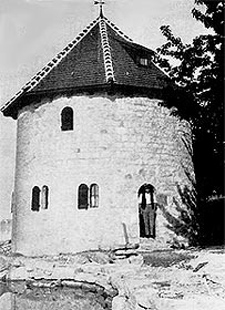
The tower, phase 1, 1923.  Creative Commons

The tower, phase 1, 1923. Creative Commons

Ten years before starting the tower, Jung had a painful break with Freud that precipitated a period of disorientation and a huge uprush of the kind of unconscious contents he had witnessed in schizophrenic patients.  Feeling that his experience was purposeful, he chose to submit to the unconscious with writing, art, and the effort to understand.  Out of this phase of turmoil and uncertainty, his unique psychological insights were born.  Paper and ink, he said, did not seem “real” enough to represent his discoveries, so in 1922 he purchased land on Lake Zurich for a “representation in stone” of his “innermost thoughts.”

Phase II, 1927.  Creative Commons

Phase II, 1927. Creative Commons

Jung wrote at length of the parallel developments of his inner life and the tower, over more than three decades, saying things like:

“At Bollingen I am in the midst of my true life, I am most deeply myself”

“At times I feel as if I am spread out over the landscape and inside things, and am myself living in every tree, in the plashing of the waves, in the clouds and the animals that come and go, in the procession of the seasons.”

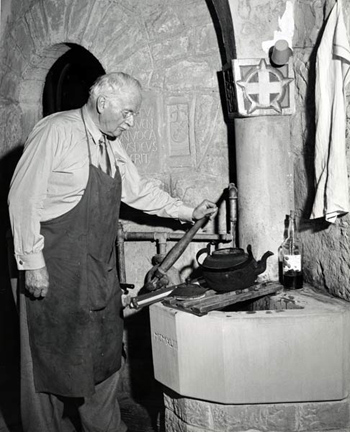
“I pump the water from the well.  I chop the wood and cook the food.  These simple acts make man simple; and how difficult it is to be simple!”

Jung pumping water at Bollingen ca. 1960.  Library of Congress

Jung pumping water at Bollingen ca. 1960. Library of Congress

While drawing inspiration from Jung, an obvious question becomes, how do I connect with this kind of depth in the midst of my own too-hectic life?  The good news is, we don’t need a tower to live in for months at a time.  The bad news is we need to unplug every day and tune into activities that nourish the soul; this is often hard arrange.  It takes focus, intention, and experimentation to find those things that center us and we are drawn to.  Any number possibilities come to mind:

  • “Spend an hour a day in a quiet room by yourself reading old stories that you find nourishing.”  That’s what Joseph Campbell said when Bill Moyers asked this question during the “Power of Myth” interviews.
  • Meditation, of almost any kind.  This my own core practice.  Zen teacher, Cheri Huber said, “If you start by watching your breath for as little as five minutes a day, it can change your life.”
  • Sports that allow one to get in “the zone,” especially walking, running, or bicycling.
  • Keeping a dream notebook.
  • Writing, though I suspect most bloggers will have the same difficulty I have in putting words at the service of psyche – how do I turn off the writing sophistication I’ve worked so hard to gain?  Can I ever truly use words in a “purposeless” manner, allowing them to go where the wish, without thinking, “Gee, this would make a good blog post?” For any chance of success, I need a definite strategy, like writing fast with a rollerball pen in cheap notebooks.
  • Visual arts or crafts.  Training or skill is not required for this kind of work, and in fact, can get in the way.  Those with artistic training may find it useful to paint or draw with the non-dominant hand.  Jung had no formal art training, but his private journal, The Red Book, only recently published, gives an idea of what may emerge if one is determined to honor the psyche.
Red Book, p. 131.  Courtesy Ox Aham, Creative Commons

Red Book, p. 131. Courtesy Ox Aham, Creative Commons

When I truly examine my own habits, it’s clear that I fritter away enough time with gadgets each day to find the space for this kind of exploration.  It doesn’t need to be with the kinds of activities I outlined above.  I find it’s ok to schedule “time for inner work” the way I schedule time at the gym, but the most powerful new discoveries seem to emerge from those quiet voices at the edge of consciousness, the tiny impulse it is so easy to overlook in our busy lives.

Such an impulse woke me one night at 1:00am one morning.  Instead of going back to sleep, I got up and wrote down a sentence.  That led to a paragraph, and then a page, and then another.  That was the start of the first (and so far only) novel I’ve finished.

Something similar happened to Jung at his tower.  He gave the stonemason at a quarry precise measurements for blocks he needed to build a new wall, but one of the stones arrived in error; it was square, about 20″ on each side.  When Jung saw it, he said, “That is my stone, I must have it!”  Over time, he carved a testament to his life and work on stone which “stands outside the Tower, and is like an explanation of it.  It is a manifestation of the occupant.”

Bollingen stone, main face, CC-BY-SA-3.0

Bollingen stone, main face, CC-BY-SA-3.0

In a seminar in 1939, Jung said:

“We have no symbolic life, and we are all badly in need of the symbolic life. Only the symbolic life can express the need of the soul – the daily need of the soul, mind you! And because people have no such thing, they can never step out of this mill – this awful, banal, grinding life in which they are “nothing but.”

The Bollingen Tower became a vital way for Jung to live the symbolic life, but he would have been the first to insist that we don’t need to carve stone or build houses to find it for ourselves.  All we need is the hunger.  And the will to begin.

What’s coming to TheFirstGates in 2014?

Courtesy Emma Paperclip, Creative Commons

Courtesy Emma Paperclip, Creative Commons

Thanks to everyone who visited this year, old friends and new.  Here are a few year end musings on where this blog may be going in 2014.   These are not resolutions.  Remembering Yoda’s words to Luke, “Do or do not, there is no try,” I don’t make resolutions.  These are sort-of-predictions, aka guesses, based on a line from a Grateful Dead song, “I can tell your future / just look what’s in your hand.”

In the case of theFirstGates, it should probably read, “look at what books are piled up on the table beside you.”  Looking at the titles in the stack, I predict more of the same, only new and (hopefully) better.

I’m currently reading a book I got for Christmas, Grimm’s Complete Fairy Tales.  The key word is complete – I haven’t read all the tales before.  The other great feature is the Arthur Rackham illustrations.  No one has ever painted Faerie like Rackham, and it’s a place I never tire of visiting.

Another new title is Trickster Makes this World by Lewis Hyde.  Not only is Trickster an ongoing object of fascination, but he pervades blogging just like the rest of life.  I’m reminded of this every time I hit Publish while meaning to click on Save.

And perhaps most important for TheFirstGates, I’m rereading The Dream and the Underworld, one of James Hillman’s important early works.  Here he turns the tables on psychology’s habit of translating the night world of dreams into the language of daylight; serving the ego, in other words.

Dream and the Underworld

Instead of asking what a dream means, Hillman asks what it wants.  This shift is fundamental to all of Hillman’s thought – psychology, the science of the psyche, in service to soul and soul-in-the-world.

Of great interest to me as a blogger is Hillman’s effort to see through literal events to the fantasies, the mythical layers that underly the stories we tell ourselves and the ones we see on the evening news.  The reality in our fantasies and the fantasy in all our realities.

The coming year is unique in one respect: 2014 marks the centennial of the start of that worldwide disaster misnamed “The Great War.”  The first world war has haunted me for years with its end-of-an-age immensity and sadness.  There are millions of stories to tell, and I’ll try to post a few here, from the bumbling youths who sparked the conflict to a young lieutenant named Tolkien who was sent to Mordor in 1916, though the generals called it The Somme.

And finally, as always I will continue to be on the lookout for those stranger-than-fiction events that leave us shaking our heads, wanting to laugh or cry or both at the strangeness of it all.

I wish you all a joyous New Year, and I hope we will all continue to share the emerging wonders of this online experience!

Getting rid of those pesky memories

In my previous post, I wrote of advances in the field of virtual reality, and posted a video clip that brought to mind the dystopian landscape of Aldous Huxley’s Brave New Word (1932).  Huxley imagined life in “The World State” in 2540, where children are born in “hatcheries.”  They are raised in “conditioning centers” and learn to be avid consumers and abhor the thought of solitude.

Happy face thumbs up

One of the World State’s tools for keeping people docile are “the feelies,” multi-sensory movies, most often centered on sex.  The connection to virtual reality should be obvious.  Another conditioning tool was “soma,” a side-effect free hallucinogenic drug that World State citizens used to go on “holidays.”  Soma relates to the subject of this post – a potential advance in the technology of feeling happy, happy.

In “Unwanted Memories Erased in Experiment,” an article in The Wall Street Journal (12/23/13, p. A1), Gautam Naik writes that scientists used electrical currents to erase memories they had implanted earlier.  Someday doctors may be able to zap painful memories and leave the rest in tact.  Assuming the technology becomes (relatively) safe, would this be a wise thing to do?

In a few cases it might be – the 39 patients who volunteered for the experiment were already undergoing electroshock therapy for severe clinical depression after all other treatments had failed.  But the article’s assertion that memory erasing might be useful to remove “associations linked to smoking, drug-taking, or emotional trauma” suggests the kind of social engineering Huxley wrote about.

Last year at a Buddhist teaching, I met an elderly woman who had spent her youth in a Soviet gulag.  As difficult as the hardship was, she had written a memoir for her family to read, “So they’ll know who I really am.”  Her core identity, as well as her later practice of Buddhism were direct results of those years of suffering.

In my late 20’s, I knew a woman who lost her closest male friends over a short period of time; they died of cancers related to Agent Orange exposure in Vietnam.  After surviving a deep depression, my friend enrolled for training to work in a hospice.  Without the pain of loss, she wouldn’t have found her calling.

The poet, Rilke, declined Jung’s offer of therapy work saying, “If you take away my devils, I fear my angels might flee.”  

The disowned parts of ourselves are especially important in scripture.  When Jesus offers living water (Jn 4:10-13), only those who know they are thirsty will hear him.  When Buddha teaches a path beyond suffering, we won’t listen if we’ve deadened ourselves with soma or reality TV.

A tour of America 80 years ago sparked Huxley’s vision of an economic and political culture at war with soul values.  Now that another “holiday season” has run its course, as the media waits for the next distraction, I am reminded once again of the cautionary words in this wonderful poem that William Stafford published in 1960:

A Ritual to Read to Each Other

If you don’t know the kind of person I am
and I don’t know the kind of person you are
a pattern that others made may prevail in the world
and following the wrong god home we may miss our star.

For there is many a small betrayal in the mind,
a shrug that lets the fragile sequence break
sending with shouts the horrible errors of childhood
storming out to play through the broken dyke.

And as elephants parade holding each elephant’s tail,
but if one wanders the circus won’t find the park,
I call it cruel and maybe the root of all cruelty
to know what occurs but not recognize the fact.

And so I appeal to a voice, to something shadowy,
a remote important region in all who talk:
though we could fool each other, we should consider–
lest the parade of our mutual life get lost in the dark.

For it is important that awake people be awake,
or a breaking line may discourage them back to sleep;
the signals we give–yes or no, or maybe–
should be clear: the darkness around us is deep.

Queen Bothildur: an Icelandic Christmas folktale

I found this story in a beautifully illustrated book of Icelandic folktales for children, Tales of the Elves, that I brought back from that country after a visit in 2012.

Tales of the Elves 400

One Christmas Eve, a richly dressed woman knocked at the door of a farm house in Hrutafjord and asked for shelter. The sheriff lived there and said she could stay.  When people asked her name, she said it was Bothildur, but she would not say anything else about herself.

She stayed home while everyone else went to midnight mass, and when they returned, they had never seen the house so clean and beautifully arranged.  The sheriff invited her to stay on as housekeeper, and she excelled at her work.  The following Christmas Eve, she stayed home again, but this time, when the household returned, they found Bothildur’s eyes red from weeping.

On the third Christmas Eve, Gudmundur, the sheriff’s shepherd boy, vowed to discover her secret.  As everyone walked to church, he feigned illness and turned back.  Gudmundur possessed a magic stone that made him invisible.  Holding it in his hand, he slipped into the farmhouse, where he saw Bothildur dressed in the finest clothing he’d ever seen.  She took a green cloth from a chest and set off into the night, with Gudmundur following closely behind.  They came to a lake where Bothildur spread the cloth on the water and stepped onto it.  The shepherd boy just had time to step onto a corner before the cloth began to sink.

Bothildur

It seemed like they were passing through smoke as they sank deeper, but at last they came to a grassy plain in front of a fair city.  Bothildur entered the city where everyone cheered.  A man who wore a crown embraced her and then everyone entered the church for Christmas mass.  Bothildur’s three children ran around the pews playing with three golden rings, until the youngest dropped his and couldn’t find it because the invisible Gudmundur had slipped it into his pocket.

When the service was over and it was time for Bothildur to leave, everyone was sad.  She walked alone with her husband onto the plain before the city.  Both were in tears and Gudmundur heard them say this was the last time they would ever meet.  They parted with great sorrow as Bothildur stepped onto the green cloth with Gudmundur behind her.

Bothildur returned home and was cleaning when the sheriff and the rest of the household returned.  Gudmundur came home later.  When asked where he had been, he told the entire tale of his trip to the land below the waters.  When Bothildur asked if he had proof, Gudmundur withdrew her son’s golden ring.  At that she was joyous.  She explained that she’d been a queen in Elf Land until a witch cursed her.  She could only return home on Christmas eve, and only a human brave enough to follow her to the world below could break the spell.  “Now you have released me and you shall be richly rewarded,” she said.

After saying goodbye to the household, Bothildur vanished.  That night, Gudmundur dreamed she came to him and gave him coins and jewels which he found beside his pillow when he awoke.  Later, he used that money to buy a farm of his own and get married.  In time, he became known far and wide as the luckiest man alive.

***

In Iceland, winter solstice celebrations were huge events – understandably, for by mid-December, the southern part of the country gets only four hours of light each day, and the northern regions, above the arctic circle, get only three.  Icelanders embraced Christianity in 1000 AD, but to this day, Christmas is a dual holiday, celebrating both the birth of Christ and the return of the sun.

Charming as it is that the doorway to the Other World should open on Christmas Eve, it’s a safe guess that Christmas is peripheral to the tale.  Stories of release from enchantment are found in every culture and predate Christianity.  Sometimes love and compassion break the spell, as in “Beauty and the Beast.”  Sometimes it’s bravery and cleverness, and sometimes even violence – in the first version of “The Frog King” published by the Brothers Grimm, the frog is disenchanted not by a kiss, but when the princess becomes so annoyed with him that she hurls him against a wall.

Aside from its simple charm, what fascinates me about Queen Bothildur’s tale is that Gudmundur, the young disenchanter, brings his own magical implement for the task.  Where do shepherd boys pick up magical stones of invisibility?  Jung believed that stones are frequently symbols of the Self, his term for the fully integrated personality.

Babylonian stone seal, ca 1595-1155 BC.  Creative Commons

Babylonian stone seal, ca 1595-1155 BC. Creative Commons

 Normally, such psycho-spiritual integration is the task of a lifetime, but in stories, legend, and scripture, young heroes as diverse as King David, St. Patrick, and Krishna worked as shepherds or cow herders when they were young.  However simple this folktale may be, it reflects what can be done by a person with a noble cause who is not at war with himself.

Belief in the Huldufólk, or Hidden People, the Elves, is common to this day in Iceland; in a 2007 survey, 57% of the population said they “do not disbelieve” in Elves.  In 2004, Alcoa had to pay a government expert to survey their proposed site for an aluminum smelter to make sure it was Huldufólk free.  Last year, we travelled a highway that had been diverted around an Elven dwelling.  We saw many small houses built on remote hillsides as homes for the Hidden People, and some Icelanders build them churches, in hopes they will convert to Christianity.

That may be an iffy proposition.  “The Icelandic word for Christmas, Jól, contains no reference to Christ or to the church. It is a Norse word that also existed in Old English as Yule.” (1)

Even so, as we read and tell their stories, I suspect the Elves are wishing us a Gleðileg jól go farsælt komandi ár – a Merry Christmas and a Happy New Year.

.