Of Inflection Points and eBooks

“Inflection point” is an interesting concept.  Originally a term from calculus, it signifies the mathematical point where a curve changes from convex to concave or vice-versa.

When I was at Intel, Andy Grove, the CEO, spoke of inflection points as key moments of transition in the life of a business or industry.  Here is a good definition of that usage from Investopedia:

“An event that results in a significant change in the progress of a company, industry, sector, economy or geopolitical situation. An inflection point can be considered a turning point after which a dramatic change, with either positive or negative results, is expected to result.”   http://www.investopedia.com/terms/i/inflectionpoint.asp#ixzz1kdT0EAcg

I don’t think we can clearly see inflection points until after the fact.  We can sense the importance of an event, but not be sure until we see the results.  Apple’s introduction of the iPod was such an inflection point, but even if Steve Jobs sensed it, the rest of us didn’t how thoroughly the way we listen to music would change.

A sadder inflection point became clear last week when Kodak filed for bankruptcy.  That was the moment, in 1975, when Kodak invented digital photography, but then chose not to purse it.

I spotted something last night that made me even more certain that Amazon’s introduction of the kindle will be seen as such an inflection point.

Last week I wrote about hearing a talk by Mark Coker, founder of Smashwords.  http://wp.me/pYql4-1DD.  Last night I saw that Coker is one of two keynote speakers, and is presenting three workshops, at one of the better writing conferences, the 28th annual San Diego State conference, taking place this weekend.

I attended the SDSU conference in 2007 because I’d met someone who sold her book there.  In 2007, one speaker talked about Print on Demand.  Ebooks were not even mentioned.  This year there are the same number of seminars on traditional publishing as there are on ebook publishing, and this in a conference that draws a lot of agents and editors. http://writersconferences.com/index.htm

I did a rough count of seminar topics, judging their their emphasis as well as I could by the titles:

39 seminars on craft of writing
8 seminars on how become traditionally published
8 seminars on how to e-publish
8 seminars on marketing or other topics
1 seminar on social media

To me, these numbers do not signify an inflection point; they signify an inflection point that has already passed.  Last week I heard an established writer say “the jury on ebooks is still out.”  I don’t think so.  I think the battle is already over.  When new technologies affect traditional media, be it music, photography, or writing, they always carry it toward greater democracy, toward putting ever more powerful tools in everyone’s hands.  This does not appear to be a reversible trend.

We all miss certain artifacts after they’re gone.  Some music lovers swear by the sound of vinyl, and while I don’t miss the darkroom, silver prints could be beautiful, and I love old kodachromes.

I hope we don’t see a day when paper books become collectors items, but nostalgia will not hold back the tide, especially when it’s grounded in both a sense of personal freedom and economic reality.  To paraphrase what a Zen teacher said about change:  we can be okay with it.  Or not be okay with it.  The one thing we cannot do is stop it.
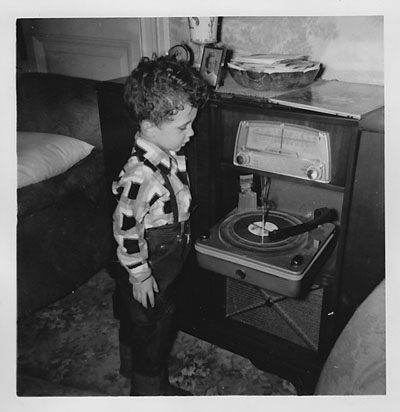
Yep, thats me. How many artifacts of the past can you count?
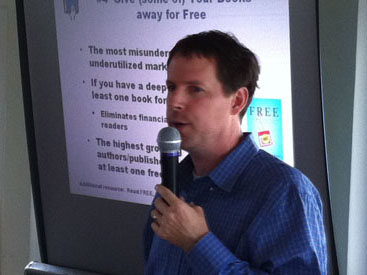
Lunch with Ebook Advocate, Mark Coker

According to Time Magazine, in 1812, the year Charles Dickens was born, 66 novels were published in Britain.  Many were written by “Anonymous,” since novels were not very reputable.  No one dreamed of making a living writing them.  Dickens, the first literary celebrity, whose bicentennial we celebrate this year, was instrumental in changing that, but he never could have imagined today’s literary landscape, which his work helped to create.

Mark Coker, guest speaker for January’s California Writer’s Club lunch, described an experience that is emblematic of the challenges faced by new writers today.  Coker and his wife co-wrote a novel.  They went through the revision process, and eventually became clients of a prestigious New York agency.  Two years later, their book remained unsold.  Coker’s solution was Smashwords, an ebook publishing service he started in 2008 that is at the forefront of changes rippling through the industry.

Mark Coker

Coker says that large publishers “look in the rearview mirror” for what has worked in the past.  There is little financial incentive for them to risk new concepts and new authors.  Even an author who wins the publishing game and gets a book on the shelves has no guarantee that a title with slow sales will not be remaindered within a matter of weeks.  That may not be enough time to establish the buzz that drives success.

Publishing on Smashwords is free and fast.  Correctly formatted books are distributed to all the major ebook publishers, and authors receive 85% of the sales.  Books do not go out of print, so there’s time for word of mouth to evolve.  Smashwords usage is growing exponentially.  Authors uploaded 140 books in 2008.  In 2011, the total was 92,000.

Smashwords historical usage, from a chart on their blog

Coker’s talk was animated with a sense of mission.  He said what gets him up in the morning is, “enabling writers to express themselves.”  He never suggested it’s easy, however, and most of the rest of his presentation detailed what is required.

First in importance, of course, is a really good book.  Coker suggested as many revisions and beta readers as necessary, and possibly professional editing.  At stake is the trust of readers, hard to build and easy to lose.

Next in importance are a well designed cover and compelling blurb.  Coker says polls reveal that “discovery” accounts for 50% of ebook sales – in other words, we still buy books by their cover.  This is good news for indie authors.  Only 18% of readers polled reported sticking with authors they know.  This means that for independent authors without design skills, hiring an artist is almost essential to come up with a cover that will capture attention as readers scroll through pages of thumbnails.  An email to list@smashwords.com will generate an auto reply listing 3d party artists and people who handle format.

Coker presented more information than I can cover in one article.  He has free guides to ebook formats and marketing at https://www.smashwords.com/.  Other topics are covered on the Smashwords blog, (referenced on the blogroll here) and at http://www.huffingtonpost.com/mark-coker.

With ebook sales continuing to climb; with Apple’s move into electronic textbooks; with Smashword’s impending foray into library distribution, it becomes increasingly clear that ebooks are where the future of publishing lies.  Mark Coker used the phrase, “democratization,” which again brought to mind the Time article on Dickens I referenced to begin post.

“The flood of books in the 19th century elicited two powerful institutional responses:  the rise of prize culture and the rise of literature as a field of study.  The message (sometimes subliminal, sometimes not) was that the masses needed help figuring out what to read, and the cultural elite…was going to provide it.”  (“Charles in Charge” by Radhika Jones in Time, Jan. 30, 2012)

Noting that such elitism broke down well before the advent of ebooks, (for example, with the rise of Oprah as our great taste-maker), Radhika Jones ends her article with a question that would likely delight Mark Coker and maybe Charles Dickens as well:  “Will the readers of the future find their 21st century Dickens on the Pulitzer roster or the best-seller list or FanFiction.net?”

“The future is in your hands,” said Coker at the end of his talk.  “The power of publishing is shifting to the authors.  Go and serve your readers.”

Ebooks at the New Year

A funny thing happened to ebooks last year – they became legit.

Last January, right after I got my kindle, I started noticing stories about Amanda Hocking and a few other ebook superstars in places like the New York Times and the Wall Street Journal.   The articles had a semi-surprised, “look at this,” tone.  No longer.  Now an ebook author doing well raises no more eyebrows than John Grisham writing another best seller.

Even though I was paying attention, I don’t quite know when the shift in attitude happened.  It was a done-deal by October.  That’s when a local member of the California Writer’s Club asked advice from the group:  his manuscript was ready.  Should he submit it through traditional channels or go the ebook route?  Everyone in the room, with no exceptions, recommended the ebook option.

As recently as twelve months ago, people still talked of ebooks as “self-publishing,” a phrase that carries a touch of “vanity press” stigma.  That has changed.  Now we speak of “traditionally published” in contrast to “independently published” authors.  Listen to the words:  traditional vs. independent.   Which one has more panache?

Not long ago, approval by traditional agents and editors signified quality.  I think the rapid loss of brick and mortar stores was a factor in changing that.  When Borders folded, half the gates that gatekeepers kept disappeared.  As the industry scrambles to find new ways to stay afloat, literary quality may not be so big a factor in the mix.  Mark Coker, the founder of Smashwords put it like this:  “The cachet of traditional publishing is fading fast. Authors with finished manuscripts will grow impatient and resentful as they wait to be discovered by big publishers otherwise preoccupied with publishing celebrity drivel from Snooki, Justin Bieber and the Kardashians. 

When you consider more serious fiction, odds seem to favor established names more than ever these days, in stores both large and small.  I stopped at an independent bookstore last fall in a small town.  It has been around for a while and continues to thrive.  There were lots of attractive craft and gift items – pens, handmade notebooks, and things like that.  The books were shelved by genre, and carefully chosen to reflect popular titles and series.  It was easy to find something good to read, but almost all the choices were books by established authors.  I’d do the same if I was the owner and wanted to stay in business, but that’s bad news for authors just starting out.

This is where time enters the equation for everyone, especially for older writers.  The man who asked the ebook question at CWC was about my age and put it like this:  “I don’t have forever.”  Mid-list titles, which authors used to be able to sell while learning their craft are an endangered species.  “Their demise has been predicted for years,” said agent Donald Maass.  “This time it’s true.”  As all these trends converge, the attraction of the ebook publishing has exploded.

One thing I notice consistently in the ebooks I have enjoyed is a certain playfulness or quirkiness,  a willingness to step off the path of genre convention.  I’m reminded of fantasy fiction in the ’80’s, when getting published wasn’t such a nail biting affair.  The stories were full of surprises.  Writers took more chances than those I see today at Barnes&Noble.

Recently, a well-meaning writer friend warned me that, “Editors don’t like colons.”  That’s the second time someone has said that, and I’ve heard exclamation points are out of favor too!  The only kind of writer who’s going to remember tidbits like that is one who is contentious, dedicated to learning her craft, and interested in giving her peers a leg up.  And yet…isn’t that kind of “wisdom” going to backfire?  Where is my imagination when I’m trying to remember which punctuation marks are okay to use?  I’m not going to be fully engaged in telling the best story I can, especially if runs afoul of news of “what editors are looking for now.”

Everyone has to come to their own conclusions about what to read, what to write, and what to do with their writing.  I find myself ever more grateful for ebooks and independently published authors.  I plan to champion more of them this year.

Handmade books

Recently, I came across an estimate of the number of ebooks that will be published next year. I think it was 3 million, but I don’t really remember, and I cannot recall if that was in the US or worldwide. Funny that such a huge number of books was such a non-event for my brain – or maybe it isn’t funny.  Maybe it’s very natural.  Add to that, say, 780,000, the number I remember for traditionally published books last year, and you get, 3,780,000 / 365 = 10,356.16 books per day in 2012.  Even if I am high by an order of magnitude, that’s still more books  being published in one day than I will read in ten years.

Of that total number, I’m guessing a dozen or so will matter to me.  The others will be non-events.  These reflections led me to recall when I was in art school, and there was a large revival of handmade paper as art and craft.  One thing people did with handmade paper was make books by hand.

Books!  Do you remember the sense of wonder books can evoke?  Remember how mysterious they were as when you were just learning to read?  The books you carried everywhere, as a kid and as an adult?  The books that opened new worlds to you or opened new ways of looking at this one?  Have you ever prowled used bookstores, remember stories of people just like you who discover hidden books on magic or other forgotten lore?

It must be this kind of love and fasciation that inspires the artists I picked at random while searching for “handmade books.”  There is nothing comprehensive about these choices .  There are far too many wonderful people making books these days for that.  Hopefully these few pictures will give an idea of what’s possible.  Check the links for further information.

Wooden Book by Barbara Yates

Barbara Yates is an environmental artist who recycles dead trees into art for parks and retreat centers

History of Western Europe by Brian Dettmer

Brian Dettmer’s work reminds me of a dream I’ve had on several occasions, where I am reading a book but cannot decipher the key passages.  Here is the link for his work and Barbara Yates’s:  http://mywiki.ws/The_Most_Unusual_Books_of_the_World

***

Handmade book by Geraldine Newfry

Check out the section on handmade books on Geraldine Newfry’s blog, The Creative Life Unfolds: http://newfry.typepad.com/newfry/handmade_books/

***

Handmade book by Lauren Evatt Finley

There are a number of step-by-step photos of the binding process in the handmade book archive section of Ms Finley’s blog, The Disarranged Studio:   http://laurenfinley.wordpress.com/category/handmade-books/

***

A tintype journal

Website for this tintype journal: http://www.thisnext.com/tag/handmade-books/

***

Handmade book by Carol Roemer

Carol Roemer is an artist whose primary medium for the last ten years has been handmade books. This is her website:  http://www.carolroemer.com/handmadebooks.html

***

This is the cover of a scrapbook “Garbonzobeenz1” made for Christmas photos of her first Christmas in a new house, with her first grandchild.

The website where I found this illustration, twopeasinabucket.com, is an extensive site devoted to scrapbooking, using traditional and digital tools. It should be of interest to anyone who won wants to explore this craft. http://www.twopeasinabucket.com/gallery/member/18824-garbonzobeenz1/1253837-christmas-magic-handmade-book/

***

And finally, here is an electronic pop-up book made by Jie Qi, a grad student in the MIT lab’s Hi-Low Tech group:

***

It’s interesting that many people who recognize the magical and iconic nature of books are visual artists and craftspeople.  It wouldn’t be the first time “outsiders” bring a fresh perspective to a discipline.  I’m not suggesting a fuzzy nostalgia for the old days:  I no more want to trade WordPress for a Gutenberg press than I want to exchange my mac air for an eniac.

What I am suggesting is that the work of these artists leads me to a deeper appreciation of the wonder of what we book creators are doing.

One More Way to Publish A Book

Think the new world of publishing is complicated these days? Here’s another option in the mix:  Espresso. That is the name of the new book printing device just purchased by the Sacramento Library.  Espresso is a $150,000 machine that works from digital files and can print and bind a softcover book, up to 800 pages in length, in about five minutes.  Only a few of the machines exist in California, and this is the only new model west of the Mississippi.  It comes to us through a grant from the California Library Association.

Printing costs are TBD.  Setup costs for original books are likely to run to $100, while ordering one of millions of books in available databases – titles no longer in print, or not to be found in bookstores or library shelves, are likely to be around $9.  Here are a few more things the downtown library plans to do with Espresso:

In connection with the original books, the library has started what it is calling the I Street Community Writing and Publishing Center.  The library will start holding writing classes in branches to try to replace the recently ended UC Davis Extension Creative Writing program.  “It’s really about working that connection between reading and writing and community,” said [Library Director] Rivkah Sass.  There are also discussions of using the machine to support 916 INK, a new program that includes publishing student authors as a key part of literacy education.  http://www.sacbee.com/2011/10/21/v-print/3992292/sacramento-library-will-unveil.html

I’ve never researched costs, procedures, and shipping options for print-on-demand, so I don’t know if this will be competitive for writers looking to self-publish quantities of books, but one exciting use comes to mind:  family memoirs, histories, and diaries.  Wouldn’t it be interesting to have the recorded thoughts of the ancestors who lived a few generations back?

In the first days of personal computers – of TRS-80’s, Commodore64’s, and Apple-IIe’s, there was a distinct, “Power to the People” ethic among the early adapters of gear that had once belonged only to corporate elites.  “Be careful what you wish for,” comes to mind when I confront my own elitist ideas on writing.  Everyone who has ever downloaded a really terrible, $0.99 ebook knows what I mean, and I did that a lot when I first got my Kindle.

Yet when I read of the library’s plans to offer and guide this advance in the democratization of publishing, I am filled with a lot of hope.  This Pandora’s Box is now fully open; there’s no going back, and up to us to apply creativity to the new tools.

I think it’s analogous to blogging.  There are hundreds of thousands out there, but given limited time, you have to be choosy.  Thanks for choosing The First Gates today!

A Vote For Ebooks

Last weekend, I attended the monthly meeting of the local branch of the California Writer’s Club. The meetings feature introductions, socializing over a buffet lunch, and a speaker. This month we tried something new. Members were invited to throw out a question or concern. The rest of the group had five minutes to offer suggestions.

A man at my table had finished writing a fantasy novel and was wrestling with whether to try to get it traditionally published or go the self-publishing route in ebook format. Quite a few members weighed in, including unpublished, traditionally published, and self-published writers. Several others present provide marketing and design services for writers. What struck me was that everyone who spoke, without exception, urged the questioner to go the ebook route.

Several people pointed out that nowadays, successful ebook sales are an alternate route to acceptance by traditional publishers, a message we heard at an agent’s workshop last winter, and one that is underscored by the deal Amanda Hocking made with St. Martin’s Press. Others mentioned the amount of time it takes to see one’s work in print even after winning acceptance by one of the big six publishers. This underscored the author’s comment that, “At my age, I don’t have unlimited time.” One of those who provide marketing services for writers emphasized the need for a plan to publicize one’s work regardless of how your book gets published.

Even ten years ago, “self-publishing” was synonymous with “vanity press.” No longer. Not one person in the room raised the issue of “legitimacy,” one of the draws of traditional publishing before the recent spate of ebook success stories. Now, to paraphrase The Godfather, everyone who spoke felt the decision was, “just business.”

Literary Indigestion

This won’t be the first time I’ve said I love fantasy and have since I was a kid.  During the ’80’s, I read scores of fantasy novels, but the day finally came when I couldn’t anymore.  One too many recycled plots, wise wizards, crusty dwarves, plucky youths, heroic thieves, feisty tavern wenches, and so on.  I developed acute genre indigestion and have only recently started reading adult fantasy again.

History repeats itself.

A dozen years ago, I discovered young adult fantasy and delighted in some of the characters and stories.  Inspired by these, I even wrote my own first novel in just six months, in 2005.  Recently, however, YA fantasy has been “discovered.”  Now I find I can’t read this genre either; bandwagons and the perception of money and names to be made don’t lead to books with much imagination or heart.

A glut of vampire romance was followed by a glut of stories of Faerie and zombies.  After the success of The Hunger Games, “dystopian” tales became the theme du jour.  Now stories of were-beasts are all the rage.  I sometimes wonder if I am a snob or too harsh in my judgements, so I yesterday I took a look at the YA fantasy titles featured on Amazon.  Here are some descriptions I found in the blurbs:

“A lyrical tale of werewolves and first love.”  – I gotta say it, “Awwww!”

“explodes onto the YA scene with a brilliant nail-biter of a dystopian adventure.”  –  Think about the phrase, “YA scene.”

“A kidnapped wolf pup with a rare strain of canine parvovirus tuns regular kids into a crime solving pack.”  –  I’m a sucker for dog stories, and I like wacky superheroes, so this one sounds like the best of the bunch.

“Can a prim young Victorian lady find true love in the arms of a dashing zombie?”  –  I would have said “dashing zombie” is an oxymoron.

“A timeless love story with a unique mythology that captivates the imagination.” – The blurb didn’t say what this unique mythology might be, so you have to take the publicist’s word.

This book is “generating a Twilight-level buzz.”   I’ve never heard of it.

OK, I guess I’m being a little snarky.  It seems that today’s YA represents a successful move by writers and publishers to attract a new demographic of younger readers to what is essentially, romance.  On one hand, this largely excludes me as a reader and writer, because while I think romance is fine, it’s not my thing.   I also find it sad to think that over the near term, we’re going to have zombie love instead of books like A Wrinkle in Time, The Earthsea Trilogy, and The Golden Compass.

So what am I doing about it?  Kicking back with literary comfort food, otherwise known as light detective stories, stories with fun characters you just want to trail along with as they bring justice into the world.  In the past, I’ve devoured stories by Conan Doyle, Agatha Christie, Tony Hillerman, and Elizabeth Peters.  Now, thanks to my wife, I have a new main-man – Hamish MacBeth, the constable of the village of Lochdubh, Scotland, who, with his dog, Lugs, and his cat, Sonsie – and wee dram now and again – excels at solving murders.  Hamish is the creation of M.C. Beaton, the pseudonym used by author, Marion Chesney, for her mystery stories.  Born in Glasgow in 1936, she has also written 100 historical romances under a different names.

M.C. Beaton

My wife has collected a bookshelf full of MacBeth stories, and I’ve only started.  My current read is, Death of a Chimney Sweep.  In one passage, Hamish is driving an author to meet her publisher. He says to her,  “Angela, you’re taking this all to seriously.”

“What would you know?  You haven’t a single ambitious bone in your body.”

“Aye, and I like it that way.”  Hamish suddenly wished the evening was over.

I love these stories!   I will have more to say about Hamish MacBeth in my next post.

An Important Book You Can Only Buy on Amazon

News on ebooks seems to come in clusters, and it happened again today.  While having lunch at Fresh Choice, one of those build-your-own-salad type places, I was reading and enjoying a Donovan Creed novel by John Locke who I wrote about yesterday.

I’ve said many times that I think the burgeoning option of ebook publishing is important for readers and writers.  But there is important and there’s important.   Here’s something weightier than simply a good read.

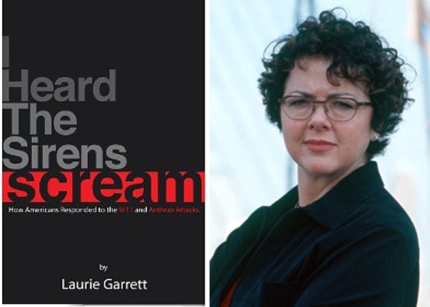
After my lunch, I got in the car and turned on NPR to listen to, “Science Friday.”  Laurie Garrett was being interviewed about her book on 9/11 entitled, I heard the Sirens Scream.

Ms Garrett is senior fellow for global health at the Council on Foreign Relations.  She’s the only journalist to win “the big three” prizes in her field, the Peabody, the Polk, and the Pulitzer, but you cannot get her book in a bookstore – it is only available on Amazon.

With all the impending chest thumping and flag waving on the occasion of the 10th anniversary of 9/11, I would suggest everyone listen to or read the transcript of this interview:  http://www.npr.org/2011/08/26/139972661/a-look-back-at-9-11-in-i-heard-the-sirens-scream

Garrett is furious that New York:  “became the reason to beat the drumbeats of war, that the attacks on our city were used by people who don’t live here to decide that we needed to invade Iraq, that the attacks on our city have been used by any number of politicians, misused, abused, with rewritten narrative, you know, the great lies told to justify all sorts of political things, everything from decreasing our civil liberties to building up a massive bioterrorism apparatus in this country, distorting our whole public health mission.

And I think the other thing is that as we approach the 10th anniversary, I should warn your listeners you’re going to be deluged with pathos.”

She contrasts this with the attempts of by Congress to deny funding to surviving Twin Towers rescue workers.  Garrett herself, who spent time near ground zero, was coughing up blood on her pillow at night, and talks of the way reports were massaged to remove the word, “asbestos.”

She summarizes worldwide response to 9/11 as unity or “singularity,” in outrage at the horror of the attacks, but goes on to say:  “You go out 120 days, that singularity has turned into the exact opposite: a moment of complete fracturing, of compete degeneration of the unity that was on one day…I think many of the ways that we responded, whether we’re talking about the public health response, the political response, the law enforcement, whatever aspect you look at, many of ways we responded set the seeds for this terrible, almost civil-war-type atmosphere that we live in in this country with such partisan dispute that the word compromise is considered evil, and the word governance is on nobody’s lips.”

You can see more of Laurie Garrett’s work on this and other topics at her blog: http://www.lauriegarrett.com