Remembering Ten Years Ago
Reply
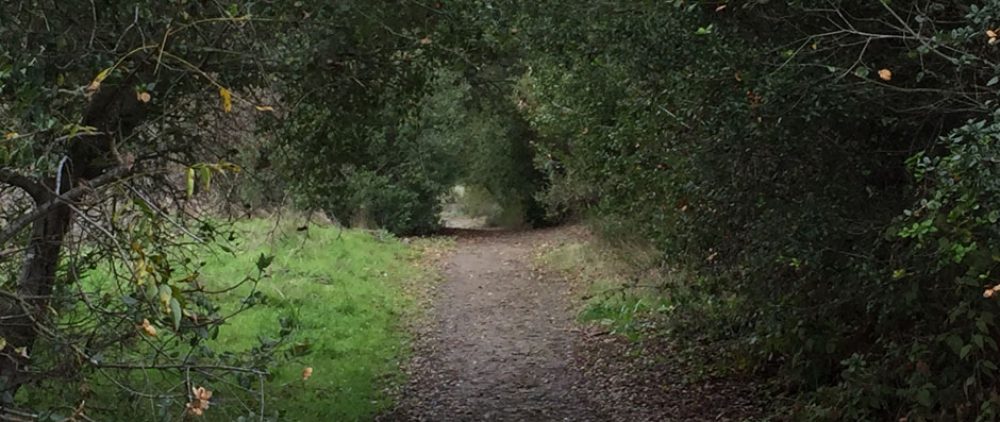
The other day, I took a break from literary activities to meet a friend in Fair Oaks Village for coffee. Once upon a time, Fair Oaks was a farming community, separated by miles of fields and orchards from Sacramento. Those days are gone, but there’s still something inviting about the town. It’s slower than the boulevards and mini-malls that surround it, but not yet gentrified. That may have something to do with the chickens, but I will get to that.

Fair Oaks Coffee Shop and Deli
So my friend were I are sitting at a table outside, having coffee and waxing eloquent on matters of great import, when I spotted a mutant chicken pecking at the pretzel I’d dropped on the sidewalk. If you really pay attention, even normal chickens are sort of scary; you can understand the theory that they descend from dinosaurs. Watch them run around, and you think of mini-velociraptors. Yet chickens are the official Fair Oaks bird. Herds of them run loose in town, and they are even featured on the town sign.
Once, when our dog, Holly, was younger, she jerked her leash out of my hand and took off after a chicken. By the time I caught her, thinking I was about to burst a lung, an irate citizen informed me that chickens are protected. I believe I said something along the lines of, “Come on, Holly, we’ll hunt for dinner elsewhere.”
Fair Oaks is famous for chickens, and I have it on good authority that people throughout the region come here to dump their excess fowl. What you have is a group of birds that interbreed, and every now and then you see a really demented one, who could play in a monster movie. Such was the one who pecked at my feet the other day. It had some kind of growth, like the extra head on the alien in Men In Black II. I was so busy thinking of tetanus shots and keeping my feet out of its way, that I forgot the camera phone in my pocket and didn’t document the monster. Today I went back with a real camera, and naturally all the chickens looked normal – or as normal as chickens can look.
Here’s the Fair Oaks chicken ideal:

Mural on the Fair Oaks, open air theater
And here’s the reality – chickens invading the public men’s room:

Employees must wash their hands before returning to work
The ideal – an idyllic shot in the town square
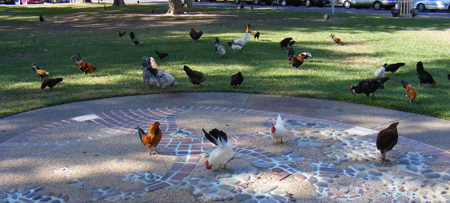
Don’t be fooled! Think of Alfred Hitchcock.
The real – high noon in roosterville.
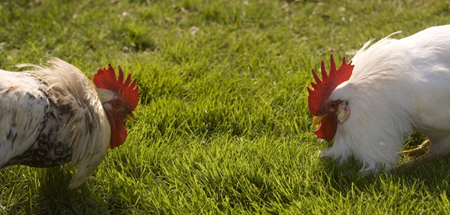
Go ahead – make my day.
And finally, here is the biggest Ideal Chicken of all – at the 2010, Fair Oaks Chicken Festival:

Has everyone had a chance to go, “Awwww?” If you can make it, this year’s Chicken Festival will be held on September 17. Feel free to bring the munchkins, but be ready to change the subject if they ask, “What’s for lunch?” Last year, the featured item was barbecued chicken. (I’m serious).
Have fun if you go. I would never dream of saying anything on my blog about eating Big Bird, but I will be home that day eating tofu. Probably with the shades drawn too, in case the mutant chicken knows where I live.
I met Dr. Amy Rogers at the Sacramento branch of the California Writer’s Club where she is Web Site Coordinator, and an author of science thrillers. What is a science thriller? Think of Frankenstein, Jurassic Park, and Contagion, coming soon to a theater near you. You can learn a lot more about the genre and read a number of reviews at Roger’s blog, http://www.sciencethrillers.com.
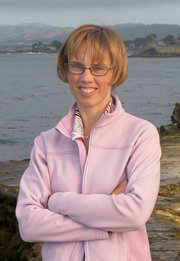
Dr. Amy Rogers
Dr. Rogers just published her debut thriller, Petroplague, in ebook format, with a paperback release due in November. She sent this synopsis:
UCLA graduate student, Christina Gonzalez, wanted to use biotechnology to free America from its dependence on Middle Eastern oil. Instead, an act of eco-terrorism unleashes her genetically-modified bacteria into the fuel supply of Los Angeles, turning gasoline into vinegar.
With the city paralyzed and slipping toward anarchy, Christina must find a way to rein in the microscopic monster she created. But not everyone wants to cure the petroplague – and some will do whatever it takes to spread it.
From the La Brea Tar Pits to university laboratories to the wilds of the Angeles National Forest, Christina and her cousin, River, struggle against enemies seen and unseen to stop the infection before it’s too late.

A former professor of microbiology, with a PHD from Washington University, Dr. Rogers has the background to make such a story plausible. In addition, Petroplague is one of two of her novels picked up by New York agents who were then unable to sell them. At this point, Rogers mentioned self-publishing, and her agent directed her to Diversion Books, which she says, “lies somewhere between self-publishing and a traditional Big Six contract. Diversion Books is loosely associated with a traditional literary agency – the first such publisher, though others have sprung up since.”
I plan to review Petroplague here, but you don’t have to wait for me. Click on the book cover photo above to go to the authors website, http://www.amyrogers.com, to view a trailer and read the first two chapters for free.
In addition, Amy has said she’ll be happy to write a guest post or answer interview questions here. So stop back soon, and visit Amy Rogers’ website and blog, for information on publishing, on scary microbes, and to check out what promises to be an exciting read!

Twenty-one million years ago, in the Pinwheel Galaxy – a close neighbor in cosmic terms – a white dwarf star exploded. This week, as the moon sets early, we will have the rare chance to see this one-time sun’s final blaze of glory from our own back yards, with just a small telescope or a pair of binoculars. Scientists are calling this a once in a generation event; type 1a supernovas like this are usually much farther away.
How do you find it? Locate the last two stars on the Big Dipper’s tail, and imagine an equilateral triangle pointing north:
According to a Washington Post article, because type 1a supernovas are equal in intensity, astronomers use them to refine calculations of distance. In the 1990’s, Robert Kirshner of Harvard: “led a team that leveraged this property to make one of the biggest discoveries of the past century: The universe is flying apart, rapidly accelerating.
To explain this, cosmologists were forced into an uncomfortable conclusion. Either gravity does not work the way it is supposed to, or a mysterious force is pushing galaxies apart at a quickening pace. They called this unknown force “dark energy” and still have little idea what it is, even though they are able to calculate that it constitutes an astounding 73 percent of all mass and energy in the universe.” http://www.washingtonpost.com/national/health-science/brightest-supernova-in-decades-serves-up-cosmic-clues-for-astronomers/2011/08/31/gIQA88CqwJ_story.html
Telescopes large and small, both on earth and in space (the Hubell) will be trained on this event, in the hopes that it may even clarify the nature of dark energy. Though I don’t have a telescope, my father’s old film camera has a telephoto lens, and I’m hoping that on a tripod, we may be able to see the pinwheel galaxy.
I find this of interest from more than a scientific (or aging Trekkie) perspective. The world’s religions tell us that things are not what they seem. Most of the time we can only approach such truths through inference, faith, or meditation. For the next few days we will have the chance to turn our physical eyes on something dramatic that has not existed physically for millions of years.
Something to think about…
 Ever since I posted some notes on Anne Lamott (August 29), I’ve been mulling over her comments on the importance of truth in writing, and how that relates to blogging. Overtly, her words do not have to do with the online world. Bird by Bird, Lamott’s book on writing, was published in 1994. By then, a few people had learned not trust everyone in a chatroom, but we were still years away from the need to decide what sorts of truth to reveal to what sorts of people in our Facebook profiles.
Conclusion 1: If we didn’t know it before, we have learned online that there are many kinds of truths. Some are for Friends and some are for Everyone, and it’s good to know the difference.
I don’t think I’m being picky; it’s just that when someone talks about “truth” I am never quite sure what they mean. “Truth or reality, or whatever you want to call it is the bedrock of life,” says Lamott. Hmmm. Well we all agree that the sun sets in the west, but luckily for us bloggers, there is little consensus on truth beyond such “obvious” things. If there were – if we learned any final realities in school, there would be little for us to write about.

Conclusion 2: According to biologists, the cells in our bodies renew themselves in seven year cycles, and experientially, my beliefs/truths transform in a similar time frame. I no longer believe several key stories I was convinced of just five years ago. Even people’s core beliefs, often matters of faith, are subject to alteration: the Jesus someone believed in at 3 is not the Jesus they know at 30 or 60.
To be fair, I think the kind of truth Lamott points to in her book on writing is “gut level honesty,” but still, what is that? In her essays she uses a lot of self-revelation. She walks that tightrope successfully because her personal stories fit and illustrate the points she is trying to make, but it’s one of those “don’t try this at home” kind of things. Luckily, most bloggers I follow use self-revelation appropriately too. Perhaps it’s because we know a post goes to Everyone, and that understanding makes us circumspect.
Conclusion 3: I was lucky enough to find a reliable standard for self-revelation in writing when I came upon Black Elk Speaks, by John Niehardt when I was 18. Though I may not always live up to it, I have always aimed at the standard set by the great Lakota medicine man. If anyone had an interesting story to tell, it was Black Elk, who knew Crazy Horse and Sitting Bull, and witnessed the Little Bighorn and Wounded Knee. Yet he begins his historic account with these words:
“My friend, I am going to tell you the story of my life, as you wish; and if it were only the story of my life I think I would not tell it; for what is one man that he should make much of his winters, even when they bend him like a heavy snow? So many other men have lived and and shall live that story, to be grass upon the hills. It is the story of all life that is holy and good to tell.”

For me, “truth in writing” is one of those abstractions, like “voice,” that it’s better not to worry about. We may “know it when we see it,” but operationally, it’s better to simply write, then post, then write again. If I “set out to find my voice,” I am guaranteed to be silly at best.
At least that is my truth for today. Next week or next month it may be something different, but that’s ok. Pretty natural, I believe. When you really think about it, most “truths” do not have a very long half-life.
 The First Gates