
What Rough Beast?

William Butler Yeats by George Charles Beresford, 1911

I posted William Butler Yeats’ best known poem, The Second Coming five years ago. Its time has come round again. Yeats (1865-1939), one of our greatest English language poets, had an abiding interest in the mythology and folklore of his native Ireland.

He was also a member of The Golden Dawn, an organization devoted to western esotericism. The Golden Dawn developed a series of visualizations and meditations designed to awaken subtle areas of consciousness. Yeats presented The Second Coming as a breakthrough of visionary experience, framed within his personal theory of  “gyres,” or cycles of time, analogous to the eastern idea of “yugas,” or ages.

Written in 1919 and published in 1921 The Second Coming was naturally read at the time as a reaction to the horrors of World War I. But the archetypal imagery Yeats brought up from the depths cuts deeper than specific personal or historical issues. It speaks as clearly to our own times, as if the forces that break and end eras and empires and civilizations are not exhausted in a decade or two. And though we can all identify our own Rough Beasts du jour, that doesn’t answer the key question of where the forces that drive such men to loose the blood-dimmed tide may come from…

The Second Coming

Turning and turning in the widening gyre
The falcon cannot hear the falconer;
Things fall apart; the centre cannot hold;
Mere anarchy is loosed upon the world,
The blood-dimmed tide is loosed, and everywhere
The ceremony of innocence is drowned;
The best lack all conviction, while the worst
Are full of passionate intensity.

Surely some revelation is at hand;
Surely the Second Coming is at hand.
The Second Coming! Hardly are those words out
When a vast image out of Spiritus Mundi
Troubles my sight: somewhere in sands of the desert
A shape with lion body and the head of a man,
A gaze blank and pitiless as the sun,
Is moving its slow thighs, while all about it
Reel shadows of the indignant desert birds.
The darkness drops again; but now I know
That twenty centuries of stony sleep
Were vexed to nightmare by a rocking cradle,
And what rough beast, its hour come round at last,
Slouches towards Bethlehem to be born?
The Crazy Wisdom of Mr. Rogers

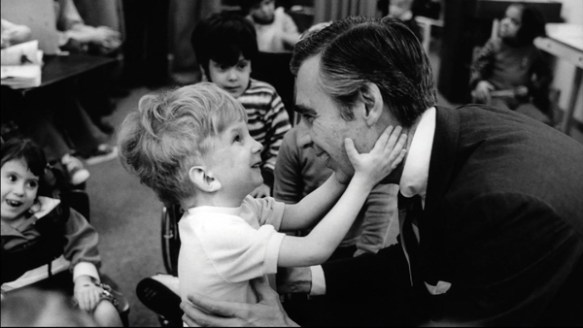
Fred Rogers and fan in “Won’t You Be My Neighbor?”

In “Won’t You Be My Neighbor,” this summer’s biographical film about Fred Rogers, he says “Love – or its absence, is all that really matters.” The sincerity and quiet strength of the man, an ordained minister who chose to express this philosophy through the medium of children’s television, is one of the reasons the movie won a 99% rating on Rotten Tomatoes.

As I watched Rogers’ interaction with children, the only comparison I could think of was clips I’ve seen of the Dalai Lama with young people. Both men – bodhisattvas by any reckoning – never lost their connection to the wonders and terrors of childhood.

I also thought of Saint Francis during the scene of Fred Rogers with Koko the Gorilla, who watched him on TV and was a fan.

At the end of the movie, we see a world that is changing for the worse. In a clip from a Fox News broadcast, commentators condemn Rogers for teaching children that they are all precious and lovable just the way they are. Let that sink in for a moment!

After his death, protestors gathered across from his memorial service to condemned him, not because they thought he was gay (he wasn’t), but because he accepted gays. One child in the crowd who looked miserable – in contrast to the children on Mr. Rogers’ show – held a sign reading, “God Hates America.” If Rogers had been there, he might have reminded the child and his parents that Jesus’ response to everyone he met was, “Neither do I condemn you.”

“Mr. Rogers’ Neighborhood” first aired 50 years ago this summer. Watching this movie, I thought of the voice-over during the opening scene of Gandhi: “People of the future will find it hard to believe that such a man existed.”

Fifty years ago, America felt like felt like a nation torn apart: an escalating war in Vietnam; the assassination of Martin Luther King and the riots that followed; the assassination of Robert Kennedy and the police riot at the Democratic convention, were punctuation marks in a year of one bad headline after another. Frightening times, yes, but no one living then would have ever imagined a summer in which we’d see children caged in concentration camps as a fascist administration, emulating the tactics of 20th century dictators, tries to stir up anger and fear at a people convenient to scapegoat. Fred Rogers would have been heartbroken!

What would he have done?

The movie showed Rogers’ testimony before a congressional committee that seemed determined to gut funding for PBS. With quiet sincerity, in a brief speech, he convinced them to do otherwise. He would have certainly found a way to speak before congress.

Beyond that, it’s impossible to say, but it seems that those who behave as heroes in the face of naked evil – people like Gandhi, Martin Luther King, the Dalai Lama, and others, find ways to avoid growing numb in the face of repeated outrage, while keeping the anger alive, but under control, so it can be harnessed as energy.

One thing Mr. Rogers would have certainly told us is this: in the 2014 midterm elections, only seven states saw a voter turnout higher than 50% (source: The United States Elections Project). He would have made certain that every child in the audience understood how important it is that this November be different.

Now that Rogers is gone, it’s up to us to figure it out for ourselves!