Are we there yet: apocalyptic yearnings

The Last Days of Pompeii by Karl Briullov, 1827-1833. Public Domain

The Oakland Hills Fire which broke out in October, 1991, was a major disaster by any estimate: 25 people died, 150 suffered injuries, and 3300 homes were destroyed. What I remember about the event, however, was an account by an independent journalist (whose name I have forgotten) who covered people arriving at evacuation shelters.

He said that a few were upbeat, almost giddy, as they talked of starting over.  The journalist said they were the first to be taken to counselors.  On-scene mental health triage workers assumed they were hysterical, most in need of hearing how terrible it was that they had lost everything.  How sad you must feel.  Have a kleenex.

I’ve always wondered about that.

The first historical accounts I know of that detail people waiting for the apocalypse date from December, 999, when groups across Europe trekked to high ground to wait for the millennial rapture.  The name, “rapture,” says it all.  It’s not the kind of disaster you read about in the papers.  It’s a chance to start over for true believers.  This is the hope picked up by new age proponents of the Mayan apocalypse, since the Mayans themselves left no hints of when the world will end.

The apocalyptic dream is the hope for a new heaven and earth that are better than this one.  Who wouldn’t like one of those, especially this year?

All the worlds religions tell us this world is not our home, but the mature voices in those religions do not hold out the hope of a cosmic get-out-of-jail-free card reserved for some chosen group.  They tell us that heaven and earth are transformed when an individual turns transformation.  Like Dante at 33, understanding he’d lost his way in a dark wood.  Like Rainer Maria Rilke who was viewing an ancient statue of Apollo when he heard an inner voice say, “here there is no place that does not see you. You must change your life.”

So tomorrow when we wake and the world looks the same, we can remember that it is not.  The sun will have turned from it’s southern trajectory, beginning its road back to summer.  And as we savor the morning coffee and the good things in our lives, we can take a moment to contemplate that turn toward a new heaven and earth.  The first steps lie with each and every one of us.

Beasts of the Southern Wild: A movie review

0125-beasts-of-the-southern-wild-2jpg-a41fc72827b8ef87

“Sometimes miraculous films come into being, made by people you’ve never heard of, starring unknown faces, blindsiding you with creative genius.” – Roger Ebert

I missed Beasts of the Southern Wild during its all too brief theatrical run last summer.  If you did too, I suggest you rent it.  Made on a low budget with a cast of first-time actors, notably the amazing Quvenzhané Wallis, who was only five when filming started, this movie is not like any other you’ve recently seen.  It is laced with joy while portraying  a group of have-nots on the cultural fringe as they struggle to hang on to their way of life.

Hushpuppy (Wallis) lives with her daddy, Wink (Dwight Henry), in The Bathtub, an island at sea level off New Orleans, barely protected by levees.  The Bathtub folk have nothing by the standards of “dry side” people.  They live by fishing and raising pigs and chickens.  They build homes in trees out of cast off materials and make boats out of pickup beds and empty metal drums.  They have moonshine, music, community, and the gift of celebration.

Hushpuppy talks to the animals and her mother, who is gone, and sometimes they reply.  She knows a storm is coming  Her schoolteacher tells the class about aurochs, huge prehistoric beasts.  “You got to learn to survive,” warns the teacher.  There’s a picture of ice caps in the classroom, and Hushpuppy is close enough to the world that she seems to hear them melting, seems to see the frozen aurochs stir.

southern-wild

The winds rise and the sky turns black.  The storm is never named, but we know it’s Katrina.  Salt water fills the bathtub and everything starts to die.

“I’m gonna make it right,” says Wink, but Hushpuppy sees that he’s sick.”  The aurochs are very close.  “No crying,” says Wink.  “You got to survive.”

Bathtub people look to Hushpuppy’s father as a natural leader, a role he tries to pass on to his daughter in his bluff and sometimes whisky-soaked way.  “Who da man?” he often demands.  “I’m the man,” Hushpuppy replies, but she’s also six years old.  What can she do against all the disasters taking shape in her mind as a herd of fearsome beasts?  If you can’t outrun an auroch, how do you stare it down?

Roger Ebert says, “Hushpuppy lives in desolation, and her inner resources are miraculous. She is so focused, so sure, so defiant and brave, that she is like a new generation put forward in desperate times by the human race.”

Everyone’s saying Quvenzhané Wallis is on the shortlist for a best actress nomination.  This year I can’t think of anyone more deserving.  Watch the movie and see what you think.

Midge, who blogs at “The Wild Woman Within,” has done us all a great service with her re-evaluation of Ebenezer Scrooge, citing numerous overlooked features of a man who did his best in difficult circumstances. Consider:

  • He was environmentally conscious, limiting his use of coal.
  • As a small business owner he was a job creator and not one of the 1%.
  • And any arm-chair shrink should be able to explain how all his losses combined to create the armor around his heart, which appears as meanness to the casual glance.

We owe Midge our thanks for setting the record straight!

Reflections on Story Water

My second post on this blog, on July 1, 2010, featured a poem called “Story Water” by the 13th century Persian mystic, Rumi.  It came to mind in the light of recent events.

Friday morning, as I worked on post #420, I got up for coffee and flipped on the radio.  The post concerned what folklore can teach us about living in difficult times.  After I heard of the murdered children, I put it aside.  Some events seem too much for stories.  Yet reflection later reminded me that stories are always with us, one way or another.  Rumi knew this.  He knew how the stories we hear feed our inner tales and the importance of choosing wisely where to place our attention.

On friday night, hundreds of people in Newtown, Connecticut went to church.  As I heard how they turned to a story of hope in a dark time, I thought of one of the first such stories I told myself.

One day in first grade, a classmate went home sick.  The following monday, the teacher told us she died.  I had seen dead birds in the woods behind our house, but that was the first time I realized death could visit at any time.  It could steal our friends and loved ones away in a heartbeat.

The dead girl’s name was Cindy Erwin, and she was the minister’s daughter.  I figured her father’s vocation gave her an in with Jesus, and she would be fine.  I never worried about Cindy, although I’ve never forgotten her name.  I knew it was the rest of us who were in trouble.

Stories like this, the ones we tell ourselves, shape our lives in ways we can barely imagine.  Everyone young or old who lived through events at Sandy Hook School or watched them unfold on TV will remember the day as long as they live and tell themselves stories about what happened and why and what it means.

According to Rumi, few of us know the answers with certainty.  That’s why we have stories.  That’s why they matter so much.  I think he would have agreed that in the end, the world is made of stories, so it matters very much which ones we tell each other and ourselves.  In ways we don’t understand, they shape the world as it unfolds.

STORY WATER by Rumi

A story is like water
that you heat for your bath.

It takes messages between the fire
and your skin. It lets them meet,
and it cleans you!

Very few can sit down
in the middle of the fire itself
like a salamander or Abraham.
We need intermediaries.

A feeling of fullness comes,
but usually it takes some bread
to bring it.

Beauty surrounds us,
but usually we need to be walking
in a garden to know it.

The body itself is a screen
to shield and partially reveal
the light that’s blazing
inside your presence.

Water, stories, the body,
all the things we do, are mediums
that hide and show what’s hidden.

Study them,
and enjoy this being washed
with a secret we sometimes know,

and then not.

Change is the only constant

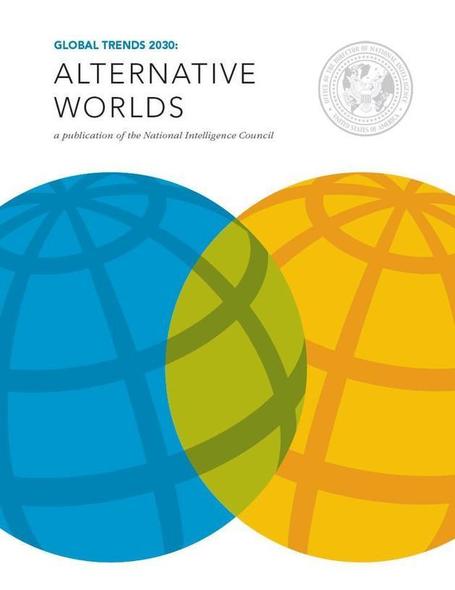
That’s what they say in the tech industry.  That’s what Buddha said 2600 years ago.  And that’s what the National Intelligence Council says in a 140 page report, “Global Trends 2030: Alternative Worlds.”

Click for the text of the whole report

Since 1997, the NIC, formed of all 16 US intelligence agencies, has issued five Global Trends reports, one after each presidential election.  For this one they engaged think tanks, government, and business leaders in 14 nations and concluded that the world will be radically different in 18 years.  The pace of change will be faster than at any period in modern history.

NIC Chairman, Christopher Kojm, says:
“We are at a critical juncture in human history, which could lead to widely contrasting futures. It is our contention that the future is not set in stone, but is malleable, the result of an interplay among megatrends, game-changers and, above all, human agency. Our effort is to encourage decision makers—whether in government or outside—to think and plan for the long term so that negative futures do not occur and positive ones have a better chance of unfolding.”

Here is a link to a summary of the report. ww.bloomberg.com/news/2012-12-10/u-s-intelligence-agencies-see-a-different-world-in-2030.html

The NIC defines “megatrends” as scenarios likely to happen under all circumstances.  “Game-changers” are “critical variables whose trajectories are far less certain.”  Additional possibilities are listed as “black swans,” discrete events that would cause large scale changes, either for good (a democratized China or a reformed Iran) or ill (global pandemic, WMD attack).

The report identifies four megatrends, changes regarded as inevitable over the next two decades:

  • Diffusion of power:  The US will lose it’s international dominance, but no other nation will take its place.  “Power will shift to networks and coalitions in a multi-polar world.”  Though the report didn’t say it, as a student of World War I history, I have to observe that the last time the world was structured this way, things did not turn out very well.  The report identifies one best case scenario as a new era of US/Chinese cooperation.
  • Individual Empowerment: A rising middle class in emerging nations, increased access to education, widespread use of technology, and health care advances can improve the lot of large numbers of people. The report notes that technology is two edged sword: it can benefit and disrupt.  Advances sometimes create and at other times eliminate jobs.  Technology fosters communication but also  leaves infrastructure vulnerable to cyber-attack.
  • Demographic Change: World population will grow from 7.1 to 8.3 billion, and 60% world will live in cities (it’s 50% now).  This will strain resources and increase pollution. Aging populations may slow economic growth in developed nations. Immigration will increase.
  • Food, Water, and Energy Shortages: In 18 years, the world will need 35% more food and 40% more water.  Our intelligence agencies don’t waste time pretending climate change isn’t real.  They note that conditions like widespread drought have grown more severe in just the 18 months they’ve been working on the report.

National Geographic issue on extreme weather, published one month before Superstorm Sandy

Rather than summarize more of the report, I invite readers to check it out for themselves.  Let’s step back and reflect on what this means.

My dogs do not like change.  They find comfort in their routines, and if I am honest, so do I.  This month a 72 year old hardware store, where you could find anything, closed it’s doors.  So did a 76 year old nursery, where master gardeners could always diagnose the ugly brown spots on your roses.  That’s enough to put me in a funk, imagining our big box future, and yet this is nothing compared to what Global Trends 2030 suggests is coming – change at a faster rate than anyone living has seen.

Change that rapid generates fear.  Looking at the last decade, we see resistance to change spawning violence.  Religious fundamentalists are more vocal in nearly all denominations.  Reactionary politicians grasps at some idealized past that is gone if it ever existed.  The urge to get what is mine at all costs further disrupt economic life and generates even more fear.  People bemoan the loss of civility.

Do we have any guides for living through times like these?

As I asked myself the question, I remembered Joseph Campbell’s assertion that world mythology holds wisdom for all the turns that life can take.  And Marie Louise Von Franz, Jung’s closest colleague, said that fairy tales offer the “purest and simplest” expression of “the basic patterns of the human psyche.”  Do stories created by people who traveled by foot and ox cart really have something to teach us in the 21st century?

I believe they do.  Next time we will consider what the old stories may say about living through difficult times.

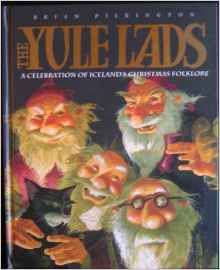
The Yule Lads: Icelandic Christmas folklore.

The Yule Lads

In most Christian countries, Christmas was slower to catch on than other major church holidays.  The clergy may have been wary of pagan solstice celebrations which happened at the same time of year and included serious revelry.  Some early Christmas festivities mimicked the custom.  They were banned in 17th century England, and American Puritans outlawed them too.

According to Brian Pilkington, author of The Yule Lads, Iceland was ahead of the curve. A 16th century law stated that “All disorderly and scandalous entertainment at Christmas and other times and Shrovetide revels are strongly forbidden on pain of serious punishment.”

Icelandic winters are long and dark, with fewer than five hours of daylight at this time of the year.  Imagination tends to fill the darkness with what we fear, and Pilkington’s book describes “the lads” that kept Icelandic children awake at night.  The gentlemen pictured on the cover are not our shopping mall Santas!

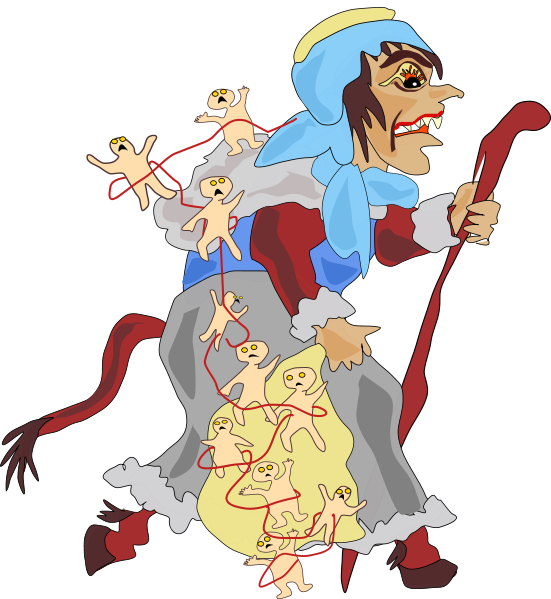
The matriarch of the clan was the ogress, Gryla, who loved to eat stewed children.  It couldn’t be just any kid though.  It had to be one who was “naughty, lazy, or rude.”  In one 13th century account, Gryla had 15 tails, and tied to each was a sack full of naughty children.  It was not “the most wonderful time of the year” if you were young!  The Icelandic word for icicle is “grylukerti” which means “Gryla’s candle.”

Gryla. CC-by-SA-2.5

Gryla had three husbands and 80 children, though legend now boils it down to 13 sons who visit the homes of children on successive nights from Dec. 12 – 25.  Time and the law have taken the edge off the Yule Lads, for a 1746 decree said “The foolish custom, which has been practiced here and there about the country, of scaring children with Yuletide lads or ghosts, shall be abolished.”  By the 19th century, the Lads had morphed from cannibals into rascals and petty thieves, who even began to leave gifts for good children who left their shoes on a window ledge.

The first to arrive was Stekkjarstaur, the “Sheep Worrier.”  He would visit the the sheep cot and try to suck milk from the ewes.  That doesn’t work in December and led author, Brian Pilkington to suggest that Sheep Worrier’s IQ is “somewhat less than three digits.”  These days  he heads for the fridge to get his milk.  If a child has been good, Stekkjarstaur leaves a sugary sweet.  Bad children get a potato.

Next comes Giljagaur, aka, “Gully Gawk” who travels through gullies and ravines, also in search of milk, but he looks for cow barns and inattentive milkmaids.  “Stubby” arrives the third night, as short as his name suggests.  He likes to raid the kitchen, as do the brothers that follow, “Spoon Licker,” “Pot Licker,” and “Bowl Licker.”  In their present forms all they do is mischief, but food thieves were no joke in earlier times.  For northern farming families, the time between Christmas and the spring thaw in April or May could be times of famine if food or fodder for livestock ran short.

The next lad to show up is Hurdaskellir, or “Door Slammer,” one of only two of Gryla’s sons who isn’t out to fill his belly.  Imagine loud bangs in the dead of night and you know how he gets his jollies.

And as if the sons of Gryla were not bad enough, children also had to contend with Jólakötturinn, the Yule Cat, a huge feral creature who hunts children on Christmas Eve instead of mice. Like the lads, the cat discriminates in choosing his victims, eating only those who have not received a new item of clothing for Christmas. Pilkington says that “Until fairly recently in Iceland, all clothing came directly from sheep. The wool had to be washed, combed, and spun before it was painstakingly crafted into a garment. It was a long, arduous process.”  Fear of the Cat induced lazy children to do their part!

This is a fun book and a fine counterbalance to the usual TV holiday movies.  You can picture families gathered around the fire as the wind howls outside, thinking as we do when hearing a good ghost story, “This can’t be true…can it?”  Something within the listeners then and within us now loves to be scared, to confront monsters and vanquish them in imagination.  On that score, Gryla & Sons and the Yule Cat satisfy!

A click on the book cover at the top of this post will take you a site where you can order The Yule Lads.

Time Magazine on self-publishng

The stigma is gone, but the road to nirvana is getting more crowded by the day.  That’s the gist of Andrew Rice’s article, “The $0.99 Best Seller” in the December 10 issue of Time.

Rice visited a romance writer’s convention where Mark Coker, founder of Smashwords, was the most popular speaker, and E.L. James, the best selling author of Fifty Shades of Grey was the symbol of success for many writers in attendance.  Fifty Shades began as Twilight fan fiction before going viral as an ebook and finally landing a traditional Random House contract.  According to Rice, “To Coker and his audience…Fifty Shades…looked like a harbinger of the future of publishing.”

Rice said there were 30 self-published ebooks on a recent list of Amazon top sellers and four self-published titles on the New York Times ebook best seller list.  Self-published ebooks are growing at four times the rate of traditionally published titles, and Rice quotes analysts as saying the “big six” publishing houses may soon become three or two or even just one.

This doesn’t mean that it’s easy.  I’m reminded of the California gold rush.  Some who arrived at the gold fields early – the “48ers” – made substantial amounts of money while those who came later did not.  Last year’s ebook celebrity, Amanda Hocking, took a traditional publishing contract when it was offered, saying marketing and promotion got in the way of her writing.  I’ve reviewed books by several excellent indie authors – Jade Scott, Amy Rogers, and Barbara Kloss, and all of them spend huge amounts of time publicizing their work.

Andrew Rice says it’s not going to get any easier:  “the chances of publishing that rare blockbuster grow more remote every day as more stories flood into the market, competing for a finite amount of reader attention.”

Yet for those indie authors I know, it’s not about getting rich or hitting the long shot best seller.  At the core, it’s about finding an avenue to tell the stories that live inside them.  The days when aspiring authors needed traditional publishing for validation and a way of getting their work into print are history, just like quill pens and Underwood typewriters.  The stigma is gone, and good riddance.