How weird news teaches us great storytelling

This post was a (literal) coffee-snorter. Be warned, if you have a cup, put it down, and if you’re eating a blueberry muffin, swallow before reading this epic tale of Walmart brigands, trailer park ninjas, the Darwin awards, and other tales of so-called real life as stranger than fiction.

Guy Bergstrom's avatarThe Red Pen of Doom

Every day, there are real stories in the morning newspaper that make you snort coffee out your nose or choke on a blueberry muffin. Note: This is why journalists call such pieces “muffin chokers.”

Yet the daily weirdness is more than funny. If you dissect these stories, you can learn deep storytelling lessons from the shallow end of the journalism pool.

Here’s a real story that just happened in my state: Man steals RV from Wal-Mart parking lot, leads police on wild chase. Swerves into sleepy little town where he knocks cars into front yards and such, then blasts through a house and crashes. Runs out, strips down to his underwear and invades a home to steal girl clothes. Cops catch him and haul him off.

This is pretty typical of a weird news story, and not simply because it started in the parking lot of a Wal-Mart — and yeah…

View original post 890 more words

Terminal Time

The phrase, “Terminal Time” has a dire sound, but as the photo below should make clear, this post is not about terminal illness. It’s about terminal, as in airports; not the end of life, but the end of patience.

Neon passageway, O'Hare Airport, 2013 by Nicola. CC By 2.0

Neon passageway, O’Hare Airport, 2013 by Nicola. CC By 2.0

The subject comes from the WordPress Daily Prompt for June 10, You’re at the airport, your flight is delayed for more than six hours, and none of your electronic devices are working. How do you pass the time?

Like millions of others, I’ve been there on several occasions. I think I was still in my teens the first time I got snowed in at O’Hare. Since Chicago’s airport has been the scene of my most dramatic delays, let’s imagine what we can do there to pass the time in an unwired kind of way.

1) Buy a paperback. This almost goes without saying, but since most airport bookstores don’t carry Moby Dick, here is a chance to indulge our guilty pleasures, whatever they may be. No one blames you for reading trash when you’re stuck at O’Hare.

2) Walk or ride the escalator through the neon passageways. If you’re with a companion, one of you can say, “Whoa, dude!” and the other can reply, “Psycedelic!”

3) Eat something. O’Hare has a huge variety, from cinnabuns, to Big Macs, to build-your-own-salads. Go to a bar if it suits you, but before you dip into the beer nuts, remember the opening scene of Contagion, with Gwenneth Paltrow doing just that.

4) Work a puzzle. Mary and I spent a happy hour doing that on the ground in Philadelphia last summer. She is crossword fan, with much experience and several dictionaries. I know lots of nerd expressions and assorted trivia, so we compliment each other.

5) People watch #1: Spot an interesting character and work out the plot of your next (or first) novel.

6) People watch #2: Figure which of your fellow travelers are aliens, as in Men In Black extra-terrestrials. Like the woman I saw with a dog in a pink tutu. This is true! She was talking to the dog, who looked absolutely miserable, while everyone tried to look away. I’m sure the dog came from a more intelligent planet than its owner.

7) Walk around. What a concept! You’ll feel better, and if you decide to be brisk, you can even get in some aerobics to work off those pizza slices.

8) Practice meditation. It’s a challenge to stay focused when you’re tired, annoyed and distracted, but that makes it interesting for brief periods of time.

9) Buy a notebook and write your next blog post longhand. Soon enough you’ll get your smartphone recharged.

10) If you’re gregarious, strike up a conversation. I’ve mentioned a few opening line suggestions like,  “Snow sucks, huh?”  Or, “Psychedelic!”  Or, “That poor dog. I hate tutus!”

You get the idea, and I’m sure you can add many more of your own. Maybe this post will help someone during the summer travel season. Now all I have to do is hope the lords of karma are kind, and I won’t have to eat my own cooking anytime soon!

Guarding the mind

guard mind 1

One summer when I was working in high-tech, I had the following experience for several weeks: I’d leave the house, enjoying the fine weather. After a pleasant enough commute, I’d grab some coffee at the cafe, greet co-workers who were doing the same, and then find myself, when I arrived at my cubicle, in a foul mood, angry, and/or depressed.

Finally, I began to notice the almost subliminal self-talk that started the moment I hit the parking lot: imagining negative outcomes for everything I had going on that day. I’d picture meetings, or presentation, or projects falling apart. A quiet but persuasive inner voice would label co-workers’ motives in the harshest light. My boss at the time was a friend who had just finished his MBA and was still finding his way by trial and error. This made him a perfect projection screen. I’d sometimes find myself wondering if he was now out to get me.

Once I caught this inner thought train and started to listen, it fell apart, as such things do in the light of day. This is one key result of mindfulness practice: attend to a thought – any thought – and it begins to shift and change, revealing its nature as something far less substantial than we think. Jung had a parallel insight when he realized, “My thoughts are not my own,” and compared them to animals encountered while walking in the forest.

Hist Center Window

Since that summer, I’ve learned to listen more closely for thoughts flying under the radar. That’s part of what prompted several posts this spring with the theme of consciously choosing where to place the attention. A recent post on the Shambhala Publications blog quoted a verse along these lines written more than 1200 years ago. A Guide to the Bodhisattva Way of Life by Shantideva (c. 685-763), a great Buddhist master and scholar, is still widely studied today (see note 1 below). In chapter 11, “Vigilance,” he deals with guarding the mind against against unwholesome states, for this is where all our actions are born. The chapter is composed of 109 quatrains. Here are the first three:

1.
Those who wish to keep a rule of life
Must guard their minds in perfect self-possession.
Without this guard upon the mind,
No discipline can ever be maintained.

2.
Wandering where it will, the elephant of the mind,
Will bring us down to pains of deepest hell.
No worldly beast, however wild,
Could bring upon us such calamities.

3.
If, with mindfulness’ rope,
The elephant of the mind is tethered all around,
Our fears will come to nothing,
Every virtue drop into our hands.

Shantideva. Public domain.

Shantideva. Public domain.

Guarding the mind is not just a Buddhist concern. When I Googled the phrase, most of the hits came from Christian websites and blogs. These discussions centered on Philippians 4:8, “Finally, brethren, whatsoever things are true, whatsoever things are honest, whatsoever things are just, whatsoever things are pure, whatsoever things are lovely, whatsoever things are of good report; if there be any virtue, and if there be any praise, think on these things”

Many of the thoughts, suggestions, and practices were similar to Shantideva’s writing as well as a more recent statement by the Dalai Lama. I am even aware of both Buddhist and Christian scriptural practices for wearing imaginal armor to shield the heart/mind from negative influence. I would not be surprised to find similar practices in other spiritual traditions.

I’ve been fortunate enough to have a few days away from my usual routines and concerns to consider these things. I’m struck again, as I was in the work episode I related above, by how subtle the negative inner voices can be.

Another bias I find in myself was articulated by James Baraz, a Buddhist meditation teacher in an article on the Huffington Post, Can We Afford Joy in a World of Suffering. Baraz describes “the Kumbaya factor,” as the fear that if we consciously turn away from what is negative, we may simply wind up “in La-La Land singing Kumbaya.”

Everyone has to work this out for themselves, but Baraz makes several key points. Depression saps our energy. No one benefits self or others while wondering, “what’s the use.” In the work experience I related above, I wasn’t the best of co-workers while imagining others were out to get me.

I’m reminded of a story I heard several times in college. In 1927, Buckminster Fuller walked to the shores of Lake Michigan, thinking to end his life. He had just lost his job and felt responsible for the death of his daughter a few years earlier. He would later tell lecture audiences that as he looked into the waters, he felt surrounded by light and heard an inner voice say:

“You do not have the right to eliminate yourself. You do not belong to you. You belong to the Universe. Your significance will remain forever obscure to you, but you may assume that you are fulfilling your role if you apply yourself to converting your experiences to the highest advantage of others.” (Fuller)

The experience led Fuller to re-examine everything and resolve to live his life as “an experiment, to find what a single individual [could] contribute to changing the world and benefiting all humanity” (see note 2 below). In this epiphany, Fuller locked onto the same truth that Shantideva articulated 1200 years before:

54.
Examine thus yourself from every side.
Note harmful thoughts and every futile striving.
Thus it is that heroes in the bodhisattva path
Apply the remedies to keep a steady mind.

55.
With perfect and unyielding faith,
With steadfastness, respect, and courtesy,
With modesty and conscientiousness,
Work calmly for the happiness of others.

Speaking in the same tradition for a 21st century audience, James Baraz summed up the idea this way: “So can we afford joy in a world of suffering? I believe, in a world of suffering, we can’t afford not to find joy.”

reflection 4

Notes: _____________________________________________________

(1) In Buddhist terminology, a Boddhisattva is one who vows to seek spiritual awakening not for self alone but for the benefit of others.

(2) Some historians, finding no account of Buckminster Fuller’s epiphany in his writings for 1927, have wondered if he made up the story later. I can only speak for myself and observe that I’ve never put my most profound experiences in a journal: the writing is too pale, and there’s no need, since the events themselves remain vivid.

I think, therefore

The Thinker, Rodin. Public Domain

The Thinker, Rodin. Public Domain

When I first started to write, in my teens and early 20’s, I was hugely influenced by an eclectic group of American writers that included vocal social critics from the earliest years of the 20th century. People like Theodore Dreiser, who wrote famously clunky prose, but whose An American Tragedy (1925) was a stinging indictment of greed in our culture. Main Street (1920) by Sinclair Lewis depicted the soul-crushing conformity of a milieu we often imagine as small town innocence. But greater than any other influence was Henry Miller, who demonstrated the power of personal essays. His books, like The Air Conditioned Nightmare (1945) shaped my view of our dominant culture.

It was natural that this kind of critique, along with that of more recent writers and essayists like Michael Ventura, should influence  my blogging. But this spring something strange happened. At the start of Lent, though I do not celebrate the season in any formal way, I announced that I would “give up” negative posts for the duration. As expected, the experiment was more interesting than I expected.

"Rodin's thinker?" by Patricia van Casteren, 2006, CC BY-NC-ND 2.0

“Rodin’s thinker?” by Patricia van Casteren, 2006, CC BY-NC-ND 2.0

I’ve already blogged about some of my findings, especially the obvious ones, like the preponderance of bad news in all varieties of media. And I knew in advance there would be less to say if I excluded negative themes. What I didn’t expect was to find myself wondering whether it mattered – it’s virtuous to write about things like climate change and income inequality – isn’t it? A very interesting question since I don’t really believe many writers and artists change social ills directly. Maybe Charles Dickens did, or Jacob Riis, with his photos of child labor, but Dreiser didn’t eliminate greed and Miller didn’t break the ruts of conformity. Writers and artists sometimes change individual hearts and minds, but how does that work? That is not a rhetorical question, but something I often wonder about. How does it work?

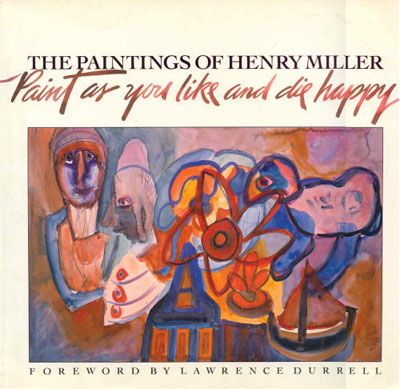
Perhaps it was this kind of question that moved Phil Ochs, one of the best of the 60’s protests singers, to write, “You must protest, you must protest they say, it is your diamond duty / Ah, but in such an ugly world, the only true protest is beauty.” Maybe it’s what led Henry Miller, in his last years, to write books like, My Bike and Other Friends, and to focus on his watercolors.

Henry Miller paintings

My biggest discovery, while turning away from negative stories during Lent, concerned inner dialog rather than outer events. I’ve attended to this in a focused way in the past at various times, but not for a while. Mindfulness practice appeared on the cover of Time, so it must be gaining fad status, but that does not diminish its worth. It’s an ancient contemplative discipline that involves simply watching the contents of consciousness. Not fixing, fighting, or merging with, but simply observing what flits through awareness (here’s a good introduction to the practice).

I don’t know about anyone else, but I often find a subtle but persistent stream of critical inner narrative on self, others, and events. The narratives tend grow in the darkness yet dissolve when observed, the way shadows disappear when you turn on the light in a room. Observation eventually leads one to suspect that thoughts have no more substance than shadows, and no more inherent reality, and yet they can have profound effects. I suspect we have all had interesting synchronicities, met things in the world corresponding to our inner states. And if one subscribes at all to notions of the effect of collective thoughts, an idea given names like, “tipping point” or “hundredth monkey,” then the contents of consciousness take on a meaning beyond their effect on oneself alone.

I follow the Dalai Lama on Facebook and often note that when he is asked about topical issues like climate change, he always gives a thoughtful answer, the tone of which is invariably, “I am hopeful.” If I learned anything with this Lenten experiment, it is how hard it can be to cultivate a hopeful attitude. I also cannot imagine anything more important. Can there be a more important seed to plant than this one – “I am hopeful?”

No discouraging words revisited

Embed from Getty Images

In an earlier post, Where seldom is heard a discouraging word, I announced an experiment. Following my wife’s efforts to suspend negative thinking and speech during Lent, I decided to refrain from critical posts through Easter. Here is the first of several observations I will share.

Avoiding negative and pessimistic topics leaves me a lot fewer subjects to blog about! Many of my posts begin with news stories, but often it seems, to paraphrase the old Hee-Haw song, “If it weren’t for bad news, I’d have no news at all.” More nights than not, when I’ve checked my usual source websites (CNN, NPR, USA Today, etc.), I haven’t found a single upbeat or funny or quirky post that I wanted to write about. Sure, there was the girl scout who sold 12,000 boxes of cookies, but even if it’s a good thing for a kid to become a marketing wizard, that isn’t my kind of story.

The real question for me, however, is not the content of this weeks’ or that weeks’ news, but the systemic nature of our news media, which makes trials and tribulations endemic. These are news stories, after all, and a good story demands tension, upping the stakes, and all that. The question is not whether these are gripping stories, but the degree to which they mirror “reality.”

I’m thinking of a book I have often cited here, Neal Gabler’s, Life the Movie: How Entertainment Conquered Reality (2000), in which the author says we are not just a post-modern culture but a “post reality culture.” Gabler locates the beginning of news-as-entertainment in America as “the penny press.” Prior to 1830, newspapers were single page “broadsheets” which appealed to the upper classes. Most of them cost six cents and the average daily circulation in New York City was 1200. Beginning with the Sun, which cost a penny, newspaper sales exploded. Gabler cites various reasons for the success of the penny press, but says that above all, it meshed with other sensational forms of entertainment:

“…for a constituency being conditioned by trashy crime pamphlets, gory novels and overwrought melodramas, news was simply the most exciting, most entertaining content a paper could offer, especially when it was skewed, as it invariably was in the penny press, to the most sensational stories. In fact, one might even say that the masters of the penny press invented the concept of news because it was the best way to sell their papers…”

In it’s first two weeks of publication, in 1835, the New York Herald ran stories that centered on “three suicides, three murders, the death of five persons in a fire, a man accidentally blowing off his head, an execution in France by guillotine and a riot in Philadelphia.” Needless to say, the Herald became wildly successful.

If it’s true that what we think of as “news” is an “invented concept,” we have to ask to what degree it mirrors reality and to what degree it creates it? Think about that the next time you open the paper or check your Tweets.

What I have discovered is how deep the contagion goes, even though I normally limit my sources, never watching the local news on TV, for instance. I confess that while I have cut negative posts from theFirstGates since March 7, I’ve probably doubled the number of depressing subjects I’ve posted on Twitter. In a way, I feel like I did a month after I quit smoking, and found that a nasty cough was still there. This is more serious than I thought at first. I’ll have more to say about it, but meanwhile, let’s change the tone as we end with a classic that came to mind at the start of this post.

A retreat with Edward Espe Brown

Edward Espe Brown

Edward Espe Brown

Saturday was the fourth time in as many years that I’ve attended a daylong retreat with Edward Espe Brown,  Zen abbot, author, cook, and altogether a charming and extremely funny man.  In 1965, Edward became a student of Shunryu Suzuki Roshi, author of Zen Mind, Beginner’s Mind.  When his teacher founded the Tassajara Zen Center near Big Sur, Ed became the head cook (as an author, he is best know for the Tassajara Cookbook and the Tassajara Bread Book).

Much of his learning took place in the kitchen, which gave him several unforgettable teaching stories. He relates his frustration in trying, without success, to produce a “perfect” muffin.  He tried numerous recipes and variations.  Everyone else thought they were great, but he was never satisfied.

One day he managed to taste a muffin without his usual preconceptions and found it delicious.  In that moment, he realized the source of his earlier discomfort – he’d been comparing his muffins to the “perfectly” shaped Pillsbury muffins he’d eaten as a kid.  This discovery led to one of the core ideas he tries to communicate as a teacher: we have the choice of living our lives according to someone else’s recipe or trying to discover our own.  “There is no by-the-book way for you to be you,” he says.

Given this background, it’s no surprise that he started the day by saying, “I’m not going to give you any meditation instructions, because then you might try to follow them – and be looking over your shoulder to ask, ‘How am I doing?”  The simplest instruction in Zen, “Just sit,” is the hardest to practice.  Similar things can be said for writing or painting (“Just write/paint what’s in your heart”) – and many other areas of life as well.

Such instructions (or lack thereof) assume the student knows the basics and some has experience.   This was true for the group that gathered on saturday.  It allows a generous teacher like Edward Brown to invite the student to seek what lies beyond a lifetime of learning how they are supposed to be.

Ed once said, “What is precious in us doesn’t come and it doesn’t go.  It is not dependent on performance.”  That’s a nice sounding aphorism, the kind of thing I jot down in notebooks.  Saturday’s retreat was a chance to test the waters, and as I hope I’ve made clear, at its best, Zen is about everything in our lives. I’d heard that Ed had written a new book, and it proved to be a fine example of finding our own way.

He has several traditional books in print on Zen and cooking, and he also edited a collection of Suzuki Roshi’s teachings.  When I’d read the title of his new book, By all Means A Zen Cautionary Tale, I assumed I’d be in for traditional reading.  Instead, I was surprised and delighted to find he’d written a semi-fictional, semi-autobiographical story of his adventures a little pig hand puppet.

When I asked him to sign a copy, I said, “This is great.  For my first 10 years, I had hand puppets.  They were my closest friends and confidents.”

“Ah, then you know,” he said.  “They’re powerful, aren’t they?”

In my next post, I’ll review By all Means, and after that, maybe the topic of conversing with inanimate things.  Please stay tuned!

——————————————————————————————–

PS:  When I posted this, I forgot to add a link to Edward’s home page, Peaceful Sea Sangha. In particular, I recommend the recordings of his talks, which give the flavor of his teaching style, his concerns, and his humor.

Dr Seuss to the rescue

A few days after his birthday 110 years ago, here’s a wonderful list of wise aphorisms by Dr. Seuss, courtesy of Rachael at Street of Dreams

beautiful loser's avatarStreet of Dreams

In honor of Dr. Seuss’s birthday, I’ve come across a fun little collection of life sayings (from his books) to live by.

I know I’ve posted similar things in the past, but everytime, I come across one of his books or a collection of his work, I am amazed at how insightful he was. And I am amazed at how complicated adults must make things.

Note: sorry this is a few days late. I thought I published this piece but apparently word press had other plans.

Dr Seuss to the rescue

View original post

The American Monomyth

In my so far disappointing effort to make sense of Tumblr, I have at least found several intriguing posts, including this one from josephcampbellwasright.tumblr.com called “The American Monomyth.”

The Monomyth is a world-wide mythic pattern that Joseph Campbell described in The Hero With a Thousand Faces, 1949:  “A hero ventures forth from the world of common day into a region of supernatural wonder: fabulous forces are there encountered and a decisive victory is won: the hero comes back from this mysterious adventure with the power to bestow boons on his fellow man.”

The Tumblr post references a lesser known book by Robert Jewett, The American Monomyth, 1977, that describes an interesting variant:

“In the American monomyth, the hero is an outsider who comes into a once-perfect community in peril (the “violated Eden”) to confront the evils that have caused trouble. The hero eschews such things as joining the community, standing apart from them in order to better keep them safe, in a manner that could best be described as vigilantism. Once the evil has been vanquished, the hero either allows himself to absorb into the community (through such means as moving in, marrying, etc.), or he moves on to the next violated Eden.”

The post lists several movies as examples, but doesn’t mention several key genres that raised the “Heroic Outsider” to the mythic status of true American Hero.  What of superheroes like Batman and Superman or crime fighters like The Untouchables?  What of the genre I grew up on, the western?

Clint Eastwood and Sidney Penny in Pale Rider, 1985, my favorite "Heroic Outsider" western

Clint Eastwood and Sidney Penny in Pale Rider, 1985, my favorite “Heroic Outsider” western

While Googling for westerns with the classic, “clean up the town” theme, I came upon an interesting syllabus for a course at Dominican University, The Western:  America’s Mythology – books it would be fun to add to my geometrically expanding list of things I would like to read!

Meanwhile, I suspect that everyone has personal favorite books and movies in this “swoops in and saves the day” genre.  What are some of yours?