A great story I neglected to post

I found this during a year-end cleaning of my “Drafts” folder – an unfinished post inspired by a newspaper article in July which details the life’s work of unsung folk artist, Arthur Harold Beal, garbage collector for the town of Cambria, CA.

Just down the road from the Hearst Castle, that world-famous monument to excess, lies Nitt Witt Ridge, the house on the hill that Beal lovingly crafted of driftwood, river stones, beer bottles, abalone shells, toilet seats, and other assorted junk.  Beal started work in the 30’s was still going in 1992, when he died at the age of 96.

Nitt Witt Ridge by megpi, CC BY-NC-SA-2.0

Nitt Witt Ridge by megpi, CC BY-NC-SA-2.0

Michael O’Malley, a plumber in town, bought the Ridge for $42,000 in 1999.  Unfortunately, the sale price did not include water rights, so he and his wife cannot live there, and because it is zoned residential, they can’t open the house for public tours.  Several times a week in the summer, O’Malley gives private tours, in return for donations, to people who contact him directly.  He is something of an expert on stories surrounding the Ridge’s creator.

Beal used to say he salvaged his wood from the ocean, but O’Malley points out the quality of the material, and suggests that Beal might have “salvaged” it from local construction sites late at night.  Beal seems to have been a curmudgeon.  Some people asked to visit the house while he was still living.  If he liked their looks, he’d let them in, if not, he would shake his fist and yell, “Move along, small change.”  O’Malley found a video of Beal on a 1981 TV episode of “Real People.”  At age 81, with a long beard and a walking staff, “he looked like a mix of John Muir and Dennis Hopper.”

Here’s a brief but informative clip of O’Malley giving a tour of the house:

Last summer, when I started this post, I added descriptions of other architectural oddities, like the Watt Towers and the Bottle House of Rhyolite, NV.  The story grew too long and languished until now.

The end of the year is a good time to contemplate things like Nitt Witt Ridge.  While others compile their lists of “The Best of 2013,” here is my contribution to a list of things wacky and weird.

Daily Prompt: Memories of Holidays Past

What is your very favorite holiday? Recount the specific memory or memories that have made that holiday special to you.

3d - 400 - christmas_edited-1

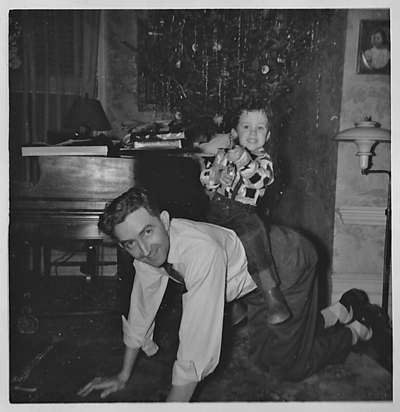
Here is a story my father loved to tell. Even in the early stages of Alzheimer’s, when we’d take a Christmas tree to his assisted living place, he’d tell us about the electric trains.

One year he ran short of track on Christmas eve, so he hopped in the chevy and drove through the snow to a hobby shop in downtown Poughkeepsie that was open until midnight.  The place was filled with other fathers on similar missions:  picking up extra track, boxcars, and engines.  Trains were the thing that year.  That little store overflowed with camaraderie, humor, and joy.  Fifty years later, his eyes lit up when told this story.  I think it embodied the Christmas spirit for him, as he embodied the joy of giving for me.

As a depression kid, money was scarce while he was growing up.  One year someone gave him a silver dollar on his birthday.  His grandmother said he should put it in the church collection plate.  He did, but when he reached in to get change, his grandma slapped his hand, knocking the plate to the floor.  Undaunted, my dad crawled under the pews and recovered every penny, but made sure to collect his ninety cents change.

Prosperity finally came.  After a stint in the navy as a radar technician, he went to work for IBM, and after that, if anyone asked for a dollar, he’d offer them two.  After he got sick, I had the chance to return some of those favors, in both large ways and small.

The first winter he was up here, we happened to drive past a train store.  “Wanna check it out?” I asked.  He did, and we found a 19th century train that called his name.  We took it back to his apartment, and I set it up on his kitchen table.  Mary took him shopping for those Christmas village buildings which matched the scale of the train.  He talked about it so much to the other residents that sometimes when were visiting, they’d knock on his door and ask to see the trains.

Mary recently asked I if hated Christmas – a reasonable question, given the tone of my comments on Black Friday and what passes for “holiday music” in stores.  I don’t hate Christmas.  I do hate the machinery of media and advertising that cynical interests use to paint a mirage of joy that can be ours if only we buy enough stuff.

I learned from my father that stuff isn’t the problem.  Grasping for stuff, out of greed or a fear that I need it to be ok is the problem.  My father taught me that stuff can be a medium of generosity, and generosity lies at the core of what Christmas is truly about.

Robots ‘R Us, installment 2

The Steam Man of the Prairies, 1868.  Public Domain.

The Steam Man of the Prairies, 1868. Public Domain.

An obscure author, Edward S. Ellis, who published a dime novel called The Steam Man of the Prairies 145 years ago, may prove to have been a visionary according to two recent news articles.

The first, in the New York Times, reports that Google quietly acquired seven robotics companies over the last six months (Google Puts Money on Robots).  The scale of the investment is huge and appears to be aimed at automating manufacturing processes.  “The opportunity is massive,” chirped Andrew McAfee, an M.I.T. research scientist.  “There are still people who walk around in factories and pick things up in distribution centers and work in the back rooms of grocery stores.”

The second article I noticed bears an uncanny relation to the cover of  The Steam Man.  The California DMV has set rules for companies aiming to test automated cars (Driverless Cars Could be Cruising California Roads by Spring).  To put it in the terms of the M.I.T scientist, we may soon be able to robotize trucks and remove even more inefficient humans from the workforce.

The problem with this manufacturer’s wet dream should be obvious.  Robert Reich, former Secretary of Labor under Bill Clinton puts it simply: “the economy remains lousy for most people. It will likely remain that way: As technology and globalization take over the economy, the U.S. has no national strategy for creating more good jobs in America.” (The True Price of Great Holiday Deals).

Economic discussion, with few exceptions, focuses on how to get back to the good old days of (relatively) full employment and opportunity for those who work hard.  Politicians bicker over which levers to pull, but no one dares to ask the fundamental question: has the structure of the world economy changed too much to recapture that particular sort of past “good times?”

A few years ago, news got out of worker mistreatment at Foxconn, the huge Chinese assembly plant where much of our high-tech gear is assembled.  Foxconn agreed to reforms, and the CEO announced plans to deploy a million robots.  By December 2011, robotic arms had reduced the number of workers on certain assembly lines from “20 or 30 down to 5.”  As we argue over fair wages for fast food workers, it’s a good bet their employers are working on ways to automate the task of making a burger, which can’t be harder than plugging components into a motherboard.

The problem, of course, is that downsized workers will not be buying either Happy Meals or iPhones.

Last March, in a post called Robots ‘R Us (?), a first look at such issues, I quoted a blogger named Orkinpod who was already considering them in depth.  On Feb. 27 he said:  “When the future arrives (and I believe that it is very, very close), and machines can supply all the things that humans could possibly ever want, what is everybody going to do?”

One thing many may wind up doing is working on food production.  Last summer I wrote of a compelling PBS NewsHour series, “Food for 9 Billion” (1).  That’s the total number of hungry humans who will occupy the planet in 2050 as the amount of arable land continues to shrink.  One of several examples given of coming change was Singapore, where five million people live on an island with only 240 acres of undeveloped land.  A 50 year old Singapore engineer developed a revolutionary type of vertical greenhouse that prompted the Directer of the National Institute of Education to say, “I think, eventually, urban factories for vegetable production will take the place of electronic factories in Singapore.”

It’s a grand irony to reflect that industrialism, which began by channeling people out of agriculture, may have succeeded too well; its end game my involve shifting some of them back into food production again.  But what about everyone else?  What happens as robotics and marvels like 3D printers leave ever more people idle?  Insiders aren’t even asking the question, though science fiction writers have since the mid 20th century.

robot3

Unfortunately, in stories where humans go up against robots, the outcomes are usually not the ones we would like to see.

Queen Bothildur: an Icelandic Christmas folktale

I found this story in a beautifully illustrated book of Icelandic folktales for children, Tales of the Elves, that I brought back from that country after a visit in 2012.

Tales of the Elves 400

One Christmas Eve, a richly dressed woman knocked at the door of a farm house in Hrutafjord and asked for shelter. The sheriff lived there and said she could stay.  When people asked her name, she said it was Bothildur, but she would not say anything else about herself.

She stayed home while everyone else went to midnight mass, and when they returned, they had never seen the house so clean and beautifully arranged.  The sheriff invited her to stay on as housekeeper, and she excelled at her work.  The following Christmas Eve, she stayed home again, but this time, when the household returned, they found Bothildur’s eyes red from weeping.

On the third Christmas Eve, Gudmundur, the sheriff’s shepherd boy, vowed to discover her secret.  As everyone walked to church, he feigned illness and turned back.  Gudmundur possessed a magic stone that made him invisible.  Holding it in his hand, he slipped into the farmhouse, where he saw Bothildur dressed in the finest clothing he’d ever seen.  She took a green cloth from a chest and set off into the night, with Gudmundur following closely behind.  They came to a lake where Bothildur spread the cloth on the water and stepped onto it.  The shepherd boy just had time to step onto a corner before the cloth began to sink.

Bothildur

It seemed like they were passing through smoke as they sank deeper, but at last they came to a grassy plain in front of a fair city.  Bothildur entered the city where everyone cheered.  A man who wore a crown embraced her and then everyone entered the church for Christmas mass.  Bothildur’s three children ran around the pews playing with three golden rings, until the youngest dropped his and couldn’t find it because the invisible Gudmundur had slipped it into his pocket.

When the service was over and it was time for Bothildur to leave, everyone was sad.  She walked alone with her husband onto the plain before the city.  Both were in tears and Gudmundur heard them say this was the last time they would ever meet.  They parted with great sorrow as Bothildur stepped onto the green cloth with Gudmundur behind her.

Bothildur returned home and was cleaning when the sheriff and the rest of the household returned.  Gudmundur came home later.  When asked where he had been, he told the entire tale of his trip to the land below the waters.  When Bothildur asked if he had proof, Gudmundur withdrew her son’s golden ring.  At that she was joyous.  She explained that she’d been a queen in Elf Land until a witch cursed her.  She could only return home on Christmas eve, and only a human brave enough to follow her to the world below could break the spell.  “Now you have released me and you shall be richly rewarded,” she said.

After saying goodbye to the household, Bothildur vanished.  That night, Gudmundur dreamed she came to him and gave him coins and jewels which he found beside his pillow when he awoke.  Later, he used that money to buy a farm of his own and get married.  In time, he became known far and wide as the luckiest man alive.

***

In Iceland, winter solstice celebrations were huge events – understandably, for by mid-December, the southern part of the country gets only four hours of light each day, and the northern regions, above the arctic circle, get only three.  Icelanders embraced Christianity in 1000 AD, but to this day, Christmas is a dual holiday, celebrating both the birth of Christ and the return of the sun.

Charming as it is that the doorway to the Other World should open on Christmas Eve, it’s a safe guess that Christmas is peripheral to the tale.  Stories of release from enchantment are found in every culture and predate Christianity.  Sometimes love and compassion break the spell, as in “Beauty and the Beast.”  Sometimes it’s bravery and cleverness, and sometimes even violence – in the first version of “The Frog King” published by the Brothers Grimm, the frog is disenchanted not by a kiss, but when the princess becomes so annoyed with him that she hurls him against a wall.

Aside from its simple charm, what fascinates me about Queen Bothildur’s tale is that Gudmundur, the young disenchanter, brings his own magical implement for the task.  Where do shepherd boys pick up magical stones of invisibility?  Jung believed that stones are frequently symbols of the Self, his term for the fully integrated personality.

Babylonian stone seal, ca 1595-1155 BC.  Creative Commons

Babylonian stone seal, ca 1595-1155 BC. Creative Commons

 Normally, such psycho-spiritual integration is the task of a lifetime, but in stories, legend, and scripture, young heroes as diverse as King David, St. Patrick, and Krishna worked as shepherds or cow herders when they were young.  However simple this folktale may be, it reflects what can be done by a person with a noble cause who is not at war with himself.

Belief in the Huldufólk, or Hidden People, the Elves, is common to this day in Iceland; in a 2007 survey, 57% of the population said they “do not disbelieve” in Elves.  In 2004, Alcoa had to pay a government expert to survey their proposed site for an aluminum smelter to make sure it was Huldufólk free.  Last year, we travelled a highway that had been diverted around an Elven dwelling.  We saw many small houses built on remote hillsides as homes for the Hidden People, and some Icelanders build them churches, in hopes they will convert to Christianity.

That may be an iffy proposition.  “The Icelandic word for Christmas, Jól, contains no reference to Christ or to the church. It is a Norse word that also existed in Old English as Yule.” (1)

Even so, as we read and tell their stories, I suspect the Elves are wishing us a Gleðileg jól go farsælt komandi ár – a Merry Christmas and a Happy New Year.

.
The 2013 Ig Nobel Prizes

2013 Ig Nobel

Though I reported on last year’s Ig Nobel Prize ceremony, I missed the 2013 edition of this annual Harvard laugh fest, which was held in September.  I only heard the details yesterday, on NPR’s “Science Friday.”  Much better late than never for this look at the work of international scientists whose “research makes people laugh and then think,” according to Marc Abrahams, editor and co-founder of “The Annals of Improbable Research.”

The ten 2013 winners Ig Nobel winners, who received their prizes from (real) Nobel Laureates, include:

The Prize in Psychology, which went to a multinational team that confirmed empirically that “people who think they are drunk also think they are attractive.”  Their article, “Beauty is in the Eye of the Beer Holder,” was published in the May 15, 2012 issue of The British Journal of Psychology.

A Joint Prize in Astronomy and Biology, awarded to Marie Dacke, Emily Baird, Marcus Byrne, Eric Warrant, and Clarke Scholtz, proves that dung beetles use the Milky Way for navigation; they can push their balls in a straight line when the night sky is clear, but not when it is overcast.

A Probability Prize was given for two related findings: “First, that the longer a cow has been lying down, the more likely that cow will soon stand up; and Second, that once a cow stands up, you cannot easily predict how soon that cow will lie down again.”  Bert Tolkamp of the Netherlands accepted the award and expressed his team’s gratitude for the honor, noting that they need the laughs, since researching cows can be “really boring.”

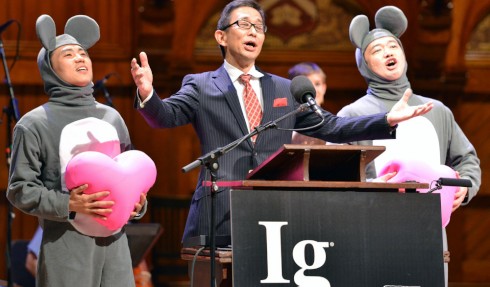
The Prize in Medicine went to a joint team from China and Japan for proving that post-heart transplant mice survive longer when listening to the Verdi opera, La Traviata, than to the music of Enya. (1)  These findings were chronicled in The Journal of Cardiothoracic Surgery.

The Operatic Heart Transplant team

The Operatic Heart Transplant team

This year’s prize ceremony, like those in the past, sold out early. As South African entomologist, Marcus Byrne, who took part in the dung beetle study, said, “It shows how much people appreciate good science. It doesn’t have to make money. It doesn’t have to save lives. It’s just part of the human condition to be curious.” 

And, I would add, to enjoy a good laugh!

Trust and belated reflections on November 22

I was going to pass on adding my $0.02 to the discussions of the Kennedy assassination.  I have nothing to add concerning the event itself.  I am writing this post because of a comment I cannot get out of my mind:

“Like a tornado, the Kennedy conspiracy theories have spun off whirlwinds of doubt about other national traumas and controversies…The legacy of that shocking instant is a troubling habit of the modern American mind: suspicion is a reflex now, trust a figment.” – David Von Drehle in Time Magazine, Nov. 25, 2013

You can’t argue with Drehle’s conclusion, that suspicion of government is a reflex,  but when and how did it come about? I truly don’t remember it starting in Dallas.  People at the time expressed shock and grief, and everyone shook their head and said the killing of Lee Harvey Oswald was “pretty suspicious,” but no one I knew, and not a single history teacher I ever had, obsessed about the conspiracy like we do now.

I wonder if that’s a key – like we do now.  I wonder if the weight given this month to assassination conspiracy theories isn’t history revised in light of our current mistrust of government, a mistrust that came about from a long string of incidents rather than a single one.

There was the Gulf of Tonkin the following year, used to justify escalating the war in Vietnam, which Robert McNamara, then Secretary of Defense, later admitted never happened.  There was the 1970 National Guard shooting of 13 students in Kent, Ohio, when fear and loathing of government rose to heights I’ve never seen before or since.  There was Watergate, the non-existent Iraq WMD’s, and now let’s all say hi to the NSA, both I who am writing and you who are reading this post.

Trust is the foundation of any honest relationship, slow to evolve and quickly broken by deceit.  In interpersonal relationships, once it’s gone it is pretty much gone for good – “fool me once…” as they say.

The flags flying at half-staff yesterday brought to mind a childhood grief, but we have moved on from the loss of one man.  What lingers and haunts is the memory of how that man could invite a public trust – “Ask not what your country can do for you…” – and seem worthy of it.  That level of hope and public trust is gone, and I don’t see it coming back.

More than a man, that is what I found myself mourning yesterday.

HalfStaffFlagNotification

Selling Thanksgiving

Norman-Rockwell-thanksgiving use

An article in our local paper’s Sunday Business Section both fascinated and sent a few chills up my spine at how effectively today’s marketeers can sell proverbial ice cubes to Eskimos.  They have persuaded large numbers of us to give up Thanksgiving as a day of gratitude for what we have, in favor of the chance to go buy more.

No one needs to wait for Black Friday now.  Major retailers will open their doors at 8:00 on Thanksgiving night, while Kmart’s shopping day will begin at 6:00 in the morning.  People like it and want it, the article says, but it’s instructive to look at the language used:

“The ever-earlier shopping frenzy is a source of dismay for traditionalists who view Thanksgiving more in terms of Norman Rockwell’s famous 1943 “Freedom from Want” painting…They ask: Isn’t the pace of life hectic enough without cutting into a day established for humble gratitude and quiet reflection?”

Is it just me or do you see a bias here?  Some implication that the traditional, quiet reflecting crowd, stuck in 1943, will probably spend the day watching reruns of “The Waltons.”

American Gothic by Grant Wood.  Public Domain

American Gothic by Grant Wood. Public Domain

The most interesting reason the article gave for jumping up from the table to hit the stores came from a “random” shopper at one of our malls, who said, “It’s fun, like a shared adventure for me and my friends.  We love it.”  An adventure is “an unusual, stirring experience,” according to Webster’s Dictionary, which isn’t what I equate with a trip to the mall, but hey, we all know Thanksgiving can be a chore.  

Millions of us have had the experience of traveling “home for the holidays,” only to remember exactly why we left in the first place.  And traditional Turkey Day roles still split along gender lines – who hasn’t heard women complain about working for hours preparing a meal, only to have the men snarf it down in 20 minutes, then pass out from tryptophans and beer in front of a football game?  From that perspective, a trip to the mall with friends might be, if not “an unusual, stirring experience,” at least a refreshing break.

Times are hard, and I can’t fault anyone for the Thanksgiving choices they make, but I do suggest a bit of reflection.  Many who read this blog are writers, and one of the best pieces of advice for writers is to create a mission statement; among all the choices I have now, what do I want from writing?  That’s a good question to ask as we face the holiday season.

Most of us long for peace and serenity, and a time of shared warmth in a community of family and friends.  Nobody wants to wake up on New Year’s Day saying, “Thank God all that is over,” though many will.  It’s a good time to review holiday options and “obligations” in light of the Dr. Phil question, “How does that work for you?”  

I’m no saint when it comes to keeping Thanksgiving “pure.”  For a number of years, when Tower Books was open, Mary and I and friends from work would gather for Thanksgiving dinner, then go browse Tower for an hour before having coffee and pumpkin pie.  Though we didn’t suspect it at the time, we may have been having a shared adventure.  So let’s admit that we’re free to spend Thanksgiving however we wish.  

It just saddens me to see corporate interests breech a once inviolate day, and turn it into an “ersatz” holiday, like Labor Day, stripped of all its original meaning and existing only so people can buy many things that they don’t really need.    

Heat and Air

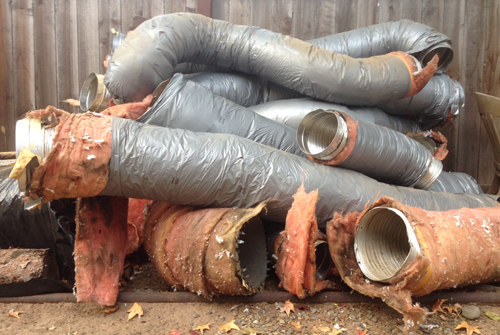
Day 1 - a portion of the old ducts

Day 1 – a portion of the old ducts

Here’s why I may be a bit light on blog posts for the next week and a half: we have an obsolete heat and air system and a lot of collapsed ducts.  We also have a trusted heat and air guy – an old school type craftsman who has helped us keep warm and cool at the proper times for over 20 years.  He’s going to retire soon, so last spring we worked out a plan to replace everything.

Day one was rendered somewhat chaotic by our two rescue dogs who were exceedingly vocal in their disapproval of someone crawling around the attic hammering things and sawing things.  As in vocal for hours.  We will also be without heat for about 10 days, but you know what?  We lucked out.  Temperatures are mild, and today is a burn day, according to the county air quality board, so there’s a fire in the wood stove right now.

As I lit the fire, I turned on the PBS News Hour, which put our minor inconvenience into perspective as I watched the horrific suffering in the Philippines:  tens of thousands of storm survivors with nothing – no shelter, no food, no water.

A few days ago, I tweeted a New Yorker blog post which discussed a leaked copy of the most recent installment of the  I.P.C.C. (Intergovernmental Panel on Climate Change) report, this one suggesting that “preparing for climate change,” an emerging theme in some quarters, is largely an illusory goal, at least for the most vulnerable portions of our world population.

The blog quotes the president in a speech he gave last spring:  “Those of us in positions of responsibility, we’ll need to be less concerned with the judgment of special interests and well-connected donors, and more concerned with the judgment of posterity. Because you and your children, and your children’s children, will have to live with the consequences of our decisions.”

The way I see it, everyone living and breathing is in a “position of responsibility.”  This is how I understand it for myself:

  1. Being responsible means I contribute to the relief effort for Haiyan, just as I have for Katrina, and Sandy, and the tornadoes last spring, and just as I will for the next superstorm.
  2. Being responsible means I cultivate gratitude for all I have and compassion for those who are suffering loss – all kinds of losses – and try to manifest this somehow every day.
  3. Being responsible means I can no longer tolerate those who would deny the reality of climate change.  Leaving aside the blame game, the world is changing, and there’s no time for those who pretend otherwise.

Not much in relation to the magnitude of the problems we are just beginning to see.  And yet…If enough people of goodwill face our situation and consider what may lie within their power to do…who knows what the outcomes may be?