Awakening Joy by James Baraz: a book review

Awakening Joy cover

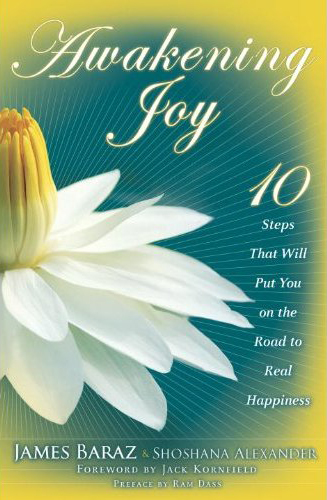
In March, I reviewed Scott Adams’ latest book, How to Fail at Almost Everything and Still Win Big. It has much in common with the book I’m reviewing today: both focus on the myriad, day-to-day choices we make and how they can steer us toward or away from the lives we want to live.

Though one of the numerous “failures” Adams recounts was a book on meditation, he wrote How to Fail in purely secular terms. Baraz, who took up the study of mindfulness meditation in 1974, writes from a Buddhist perspective, but says, “many people, including myself, consider Buddhism to be more a philosophy than a religion, a way to live a harmonious life.” This tone should make Awakening Joy accessible to people of any faith or no faith.

Baraz, a founding member of Spirit Rock, first taught an Awakening Joy class in his living room in 2003. In working with initially interested but skeptical students, who didn’t just want to sit around singing Kumbaya, Baraz honed the presentation that is encompassed in his book and a five month online class.

The book has ten chapters or “Steps,”  which center on topics like mindfulness, compassion, forgiving oneself, and letting go. In some ways the first step is most challenging – figuring out what “joy” means personally and accepting that we want it and deserve it, now and not at some future time when we will have “earned” the right to feel good.

Baraz quotes the Buddha who said, “Whatever the practitioner frequently thinks and ponders upon, that will become the inclination of the mind.” Can it really be that simple? Anyone who has ever tried to meditate knows that working with the “inclination of the mind” may be simple but isn’t easy.

Awakening Joy is written with simple concepts, personal stories, and exercises designed to cut through our suspicion that feeling good means becoming Pollyanna. We’ve all seen small children manifest joy. What happened to us along the way? Baraz presents a series of simple steps designed to help us turn back toward the direction we’d rather travel.

Alternate views of the evil empire

Here is another take on the Amazon / Hachette controversy by Barry Eisler, a former CIA operative and best-selling author of thrillers. Eisler made headlines in 2011 when he turned his back on traditional publishing (which he calls “legacy publishing”) to publish his work independently on Amazon.

In this June 4 article in The Guardian, Eisler ticks off these pluses for Amazon: it “singlehandedly created a market for digital books, [is] now the greatest source of the legacy publishing industry’s profitability (though of course legacy publishers are sharing little of that newfound wealth with their authors)…built the world’s first viable mass-market self-publishing platform, a platform that has enabled thousands of new authors to make a living from their writing for the first time in their lives. And [it] pays self-published authors something like five times as much in digital royalties as legacy publishers do.”

Eisler makes some interesting arguments while waving a red flag (Amazon-hating authors are the literary “one-percent”). I recommend the article to anyone interested in this current publishing brouhaha. My biggest takeaway was Eisler’s simple observation, in an otherwise complex debate, that individual attitudes are probably based more on personal interest than selfless concern for the future of literature. To blame Jeff Bezos for the loss of bookstores, he says, is like buggy makers blaming Henry Ford for the development of internal combustion. Though some of his analogies may be questionable, they point toward two facts that are not: (1) new technologies never go back into the box, and (2) their ramifications are never known at the outset.

I was halfway through the paragraphs above when the postman brought the June 16 issue of Time, with an essay on the back page by Joel Stein, Hachette author of Man Made: A Stupid Quest for Masculinity.

Stein ventured, “with trepidation,” to Amazon “to see what barbarism it had committed on my book’s page – changing my author photo go one of my high school mullet shots, perhaps, or allowing yet more people to start their one-star reviews with ‘No, I haven’t read this book.'”

When he found nothing amiss, Stein sadly reflected that Amazon, with its cutting edge algorithms, had to know how much it would hurt his ego and confidence to be left out of the feud. “I have no idea who will publish my next book,” he says, “though I do know they’ll be sorry they did.”

Diversity and variety are central to the richness of life. I’m old enough to remember and miss various mom and pop stores of all kinds, not just bookstores. A local nursery used to employ master gardeners, who could look at a sick leaf and tell you exactly what to do. Through no fault of their own, the people who work in the Lowe’s garden section can only tell you, “Fertilizers are down aisle one.” As a kid, I learned to make flying airplanes out of balsa wood and tissue paper at a local hobby shop; it was a far more interesting place than any Toys ‘R Us.

Right now, perhaps all we can do in the publishing battle is watch and wait, and opt for diversity and richness in whatever way we can.

Those Who Wish Me Dead by Michael Koryta: a book review

those who wish me dead

If you could find that and hold it there within yourself, a candle of self-confidence against the darkness, you could accomplish great things. He knew this. He’d been through it.

Fourteen year old Jace Wilson witnesses a murder-for-hire near his home in Indiana. Witness protection will not help, for the system has been compromised. U.S. Marshals appear to be involved. At the suggestion of an executive bodyguard, Jace’s parents send him to the Wyoming-Montana border, to the wilderness survival school for troubled youth that Ethan Serbin, a retired military survival expert teaches. Once he is in the wilderness, away from computers and cell phones, Jace will be safe, right?

Of course not. Even as Jace, who has been fearful all his life, begins to learn about trusting himself, about building confidence as he learns to build a fire with flint and steel, the killers, Jack and Patrick Blackwell, relentless sociopathic brothers, are  close behind. To hide the murder of a local sherif, the Blackwells set a hillside on fire that burns out of control and into the mountains where Ethan and his young charges are camped.

Realizing they’ve found him, Jace slips away by himself. Killers and searchers, Ethan and his injured wife, Jace and Hannah, a guilt-ridden fire lookout whose lover died in a wildfire saving her, struggle to survive mountain thunder storms, each other, and a fire that grows to monster size as it races into the high country.

I’ve reviewed three of Koryta’s books, including So Cold the River (2010), perhaps my all time favorite thriller. This one is just as good; I devoured it in less than two days. In Those Who Wish Me Dead, the author serves up a near perfect blend of sympathetic protagonists, villains who are fascinating in their complexity, and tension that is finely tuned, neither too loose nor too tight. There really aren’t that many books that I literally cannot put down, but Those Who Wish Me Dead was one.

Michael Koryta

Michael Koryta

I’m not dead yet

My title, a line from Monty Python and the Holy Grail, came to mind during recent reflections on independent bookstores.

Shakespeare and Company bookstore, Paris. Wikimedia Commons

Shakespeare and Company bookstore, Paris. Wikimedia Commons

I used to go to bookstores to make discoveries. The best were quirky, and I loved to be surprised and find something new to read. My all time favorite was a sci-fi/fantasy specialty store in a low rent strip mall. The store was a labor of love for the owner, who made most of his income trading collectables – signed Robert Heinlein first editions and vintage comic books.

I could walk in and say, “I’m looking for urban fantasy that centers on spirit guides,” or, “I’m in the mood for a quest – got anything that’s not a dumb Tolkien ripoff?” Most of the time, I’d find what I was looking for and have an interesting chat on trends in the genre with someone who was steeped in that world. You never know what you’re going to find in a place like that. Sadly, independents are on the ropes, but as the Pythons put it, they’re not dead yet. Here is a link to indiebound.org, which has a tab at the top right to locate independent booksellers.

We don’t even have to abandon ebooks to shop at indies! In February, 2012, I wrote about The Book Seller, a great independent shop in Grass Valley, that encourages ebook fans to order through their website; that way they get a commission on each sale (the format is .epub, the standard all-but-Amazon format, which can be read on a Nook or any laptop, smartphone, or tablet using the free Nook app).

I’m pretty sure that for just about everyone reading this blog, books are a huge and treasured part of our lives. If anything good has come out of the Amazon-Hachette dispute, it’s information like this which can help me rethink the way I buy books.

As Mark Coker put it, the ideal is “a vibrant ecosystem of multiple competing retailers.” It’s good to know what I can do to help secure such a future.

From indiebound.org

From indiebound.org

Footnote, June 3:  Calmgrove, a blogging buddy, noted in a comment that the initials of my title, I’m Not Dead Yet, form a nice acronym, INDY. In addition to independent bookstores, he says it has something to do with fruit fly genetics – feel free to pursue that with him if you wish…

To the barricades! No, the other barricades.

Printing, ca. 1568.  Public domain.

Printing, ca. 1568. Public domain.

“Right now, bookstores, libraries, authors, and books themselves are caught in the cross fire of an economic war. If this is the new American way, then maybe it has to be changed — by law, if necessary — immediately, if not sooner.” – James Patterson

I haven’t blogged about ebooks and independent publishing lately. Over the last few years, it’s become clear they are here to stay. Success breeds acceptance, and the “vanity press” stigma is gone. In olden days (ca. 2011), I found a kind of “blows against the empire” satisfaction in promoting ebooks, writing reviews, and encouraging Indie authors. The evil empire was big publishing. This was the time of the little guy.

I still like Indie authors, though the “righteous cause” fantasy is gone. Now suddenly, at least to a casual observer like me, the situation appears reversed, with Amazon in the role of bully-boy, and those same publishers (perhaps) fighting for their existence, and with them (maybe) hangs the fate of a lot of remaining brick and mortar stores.

I first learned of the Amazon-Hachette duel from Michael Koryta, a favorite action-adventure writer I follow on Facebook. On May 19, Koryta reported serious problems pre-ordering his new book, due out June 3, from Amazon. He said the situation goes far beyond the interests of one author, and provided some of the links posted below.

On May 29, USA Today quoted James Patterson as saying “the future of our literature is in danger.” Patterson says that “Amazon wants to control book buying, book selling and even book publishing,” and laments that federal anti-trust laws no longer have teeth.

Here are several editorials on the situation:

Amazon vs. Hachette: When Does Discouragement Become Misrepresentation? From the NY Times Blog

Amazon said to play hardball in book contract talks with publishing house Hachette The Washington Post

AAR Calls Out Amazon in Hachette Dispute, From a statement sent by Association of Authors Representatives to Amazon.

And if I was only going to read one account of this dispute, I’d chose this one by Mark Coker, founder of Smashwords and early champion of ebooks, who believes in the vitality of a diverse writing and publishing world: Amazon’s Hachette Dispute Foreshadows What’s Next for Indie Authors

I’ve heard Coker speak on several occasions, and he’s a keen observer of a complicated landscape and future. His predictions on publishing tend to be right. In this post, he explains that the conflict centers on “agency pricing,” and who gets what profit margin for ebooks. Amazon is demanding a greater share. Here is what is at stake, says Coker:

“Books represent only one of hundreds of layers of icing on the cake of Amazon. Amazon can lose money on books while still operating a profitable business. Pure-play book retailers – Kobo and Barnes & Noble for example, must earn money from book sales. Unlike Amazon, they don’t have the financial resources to sell books at a loss forever…If Amazon can abolish agency pricing it will have the power to put its largest pure-play book retailing competitors out of business. This will make the publishers even more dependent upon Amazon, which further weakens their power.”

That’s the bad news. The really bad news, according to Coker, is that next they’ll come after Indie authors, just as they have in their audio book division, Audible. Gone are the 70% margins for authors that the agency model protects. Instead, exclusive Audible authors get 40% while the non-exclusive rate is 25%.

Coker winds up with with advice for independent authors, who, he says, are “the future of publishing.” It’s well worth reading the details in his article, but here are his main suggestions:

  1. Choose your partners carefully.
  2. Favor retail partners that support the agency model.
  3. Avoid exclusivity.
  4. Support a vibrant ecosystem of multiple competing retailers.

Remember the vibrant ecosystem of multiple competing book retailers? Though it is on the ropes, it’s not yet extinct. That’s worth thinking about and will be the subject of my next post.

More notes on Buddhism

Prajnaparamita, Sanskrit for "The perfection of wisdom," is often personified as a goddess of transcendental wisdom in Buddhist iconography, as in this 13th c. stature from Java. Public domain.

Prajnaparamita, Sanskrit for “The perfection of wisdom,” is often personified as a goddess of transcendental wisdom in Buddhist iconography, as in this 13th c. stature from Java. Public domain

If you have not already done so, please read the previous post as an introduction to this one. I’m going to discuss two additional questions that are commonly asked about Buddhism. Then I’ll list some of my favorite references.

Is Buddhism a religion?

For some people it is and for some it’s not. There are Buddhist churches, similar to any other church, though westerners usually focus on the contemplative dimension with its “spiritual but not religious” nature.

The first long Zen retreat I attended was led by a Catholic priest at a Sisters of Mercy Retreat Center. This was not watered down Zen. The priest, who bears the title, Roshi (master) is member of a recognized Japanese lineage, as are other Catholic priests and nuns. The church allows this, holding that Zen is not a religion, but a means for exploring the nature of awareness. I’m not aware of any contemplative Buddhist tradition that requires members to drop their other religious affiliations.

Is Buddhism atheistic?

Buddha never talked about metaphysics. He focused on suffering and the path to enlightenment as the end of suffering. Often when he was asked about ultimate things, he refused to answer. Once a monk asked, and Buddha told “the parable of the arrow.” As Thich Nhat Hahn, a Vietnamese Buddhist monk explained it:

[Buddha] said, “Suppose a man is struck by a poisoned arrow and the doctor wishes to take out the arrow immediately. Suppose the man does not want the arrow removed until he knows who shot it, his age, his parents, and why he shot it. What would happen? If he were to wait until all these questions have been answered, the man might die first.” Life is so short. It must not be spent in endless metaphysical speculation that does not bring us any closer to the truth. (the parable of the arrow).

So it’s accurate to say Buddhism is non-theistic, but it isn’t explicitly atheistic either; Buddha never said one way or the other. As Brad Warner, a Zen priest for 30 years, puts it in his book on the subject, There is No God, and He is Always With You, it depends on what you mean by “God.” If we mean some large, powerful being “out there,” who created us at some finite point in time and pulls strings, then no, Buddhists don’t believe that. If we’re speaking of something like Paul Tillich’s “Ground of Being,” then I think it’s implied in much Buddhist writing and by many Buddhist teachers I’ve heard. To quote Anam Thubten as I did in the previous post:

There is Buddha in each of us right now who can never be defeated by the force of inner darkness, the force of greed, hate, attachment, and delusion, and that Buddha has no form, no image. That Buddha, indeed, is residing in all of us as our pure, quintessential being. We must always turn our attention inward whenever we have the desire to seek divinity, or Buddha, God, or Brahma. (The Magic of Awareness)
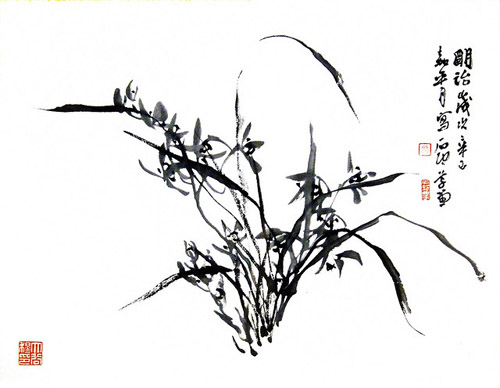
Japanese brush painting, by Lone Primate, 2007, CC By-NC-SA 2.0

Japanese brush painting, by Lone Primate, 2007, CC By-NC-SA 2.0

Buddhist Resources

The best resource of all is a nearby sangha (group of practitioners) or meditation group in one’s own area, if it’s a good fit. Meanwhile, here are a few books and websites that I find valuable.

Books:

A Path With Heart (1993) by Jack Kornfield.
This is the first book on Buddhism I’d recommend to someone wanting to learn more. Part spiritual autobiography and part introduction to Buddhist thought and practice by an influential teacher of Vipassana (Insight Meditation). Kornfield, a co-founder of Spirit Rock (web link below), gives fine descriptions of some of the difficulties westerners may have when approaching eastern traditions.

No Self No Problem (2009) by Anam Thubten
The most important single work in turning my attention to Buddhism. I found an earlier edition of the book and attended a daylong retreat (the first of many) with Anam Thubten a few weeks later. There’s a link to Anam Thubten’s website below.

An Introduction to Tantra: A Vision of Totality (1987) by Lama Thubten Yeshe
The best introduction I’ve found to Tibetan Buddhism by a renowned 20th century lama and member of the Dalai Lama’s tradition. “Dwelling deep within our heart, and within the hearts of all beings without exception, is an inexhaustible source of love and wisdom. And the ultimate purpose of all spiritual practices, whether they are called Buddhist or not, is to uncover and make contact with this essentially pure nature.”

Awakening Joy (2010) by James Baraz
James is a teacher at Spirit Rock. I bought this book several years ago, when he gave a local daylong retreat here, and just started reading it. It’s the most “ecumenical” of all these books. The author presents 10 themes, with exercises, to increase our wellbeing now, where we are, not at some future time when we are enlightened. The book meshes with an online course he teaches. Website below.

Online Resources:

Spirit Rock. An insight meditation center north of San Francisco that hosts retreats all year long. See especially the “Meditation101 tab” for the basics of insight meditation and dozens of talks by visiting instructors.

Dharmata Foundation. This is Anam Thubten’s home page. Well worth checking the calendar from time to time. From his home center in Point Richmond, CA, this Tibetan master travels extensively. In May he gave retreats in South Korea, Little Rock, AR, and Maine. In June, he will teach in Princeton, NJ, New York, NY, Maui, and Grass Valley, CA. Hearing him is well worth the effort (here is one account I’ve posted of a retreat with him).

James Baraz. Here is James’ website and teaching schedule with a link to his Awakening Joy course (available online).

Tricycle. The pre-eminent Buddhist magazine, with 20+ years of articles from all traditions. Check out a hard copy in a bookstore for a directory of dharma centers by region. There are always online retreats available to subscribers.

Peaceful Sea Sangha. Website for Edward Espe Brown, who I’ve posted about here several times. He also travels and teaches widely, with a trip to Prague, Austria, and Germany scheduled over the next month and a half. His audio teachings are wise and hilarious. I discovered a poem I recently referenced, “10,000 Idiots” by Hafiz, in one of them.

I could go on and on, but this is already long enough. These are only a few suggestions. Feel free to comment or email with any specific questions, observations, or resources of your own.

 

It’s In His Kiss by Vickie Lester: a book review

IIHKCover5x8final291p copy

Death is a sidewinder. It strikes from a place concealed and unthinkable, triggering a reality completely unexpected. – Vickie Lester

Anne Brown, a New York teacher and author of literary novels is on her way to Palm Springs in the middle of winter. Movie studio bigwigs are flying her out to renew the option on her first novel, a decade out of print. Why do the rich and beautiful people welcome her with open arms? Is it because she’s the out of wedlock daughter of a retired movie mogul?

No, it’s a bit more sinister than that, Cliff, the most beautiful person there, tells Anne. An acting agent, he fills her in and offers to help her navigate the proverbial shark infested waters. And draws her into a whirlwind affair that is hardly the norm for Anne, a confirmed bachelorette, who thinks of herself as the girl that guys just want to be friends with.

It seems too good to be true, but it is, until the following morning, when Cliff is found dead by the side of the road in his Ferrari. It looks like a tragic heart attack until the coroner finds he overdosed on the kind of drug cocktail used to enhance pleasure at the gay sex club up the road. Cliff hardly seemed gay to Anne, and everyone who knew him swears he was straight in every sense of the word.

Filled with grief, anger, and curiosity, Anne begins to ask questions. It soon becomes apparent that everyone at the Palm Springs house that weekend was hiding something. “Was there not one single normal person in all of L.A.?” she wonders. And then a black Escalade tries to chase her down on the freeway…

Vickie Lester, who blogs at Beguiling Hollywood, used to write screenplays, “Horrid, arty, little things,” she says, “that were…optioned again and again, but never made into movies. Perhaps, because they were neither commercial or cinematic?”

Now she has turned her considerable talent and insider’s knowledge of Hollywood into a gripping mystery, with an ending I never saw coming.  It’s In His Kiss is funny and smart and offers an insider’s view of a world of illusion that still fascinates.

The City of Angels was named for beings most often seen by children, visionaries, and the insane. The best novels out of LA are woven with a noir tone – all that sun and all those palm trees have to cast a shadow. Anne Brown and Phillip Marlowe are very different characters, and yet I imagine the spirit of Raymond Chandler is pleased. As a fan of both authors, I know I was!

Vickie Lester at Joshua Tree

Vickie Lester at Joshua Tree

The power of solitude

Beside the Dalai Lama, Pema Chödrön is probably the most widely known practitioner of Tibetan Buddhism. Born in New York City, she was ordained as a nun in 1974 and has written several popular books on Buddhist practice, including When Things Fall Apart (1996), The Places That Scare You (2001), and Start Where You Are (2004).

In 2006, Bill Moyers talked with Pema Chödrön as part of his Faith and Reason series. Here is the full interview, and below is segment, lasting just under five minutes. Chödrön, who spent a year in silent retreat, says everyone needs periods of solitude in life, even if just a brief time every day. Distraction, she says, is not just our phones and gadgets, but the distracted state of our ordinary minds. Just a little time out from this allows us to re-engage our lives with a “more spacious” awareness, and this makes it profoundly valuable.