About Affirmations

“Affirmations are simply the practice of repeating to yourself what you want to achieve while imagining the outcome you want.” – Scott Adams

For a long time, the word “affirmation” brought to mind, “Every day in every way, I am getting better and better.” When you see it in print like that, it’s hard to believe and easy to dismiss. The phrase was created by Emile Coué (1857-1926), a French psychologist and pharmacist who developed a method of psychotherapy based on autosuggestion.

Later, when I studied the teachings of Paramahansa Yogananda, I found a broader concept of affirmations and why certain types of suggestions work for certain types of people.  In Scientific Healing Affirmations, (1925), Yogananda wrote:

“Imagination, reason, faith, emotion, will, or exertion may be used according to the specific nature of he individual – whether imaginative, intellectual, aspiring, emotional, volitional, or striving. Few people know this. Coué stressed the value of autosuggestion, but an intellectual type of person is not susceptible to suggestion, and is influenced only by a metaphysical discussion of the power of consciousness over the body. He needs to understand the whys and wherefores of mental powers. If he can realize, for instance, that blisters may be produced by hypnosis…he can understand the power of the mind to cure disease. If the mind can produce ill health, it can also produce good health.”

Recently, I found an even simpler testimonial to the power of affirmations in Scott Adam’s book, How to Fail at Almost Everything and Still Win Big. Discussing affirmations in an earlier book, Adams drew negative email from people who claimed he believed in magic. In two chapters of his latest work, Adams lays out the principles of affirmations without venturing any guesses on why they have worked for him, with the exception of one simple principle:

“The pattern I have noticed is that the affirmations only worked when I had a 100 percent unambiguous desire for success.”

He then summarizes his experience with affirmations, leading up to the big one in his life: “I, Scott Adams, will be a famous cartoonist.”  As the book makes clear, he was already working in the field and committed when he practiced this suggestion.

I recommended How to Fail when I reviewed it, and the chapters on affirmation alone are worthy of another recommendation.

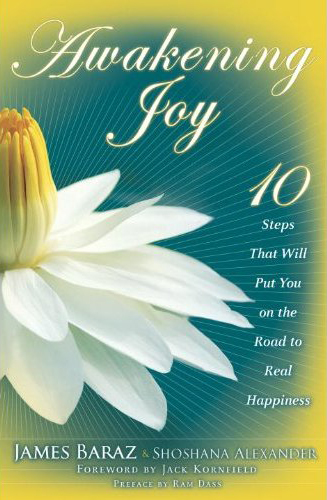
Awakening Joy by James Baraz: a book review

Awakening Joy cover

In March, I reviewed Scott Adams’ latest book, How to Fail at Almost Everything and Still Win Big. It has much in common with the book I’m reviewing today: both focus on the myriad, day-to-day choices we make and how they can steer us toward or away from the lives we want to live.

Though one of the numerous “failures” Adams recounts was a book on meditation, he wrote How to Fail in purely secular terms. Baraz, who took up the study of mindfulness meditation in 1974, writes from a Buddhist perspective, but says, “many people, including myself, consider Buddhism to be more a philosophy than a religion, a way to live a harmonious life.” This tone should make Awakening Joy accessible to people of any faith or no faith.

Baraz, a founding member of Spirit Rock, first taught an Awakening Joy class in his living room in 2003. In working with initially interested but skeptical students, who didn’t just want to sit around singing Kumbaya, Baraz honed the presentation that is encompassed in his book and a five month online class.

The book has ten chapters or “Steps,”  which center on topics like mindfulness, compassion, forgiving oneself, and letting go. In some ways the first step is most challenging – figuring out what “joy” means personally and accepting that we want it and deserve it, now and not at some future time when we will have “earned” the right to feel good.

Baraz quotes the Buddha who said, “Whatever the practitioner frequently thinks and ponders upon, that will become the inclination of the mind.” Can it really be that simple? Anyone who has ever tried to meditate knows that working with the “inclination of the mind” may be simple but isn’t easy.

Awakening Joy is written with simple concepts, personal stories, and exercises designed to cut through our suspicion that feeling good means becoming Pollyanna. We’ve all seen small children manifest joy. What happened to us along the way? Baraz presents a series of simple steps designed to help us turn back toward the direction we’d rather travel.

Notes on the Mind – Body connection

Subtle body from 1899 yoga manuscript. Public domain.

Subtle body from 1899 yoga manuscript. Public domain.

One of the key themes emerging for me this year, both in living and blogging, involves mental hygiene, in particular, watching what ideas and thoughts I dwell on. I tried to express it in posts like Guarding the Mind and The Wishing Tree Revisited. Cheri Huber a Zen teacher, sums it up like this: “The quality of your life depends on the focus of your attention.”

As I check out things online, I bookmark articles that look like they might lead to interesting posts. Several recent posts center on a parallel theme,  the intimate connection of mind and body.

The first comes from Julieanne Victoria’s blog, Through the Peacock’s Eyes. In a post called, Effect of Thought on Health and the Body, she describes a small book by James Allen, amazing because of its visionary nature – it was written in 1902 and published in 1920.

Nowadays we’re used to seeing people practice Tai Chi in parks. We find yoga classes at local gyms and hear of corporate executives learning mindfulness meditation. A discussion of the ends and means for lifting such practices out of traditional contexts is a topic for another time. The point is, general awareness of the mind-body connection snowballed in the west in the latter half of the 20th century. I think it’s just beginning, which makes James Allen’s conclusions, penned 112 years ago, all the more unique.  Check out Julieanne Victoria’s post. It is inspiring to read these words of a man who understood these truths before almost anyone else in our culture.

One manifestation of the mind-body connection that everyone knows about involves stress. Stress is bad and A-Types have it worst, right? What if you learned, as I did in a recent NPR article, that almost all of the studies that created “stress” and “A-Type” as modern words and concepts were funded by big tobacco companies, seeking to prove that stress and not cigarettes, cause heart problems and cancer? This article is an eye opener, and not because of this single topic. It’s illuminating to see how far money can go in creating the “truths” we try to live by.

The final post that caught my attention comes from the Scientific American BlogWhat does Mindfulness Meditation do for your brain. Leaving aside all questions of what might be lost in separating mindfulness practice from it’s Buddhist context, the benefits appear to be compelling:

“It’s been accepted as a useful therapy for anxiety and depression for around a decade…It’s being explored by schools, pro sports teams and military units to enhance performance, and is showing promise as a way of helping sufferers of chronic pain, addiction and tinnitus, too. There is even some evidence that mindfulness can help with the symptoms of certain physical conditions, such as irritable bowel syndrome, cancer, and HIV.”

Beyond these experiential findings, the Scientific American post presents a powerful physiological finding. MRI scans of people after an eight week mindfulness meditation course show the amygdala shrinking. This is the brain’s fight or flight center, associated with emotion and fear. At the same time, the pre-frontal cortex, “associated with higher order brain functions such as awareness, concentration and decision-making,” becomes thicker. In addition, brain links are altered: “The connection between the amygdala and the rest of the brain gets weaker, while the connections between areas associated with attention and concentration get stronger.”

These few posts are just the barest notes on a huge topic, but one I find fascinating. I’ll be posting more as I see more interesting stories along these lines.

More notes on Buddhism

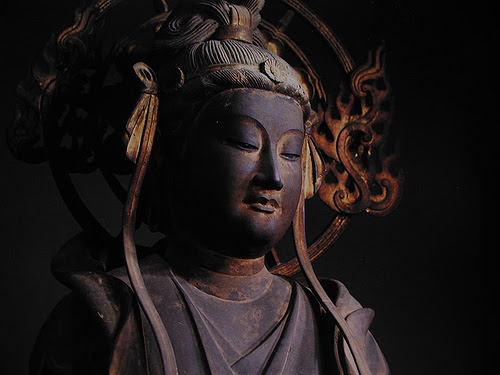
Prajnaparamita, Sanskrit for "The perfection of wisdom," is often personified as a goddess of transcendental wisdom in Buddhist iconography, as in this 13th c. stature from Java. Public domain.

Prajnaparamita, Sanskrit for “The perfection of wisdom,” is often personified as a goddess of transcendental wisdom in Buddhist iconography, as in this 13th c. stature from Java. Public domain

If you have not already done so, please read the previous post as an introduction to this one. I’m going to discuss two additional questions that are commonly asked about Buddhism. Then I’ll list some of my favorite references.

Is Buddhism a religion?

For some people it is and for some it’s not. There are Buddhist churches, similar to any other church, though westerners usually focus on the contemplative dimension with its “spiritual but not religious” nature.

The first long Zen retreat I attended was led by a Catholic priest at a Sisters of Mercy Retreat Center. This was not watered down Zen. The priest, who bears the title, Roshi (master) is member of a recognized Japanese lineage, as are other Catholic priests and nuns. The church allows this, holding that Zen is not a religion, but a means for exploring the nature of awareness. I’m not aware of any contemplative Buddhist tradition that requires members to drop their other religious affiliations.

Is Buddhism atheistic?

Buddha never talked about metaphysics. He focused on suffering and the path to enlightenment as the end of suffering. Often when he was asked about ultimate things, he refused to answer. Once a monk asked, and Buddha told “the parable of the arrow.” As Thich Nhat Hahn, a Vietnamese Buddhist monk explained it:

[Buddha] said, “Suppose a man is struck by a poisoned arrow and the doctor wishes to take out the arrow immediately. Suppose the man does not want the arrow removed until he knows who shot it, his age, his parents, and why he shot it. What would happen? If he were to wait until all these questions have been answered, the man might die first.” Life is so short. It must not be spent in endless metaphysical speculation that does not bring us any closer to the truth. (the parable of the arrow).

So it’s accurate to say Buddhism is non-theistic, but it isn’t explicitly atheistic either; Buddha never said one way or the other. As Brad Warner, a Zen priest for 30 years, puts it in his book on the subject, There is No God, and He is Always With You, it depends on what you mean by “God.” If we mean some large, powerful being “out there,” who created us at some finite point in time and pulls strings, then no, Buddhists don’t believe that. If we’re speaking of something like Paul Tillich’s “Ground of Being,” then I think it’s implied in much Buddhist writing and by many Buddhist teachers I’ve heard. To quote Anam Thubten as I did in the previous post:

There is Buddha in each of us right now who can never be defeated by the force of inner darkness, the force of greed, hate, attachment, and delusion, and that Buddha has no form, no image. That Buddha, indeed, is residing in all of us as our pure, quintessential being. We must always turn our attention inward whenever we have the desire to seek divinity, or Buddha, God, or Brahma. (The Magic of Awareness)

Japanese brush painting, by Lone Primate, 2007, CC By-NC-SA 2.0

Japanese brush painting, by Lone Primate, 2007, CC By-NC-SA 2.0

Buddhist Resources

The best resource of all is a nearby sangha (group of practitioners) or meditation group in one’s own area, if it’s a good fit. Meanwhile, here are a few books and websites that I find valuable.

Books:

A Path With Heart (1993) by Jack Kornfield.
This is the first book on Buddhism I’d recommend to someone wanting to learn more. Part spiritual autobiography and part introduction to Buddhist thought and practice by an influential teacher of Vipassana (Insight Meditation). Kornfield, a co-founder of Spirit Rock (web link below), gives fine descriptions of some of the difficulties westerners may have when approaching eastern traditions.

No Self No Problem (2009) by Anam Thubten
The most important single work in turning my attention to Buddhism. I found an earlier edition of the book and attended a daylong retreat (the first of many) with Anam Thubten a few weeks later. There’s a link to Anam Thubten’s website below.

An Introduction to Tantra: A Vision of Totality (1987) by Lama Thubten Yeshe
The best introduction I’ve found to Tibetan Buddhism by a renowned 20th century lama and member of the Dalai Lama’s tradition. “Dwelling deep within our heart, and within the hearts of all beings without exception, is an inexhaustible source of love and wisdom. And the ultimate purpose of all spiritual practices, whether they are called Buddhist or not, is to uncover and make contact with this essentially pure nature.”

Awakening Joy (2010) by James Baraz
James is a teacher at Spirit Rock. I bought this book several years ago, when he gave a local daylong retreat here, and just started reading it. It’s the most “ecumenical” of all these books. The author presents 10 themes, with exercises, to increase our wellbeing now, where we are, not at some future time when we are enlightened. The book meshes with an online course he teaches. Website below.

Online Resources:

Spirit Rock. An insight meditation center north of San Francisco that hosts retreats all year long. See especially the “Meditation101 tab” for the basics of insight meditation and dozens of talks by visiting instructors.

Dharmata Foundation. This is Anam Thubten’s home page. Well worth checking the calendar from time to time. From his home center in Point Richmond, CA, this Tibetan master travels extensively. In May he gave retreats in South Korea, Little Rock, AR, and Maine. In June, he will teach in Princeton, NJ, New York, NY, Maui, and Grass Valley, CA. Hearing him is well worth the effort (here is one account I’ve posted of a retreat with him).

James Baraz. Here is James’ website and teaching schedule with a link to his Awakening Joy course (available online).

Tricycle. The pre-eminent Buddhist magazine, with 20+ years of articles from all traditions. Check out a hard copy in a bookstore for a directory of dharma centers by region. There are always online retreats available to subscribers.

Peaceful Sea Sangha. Website for Edward Espe Brown, who I’ve posted about here several times. He also travels and teaches widely, with a trip to Prague, Austria, and Germany scheduled over the next month and a half. His audio teachings are wise and hilarious. I discovered a poem I recently referenced, “10,000 Idiots” by Hafiz, in one of them.

I could go on and on, but this is already long enough. These are only a few suggestions. Feel free to comment or email with any specific questions, observations, or resources of your own.


Notes on Buddhism

Japanese Buddha. Photo by Maren Yumi Motomura, CC BY-NC-SA 2.0

Japanese Buddha. Photo by Maren Yumi Motomura, CC BY-NC-SA 2.0

Recently, my blogging buddy, Adam (Reviews and Ramblings), asked if I could recommend a good book on Buddhism, since the Dharma (as practitioners call Buddhist theory and practice) is so much a part of my outlook and what I write here. I’ll list some books at the end of this series of posts, but first I need to do some rambling of my own because…it’s complicated! What would you do if someone asked you to recommend a book on Christianity? Or U.S. History? Or writing young adult novels? Or anything you’ve studied in depth because it’s a passionate interest? You might say, “Well, it’s complicated.”

So here goes…

Who was Buddha?

Some 2600 years ago, Prince Siddhartha Gautama, the historical Buddha (there had been countless others before him) was born in northern India. According to legend, a prophecy said he would become either a great king or a great holy man. Hoping for the first outcome, Siddhartha’s father had him raised in a walled palace, where young and beautiful companions and servants saw to his every desire.

At age 29, the prince ordered a chariot driver to carry him outside the palace walls, where he saw an aged man, a sick man, and a corpse. The charioteer explained that aging, sickness, and death are the fate of all living beings. When the prince saw a yogi, and learned that he sought release from suffering, he determined to follow that path.

For six years, he practiced austerities with a group of forest ascetics, but realized that even the most exalted states of consciousness did not offer what he was looking for. He sat beneath a bodhi tree, resolving to stay there until he’d unravelled the mysteries of life and death. During the final night, he withstood assaults from Mara, the lord of illusion, and experienced full awakening in the morning. He wondered if it was possible to communicate this truth – the Dharma – to others. Legend says that Brahma, king of the gods, appeared and begged him to try, and he did so for the rest of his 80 years.

In Buddhist teaching there is always relative truth and ultimate truth, and the question, “Who was Buddha?” is no different. Anam Thubten, a Tibetan master describes “the ultimate Buddha” in these words:

“There is Buddha in each of us right now who can never be defeated by the force of inner darkness, the force of greed, hate, attachment, and delusion, and that Buddha has no form, no image. That Buddha, indeed, is residing in all of us as our pure, quintessential being. We must always turn our attention inward whenever we have the desire to seek divinity, the divine, or Buddha, God, or Brahma.”

Borobudur Temple, Java, 9th c. Creative Commons

Borobudur Temple, Java, 9th c. Creative Commons

What did Buddha teach?

Gautama Buddha gave different teachings to different audiences, and over time, widened the scope of his teachings. When they were carried to other countries, and ultimately to the west, some aspects were emphasized over others. What everyone agrees on is that Buddha taught the reality of suffering and the path to overcome it. Different schools teach different means to do so, but in general, three realizations are key:

Renunciation: This does not mean becoming monastic. It means letting go of the hope that we can ever find the permanent happiness we seek “out there,” in the world, where everything changes. In Tibetan, the word for Buddhist means, “one who lives within.”

Compassion or Boddhichitta: This is the determination to awaken in order to most effectively benefit other living beings who also suffer and desire happiness as much as we do. And as the Dalai Lama put it, “If you want others to be happy, practice compassion. If you want to be happy, practice compassion.”

Right View: This is the hardest to explain or grasp. Although in relative terms, the world appears real and solid, in ultimate terms, it is much like a dream, where nothing is solid or fixed. Beyond memory, the only thing that endures when a dream ends is the dreaming mind, which has no form, no shape, no color, and lies beyond the grasp of any conceptual thought – much like Anam Thubten’s description of the “Buddha within.”

One Tibetan lama said, “Our suffering is like a child dying in a dream.” Everyone knows what it’s like to have such a nightmare and then wake up. As I understand it, all Buddhist practice aims at waking up in the midst of the very life we are living.

One story says that soon after Buddha’s enlightenment, a man passed him on a road. Noticing something special about him, the man asked, “Are you a sage?” Buddha said “No.” “Are you an angel?” the man asked. “A man? A god?” To all of these inquiries, Buddha said no. Finally the man asked, “What are you?”

Buddha said, “I am awake.”

***

Many people think of Buddhism as negative, with it’s seeming emphasis on suffering. There’s more to it than that. Buddha began with this observation: most people spend most of the hours of most of their days with a greater or lesser degree of dissatisfaction. He went on to teach that there is a way beyond dissatisfaction and suffering. “I cannot bestow it upon you,” he said, “but I can show you the road to take.”

That is plenty for now. In my next post I’ll address two other questions whose answers are also not obvious: is Buddhism a religion and is it atheistic? And then finally (I promise) I’ll get around to listing several books and web links on the subject.


The power of solitude

Beside the Dalai Lama, Pema Chödrön is probably the most widely known practitioner of Tibetan Buddhism. Born in New York City, she was ordained as a nun in 1974 and has written several popular books on Buddhist practice, including When Things Fall Apart (1996), The Places That Scare You (2001), and Start Where You Are (2004).

In 2006, Bill Moyers talked with Pema Chödrön as part of his Faith and Reason series. Here is the full interview, and below is segment, lasting just under five minutes. Chödrön, who spent a year in silent retreat, says everyone needs periods of solitude in life, even if just a brief time every day. Distraction, she says, is not just our phones and gadgets, but the distracted state of our ordinary minds. Just a little time out from this allows us to re-engage our lives with a “more spacious” awareness, and this makes it profoundly valuable.

Guarding the mind

guard mind 1

One summer when I was working in high-tech, I had the following experience for several weeks: I’d leave the house, enjoying the fine weather. After a pleasant enough commute, I’d grab some coffee at the cafe, greet co-workers who were doing the same, and then find myself, when I arrived at my cubicle, in a foul mood, angry, and/or depressed.

Finally, I began to notice the almost subliminal self-talk that started the moment I hit the parking lot: imagining negative outcomes for everything I had going on that day. I’d picture meetings, or presentation, or projects falling apart. A quiet but persuasive inner voice would label co-workers’ motives in the harshest light. My boss at the time was a friend who had just finished his MBA and was still finding his way by trial and error. This made him a perfect projection screen. I’d sometimes find myself wondering if he was now out to get me.

Once I caught this inner thought train and started to listen, it fell apart, as such things do in the light of day. This is one key result of mindfulness practice: attend to a thought – any thought – and it begins to shift and change, revealing its nature as something far less substantial than we think. Jung had a parallel insight when he realized, “My thoughts are not my own,” and compared them to animals encountered while walking in the forest.

Hist Center Window

Since that summer, I’ve learned to listen more closely for thoughts flying under the radar. That’s part of what prompted several posts this spring with the theme of consciously choosing where to place the attention. A recent post on the Shambhala Publications blog quoted a verse along these lines written more than 1200 years ago. A Guide to the Bodhisattva Way of Life by Shantideva (c. 685-763), a great Buddhist master and scholar, is still widely studied today (see note 1 below). In chapter 11, “Vigilance,” he deals with guarding the mind against against unwholesome states, for this is where all our actions are born. The chapter is composed of 109 quatrains. Here are the first three:

1.
Those who wish to keep a rule of life
Must guard their minds in perfect self-possession.
Without this guard upon the mind,
No discipline can ever be maintained.

2.
Wandering where it will, the elephant of the mind,
Will bring us down to pains of deepest hell.
No worldly beast, however wild,
Could bring upon us such calamities.

3.
If, with mindfulness’ rope,
The elephant of the mind is tethered all around,
Our fears will come to nothing,
Every virtue drop into our hands.
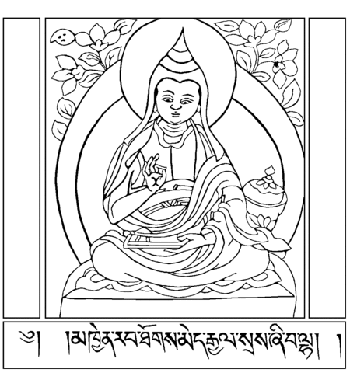
Shantideva. Public domain.

Shantideva. Public domain.

Guarding the mind is not just a Buddhist concern. When I Googled the phrase, most of the hits came from Christian websites and blogs. These discussions centered on Philippians 4:8, “Finally, brethren, whatsoever things are true, whatsoever things are honest, whatsoever things are just, whatsoever things are pure, whatsoever things are lovely, whatsoever things are of good report; if there be any virtue, and if there be any praise, think on these things”

Many of the thoughts, suggestions, and practices were similar to Shantideva’s writing as well as a more recent statement by the Dalai Lama. I am even aware of both Buddhist and Christian scriptural practices for wearing imaginal armor to shield the heart/mind from negative influence. I would not be surprised to find similar practices in other spiritual traditions.

I’ve been fortunate enough to have a few days away from my usual routines and concerns to consider these things. I’m struck again, as I was in the work episode I related above, by how subtle the negative inner voices can be.

Another bias I find in myself was articulated by James Baraz, a Buddhist meditation teacher in an article on the Huffington Post, Can We Afford Joy in a World of Suffering. Baraz describes “the Kumbaya factor,” as the fear that if we consciously turn away from what is negative, we may simply wind up “in La-La Land singing Kumbaya.”

Everyone has to work this out for themselves, but Baraz makes several key points. Depression saps our energy. No one benefits self or others while wondering, “what’s the use.” In the work experience I related above, I wasn’t the best of co-workers while imagining others were out to get me.

I’m reminded of a story I heard several times in college. In 1927, Buckminster Fuller walked to the shores of Lake Michigan, thinking to end his life. He had just lost his job and felt responsible for the death of his daughter a few years earlier. He would later tell lecture audiences that as he looked into the waters, he felt surrounded by light and heard an inner voice say:

“You do not have the right to eliminate yourself. You do not belong to you. You belong to the Universe. Your significance will remain forever obscure to you, but you may assume that you are fulfilling your role if you apply yourself to converting your experiences to the highest advantage of others.” (Fuller)

The experience led Fuller to re-examine everything and resolve to live his life as “an experiment, to find what a single individual [could] contribute to changing the world and benefiting all humanity” (see note 2 below). In this epiphany, Fuller locked onto the same truth that Shantideva articulated 1200 years before:

54.
Examine thus yourself from every side.
Note harmful thoughts and every futile striving.
Thus it is that heroes in the bodhisattva path
Apply the remedies to keep a steady mind.

55.
With perfect and unyielding faith,
With steadfastness, respect, and courtesy,
With modesty and conscientiousness,
Work calmly for the happiness of others.

Speaking in the same tradition for a 21st century audience, James Baraz summed up the idea this way: “So can we afford joy in a world of suffering? I believe, in a world of suffering, we can’t afford not to find joy.”

reflection 4

Notes: _____________________________________________________

(1) In Buddhist terminology, a Boddhisattva is one who vows to seek spiritual awakening not for self alone but for the benefit of others.

(2) Some historians, finding no account of Buckminster Fuller’s epiphany in his writings for 1927, have wondered if he made up the story later. I can only speak for myself and observe that I’ve never put my most profound experiences in a journal: the writing is too pale, and there’s no need, since the events themselves remain vivid.

The 10,000 Idiots

Hafiz. Public Domain

Hafiz. Public Domain

Hafiz or Hafez was a great 14th century Persian poet and mystic whose dates are given as approximately 1325-1389. During his life, he is said to have composed 5,000 poems of the seeker’s longing for union with the divine. Unfortunately, many of these were never written down.

His poems retain an amazing resonance to those who practice any kind of spiritual discipline.  This is one of my favorites – not one of his most sublime, but always relevant…

The 10,000 Idiots

It is always a danger
to aspirants on the Path
When they begin to believe and act
As if the ten thousand idiots
Who so long ruled and lived inside
Have all packed their bags
And skipped town
Or
Died