Short Short Story Competition

This one is from Writer’s Digest, for stories of 1500 words or less, due Dec. 1. http://writersdigest.com/short

PRIZES
First Place: $3,000 and a trip to the Writer’s Digest Conference in New York City
Second Place: $1,500
Third Place: $500
Fourth Through Tenth Place: $100
Eleventh Through Twenty-Fifth Place: $50 gift certificate for Writer’s Digest Books

I do not see any genre categories for this. 1500 words is about six pages. Hmmm. I’m not a short story writer, but this might be a chance to exercise some unused muscles…

Writer’s Digest Popular Fiction Awards

Here is a Popular Fiction competition from Writer’s Digest for stories of 4000 words or less in the categories of:

  • Romance
  • Mystery/Crime
  • Science Fiction/Fantasy
  • Thriller/Suspense
  • Horror

Entries are due November 1 with a $20 fee.  Multiple entries are allowed, online or by snail mail.  Prizes are:

Grand Prize: a trip to the Writer’s Digest Conference in New York City, $2,500 cash, $100 worth of Writer’s Digest Books and the 2011 Novel & Short Story Writer’s Market.

First Prize: The First Place-Winner in each of the five categories receives $500 cash, $100 worth of Writer’s Digest Books and the 2011 Novel & Short Story Writer’s Market.

Honorable Mention: Honorable Mentions will receive promotion in Writer’s Digest and the 2011 Novel & Short Story Writer’s Market.

Full details are available here: http://www.writersdigest.com/popularfictionawards

September Writing Contests

Zoetrope:  All-Story Short Fiction Contest: http://www.all-story.com/contests.cgi

Prizes: $1,000, $500, and $250 and seven honorable mentions. Deadline October 1. 5000 words or less.

The announcement says: We accept all genres of literary fiction.   If the juxtaposition of “genre” and “literary fiction” has you scratching your head, you can purchase an online issue to get an idea of what that means.

They also say:  There are no formatting restrictions; please ensure only that the story is legible. That puts me in mind of colored inks and napkins, but that’s just because I do not knowingly write literary fiction.

Delacorte Press Contest for a First Young Adult Novel: http://www.randomhouse.com/kids/writingcontests/

This contest is in its 29th year. First prize is a book contract from Random House, $1,500 cash, and a $7,500 cash advance against royalties. This is for fiction in a contemporary setting, between the ages of 12 and 18, with manuscript length between 100 and 224 pages.

Fairly standard formatting requirements (no napkins) and entries must be postmarked between October 1 and December 31. The judges reserve the right to not award a prize and looking at the list of past winners it is clear that sometimes they have not.

Hint Fiction Writing Contest: http://www.writingclasses.com/ContestPages/hintfiction.php

This is the 25 word short story contest I talked about in another post here.   There are still five weeks left.  I initially set out to write a story a day…so far I have done five, so I need to get busy.

I find it a fun way to play with images, especially with “other” genres, imagining things like an innocent person kneeling beside a corpse.  It isn’t hard to write good 25 word stories, but I am finding it is maddeningly hard to do great ones.

I’m sure there are many other contests coming up, and one of these days I will have to go looking for them.

How to Write a Great Novel

“Put your left hand on the table. Put your right hand in the air. If you stay that way long enough, you’ll get a plot,” Margaret Atwood says when asked where her ideas come from. When questioned about whether she’s ever used that approach, she adds, “No, I don’t have to.”

“How to Write a Great Novel,” is not a title one expects to see in an article in the online Wall Street Journal, but here it is. A friend sent this piece, dated Nov. 2009, which recounts some of the strategies eleven different authors use to deal with, “the daily work of writing, clocking thousands of solitary hours staring at blank pages and computer screens.

http://online.wsj.com/article/NA_WSJ_PUB:SB10001424052748703740004574513463106012106.html

Nicholson Baker rises at 4:00am and writes in the dark, on a black screen with gray type, then goes back to sleep and when he rises again, edits what he produced in the “dreamlike state.” For a recent novel about a “rambling professor,” he grew a beard, put on a floppy hat, and spent a lot of time creating the character’s voice which was “something I had to work on a lot in order to get the feeling of being sloppy.”

Hilary Mantel also likes to work in the morning, even before she has coffee  [yow!!!!!].  Mantel spent five years writing Wolf Hall, a Tudor historical drama, and kept a 7′ bulletin board in her kitchen to capture ideas jotted in the notebooks she carries everywhere.

Richard Powers lounges in bed all day and “speaks his novels aloud to a laptop computer with voice recognition.”

Junot Diaz, a Pulitzer-prize winning author, shuts himself in the bathroom and perches on the edge of his tub with a notebook when working on difficult passages.

Kate Christensen was “two years and 150 pages into her first novel,” when she discovered what the book was “really about.  She threw out her earlier work and started again.  The process repeated itself with her second, third, and fourth novels. Christensen, who won the PEN/Faulkner award in 2008, starts her mornings with housework, emails and phone calls “to avoid facing her work.”   In the past, she’s played 30 games of solitaire before typing a first sentence.

Michael Ondaatje writes in 81/2 x 11 notebooks, then cuts and pastes his sentences with scissors and scotch tape.  His prose will sometimes run four pages deep.

Kazuo Ishiguro, author of six books including “Remains of the Day,” which won the Booker Award, spends two years researching and one year writing his novels, but says sometimes they still don’t come together.  He showed his wife a draft of a story set in medieval Britain and she said, “This is awful. You have to figure out how they speak to each other. They’re speaking in a moron language.”

 These are interesting vignettes to read, because the authors vary so widely in their working habits:  some use computers, some write longhand.  Some make elaborate plotting diagrams, others get up early to sidestep the rational mind.  Some have trouble turning off the flow of words, and some approach the writing desk with trepedation. 

What they have in common is a very uncommon tenacity, and a willingness to arrange their lives and and working methods in very personal ways in order to coax imagination onto page.

A Novel Planning Method

There seem to be two general approaches to plotting a novel. When I was younger, my efforts consistently ran aground because I tried to fit myself into the outlining and pre-planning camp.

When I first learned to trust imagination and revel in the lets-see-what-happens-next process, I finished a 90,000 word draft in seven months of evenings and weekends. The good news is, I’d found my natural way of working – the bad news is it took me seven months to see the gaping plot flaws an outliner could have flushed out in a couple of weeks.

I undertook a study of plot and learned about the three act structure, the key plotpoints, and various other fundamental concepts.  What I still didn’t have was a method of planning that didn’t inhibit imagination, the way an armature supports a ceramic sculpture but doesn’t inhibit expression.

I found something very useful online, Randy Ingermanson’s “Snowflake Method,” a literary brainstorming practice  that takes its name from the simple to complex process of designing a snowflake fractal:

http://www.advancedfictionwriting.com/art/snowflake.php

Ingermanson begins by suggesting a one-sentence synopsis of the entire story – something that may seem impossible at first, but which I now believe is absolutely necessary.  The process clicked into place for me when I saw, on another web site, the following example offered for  The DaVinci Code: A late night murder in the Louvre leads to the discovery of a secret the Vatican has tried to suppress for 2000 years. Very high-level like that.

Ingermanson then suggests growing this story summary to a paragraph and then a page, in the spirit of discovering what the story is really about.  If the villain isn’t bad enough or is too easily defeated, it’s worth knowing upfront rather than thousands of words later.

Once I have gone as far as I wish with the Snowflake Method, I’ve got a decent high level map of plot and perhaps my protagonist and villain, but for me, something is still missing – how do I find out what’s going to happen next?  How do I dream up new complications, discover and weigh alternative endings, without writing those thousands of practice words?

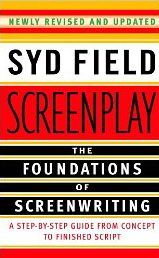
I’ve recently begun to explore something I saw a decade ago, the “storyboards” Peter Jackson and his team developed to map the scenes of The Lord of the Rings. This was part of the “making of” section of the DVD’s. I dug them out and watched again after recently reading Syd Fields’ excellent, Screenplay: The Foundations of Screenwriting, which recommends using 3×5 cards to work out plot.

Screenplay

I find that either a quick sketch or a few words can sum up a scene in a graphic manner that appeals to imagination. I can carry a few cards in a shirt pocket and glance at them over a cup of coffee or mull them over while driving home.

Two Towers Storyboard

They do not need to be nearly this detailed, because we are not planning camera angles.  This could be summed up as:

After witnessing Frodo confront the Nazgul, Faramir releases Frodo, Sam, and Gollum to pursue their mission to Mordor, or simply, After Nazgul, Faramir lets them go.

I find that if I let the images play around in the background of my mind long enough, the next step will come, and often surprise me.  I fully expect this process to evolve and change, but for now, this is a huge step forward.

Save the Words

The following link was sent by a friend some time ago, a website by the Oxford Dictionary people, dedicated to saving endangered words.

http://www.savethewords.org

It works kind of like the  endangered animal sites where you can chose an animal to adopt, but just because word-adoption is free, does not mean the situation isn’t dire!  My friend wrote: 90 percent of everything written today uses only 7000 words. That’s a little over 4 percent of the 171,476 words that are listed in the Oxford University Dictionary.

To adopt a word, follow the link and scroll around until you find a word or words that move you, and complete the online pledge:  I hereby promise to use this word, in conversation and correspondence, as frequently as possible, to the very best of my ability.

Look at all the choices!

aquabib – water-drinker
blateration – blabber; chatter
frutescent – having or approaching the habit or appearance of a shrub
latibule – hiding place
leeftail – in great demand
nidifice – a nest
pessundate – to cast down or destroy
pudify – to cause to be embarrased
quibbleism – the act of beating around the bush
squiriferous – having the character or qualities of a gentleman

I will not indulge in quibbleisim, but shall tell you directly that my chosen word is flosculation – an embellishment or ornament in speech.

Genre Soup

Genre bending and blending has gone mainstream. (Vampire-romance-coming of age tales anyone?).  It’s really not anything new (Think of The Odyssey:  paranormal-action adventure-romance), but lately it it seems to be the golden road to standing apart from the crowd, and to blockbuster sales, action figures, and movie deals – except when it doesn’t work.

I once heard a literary agent explain that one reason the first Harry Potter book was rejected 23 times was because J.K. Rowling mixed the conventions of middle-grade and young adult fiction, which was a no-no at the time.

So if you feel the urge to cross the boundaries, whaddya do?

First, realize you are in good company.  In his introduction to Stories, Neil Gaiman says: I realized that I was not alone in finding myself increasingly frustrated with the boundaries of genre:  the idea that categories which existed only go guide people around bookshops now seemed to be dictating the kind of stories that were being written.

Literary agent, Joanna Stampfel-Volpe discusses the question with advice and cooking metaphors: http://www.writersdigest.com/article/dos-and-donts-of-combining-genres.  She boils it down to some common sense guidelines.

1) Write the stories you’re dying to tell.
2) Don’t try to please everyone.
3) Know your story and intended audience well enough to identify your “base genre.”

I’d add one more, based on something I saw the first time I told a story from a stage. Almost twenty years ago, our local storytelling guild was preparing a show for “Tellabration,” a day in November set aside by storytellers around the world to bring this most ancient art form to as many people as possible. http://www.tellabration.org/

It was the first Tellabration for a young woman and me. The old timers had coached us thoroughly. My inner-ham emerged and mine went pretty well. Then it was my fellow newbie’s turn. She was telling a spooky Eskimo story called, “The Skeleton Woman,” but when she got to the first chilling moment, everyone started to laugh! The hero of the tale, a young fisherman, was out in his kayak and managed to hook a skeleton which rose to the surface and pursued him as he paddled like hell, and that image struck the audience as funny.

With no indication of how nervous she was (she’d confided to the group before we started), the woman turned on a dime, and played the story for laughs, making it up as she went along. She finished with a well-deserved round of thunderous applause.

Horror and comedy genres are not “natural” companions but ever since I saw that switch,  my fourth rule for genre – and maybe my first rule for everything else would have to be:

4) Flexibility and a sense of humor are highly recommended!

More Writing Contests

Here are some additional listings of writing contests that people have recently sent me:

  • The Writers of the Future Contest (founded by L. Ron Hubbard in 1983 for SciFi and Speculative Fiction writers), and the Illustrators of the Future Contest.  Quarterly prizes plus a $5000 annual prize in both categories: http://www.writersofthefuture.com/contest

Also, anyone interested in writing for children or young adults should seriously think of joinign the Society of Children’s Book Writers & Illustrators, aka, SCBWI:   http://www.scbwi.org

Although there are grants available to members, the primary focus is support and information, through newsletters, regional and national conferences, listings of regional critique groups, listing of online manuscript exchange opportunities, and a lot more.

Disclaimer:  I’m praising the SCBWI (it takes about six months to get the acronym straight) simply as a satisfied member.  The $75 annual fee is money very well spent IMO.

I suspect that a simple google search on “writing contest” will turn up a whole lot more, but I will post additional listings as people send them to me.