Forgotten Hero Honored – 67 Years Later

At 5:30am on the morning of Dec. 16, 1944, a massive German artillery barrage along an 80 mile front in the Ardenne Forest opened the Battle of the Bulge, the bloodiest conflict of WWII.  The battle, which raged until late January, cost 89,000 American casualties, including 19,000 killed.

Some of the fiercest fighting took place in the Belgian town of Bastogne, at a crossroads the Germans needed to capture in order to split the Allied armies in half.  Bastogne was the town where American general, Anthony McAuliffe, famously answered, “Nuts!” when ordered to surrender.  The town sustained a massive barrage, but never fell, and many stories of heroism later emerged.  This week a forgotten hero was honored – Augusta Chiwy, a Congolese nurse, now 93 years old, who saved hundreds of lives.

Augusta Chiwy. Photo by Clark Boyd

Chiwy’s story came to light, in great part, because of Martin King, a Scottish military historian. King has lived in Belgium for 30 years, interviewed countless veterans of the Bulge, and co-authored a book on the battle. He explained how Chiwy, just 4’8″ tall, repeatedly braved artillery and machine gun fire, in freezing weather, to drag wounded soldiers to safety.  “What I did was very normal,” Chiwy said. “I would have done it for anyone. We are all children of God.”

On Christmas Eve, 1944, an Allied aid station where Chiwy was sipping champagne with the only doctor in town was hit by a German shell.  She was blown through a wall, but afterwards, got up and began helping the doctor, who also survived, tend to the wounded.  Several history books said Chiwy died in the blast, but King did not believe it.  He finally found her living in a retirement home in Brussels.  It took some time before she would speak of her experiences.  King noted that nowadays she would likely be diagnosed with PTSD.

The more he listened to her, the more convinced King became that Augusta Chiwy should be honored for her service.  He began to write the King of Belgium and the US Military.  At last it paid off.  Chiwy was knighted by the Belgian king in June.  General David Petraeus, who once commanded the 101st Airborne, which defended Bastogne, wrote her a letter of appreciation, and earlier this week, she was awarded the US Army’s Civilian Award for Humanitarian Service.

Col. JP McGee, who commands the “Bastogne Brigade” of the 101st Airborne Division, gave her the award and said:

“M’aam, you embody what is best and most kind in all of us…It is an honor to share the stage with you and to be able to say on behalf of US veterans everywhere — thank you. The number of lives that you touched is incalculable. There are men and women in America who would never have a father or grandfather if you hadn’t been there to provide them basic medical care.”

After the ceremony, Chiwy said, “I’ve had a good life. I’ve got my children, and my grandchildren.  And,” she added, pointing to her head with a smile, “I’ve still got my marbles.”

You can listen to the story, here:  http://www.theworld.org/2011/12/nurse-honored-augusta-chiwy/

The King and the Corpse by Heinrich Zimmer: A Book Review – Part One

Heinrich Zimmer (1890 – 1943) was a Sanskrit scholar, an Asian art historian, and an expert in Indian philosophy and spirituality.  After the Nazis dismissed him from Heidelberg University in 1938, he made his way to the US where he taught at Columbia as a visiting professor.  The young Joseph Campbell attended some of his lectures and became a close friend.  Zimmer died of pneumonia in 1943, and Campbell spent the next 12 years editing and publishing some of his papers.  Campbell finished Zimmer’s book on folklore, The King and the Corpse, in 1948.

I discovered Zimmer’s writing as a freshman in college at the same time as I discovered Jung.  The two men, in fact, were long time friends, but their writings on myth and folklore were different.  Jung and his circle largely used story to expand and validate their theories, while Zimmer, and Campbell after him, sought to find the living essence of ancient tales that will speak to us now if we learn to listen.

In his introduction to The King and the Corpse, Zimmer called himself a “dilettante,” from the Italian verb, dilettare, “to take delight in.”   The essays in the book he said, “are for those who take delight in symbols, in conversing with them, and enjoy living with them continually in the mind.”   When I read Heinrich Zimmer, I discovered I was that sort of person.

Heinrich Zimmer, 1933

The King and the Corpse is collection of tales from around the world presented, along with Zimmer’s personal meditations, in a style of exposition later popularized by Campbell.  There’s a story from the Arabian Nights, four stories from the Arthurian cycle, and the rest come from India. The one that has always stayed with me is the title story, “The King and the Corpse.”

For ten years, every day, as a king sat in his audience chamber, an ascetic beggar appeared and wordlessly gave  him a piece of fruit.  Thinking little of it, the king gave the gift to his treasurer who tossed it over the wall into the treasure house.  One day a monkey got loose and hopped onto the king’s lap.  Playfully, the monarch gave him the fruit.  The monkey bit into it and a jewel fell out and rolled across the floor.  The king and treasurer hurried to look in the treasure house, where they found glittering jewels in the pile of rotten fruit.

It had been years since I read this tale, but I’ve seen this motif in other stories, and this time, its power jumped out at me.  The king’s attitude toward the fruit mirrors my own attitude toward health and youth in younger days, when these gifts arrived every day, with little effort on my part, almost as if life owed them to me, and there was no end in sight.  In his essay, Zimmer takes a larger perspective, suggesting each day we are given is like a piece of fruit hiding a jewel that we might discover if we only stopped to look.

The next day, when the ascetic arrived, the king demanded an interview before he would accept the gift.  The beggar said he needed a brave man, a hero, to help in a work of magic.  He asked the king to meet him at midnight on the night of the next full moon, in the funeral ground, where the dead were cremated and criminals hanged.  On the appointed night, the king strapped on his sword and strode through the smoke and flames of the funeral pyres, ignoring the clamor of ghosts and ghouls.  He found the ascetic, in sorcerer’s robes, drawing a magic circle on the ground.  “What can I do for you?” the king asked.  The magician told him to cross to a certain tree, cut down the body of a hanged man, and bring it to him.

This too, according to Zimmer, is a sign of the king’s youth and naiveté.  The realm depended on him, but without a thought, he agreed to meet a magician that he didn’t know, by himself, at the dark of the moon, at the witching hour on dangerous ground.  Yet the king was nothing if not brave.  He cut down the hanged man and hoisted the body onto his shoulder, but as he did, the corpse began to laugh.  “What is it?” the king asked.  The corpse said the way was long and offered to shorten the king’s journey by telling a story.  When the king did not reply, the corpse began.  He told the king a complex tale, filled with moral ambiguity, and then asked which character in the tale had been right.  “And by the way,” the corpse added, “If you know the answer but do not tell me, your skull will explode.”

To Be Continued.

The Wasteland

One of the books I treasure is a battered old trade paperback with yellowing pages.  I value the book,  Creative Mythology, because of the author’s inscription: “For Morgan with all my good wishes. Joseph Campbell, 3/13/79.”  

joseph_campbell_4

You could say Campbell’s  four day lecture series that spring did much to open the path my imagination has followed ever since.  None of the stories Campbell unpacked in his lectures or books affected me more than Parzifal (or Parsifal) and his quest for the holy grail. The version of the grail story Campbell recounts is by Wolfram Von Eshenbach (1170 – 1220).  Wolfram was a German knight and poet, and his Parzivalis regarded as one of the finest medieval German epics.  Campbell looks to this version because it’s roots reach deeper than later Christianized versions where only the pious and chaste Galahad can attain the grail.  What matters for this post are those echoes we can see in the tale of the ancient legends of sacred kingship, and the ways an unfit or weakened king can blight the land.

Wolfram Von Eshenbach from Codex Manasse

Sometimes in youth we receive a vision or powerful experience that shapes much of the rest of our lives.  So it is with Parzival who finds his way to the mystical Grail Castle and meets its wounded king, Anfortas,  who is also known as The Fisher King.  As a young knight, a spear pierced the Fisher King’s “thighs” – a euphemism for testicles according to Campbell.  In ancient times, the virility of the king and the fertility of the land were one.  In the grail stories, Fisher King could not be healed and couldn’t die.  All the realm was barren.

Robin Williams as the Fisher King in the 1991 movie of that name, a contemporary retelling of the story

While in the castle, during a mysterious ritual, Parzival has a vision of the grail, which is described as a stone, though its shape isn’t fixed, and it brings everyone “what their heart most desires.”  Though he is intensely curious, Parzival does not ask the meaning of what he sees.  In the morning, the castle is empty.  All traces of life are gone.  He rides away, and when he tells his story, listeners turn away in disgust.  If Parzival had asked the right question, he would have healed the king and restored the land.    The young knight wanders the blighted realm for 20 year, enduring hardships and contemplating his failure.  Just like us, he watches time turn his youthful dreams of glory to ashes.

“Parsifal” by Odilon Redon

At last, one cold Christmas Eve, Parzival encounters a hermit, tells his tale, and learns the question he should have asked. After that, he achieves the castle again.  When the ritual ends, Parzival asks, “Whom does the grail serve?”   Everything hinges on asking the right question.  Anfortas is healed, spring returns, and Parzival becomes the new Grail King.

***

Hearing this old tale, we have to ask how the story plays forward.  “Wasteland” clearly describes the state of the world we read about in the papers, and “impotent” seems an apt description of most of the world’s governments.  This perception is not even new, for T.S. Eliot named it ninety years ago in his poem, The Wasteland:

What are the roots that clutch, what branches grow Out of this stony rubbish? Son of man, You cannot say, or guess, for you know only A heap of broken images, where the sun beats, And the dead tree gives no shelter, the cricket no relief, And the dry stone no sound of water.

Giving mythical weight to our latest headlines, storyteller and mythologist, Michael Meade says: “Like Parsifal, the modern world has awakened from a deep sleep to find that the castle of abundance has disappeared, that the financial markets are in ruins, that blind religious beliefs are once again producing mindless crusades, and that great nature itself threatens to become a barren wilderness. Like Parsifal, we failed to ask the right questions when surrounded by abundance.” From “Parsifal, the Pathless Path, and the Secret of Abundance,” first published in Parabola, Fall 2009.  http://www.mosaicvoices.org/index.php?option=com_content&view=article&id=72:essay4parsifal&catid=53:essays&Itemid=68

This has happened before, again and again, Meade reminds us – beginnings and endings, decay and renewal.  The castle of abundance waits for us, individually and collectively, somewhere in the wilderness, but old pathways won’t take us there.  There’s a time to do as Parsifal did – drop the reins and let the horse, an image of our instinctive wisdom, pick its way through the forest. The old stories were told in the winter, when the nights were long and the fires warm.  This winter, I am drawn to look at some of these tales, to see what they are still whispering to our souls, for they are wiser than the daily ephemera that passes for wisdom but is really the source of our confusion.

As Michael Meade puts it: “Despite the current confusions of dogmatic religions and the literalism common to modern attitudes, the earthly world has always been a manifestation of the divine. Call it the Grail Castle, the Kingdom of Heaven, Nirvana, the Otherworld; it has many names and each is a representation of the eternal realm that secretly sustains the visible world. When time seems to be running out it is not simply more time that is needed, rather it is the touch of the eternal that can heal all time’s wounds and renew life from its source.”

The Importance of Stories and Listening

This wonderful article was sent to me by a friend and a marvelous storyteller, Robert Bela Wilhelm.

The article, “The Art of Listening,” by Henning Mankell, was published in the Dec. 10 New York Times.  Mankell is a Swedish author of many books, including the Wallendar novels.  He also spent 25 years in Africa, an experience central to what he writes here.

Henning Mankell

His comments on listening are striking:  “In Africa listening is a guiding principle. It’s a principle that’s been lost in the constant chatter of the Western world.”

Of great interest too is his observation that western story structure is simply one possibility among many.  Mankell writes:  “instead of linear narrative, there is unrestrained and exuberant storytelling that skips back and forth in time and blends together past and present. Someone who may have died long ago can intervene without any fuss in a conversation between two people who are very much alive.”

Check this out.  The article is brief and I’m sure you will enjoy it.  http://tinyurl.com/7gqfchj

What Is Your Innermost Request?

On Saturday, Zen teacher, Edward Espe Brown, gave his second all-day retreat of the year for the Sacramento Buddhist Meditation Group.  Zen is not exactly “my thing,” but like the SBMG as a whole, I’m ecumenical, ready to look for insight wherever I can find it, and I really enjoy Ed Brown.  Zen is actually so free of doctrine that Catholic priests have become advanced practitioners, and Edward Brown is un-doctrinaire even for Zen.  At the start of the retreat, after the hostess introduced him and  listed his “credentials,” Brown said, “Yep, I’m certifiable.”

Edward Espe Brown

Edward Espe Brown

“I’m not going to give you very many instructions,” he said.  “If I do, there’s the danger of wondering, ‘Am I doing it right?'”  This is one of Brown’s constant themes:  no one else can tell you the right way to do Zen or life.  One statement framed both of Brown’s visits this year, a quote from his teacher, Shunryu Suzuki Roshi:  “When you become you, Zen becomes Zen.”  Zen is about “becoming authentically you,” Brown said.

Brown is an accomplished chef and uses lots of cooking metaphors.  One time a group of his students was tasting a dish and one of them asked, “What am I supposed to be tasting?”  To Edward Brown, that a question all of us ask in one form or another:  “What am I supposed to be doing?”  “What am I supposed to be feeling – or experiencing – or thinking?”  “What am I supposed to be writing?”

Understanding the point takes a bit of subtlety; it does not deny that we have an “ordinary” self that must operate in “relative” reality and know how to balance a checkbook, check the oil, boil an egg, or get a job.  Brown was directing remarks to that “unmanifest self,” the “big mind” within us, our Buddha nature.  “It’s the sky not the weather,” he says.  It’s the larger “us,” that can only say, “I am,” not “I am this or I am that.”

Because this silent knowing is so often drowned out by day to day concerns, it often requires a strategy to hear it.  Meditation is one strategy.  Another is learning to ask the right kind of question.  Brown posed one such question:  “What is your inmost request?”  What do we want in our depths?

He did not mean our ordinary wants and needs, however pressing.  He gave an example, saying that for many years, his inmost request was, “I want it to be ok for me to be here.”  Questions like this do not come with fast or easy answers.  There is nothing fast or easy about becoming authentic, especially in a culture that fears real individuals.  If we’re looking for others to tell us what to do, they will be glad to oblige.

Yet failing to ask what we really are and what we truly long for carries a greater risk.  William Stafford, the poet, put it this way:  “a pattern that others made may prevail in the world and following the wrong god home we may miss our star.”

Great Info on Charles Dickens From a Reader

I enjoy all the comments I receive, and sometimes they lead me down the trail to another post. One like that came in this morning, when blogger, Nixy43 (aka, Helen Nix) left a note on my recent post, Humbug Revisited:  http://wp.me/pYql4-1sF.

Ms Nix, a Londoner, is compiling a detailed list of 1000 interesting things to do in London for less than a tenner.  Any idiot can enjoy London on a large bankroll, she says, but it’s not so easy for the frugal tourist or people who live there.  She sent me a link to her marvelous post, “Thing 86:  Enjoy a literary evening at Foyles and bond with Dickens at Christmas.”  http://wp.me/p1I6Mp-5m

There is much information about Dicken’s, about changing attitudes to Christmas when he wrote A Christmas Carol, and links to much information about this classic.  London is gearing up for an all out celebration of Dicken’s in 2012, the 200th anniversary of his birth, so if there is any chance you will visit next year, this post is a must.

Stop by, enjoy the story, and thank Helen for posting it!

Charles Dickens

Robinson Jeffers: An American Stonecutter

My previous post, on the restoration of a medieval Chapter House, reminded me of two renowned people who worked in other fields but turned to stonework for renewal.  One was the great Psychoanalyst, Carl Jung, who viewed stone as a symbol of the True Self, and carved stone as a means of self-discovery.

Jung’s Bollingen Stone

The other was the renowned poet, Robinson Jeffers (1887 – 1962), who studied geology in college, and worked in stone all his life.  In 1914, Jeffers and his new wife, Uma, moved from Los Angeles to Carmel, CA.  To build a home, Jeffers first hired a local builder and then worked alongside the man, learning the art of stonemasonry.  By 1919, Jeffers was hauling  boulders up from the beach, shaping them, and using them to add rooms to the home, which he named Tor House.  Later, he built the four story, Hawk Tower, as a gift for his wife, who loved Irish literature and stone towers.

Tor House and Hawk Tower, built by Robinson Jeffers in Carmel

The tower was named for a hawk that appeared while Jeffers worked on the structure, and disappeared the day it was finished.  After his death, Jeffers’ oldest son finished the construction then deeded the buildings to the Tor House Foundation, which was formed by Ansel Adams for their preservation.  The Foundation maintains the grounds and offers excellent guided tours.  You can even climb by a secret stairway to the very top of the tower.  There’s a wealth of information on Jeffers and Tor House at the Foundation website, where you can also schedule tours in advance:  http://www.torhouse.org/.

Jeffers work with stone is central to his austere poetic vision of a human spirit that longs to fly like a hawk and find something that lasts, but must finally acknowledge that in this life, it can do neither.

***

To the Stonecutters
by Robinson Jeffers.

Stone-cutters fighting time with marble, you fore-defeated
Challengers of oblivion
Eat cynical earnings, knowing rock splits, records fall down,
The square-limbed Roman letters
Scale in the thaws, wear in the rain. The poet as well
Builds his monument mockingly:
For man will be blotted out, the blithe earth dies, the brave sun
Die blind, his heart blackening:
Yet stones have stood for a thousand years, and pained thoughts found
The honey peace in old poems.

***

Robinson Jeffers

***

Rock and Hawk
by Robinson Jeffers

Here is a symbol in which
Many high tragic thoughts
Watch their own eyes.

This gray rock, standing tall
On the headland, where the sea-wind
Lets no tree grow,

Earthquake-proved, and signatured
By ages of storms: on its peak
A falcon has perched.

I think, here is your emblem
To hang in the future sky;
Not the cross, not the hive,

But this; bright power, dark peace;
Fierce consciousness joined with final
Disinterestedness;

Life with calm death; the falcon’s
Realist eyes and act
Married to the massive

Mysticism of stone,
Which failure cannot cast down
Nor success make proud.

***

Hawk Tower

Sacred Stones in Northern California

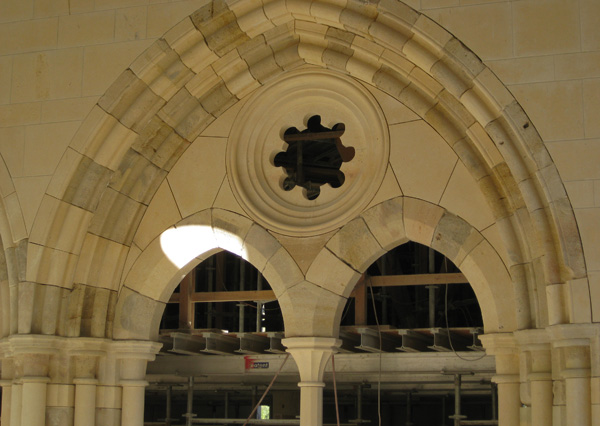
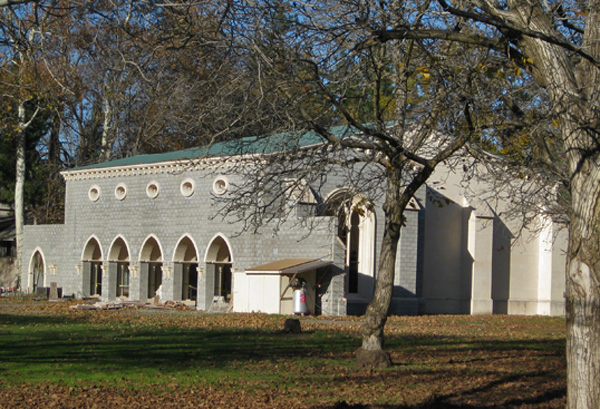
There are only two medieval structures in North America. Now a third is nearing the end of restoration in the small agricultural town of Vina, California, 100 miles north of Sacramento. It’s the 12th century Chapter House of Santa Maria de Oliva, a Spanish monastery that stood near Madrid. This building’s round the world journey makes an interesting tale.

The monks began their day in the Chapter House, where a chapter of the Rule of St. Benedict, an ancient guide to monastic living, was read and interpreted. This went on through the centuries until 1835, when the Spanish government closed all small monasteries and seized their lands. Santa Maria de Oliva was sold to a wealthy family that used the Chapter House to store farm equipment.

In 1931, William Randolpf Hearst bought the Chapter House for $285,000, intending to use the stones in the interior of a house he planned near Mt. Shasta. All the stones were marked for reassembly, and sent to California on 11 separate ships. The depression and WWII delayed Hearst’s plan, and in the end he donated the stones to the City of San Francisco to erect a Medieval museum in Golden Gate Park. This never happened and the stones lay outdoors in the park. Many were damaged, lost, or used for other projects

Meanwhile, the Cistercian Abbey of New Clarvaux was founded in Vina in 1955, and the first abbot began to make inquiries. In 1994, the Fine Arts Museums of San Francisco gave the stones to New Clarvaux with the stipulation that reconstruction begin in 10 years and the completed Chapter House be open to the public.

I first went to New Clarivaux in 1998 to stay for a few days at their retreat facilities. It’s an amazing place to unwind, and I have been there a number of times, so I saw the foundation of the Chapter House laid in 2001.

Section of New Clairvaux guest rooms

I had not been there recently, however, so when I drove up this past weekend, I found the structure was almost done – almost meaning another 18 months in a 10 year effort. Only 40% of the original stones were usable. The rest had to be repaired or replaced by stonemasons the abbey employed (they’ve raised $6.3 million to date, largely through small donations from across the country).

Master stonemason, Frank Helmholz, left Vina in November, bound for Luxor, Egypt, where he will spend the winter restoring a 3,400 year old temple. He plans to return to Vina next May. In an interview for the abbey newsletter, Helmholz said:

“In this modern age when everything is done fast and often doesn’t last long and serves no higher purpose, carving stones is a bit of a refuge. To create something that takes patience, dedication, and is lasting is very rewarding. And serving the monks in their spiritual lives gives a greater sense of meaning that is rare nowadays…to be part of something that has a higher purpose than one’s own comfort is inspiring in whatever form it takes.”

The abbey newsletter points out another significant point in the life of the Chapter House. It was built by Cistercians in Spain. Now it stands in another Cistercian abbey in the land that once was called New Spain. The stones have finally come home.

I have only alluded to the retreat facilities at New Clairvaux. In addition to nut crops and a vineyard, it’s one of the ways the monks earn their living, and it’s a marvelous place to spend some time apart. I will post about it later, but meanwhile, you can follow the link below for a summary.

www.sacredstones.org

www.newclairvaux.org