200 Posts!!!

It’s like one of those birthdays that end in zero.  It’s sort of like any other day – but it’s not.  This is just another post, though it’s something more at the same time.  At a minimum, this is an occasion to step back and reflect.  Here are a few random thoughts about this blog as a work in progress:

I need to update my About page:

This First Gates is no longer about what it was in the beginning.  I started writing about fiction and the process of writing.  Later I included spiritual topics, but from my current perspective, the thread animating all these posts is imagination.  Not only artistic “creative imagination.”  I use the word in the wider sense employed by psychologist, James Hillman, an influential post-Jungian thinker:

“By soul I mean the imaginative possibilities in our natures…that mode which recognizes all realities as primarily symbolic or metaphorical” – James Hillman, Revisioning Psychology, 1977.

I ventured into the realms of politics and economics this summer not for the subject matter alone, but because of the passions involved.  People do not get that excited over literal truths.  Along with Hillman, I’m fascinated by the reality in our fantasies and the fantasy in our “realities.”  This understanding is likely to guide my choice of subject matter in the future.

Am I slowing down?

A bit, at least over the last six weeks or so.  Through spring and early summer I was posting three or four times a week.  Lately it has been about twice a week.  Partly it’s the season and a desire to be out and about more, enjoying the warmth and the daylight while they last.  Related to that are a summer’s worth of neglected yard chores I have no excuse to avoid now that the days are growing cooler.  We also tend to travel in the fall (thought that doesn’t necessarily preclude blogging).

Nerdvana - Wifi in the Woods

There’s an ebb and flow to things like this, and I suspect I will pick up steam again as the days grow shorter and colder.

Enjoying the blogosphere:

When I started, I didn’t know other bloggers, and it took me a while to connect.  Lately the number of blogs I follow has exploded.  Sometimes I am reminded of hanging out with kindred spirits in college.  However naive the discussions, the excitement and fervor often came to mind during the years of corporate meetings, where such qualities were notable by their absence.  It’s trendy to criticize connecting online rather than face to face – as if distance and time zones and schedules are easy to overcome.  As a next-best-thing, this is a pretty decent medium for sharing stories and ideas.

Thanks to everyone:

Let me again thank everyone who stops by here to read or leave a comment.  It’s you who keep me going.  Now it’s time to go read a few blogs and mull over possible topics for post #201.

Seven Year Cycles, Part Deux

While reviewing my previous post on seven-year cycles, two other writings came to mind.  In their own ways, both hint that our concepts of time, and and things like cycles, are just that – concepts.

The first of these writings comes from T.S. Eliot’s epic poem, The Four Quartets.

T.S. Eliot

You cannot face it steadily, but this thing is sure,
That time is no healer: the patient is no longer here.
When the train starts, and the passengers are settled
To fruit, periodicals and business letters
(And those who saw them off have left the platform)
Their faces relax from grief into relief,
To the sleepy rhythm of a hundred hours.
Fare forward, travelers! not escaping from the past
Into different lives, or into any future;
You are not the same people who left that station
Or who will arrive at any terminus,

***

Rodney Smith says something similar in Stepping Our of Self-Deception:  The Buddha’s Liberating Teaching of No-Self (2010).   Smith founded the Seattle Insight Meditation Society and is the author of, Lessons from the Dying which grew out of his years of hospice work.

Rodney Smith

He says, “future and past have no reality outside thought…no true authenticity other than the validity we give an idea or image.”   Smith does not deny our experience of past and future, but suggests that it’s not what we usually imagine.  Past and future, he says, are ideas we entertain in the present moment:  how could they be anything else?

His comments remind me of crossing one state into another.  The sign says, “Welcome to Oregon,” but you find no lines on the earth as there are on the map: one instance of the difference between a concept and the experience made visible.

Seven Year Cycles

If you google on almost any topic related to “cycles,” you wind up with a flood of information.  Scientists define life cycles for everything from insects to stars.

Cycles abound in spiritual and esoteric traditions, ranging from newspaper horoscopes to “Days and Nights of Creation” lasting millions of years.

I was searching for something simpler than that.  Biologists say our bodily cells renew themselves every seven years.  Parallel to that, I’ve noticed my world of ideas, interests, and ambitions changing, sometimes radically, over a similar time frame.  I’m not the only one.  Google on, “seven year life cycle,” and you get 5,400,000 hits.  Although Rudolph Steiner wrote on the subject, most of the entries I found were generic, analogous to newspaper horoscopes.  Here is Aquarius.  Here are your life tasks between the ages of 21 and 28.

No doubt Gemini’s, and seven-year-olds, and seventy-year-olds each have things in common, but I was looking for individual accounts of people who find their ideas, concepts, and aspirations changing every seven years or so

What brought this to mind was thinking of 2005, a year in which I experienced many beginnings.  One night I woke up at 12:30am, grabbed a pen and a notebook, and wrote the opening pages of my first novel.  The momentum grew, and I finished the first draft five months later (in retrospect, it was pretty bad, though I doubt that I’ll ever have so much fun writing again).

Aided by a sabbatical from work, and energized by visits with family and friends I hadn’t seen in years, I was bursting with fresh energy, new ideas, and new ambitions.  Many threads in my life seemed to become clear.  I jotted some down in a notebook.  I underlined things I was very sure of.  A bit of skepticism remained, so I made  note in the margin:  “check back in five years.”

Six years later, in most respects, I am not the same person.  I don’t really read or aspire to write the books I cared about then.  My spiritual ideas have shifted.  What I value and want to accomplish are not the same.  My overall outlook is different.  I’ve noted these seven year changes before; this was just more pronounced.

Once again I have to conclude that most of the contents of consciousness are in flux and do not capture the “core” of who I am or who anyone else is.  The metaphor I use is the mirror.  A mirror is not defined by what it reflects from moment to moment.  “I” am not what passes through awareness, “I” am the indefinable awareness itself.

This is wisdom that’s thousands of years old but I believe it more and more as time goes on.  This is the koan:  what is a mirror beyond what it reflects?  What is the heart/mind beyond what it conceives?

Celebrate Banned Books Week

Banned Books Week, Sept. 24 – Oct. 1 is our only national celebration of the freedom to read.  The event was founded by the American Library Association in 1982, in the face of a surge in “challenges” to books in libraries, bookstores, and schools.  The ALA reports more than 11,000 challenges since then, and estimates that 70% are never reported.  At least 348 books were challenged in 2010.  http://www.bannedbooksweek.org/.  In whatever ways we find suitable, this is a wonderful occasion to celebrate books that somebody, somewhere, did not want us to read.

Huckleberry Finn was banned by the Concord Public Library in 1885 as “trash suitable only for the slums.”

In addition to “sexually offensive” passages in Anne Frank’s diary, some readers complained that the book was “a real downer.”

The Arabian Nights, was banned both by Arab governments and the US, under the Comstock law of 1873.  (Hint – get hold of an unexpurgated edition of Burton’s translation).

Brave New World by Aldous Huxley.  It “centers on negative activity.”

When I found Catcher in the Rye at sixteen, I was no longer alone.  More than one generation had this experience.  The most widely banned American book between 1966 and 1975, people complained it had “an excess of vulgar language, sexual scenes, and things concerning moral issues.”

Fahrenheit 451 by Ray Bradbury.

The Grapes of Wrath by John Steinbeck.

Gulliver’s Travels by Jonathan Swift.

I Know Why the Caged Bird Sings by Maya Angelou. Parents in Kansas objected to “vulgar language, sexual explicitness, and violent imagery,” in this autobiography.  The author mentions being raped as a girl.

A Light in the Attic supposedly,”glorified Satan, suicide and cannibalism, and also encouraged children to be disobedient.”

Of Mice and Men A second winner for Steinbeck.

The Scarlett Letter by Nathaniel Hawthorne.

Song of Solomon by Toni Morrison, a Nobel Laureate.

Uncle Tom’s Cabin by Harriet Beecher Stowe.

A Wrinkle in Time by Madeline L’Engle. This award winning favorite was on the ALA most challenged list from 1990-2000 for, “offensive language and religiously objectionable content (for references to crystal balls, demons and witches).”

Lord of the Flies by William Golding.

The Sun Also Rises by Ernest Hemingway.

Catch-22 by Joseph Heller.

As I Lay Dying by William Faulkner.

Lady Chatterly’s Lover by D.H. Lawrence.

Madame Bovary by Gustave Flaubert.

Ulysses by James Joyce. The US Post office burned 500 copies in 1922.

This book has frequently been banned for the abuse James suffers. “Others have claimed that the book promotes alcohol and drug use, that it contains inappropriate language, and that it encourages disobedience to parents.”

***

I find it easy to roll my eyes and assume that the bad old days of suppressing Mark Twain are behind us.

Unlike the good people in the American Library Association, I’m not on the front lines, seeing the constant attempts to limit what we can read and think.  Banned Books Week is a perfect time to reflect on our freedoms and pass the word of this celebration to others.  And read or reread a book that someone, somewhere, tried to keep out of our hands!

A Mountain Interlude

Interlude:  n.  <origin> Middle English (originally denoting a light dramatic entertainment):  from medieval Latin interludium, from inter “between” + ludus “play.”

1  an intervening period of time.
2  something performed during a theater intermission.
<special usage>: a temporary amusement or source of entertainment that contrasts with what goes before or after.

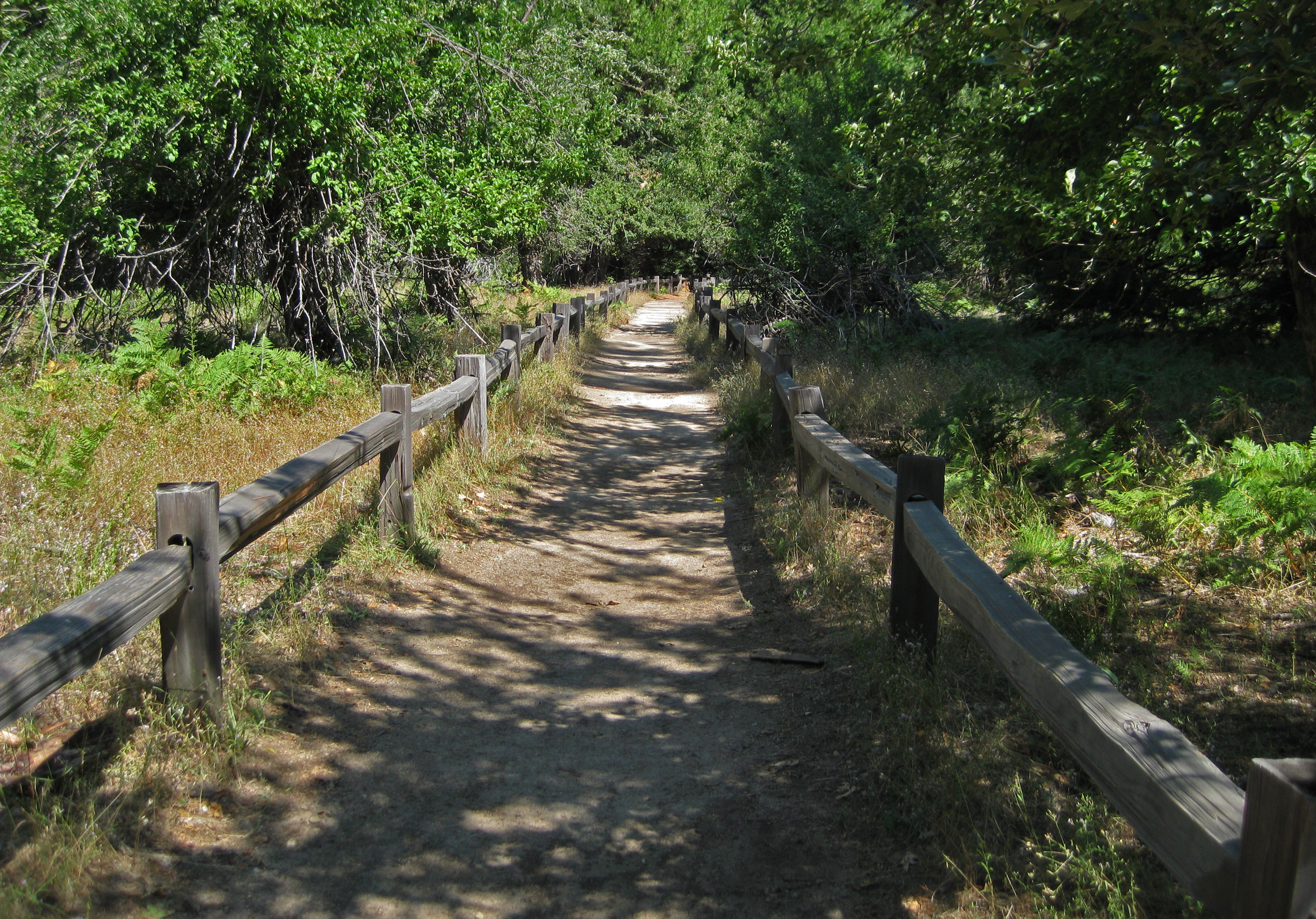
Trail in Yosemite Valley

Normally the valley is brown by September, but weather has not been normal this year.  Extreme rainfall this spring and recent thunderstorms have kept parts of the valley bright green.

Stump in one of the meadows

Over the years I’ve found the beauty that moves me most right at hand, right in front of me on a walk, rather than the famous scenes, the stuff of picture postcards, which are almost too much to take in.

Along the south fork of the Merced River

I first saw Yosemite when I was 12.  My family came up year after year, in all of the seasons, as often as they could.  I got my first job up here, washing dishes and flipping burgers, because I wanted to stay for a whole summer.

Above the river

Mary and I first came up soon after we met, and have continued to visit these woods for the last 35 years, by ourselves and with family, friends, and dogs.  Mary took this photo near the Awahanee:

Photo by Mary Mussell

Some of my favorite spots are outside of the valley. Chilnuala Falls, in Wawona, near the south entrance to the park is one of them. As people learned all too well this year, you have to be careful when hiking and climbing, and once you get away from the crowds, keep an eye out for mountain lions too.  Still, I’m sure driving is infinitely more dangerous.

lower Chilnuala Falls

I know this area better than any other place on earth.  I’ve photographed here for decades, in all seasons and in all kinds of light. Nothing is ever the same twice. You truly cannot step into the same river – or walk along the same riverbank – twice.

The Road goes ever on and on,
Down from the door where it began.
Now far ahead the Road has gone,
And I must follow if I can.
Pursing it with eager feet,
Until it joins some larger way,
Where many paths and errands meet.
And wither then? I cannot say.
– J.R.R Tolkien

Petroplague by Amy Rogers: A Book Review

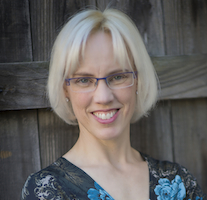
Dr. Amy Rogers

Dr. Amy Rogers

Neil, a disaffected eco-activist, meets an explosives expert at 2:00am.  They drive to a deserted gas station in south-central LA.

Christina Gonzales, a PHD student at UCLA, volunteers at the La Brea tar pits.  After monstrous gas bubbles burst over the tar, Christina and her co-worker smell vinegar, which doesn’t make any sense.

An elderly woman spots a huge puddle of “drain cleaner” in the alley behind her house.  She blames the neighbors and calls the police because this could injure her cats.  A moment later, explosions rock the entire block.

Christina learns that an apparent methane explosion at a deserted gas station has ruined her PHD project, an attempt to use genetically altered bacteria to break down heavy crude oil into easy-to-harvest natural gas.

If you think these events are coincidence, you have probably never watched a disaster film.  Like the best movies in the genre, or the novels of Stephen King, Amy Rogers takes a mixed group of people, with their individual hopes, plans, secrets, and strengths, and puts them in an impossible situation.  By the time I had read this far, I was hooked.  From here, Petroplague just gets better and better – meaning the tribulations of Rogers’s characters get worse and worse.

Imagine Los Angeles, or the largest car-dependant megalopolis you know.  Imagine a mutant bacteria in the underground oil supply and the local refineries that breaks down hydrocarbons, reducing petroleum  into acetic acid and highly flammable hydrogen, among other things.  Cars stall on the freeway.  Airplanes fall from the sky.  The acid corrodes gas tanks and lines, releasing hydrogen that the smallest spark can ignite.  Nothing that runs on gasoline moves:  no firetrucks or ambulances or police cruisers.  No food deliveries or garbage pickups.  The looting begins.  Instability under the Santa Monica fault leads to bigger and bigger earthquakes.  The La Brea Tar Pits “erupt.”   When Christina and her PHD supervisor discover an antidote for the plague, both an eco-terrorist network and ruthless corporate interests are willing to go to any lengths to suppress it.

Are you scared yet?  If not, as Yoda told Luke, You will be!  Because this is just the beginning.  Now that we care about Christina, the real chills and thrills begin.  Eco-terrorists smuggle the petroplague out of the LA quarantine area and plot to release it worldwide in a matter of days.  Christina and her allies face virtually every danger you can think of as LA spins into chaos – and some you can’t.  Think of all the seat gripping you do watching James Cameron movies like,  The Terminator and Titanic.  This is what Amy Rogers does; she throws the good guys into a tight situation and keeps cranking up the pressure.

I read lots of thriller/action adventure stories.  When you become familiar with a genre, you begin to recognize conventions and trends.  As anyone who has glanced at this week’s movie listings can attest, epidemics are a standard disaster scenario, but as far as I know, Rogers’s story question is unique – what would happen in our oil-dependant world if a petroleum-destroying plague got loose?

A lot of books in this genre suffer from forgettable heroes and two-dimensional villains.  Psychopaths are a dime a dozen these days, but not in Petroplague.  Several of the bad guys are idealists-gone-wrong, sometimes-conflicted fanatics of conscience, who you cannot hate even as you cringe at their actions.  One of the evil-doers is a corporate higher-up, willing to screw anyone or everyone in the name of profit.  Even if that is a stereotype, it is not hard to imagine in our post-economic meltdown world.

We bond with the heroes of the story because they are very human, even as events evoke courage they didn’t know they had.  When Christina first learns of the plague, all she can think of is her ruined dissertation, but her circle of concern and her actions rapidly grow beyond self-interest.  Her cousin, River, and River’s boyfriend, Mickey, are ready to run when things get tough – but they don’t.  A politician who survived a helicopter crash in Iraq, finds the courage to pilot another chopper filled with fuel that might have been compromised by the plague.

It’s always a pleasure to post here about a book I really enjoyed.  I couldn’t put this one down.  I urge you to stop by Amy Rogers’s web site to learn more about the author and the various formats in which you can read Petroplague.  http://www.amyrogers.com/

An Interlude with Mutant Chickens

The other day, I took a break from literary activities to meet a friend in Fair Oaks Village for coffee.  Once upon a time, Fair Oaks was a farming community, separated by miles of fields and orchards from Sacramento.  Those days are gone, but there’s still something inviting about the town.  It’s slower than the boulevards and mini-malls that surround it, but not yet gentrified.  That may have something to do with the chickens, but I will get to that.

Fair Oaks Coffee Shop and Deli

So my friend were I are sitting at a table outside, having coffee and waxing eloquent on matters of great import, when I spotted a mutant chicken pecking at the pretzel I’d dropped on the sidewalk.  If you really pay attention, even normal chickens are sort of scary; you can understand the theory that they descend from dinosaurs.  Watch them run around, and you think of mini-velociraptors.  Yet chickens are the official Fair Oaks bird.  Herds of them run loose in town, and they are even featured on the town sign.

Once, when our dog, Holly, was younger, she jerked her leash out of my hand and took off after a chicken. By the time I caught her, thinking I was about to burst a lung, an irate citizen informed me that chickens are protected.  I believe I said something along the lines of, “Come on, Holly, we’ll hunt for dinner elsewhere.”

Fair Oaks is famous for chickens, and I have it on good authority that people throughout the region come here to dump their excess fowl.  What you have is a group of birds that interbreed, and every now and then you see a really demented one, who could play in a monster movie.  Such was the one who pecked at my feet the other day.  It had some kind of growth, like the extra head on the alien in Men In Black II.  I was so busy thinking of tetanus shots and keeping my feet out of its way, that I forgot the camera phone in my pocket and didn’t document the monster.   Today I went back with a real camera, and naturally all the chickens looked normal – or as normal as chickens can look.

Here’s the Fair Oaks chicken ideal:

Mural on the Fair Oaks, open air theater

And here’s the reality – chickens invading the public men’s room:

Employees must wash their hands before returning to work

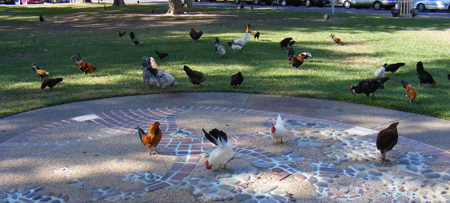
The ideal – an idyllic shot in the town square

Don’t be fooled! Think of Alfred Hitchcock.

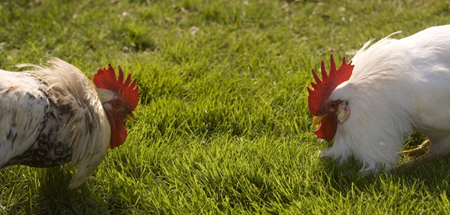
The real – high noon in roosterville.

Go ahead – make my day.

And finally, here is the biggest Ideal Chicken of all – at the 2010, Fair Oaks Chicken Festival:

Has everyone had a chance to go, “Awwww?”  If you can make it, this year’s Chicken Festival will be held on September 17.  Feel free to bring the munchkins, but be ready to change the subject if they ask, “What’s for lunch?”  Last year, the featured item was barbecued chicken.  (I’m serious).

Have fun if you go.  I would never dream of saying anything on my blog about eating Big Bird, but I will be home that day eating tofu.  Probably with the shades drawn too, in case the mutant chicken knows where I live.