Some Notes on Short Stories by Stephen King

Last Sunday, as I walked into the Borders where my SCBWI critique group meets, I spotted a winner in the discount racks near the entrance:  The Best American Short Stories of 2007 was marked down to $3.99.  This was a no brainer with the added bonus of featuring Stephen King as editor.

I bought the book without even checking the contents, so I was delighted when I got home and found a story by John Barth called, “Toga Party,” about a group of sixty and seventy-year-olds in a posh retirement neighborhood who all receive invitations to one of those parties, “like that crazy Animal House movie from whenever.”  The story begins humorously but doesn’t end that way.  In a similar vein, Stephen King’s comments on the state of the American short story begin humorously but don’t end that way.

King wrote about going into a large bookstore in Florida in search of that month’s stories to read.  The first thing he saw was a table upfront with titles by James Patterson, Danielle Steel, and himself.  Disposable stuff, but it pays the rent he says, “because money talks and bullshit walks.”   He continues:  “Bullshit- in this case that would be me – walks past the bestsellers, past trade paperbacks with titles likeWho Stole My Chicken?,’ ‘The Get-Rich Secret,’ and’Be a Big Cheese Now,’ past the mysteries, past the auto repair manuals, past the remaindered coffee-table books.”   He finds the magazine wall, next to the children’s reading area.

King says he found The New Yorker and Harper’s without much effort, but had to search the floor-level racks to find the stash of magazines, like the Kenyon Review, that feature short stories:

“So think of me crawling along the floor of this big chain store’s magazine section with my ass in the air and my nose to the carpet in order to secure that month’s budget of short stories, and then ask yourself what’s wrong with this picture.  A better question – if you’re someone who cares about fiction, that is – what could possibly be right with it?”

With an ever dwindling audience, some writers who still care about short stories keep on working, but too often, King notes, their audience is simply other writers who read,“not to be entertained but to get an idea of what sells…and this kind of reading isn’t real reading, the kind where you just can’t wait to find out what happens next…There’s something yucky about it.”

King then says he read “scores of stories that felt…airless, somehow, and self-referring…show-offy rather than entertaining, self-important rather than interesting, guarded and self conscious rather than gloriously open, and – worst of all – written for editors and teachers rather than for readers (emphasis added).

There we have in a nutshell what I have been trying to put my finger on lately.  The last time I went to a large bookstore to browse for books, I went to the mystery section and found the number of rows had been cut in half.  Tough luck for those who like to read and write mysteries – the marketing department, which is after all, just trying to survive – has decided you are not cost effective.

No need for me to belabor the point anymore, it is what it is, but reading King’s editorial notes made me glance at all I have posted here about ebooks.  I certainly never set out to be their champion, in fact I started out somewhat skeptical.  My ideas have changed 180 degrees.  When half the mysteries and most short stories can disappear for reasons that have nothing to do with quality, who can argue with writers who look at a new way to get their books read?

Last week a writer in London asked me to review her ebook after reading this blog and noting that YA fantasy is “my thing.”  Now that I have finished my blog-break, it’s time for me to get back to her work, and with renewed appreciation for her and all the other authors willing to take a chance with a new way to do what storytellers have always done – tell their stories.

A Walk in the Park and Minor White

The other day, I fired up Google to look at opinions on the appropriate age for protagonists of young adult vs. middle grade fantasy. The reason, as I have said here recently, is that I am reviewing all my ideas and assumptions about the story I’m working on. Everything is on the table.  I was thinking of the greater freedom middle grade fantasy allows; as one blogger put it, “in middle grade, tall ships and laptops can exist in the same universe.”

Opinions on the age divide between the two genres varied, and in particular, no one seemed to know where to put a 14 year old lead character – what I am currently leaning toward for my heroine.  She started out 14, became 16 for a while, and is probably going to get younger again.

At the end of this search I was not only frustrated with the lack of clear answers, but also slightly disgusted with myself.  I have written about not being bound by rules, and these are the most inane sort of rules.  I remembered my very first post on this blog, when I quoted from Neil Gaiman’s editorial notes for the collection of stories called, Stories (William Morrow, 2010).  Gaiman says:  “I realized that I was not alone in finding myself increasingly frustrated with the boundaries of genre:  the idea that categories which existed only to guide people around bookshops now seemed to be dictating the kinds of stories that were being written.”

The next day, Mary and I were walking in the local park and I was relating the results of my search and grousing a bit.  I said, “It would be nice to forget the whole business of getting published.”  She shrugged and said, “Why don’t you?”

Why don’t I indeed?  And we’re not talking here of the old cliche, “I just write for myself,” which implies indifference to quality or being read.  We’re talking of what T.S. Eliot meant when he said, “Take no thought for the harvest but only for the proper sowing.”

Why don’t I?  The reason is simple.  I’m still learning my craft as a writer, still a little hungry for external validation, but I have travelled this arc from apprentice to journeyman before.  I thought of the words and photographs of Minor White who influenced me more than anyone else when, after two years of college, I changed majors and schools to study art and photography.  Minor White’s dedication to photography as a spiritual practice was one of the reasons I went.

White, (1908-1976), began taking photographs in 1938 after spending five years writing poetry.  In 1946, Ansel Adams invited him to join the faculty of the first American fine arts photography department at the California School of Fine Arts in San Francisco.  White’s work always had an inward focus; he evolved the concept of “equivalents,” a word first coined by the photographer, Alfred Stieglitz, who served as a mentor for White’s and Adams’s entire generation.

Equivalents are photographs, often of mundane subjects, that are seen with an almost visionary regard for form and light.  At their best, “equivalents” evoke powerful and even semi-mystical responses in the viewer, unrelated to the literal meaning of the image.  Later in his working and teaching career, White wrote extensively of Zen and camera work.

Snow Door by Minor White

Zen has always been associated with certain arts, traditionally, painting, poetry, archery, flower arranging, and the tea ceremony. Zen Master Dogen (1200-1253) wrote a manual for cooks.  My friend, Rosi Hollinbeck, has written about the inspiration she gets from Natalie Goldberg who writes about writing from the perspective of a long time Zen practitioner:  http://rosihollinbeckthewritestuff.blogspot.com/2011/03/book-for-writers-and-lovers.html.

For me, it was Minor White who opened a doorway into the practice of art as a spiritual discipline.  At the core of any such discipline are moments of selflessness, where the subject-object split disappears, and mindfulness replaces concern for the “product.”

I hadn’t thought of Minor White in some time, but the memory brought a great sense of relief, because I remembered that once before I had learned a craft well enough that it sometimes became transparent, became a doorway to “the still point in the turning world.”  Sometimes I didn’t realize when it was happening; sometimes I did, as with this image of a crumbling barn in western New York.

"Near Oswego, NY," 1973, by Morgan Mussell

Seen from this perspective, the answer to Mary’s question, “Is it possible to forget about results in writing,” becomes, “It is necessary!”

I was fortunate enough to meet some of the great photographers of White’s generation – Ansel Adams and Imogen Cunningham.  I never met Minor White himself.  It’s probably just as well.  He was a heros then, and some heroes can loom so large it is hard to let them go when the time comes.

Minor White, 1973. Photo by Robert Haiko

I don’t really have heroes now; heroes are for young men.  What I have is tremendous gratitude and respect for those who, like Minor White, served as mentors and guides.  These are people who found a way to walk their own individual paths, and in doing so, showed us that it remains possible.

The Inklings and Stuff

The Inklings was the name of an informal literary group at Oxford that met for nearly two decades, between the early 1930’s and 1949.  Fans of fantasy literature know that regular members included authors J.R.R. Tolkien, C.S Lewis, Owen Barfield, Charles Williams, Neville Coghill, a Chaucer specialist, and Hugo Dyson who had been a member of the club that spawned the Inklings, “The Coalbiters,” a group founded by Tolkien to discuss Icelandic myth.

The Inklings discussed, among other things, myth, religion, and what we now call fantasy “world-building.”  Tolkien read chapters of Lord of the Rings and Lewis read his Narnia books.  They met on Thursday evenings in Lewis’s college rooms, and often shared lunch on Tuesdays at the Eagle and Child pub, commonly called, “The Bird and the Baby.”

The Eagle and Child Pub, Oxford

Nowadays we call such literary clubs, critique groups.  You often hear fans of fantasy literature say, “Oh, to have been a member of that group!”

Lately I’ve been thinking of the downside of such associations.  If you were C.S. Lewis, what would you have done when Tolkien told you not to publish Narnia?  “You will embarrass yourself,” he said.

I also think about the first Harry Potter book, which would never have been blessed by any critique group.  J.K. Rowling broke too many rules.  For starters, she mixed elements of middle-grade fantasy with young-adult fantasy, and by all conventional rules, that is a no-no.  The problem is, conventional rules lead to conventional books.  Check out some book-jacket blurbs at the local Barnes & Noble to see for yourself if that’s true.

I can clearly remember when it wasn’t like this.  In the eighties I used to hang out at a quirky fantasy bookstore.  I could go in with a theme in mind like, “spirit guides in contemporary urban fantasy,” and walk away with a couple of titles the owner pointed out to me.  Try that at the Barnes & Noble!

Learning and practicing conventional wisdom is a part of mastering any craft.  I went through it in art school.  It was necessary, but eventually became like wearing mental blinders that prevented me from appreciating or producing work that ventured beyond certain boundaries.  The problem was, I could not see past the filters even when I started wanting to, because I had spent so much effort learning the rules.  Only with the passage of time – a lot of time – did my rigid ideas relax and dissolve.

Is there any way to speed up the process now?  Because now I know what is really at stake:  it’s about recapturing a spirit of freshness and play as a reader and a writer.

***

This morning I found myself rereading notes I had taken in March when I attended a retreat with Edward Espe Brown, an event I posted about at the time.  No wonder!  Brown is one of the least doctrinaire people I have ever met.  Here is the story that really stuck with me:  Brown was leading a meditation session, and as leader, his role was rather formal.  One day he sat down and reviewed his inventory of meditation techniques – which was extensive – to choose one to practice that day.  A sudden inspiration arose in his mind – Why don’t you just touch what is inside with warmth and kindness?

That is a very revealing exercise.  One of the first things that comes up for me you could call the “inner achiever.”  I bet most of us learned early in life to be virtuous and hard working.  Play only after you get your work done, and so on.

It’s easier to see the dynamic in meditation where nothing else is going on.  I tend to procrastinate more in attempting such a strange (warmth and kindness?) exercise in writing.  Yet a timed period of freewriting in the morning, before the daylight mind is fully awake, can lead to a startling result – it can open a doorway into play and an unexpected abundance of ideas.

I do this freehand in spiral notebooks and tell the inner achiever these are “warm up exercises.”  And after repeating this for a few days, I’ve witnessed ideas pouring onto the page, in such a profusion that it’s sometimes hard to keep up.  Try it and see.  For me it was something of a revelation.  I’ve done free writing before without experiencing this, but I suspect I was secretly harboring agendas along the lines of self-improvement or self-discovery or something like that.

Where are all these ideas going?  I really don’t know, and I am determined not to ask.  It’s too adult a question – “Are you engaged in an educational form of play?  Is this leading toward a measurable goal?  I have no idea.  I don’t even know if these ideas are “mine” or if “me” and “mine” have any meaning while this is going on.

Here are some other notes I jotted down when Edward Brown was here:

  • What is precious in us doesn’t come and doesn’t go.  It is not dependent on performance.
  • You can’t figure it out.
  • Focus on what is beyond thinking – and that means what is in the heart.

Finally, he posed a stunningly simple question:  Are you going to be a rule follower or are you going to be you?

You can’t just make a simple decision on that one and then do some warm up exercises.  What was it that C.S. Lewis knew about himself and his work that kept him going when Tolkien told him Narnia wasn’t fit to publish?

That is a very important question for any writer who wants to listen to others without losing his or her own inner center of gravity.

Soulman, Warren Haynes, Releases a Solo Album

Cover of Warren Haynes solo album, "Man in Motion"

I only knew Warren Haynes, one of Rolling Stone’s “Twenty-five best guitarists of all time,” as a member of the Allman Brothers, so I was very pleased to catch this NPR interview on Sunday morning.

http://www.npr.org/2011/05/08/136063696/warren-haynes-a-rocker-gets-some-me-time

In addition to the Allman Brothers and The Dead (that’s the Grateful Dead, minus Jerry Garcia), Haynes plays with his own band, Gov’t Mule, but over the last twenty years, certain songs haven’t fit with any group, and this prompted him to record a solo album, “Man In Motion,” which was just released today (May 10, 2011).

In the interview, Haynes discusses the music that has influenced him, from the time of his boyhood in Asheville, NC, when African-American gospel music on the radio “made the hair on his arms stand up.”  Man In Motion was recorded in just six days; Haynes wanted to keep the emotions fresh and not belabor the music.

The interview featured clips of three songs, which I very much enjoyed.  Right on schedule, “Man in Motion” is available on iTunes this morning.  I sampled a couple of cuts but have not yet had time to listen to all the clips.  The song I most wanted to post here is not up on youTube yet, but here’s something to entice readers to check out the new album:  a wonderful clip of Warren Haynes with Gov’t Mule last summer, performing, “Soulshine.”  Enjoy!

Footnote, Saturday, May 14.  I downloaded the whole album and have been listening for the last few days.  I can’t really find any false notes.  It’s great music and the dogs like it too (dogs and music will be a separate post).  If the description and the clip interest you, check out the cuts from Man in Motion on iTunes or youTube.  Bet you can’t keep your toes from tapping!

First Family by David Baldacci: A Book Review

Sometimes you luck out and find good reads just by browsing, and so it was with David Baldacci’s First Family, 2009, an action adventure novel featuring private detectives Sean King and Michelle Maxwell.  As ex-Secret Service agents, both know Washingon, and in this case, the first lady, who calls them when her 12 year old niece, Willa, is kidnapped.

At first, we know who the good guys and bad guys are, and the breakdown of that certainty as the story moves forward is the single most telling feature of this tale.  In fact, for me, Sam Quarry, the mastermind of the kidnapping plot is likely to be the most unforgettable character.  He is ruthless, even fanatical, in the pursuit of his brand of justice, but then we see him stop in a nursing home to read Jane Austin to his daughter who has been in a coma for 13 years.  As the story unfolds, we come to appreciate the ingenuity he brings to bear on his personal concepts of right and wrong.  Our gradual understanding of what drives him parallels the fall of our admiration for several other characters who at first appeared virtuous but are revealed as anything but.

This is Baldacci’s fourth novel featuring the team of Sean and Melissa.  If I’d started the series at the beginning I might know why they left the Secret Service under clouded circumstances.  They are a compelling team, and the plot is complicated when Melissa’s mother is murdered in a separate event that parallels the main action when it leads to the exposure of family secrets.

The rhythm of a book, its pacing, is something very mysterious.  James Patterson sets a hook or mini-crisis every four pages, which is the length of his chapters.  Other writers speed things up even more

Baldacci steps away from constant thrills and chills.  Yes, there is the obligatory shootout early on, but the author also keeps us reading as he details the minute preparations Sam Quarry has made on his land in rural Alabama.  The little shack he has planned and constructed by hand is lined with metal and surplus dental x-ray blankets.  Why?  The video camera mounted almost invisibly near the cabin has a hidden feed to a bunker up the hill.  Why?  Quarry spends hours in the basement of his falling-apart family home, with charts and notes, illustrating a web of connections he has spent years uncovering.  We know just enough to keep us reading.  Baldacci knows that mystery and nagging questions can keep us turning the pages as eagerly as drama and shoot-em-up action.

I cannot say much more without giving away the plot.  I can say this – I am definitely going to read the first of the Sean King and Michelle Maxwell mysteries, and if First Family is any indication, I have a whole new series to enjoy.

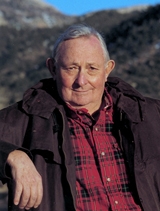
Tony Hillerman: An Appreciation

Tony Hillerman

Tony Hillerman

For many years during the nineties and the early part of the last decade, Tony Hillerman’s mysteries were a part of my annual celebration of spring.  In April or May his newest title would hit the bookstores – just in time for the beach or the pool at the gym.  “Beach read” is often synonymous with “guilty pleasure,” but I never feel guilty about enjoying good stories.

Hillerman is best known for the 18 mysteries set in northern Arizona and New Mexico and featuring Navajo tribal policemen Joe Leaphorn and Jim Chee, and later in the series, officer Bernadette Manuelito, who eventually marries Chee.  This series won Hillerman the 1974 Edgar Award, the 1991 Mystery Writers of America Grand Master Award, as well as the Navajo Tribe’s “Special Friend of the Dineh Award.”  Dineh is usually translated as “the People.”

The stories emphasize the Navajo ideal of living in harmony with the world and bring in themes from Navajo cosmology.  Many of Hillerman’s criminals are rumored to be witches – the worst thing you can become.  Leaphorn, the first detective in the series is skeptical, but…

Leaphorn didn’t believe in witchcraft.  He believed in evil, firmly believed in it, saw it practiced all around him in its various forms-greed, ambition, malice-and a variety of others.  But he didn’t believe in supernatural witches.  Or did he? (The Shape Shifter, 2006).

Chee, the younger officer, tries to walk in the worlds of both a modern policeman and a tribal shaman.  More than once, at the end of a case, Chee undergoes a traditional ritual to restore his balance and harmony.

Details of Navajo culture pervade all of Hillerman’s books and lend the restrained pacing of a people who think it rude to interrupt someone else who is talking.  In real time, the cops may have to drive a hundred miles to interview a suspect, but Hillerman keeps things moving by letting his detectives constantly mull over the compounding mysteries, and notice tiny details in the vein of Sherlock Holmes.

That said, the book I recently found, The Shape Shifter, the only one the Navajo mysteries I had not read read, is not where I would suggest a new reader start.  In places, it is a bit too slow, and it assumes we are familiar with the characters.

Skinwalkers (1990) would make a better first time Hillerman read.  This is the book where Leaphorn and Chee first team up, and the story is filled with supernatural menace.  Skinwalkers are especially nasty witches who change shape to harm others, like European werewolves.  Skinwalkers is one of three Hillerman titles featured on the PBS series, Mystery, with Wes Studi brilliantly cast as Leaphorn.

Skinwalkers movie

This is old-time detective fiction at its best, with the unique slant of a unique people, living in a remote and beautiful part of the country.  I only wish there were more of Hillerman’s books I hadn’t read.

Literary Comfort Food

In early March I was searching the shelves at a Barnes&Noble for a mystery for Mary’s birthday, when I spotted a treasure – one of Tony Hillerman’s Navajo Tribal Police mysteries neither of us had read.  The Shape Shifter (2006) is the last of the 18 titles in this series that won Hillerman (1925-2008) numerous awards both as a mystery writer and as a friend of Native Americans.  I will review The Shape Shifter when I finish, but starting it today reminded me of other stories that represent pure reading pleasure to me.  Books that carry me into another world.  Books that I read because I like to hang out with the characters, almost regardless of what they are doing.

I realized this morning as I sat down to coffee with Lieutenant Joe Leaphorn, and officers Jim Chee and his new wife, Bernadette Manuelito, that the greatest pleasures I’ve had in reading, bar none, are books in which I just want to be with the characters, almost regardless of whether they’re solving mysteries or buying groceries.  In addition to Hillerman’s tribal officers, other examples come to mind:

  • Frodo Baggins and friends.
  • Holmes and Watson.
  • Amelia Peabody and family in Elizabeth Peters’ Egyptian mysteries.
  • Rat and Mole and Toad in Wind in the Willows.
  • The sometimes annoying but always brilliant, Hercule Poirot.
  • Lirael and the disreputable dog in Garth Nix’s Abhorsen Trilogy.
  • Hamish Macbeth, the irrepressible Scottish detective in M.C. Beaton’s series.

I have also spent way too much money and time reading second rate fantasy series in the often vain hope of recapturing the Tolkien experience.

It’s important to realize that in stressing the importance of characters, I am not referring to the contemporary buzzword, “character driven.”  That has little or nothing to do with my list of comfort-food books, since with the possible exception of Wind in the Willows, these titles all belong in the “plot driven” category;  most mysteries begin, not with the detective’s quirks but with the discovery of a corpse, and problem of the Ring of Power was independent of Frodo.

As I said – these fictional people are friends, whether they are solving mysteries, dodging orcs, or sitting down to second breakfast.  This is a real clue for me, something to remember as I juggle plot elements.  Even though that is critical work, I find myself anxious to get back to the characters, both the heroine and the villain.  That, more than anything else, tells me I am heading in the right direction.

But now, before that or anything else, I have to get back to the The Shape Shifter, where storm clouds, both literal and metaphorical, are gathering over the reservation.

True North

In December, 1975, my sister sent me a small wrapped box with a note attached.  Our mother had died suddenly the previous May, but my sister found a small package, wrapped for Christmas the year before, at the back of a closet.

Inside was a compass.  I’m sure my mother intended it as a pragmatic gift – I was spending a lot of time on back roads and camping out in the southwestern deserts where you really want to know where you are and where you are going, but ever since, that particular compass and compasses in general, have carried a lot of symbolic meaning for me.  Finding true north.  Finding one’s way.

The earlier name for a Compass Rose was Wind Rose

My ideas have changed since I got that compass.  I used to imagine “one’s way” as “one way.”  As if our lives were like trains, and we are either on the track or off.  Now I imagine something more like “possible futures,” (a classic sci-fi term).  Not a single track, but an ongoing dance between ourselves and the world, of choices and unfolding events.

***

Recently I posted that I am rethinking the plot of the novel I’m writing because my forward progress had slowed and a step back showed there were flaws and gaps in my core conception.  Later I realized some of the story elements had become so common as to have already become cliches.  I understand how fast that can happen; Thomas Edison used to speak of times when “ideas were in the air,” and I’m sure there were far fewer inventors in his day than young adult writers in ours.

I’ve taken my own advice recently, and done a lot of free-writing, easily filling up single spaced pages with several alternate plots that seems fresher to me, but remain similar in setting and character to the story I was working on before.  One in particular sparked my excitement.  Then I spotted a review of a recently published, YA novel that had features strangely in common with my current conception.

Conventional wisdom urges us not chase popular stories, but these days, my impulse is almost the reverse – it almost seems harder to run away from what other people have done!  Something else we are told often is, “tell the story that only you can tell.”  To me, this sounds a lot like the “true north” idea.  Our thoughts, our emotions, our memories are not stable, so why should our stories be?  That kind of imagined fixity  is something the conscious mind loves, but the unconscious or whatever you wish to call the wellsprings of our creativity, does not share in such linear thinking.

I used to admire an Arizona man named Frederick Sommer, who took hauntingly surreal photographs in the desert.  Once an interviewer asked him why he photographed, seeming, from the tone of the article, to want some kind of deep philosophical rationale.  Instead, Sommer shrugged and said, “You’ve got to do something during the day.”  I’ve always loved the irreverence of his response.  I remember it in moments when I begin to take myself and work too seriously.  As ego involvement grows, I risk mistaking what I do for what I am.

Frederick Sommer

In retrospect, I learned a lot when I was writing software.  I learned that when something isn’t working, you look at it closely, and if necessary, try something else.  I may have missed schedules but I seldom missed sleep.  The years that I spent writing software convinced me that I can solve problems – that if I keep looking long enough, I’ll find a creative solution that was there all along, overlooked.

I write for a lot of reasons.  One of them is that I have to do something during the day.