The Cypress House by Michael Koryta

Arlen Wagner, son of a West Virginia undertaker, knows about death, but nothing prepares him for that midnight in the Belleau Wood when he sees a squadron of skeletons marching toward his position and understands that every one of those men is going to die. In the years after the first world war, Arlen relies on whisky and manual labor to try to live with his unwanted “talent” for seeing death before it strikes.

In the summer of 1935, as Arlen and 19 year old Paul Brickhill, travel to a CCC camp in the Florida Keys, everyone on the train suddenly appears as a dead man. At the next stop, only Paul heeds Arlen’s warning to wait for the next train, and only Paul survives.

After that, things get strange…

That comment is not just meant to be facetious but points to one of the tactics Koryta uses to weave supernatural elements into his tale in a seamless fashion that is too often missing from the “urban fantasy” sub-genre that I once enjoyed but which soon became predictable.  Koryta is a master of mood who plants the vision of dead men on a train among a wealth of ordinary details:  the ever present heat, the smell of unwashed bodies, the cigarette smoke, the card games, and Arlen’s surreptitious sips from his flask.  In the next moment, he can make a simple walk down an empty road in the dark of the tropical night burst with menace.

He delivers on the promise of menace – and secrets.  Everyone has secrets – layers of them.

Arlen and Paul catch a ride with a man who takes them to The Cypress House, a roadhouse in the middle of nowhere, owned by a stunningly beautiful woman.  A few minutes after their arrival, the man who gave them a ride tries to slip away, but is incinerated when a bomb explodes in his car.  Why?  Why are Arlen and Paul arrested for the crime?  What secrets hide in the Cypress House – cypress house – another name for a coffin, Arlen remembers his father saying.  The very best kind of coffin, the coffin of choice for ancient kings and for popes.  Arlen’s father, who claimed he could talk to the dead.  He was insane – wasn’t he?

Michael Koryta, author of five mystery novels, charted a new direction by introducing supernatural elements into So Cold the River, which I praised on this blog last summer.  The Cypress House just came out.  Like its predecessor, this is one of those rare books I could not put down.

Happy Imbolc, St. Brigid’s Day, Candlemas, Groundhog Day.

Our Celtic ancestors marked the changing seasons not by solstice and equinox days, which divide the year into quarters, but with the “cross-quarter days” which fall between the astronomical events.  Seasons figured in this way more closely match our experience in the northern temperate zones.  Winter begins at Samhaim (Halloween) and ends on Imbolc, the first day of spring, February 2.  Imbolc or Oimelc are Gaelic words that refer to the lactation of ewes.  Through most of the British Isles, February was bitterly cold, yet it was also the time when lambs were born and shoots of green grass appeared, events that were heralds of new life and a new year.   http://www.chalicecentre.net/imbolc.htm

This time of year was celebrated in the British isles for at least 3,000 years, the age of several megalithic stone circles in Ireland oriented toward the positions of the sun on Samhain and Imbolc http://en.wikipedia.org/wiki/Imbolc.  The people who raised the standing stones were as remote from the Celts as the Celts are from us:  we can only speculate on their motives and the meaning the day had for them.  And even though the word, Imbolc was used in the middle ages in Ireland and Scotland, who and what the Celts celebrated isn’t certain.  The earliest written records of Celtic cosmology come from Julius Ceasar’s commentary on the Gallic War, 51-52 BCE, in which Celtic beliefs are filtered through the Roman perspective.

Even so – even if our stock of “Celtic lore” dates from the 19th century on, when a revival of interest began (think of pre-Raphealite painting and William Morris’ craft movement), that does not mean it is not “authentic.”  When Yeats tramped around Ireland at the turn of the century gathering fairy lore, some of his informants lived such remote lives that they only spoke Gaelic.  How far back can such an oral tradition go?  Pretty far according to most folklorists.

At Imbolc, the maiden goddess, Brigid or Bride supplants the Cailleach, the hag of winter.  Brigid is the goddess of healing, poetry, and smithcraft.  And fire and divination and wisdom and childbirth.  As patron of healing she presides over numerous sacred wells in Ireland and in Britain (where they were renamed for Minerva by the Romans).  To this day, people extinguish old fires and light new ones for the coming year in her honor.

Brigid the goddess was supplanted by Brigid the saint in the Christain era, where she was revered as, “the Mary of the Gaels.”  Numerous miracle stories surround her life.  When just an infant, neighbors saw a fire burning at her house that rose to the heavens.  http://www.brighid.org.uk/saint.html.   Though a beautiful woman, Brigid renounced marriage to found dual monastic communities at Cill Dara, now Kildaire, in Ireland.  The nuns tended a sacred flame that burned continuously until the reformation, except for a brief 13th century inteval where a bishop had it extinguished for being too pagan.

Brigid and children, Kildaire, Ireland, copyright, brigid.org.uk

February 2 has long been celebrated by Christians as Candlemas.  The early church was not the least bit shy about superimposing new festivals over earlier pagan rites.  This day celebrates the Presentation of Jesus at the temple and the purification of the Virgin Mary.  The association of the day with candles comes from the passage where Simeon, an aged seer, recognizes Jesus and proclaims him as “a light for revelation.”  (Luke 2:21).  One website that explores correspondences between Christian and pagan festivals notes that the association of fire or light with this date is widespread through Europe.  In ancient Armenia, Feb. 2 was sacred to Mihr, the god of fire.  http://www.schooloftheseasons.com/candlemas.html

Of course no discussion of February 2 would be complete without a reference to Groundhog day, although locally, the staff at the Folsom City Zoo Sanctuary points out that groundhogs are not native to the American west.  Here we celebrate Prairie Dog Day.

"Don't drive angry!"

There is also an old Celtic tale involving the Cailleach that explains the importance of weather on Feb. 2.

Legend has it that if she intends to make the winter last a good while longer, she will make sure the weather on Imbolc is bright and sunny, so she can gather plenty of firewood. Therefore, people are generally relieved if Imbolc is a day of foul weather, as it means the Cailleach is asleep and winter is almost over. (see the Wikipedia link above.)

***

I don’t keep sheep, but the signs of spring are everywhere. It’s light out at 5:00pm. The sap from the liquid amber tree takes a nightly dump on my car and I swear every year at this time to dig out our car-cover. The buds on the apple tree are a bit late but I expect them any day now. Strangely, pruning the apple tree is one of those rituals of super-bowl sunday I always enjoy.  The super-bowl itself is like the closing rite of winter – after this I won’t want to spend an entire sunday afternoon indoors. In two weeks the almond and walnut trees will be covered with blooms that look like snow when they fall.  Our brown hills will turn emerald green for a month or so.

May everyone have a happy Imbolc and bask in the promise of the return of light and warmth to the earth.

More On eBooks

On Thursday, Amazon reported 4th quarter profits of $400,000,000, which disappointed investors and caused the share price to drop.  Perhaps of greater interest to literary folk, the company reported that sales of ebooks had eclipsed paperbacks for the first time (they exceeded hardbacks last summer).

http://www.npr.org/2011/01/28/133293543/Amazon-Reports-Profit-Margins-Slid

The report featured comments by Nancy Pearl, an author and librarian, who noted that convenience often comes at a price; she mourned the loss of interaction with librarians and booksellers.

I’m not so sure.  I had two thoughts right off the bat:

1)  I have never had a “relationship” with a large bookseller since Tower went under.  I used to wander the aisles of the local Tower and make interesting discoveries on a regular basis.  Quirky titles on all kinds of subjects offered plenty of room for surprise.  I frankly do not like the shopping experience at Borders or Barnes&Noble.  Too slick.  Market and demographic research has smoothed out the quirks.  I shop at Amazon by preference, since I find the homogenized selections at the mega-stores depressing; online search and “my recommendations,” are more likely to yield exciting new finds.

2) I do have a great relationship with the local used bookstore, one of the Bookworm stores.  Ebooks won’t change that.  I don’t know how many times I’ve gone in to ask for a good book by a specific local author, or a good action-adventure title for a rainy weekend, and gotten spot-on advice.  I’ve had the same relationship with other used bookstores, and with a late-lamented fantasy and sci-fi specialty shop.

I am not going to offer predictions because I think ten years from now they will all sound foolish, but I am going to offer some reflections on ebooks and the changes in publishing, just because I find it fascinating.  These thoughts are just random and not in order of importance.

3) Certain titles I will always want as printed books:  books I read again and again, like some of the favorites I write about here.  Like certain non-fiction titles from cookbooks to Zen Mind, Beginner’s Mind that are highlighted and have notes in the margins.  Illustrated books.  Books that are good friends; it wouldn’t be home without Lord of the Rings on the shelf.

4) I’ve had my Kindle for a month now, and love it.  It’s perfect for books I may not read more than once.  I would not have so many  books in boxes in the  garage  if I’d had the option at the time I purchased them. You never know in advance of course, but there are even must-read best sellers I won’t read twice – The DaVinci Code now that I know what happens. Cold Mountain because I was so pissed when Inman died.

5) In 2010 I came to love audio books so much that at my request, I got a year-long membership in audible.com for my recent birthday.  I got seriously into audio books last year as I was making regular trips to the bay area.  I think almost any kind of story is feasible on an audio books, but I really enjoy action-adventure titles while traveling or commuting.  More than once I’ve been so engrossed in a James Patterson book that I was disappointed to reach my destination early, and sat in the car listening until the last moment.

6) I was recently discussing publishing upheavals with several other writers, specifically eBooks and Borders’ financial troubles (that seem to derive from coming late to the party).  No one seemed to think brick-and-mortar bookstores would go away any time soon.  Someone made a plausible case that indie and specialty stores could experience a revival.  I am all in favor of that!

7) In parallel with Amazon’s financial report, a Wall Street Journal article posted on Yahoo suggested they aren’t yet doing that well with Kindle.  The piece claimed they are loosing money ($20 or so) on the latest hardware.  That is acceptable as they are working on the “razor blade” business model – sell the razors cheap and make your money on blades.  But Amazon will not reveal their actual profits from eBooks, and if profits are disappointing and that is their biggest driver…   Clearly the revolution won’t happen unless the manufacturer/publisher is making sufficient money.

***

The only things one can be sure of are trueisms, along the lines of, “Change is the only constant.”  The only thing I am certain of in this arena are that the landscape of book publishing and distribution will be very different in five years, let alone ten. 

I would be curious to hear other people’s opinions.  Leave a comment or drop an email.  Do you like ebooks?  Hate them?  Are they a boon or bane for new writers trying to launch their work?  Are books on paper going the way of manuscripts on parchement?  Or none of the above but something else?


Camelot and the Wild West

Last Sunday, after the Bears lost, I was working on one of my western movie posts. Mary switched channels and I looked up to catch the conclusion of First Knight, starring Sean Connery as King Arthur and Richard Gere as Lancelot. Several thousand light bulbs went on as I watched and realized the old west and Arthur’s Britain are territories of legend with much in common.

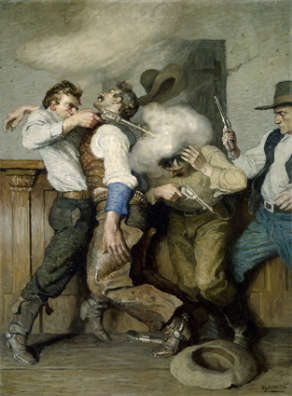
Duel to the Death by N.C. Wyeth

Both the old west and the Arthurian forests are places where legend fills in all we do not know.  Where there be dragons, there also is imagination.  We populate these realms with our angels and demons, and yet the settings are of this world, as opposed to outer space or Middle Earth.  You can visit Tombstone or Glastonbury.  Most historians agree there really was an Arthur of Britain who held off the Saxon invaders after the Roman legions left.  We know that Wyatt Earp, George Custer, and Calamity Jane were as real in their time as we are now.

Gunfight by N.C. Wyeth

I suspect that most of the tales we love of both knights and cowboys are hero journeys, in the classic sense outlined by Joseph Campbell. In his PBS series, The Power of Myth, Campbell said that when they left to search for the Holy Grail, each knight picked his own place to enter the forest – to follow the path of another would have been shameful.

That same ethic frames a number of westerns, and is historical fact in the case of the the mountain men.  Several kept articulate journals describing the yearning that moved them leave “civilization” behind to see what lay beyond the next ridge.

I do not want to belabor the point, but Pothos, the yearning for the unobtainable, was actively cultivated as a virtue in the courtly love ethic celebrated by the troubadors and in the stories of Cretien de Troyes.  Just like modern film directors, Cretien was writing about an era that was gone in his time, but inspired dreams we still share today.  Be it John Ford or Peckinpah, I’m a sucker for a good western, just as I love stories of the knights of old, from Mallory to Monty Python.

***

There is one huge difference between the world of Arthurian legend, and the world of the western – and by extension, the 21st century world we all inhabit.  When the knights entered the forest on their solitary quest, they knew what they were trying to save – Camelot – and they knew what they were trying to find – The Holy Grail.  These legends grew from a world that in reality was probably more brutal than the west of any of Sam Peckinpah’s westerns, and yet from all accounts I have read, this was a world where ultimate certainties were not in doubt.

For us the entrance into the forest or desert is a little darker, for we don’t even start with the same certainty that what we are after exists.  Still, in one account Joseph Campbell quoted, the Holy Grail, was never the same for any two people.  It changed to give each what their heart desired.  A very contemporary Grail!  If we don’t start out with a clear idea of what we are looking for, well I don’t think the knights of legend really did, or the people who climbed onto a covered wagon.

***

And finally, though lists always leave something to be desired, here is a pretty decent NPR list of classic and important westerns, from Stagecoach to Brokeback Mountain, to the new True Grit.  Happy Trails!

http://www.npr.org/blogs/monkeysee/2011/01/13/132905247/git-along-little-dogies-a-western-starter-kit/

McCabe and Mrs. Miller

I had planned to discuss Robert Altman’s McCabe and Mrs. Miller (1971), in the same vein as my earlier discussion of True Grit and Pat Garrett and Billy the Kid, but after wrestling with the post for two days, I realized this film does not fit both of the characteristics I was trying to understand in the others, characteristics I said made them memorable beyond the confines of genre.

Awareness of the nearness of death is there all right – in fact there are few movies in any genre where life is cheaper, as shown in the scene where a hired killer shoots a naive cowboy for target practice.

What is missing is that yearning-for-what-we-cannot-name, an unrequited longing that I called by its Greek name, Pothos.  The characters in McCabe never get that far.  They can’t even satisfy their basic yearnings for livelihood, dignity, love, and survival.

Warren Beatty and Julie Christie in McCabe and Mrs. Miller

Some of the modern directors who brought us the western anti-hero and a new and darker vision – people like Sam Peckinpah, Sergio Leone, and Clint Eastwood – nonetheless loved the genre and set about transforming it rather than trashing it.

Altman sought to use the western genre to make a point.  The year before, 1970, he had used the setting of the Korean war in MASH to reveal the damage modern warfare does to the human soul.  In McCabe and Mrs. Miller, he uses the western genre to make a similar statement about large corporations and unbridled capitalism.  He called the movie an anti-western and set out to dismantle the myths.

John McCabe (Warren Beatty) is a gambler and would-be entrepreneur with an undeserved reputation as a gunfighter.  Constance Miller (Julie Christie) is an opium addicted madam.  They form a business and later a romantic partnership to open a high class brothel in Presbyterian Church, a mining camp named for its largest and least used building.

The brothel is so successful that representatives of the Harrison Shaughnessy mining company arrive to buy the pair out.  Not understanding that this is “an offer he can’t refuse,” McCabe holds out for more.  The company sends three hired killers to get rid of him.

Terrified, McCabe is able to shoot two of the men in the back from hiding (remember, this was 1971, the Bonanza era, the middle-of-the-street, “Draw, padnah,” era of fairplay in gunfights).  He kills the third man but is mortally wounded.  In the final scene, McCabe lies dying in the snow while Christie lies in a haze of smoke in an opium den.

That’s it.

I tried for two days to find something moving and uplifting in the film, and there is really nothing except the lyrics of three Leonard Cohen songs on the soundtrack.  In the opening scene, as McCabe rides into town, Cohen sings, “He was just some Joseph looking for a manger.” If true, that would have lifted McCabe’s story to the level of tragedy, offering some form of  catharsis, some purging of our emotions by terror and pity, but I don’t think it happens here.  Nothing is purged.  Our negative emotions stay with us as they do after a bad episode of the six o’clock news.

McCabe and Mrs. Miller is an important western in the history of the genre.  It is an unforgettable western and a haunting western, but not for the same reasons as the others I have been considering.

NEXT:  A Meditation on the Wild West and Camelot


Pothos in Westerns 2: Pat Garret and Billy the Kid

Sam Peckinpah was 48 when he directed Pat Garrett and Billy the Kid. His health was failing after too many years of drug and alcohol abuse; a documentary I saw showed the crew carrying him from one scene to another on a stretcher. He was also battling the studio for artistic control of  the project, a fight that he lost.  Critics panned the production release of the movie, though 10 years later, when the director’s cut was available, they praised it as one of his finest.

Peckinpah poured his heart and soul into this tale of a rebel who died too young.  It isn’t hard to see the connection. Maximilian Le Cain, a filmmaker living in Ireland, says:

[Peckinpah’s] finest works are permeated with an intensely haunting atmosphere of melancholy, loss, and displacement. His heroes are exiles, men out of step with their dehumanised times, alienated from love or domesticity, yearning for a redemption that they seem able to find only in self-destruction. It is a dark but intensely romantic vision. If for nothing else, Peckinpah admires his heroes for their staunch individualism in the face of a world that is changing for the worse, eroding under the blindly ruthless power of money. http://archive.sensesofcinema.com/contents/01/13/garrett.html

One summer saturday afternoon in 1973, I went to see Pat Garrett and Billy the Kid. I walked out of the theater stunned, went home and got my sister, and saw the movie again.  In the months and years that followed, I read everything I could about Billy the Kid.  I made a series of prints called, “Homage to Billy the Kid”  (the one that survives is shown below).  Two years later, my wife and I explored Lincoln County, New Mexico, where the key events of William Bonney’s life played out.

Homage to Billy the Kid, color etching by Morgan Mussell, 1973

It isn’t hard to understand why I resonated with Billy the Kid’s story.  “Billy, they don’t want you to be so free,” sings Bob Dylan in the title song.  I was an art student, stuck that summer in a western New York factory town, longing for the southwestern deserts where the skies and vistas are so open they don’t seem real.  Times were hard; the sixties were over; just as in the late 19th century, the price of being “out of step” had gone up.

Some biographies paint William Bonney as an engaging rebel, and others as a psychopathic killer.  I doubt that there is any chance of extracting the “real” William Bonney from legend, but one thing appears to be historical fact:  Billy the kid would not have been declared an outlaw if he had fought on the winning side of “the Lincoln County War,” a bloody open-range type conflict that culminated in a pitched battle on the streets of Lincoln.  There were no angels in that fight; no one deserved a white hat.

Not only is Pothos, the unrequited longing for “something more,” beautifully evoked by Kris Kristofferson’s portrayal of Billy, it permeates the New Mexico landscape and sky, which is like another character in the movie:  it mirrors the Kid’s doomed quest to “live free” with an extraordinary beauty that we glimpse but can never grasp and hold.

Perhaps the best known artifact of Pat Garrett and Billy the Kid is Bob Dylan’s elegy, “Knocking on Heaven’s Door,” which sets the tone for the whole movie in its most haunting scene:

Knocking on Heaven's Door in Peckenpah's "Pat Garrett and Billy the Kid"

Knocking on Heaven’s Door in Peckenpah’s “Pat Garrett and Billy the Kid”

In an effort to find the Kid, Garrett seeks out another town’s sherif, Colin Baker (Slim Pickens), a man so disillusioned he has to ask his wife where he left his badge.  He is building a boat in his yard – a pathetic dingy – so he can “drift out of this damn territory.”  Baker, his wife, and Garrett raid the hideout of a former member of Billy’s gang, and Baker is mortally wounded.  He stumbles over to die by the little creek he hoped to sail away on, and we see it is too shallow to float anything larger than a paper boat.

Sam Peckinpah grew up outside Fresno and used to cut school to cowboy on a relative’s ranch.  According to Maximilian Le Cain (citation above), he did his best to live the myth of the hard living, hard drinking, womanizing, knife-throwing free spirits whose stories he tells.  Cain believes that when Peckinpah started Pat Garrett, he understood and set out to reveal the emptiness of this way of life – its inability to satisfy the hunger within.  He says:

Pat Garrett presents us with a country full of men without a future…If the Western is fundamentally about a struggle for survival in the face of a hostile wilderness, Pat Garrett is about people just waiting around to die. If the West is a wide-open country, Peckinpah’s sees it as a prison from which almost every decent person is trying to escape.

Quite a few movies came out debunking the myth of the west in the decade after that optimistic western epic, How the West Was Won (1962).  Many of these films were politically motivated in an era when, if the body count from Viet Nam was too depressing, you could flip to the ironclad righteousness of the Cartwright boys on Bonanza.

Superficially, Pat Garrett, appears to fit into this group of largely forgotten movies, but it is more.  What lifts it above the myth-busting movies, according to Maximilian le Cain, is Peckinpah’s love of the genre:

Unlike the revisionists, [Peckinpah’s] best films were at least partially self-portraits as opposed to ‘issue’ movies. He exposed the emptiness at the heart of the myth from the inside with the same anguish that he might feel in disclosing a fatal disease from which he was suffering. It is this depth of feeling that really sets this film apart from its contemporaries and has ensured its survival in the face of time.

True Grit, Pothos, and Westerns that Stick With You

Not just Americans, but people around the world understand that some westerns completely transcend genre. Their stories stay with you; like the greatest drama (to paraphrase Joyce) they arrest the mind in the presence of what is grave and constant in human suffering and unite the mind with the sufferer.

Rooster and Maddie in True Grit 2010

I think the stunning remake of True Grit may prove to be one of these.  It has the two elements I believe are at the core of unforgettable westerns – great unrequited longing and an open-eyed view of the nearness of death.

The westerns I cannot forget – and I’m going to discuss three of them – have in common, a longing that goes beyond anything specific, but is best described by the wonderful Greek word, Pothos:  an insatiable longing for what lies over the horizon, for what is ever out of reach.  Pothos means desire, longing for, regret, want….It is [a] painful restlesness. That quote comes from a website, pothos.org,  devoted to Alexander the Great, the man who conquered the world but was never satisfied.  http://www.pothos.org/content/index.php?page=pothos-2

Like any good story, True Grit begins with an appealing character, Maddie Ross, who has a compelling need:  she is determined to bring the man who killed her father to justice.  The initial motive is overshadowed as Maddie’s relationship with federal marshal, Rooster Cogburn, develops.  My friend and writing buddy, Rosi Hollinbeck nails it on her blog:  it’s a love story   http://rosihollinbeckthewritestuff.blogspot.com/2011/01/book-for-readers-and-writers.html

The key thing is, you sort of know the nature of the love between them, but can’t quite say what it is, and the characters don’t quite know what it is either, so they inevitably drift apart, though the final scene suggests this may have been the most important connection in both of their lives.

The nearness of life and death is the constant minor chord that opens the movie and is present under the stormy sky at the close.   The best westerns are not about special effects and high body counts for their own sake, and they are not about the cavalry charges of childhood saturday matinees.  To some degree, they are meditations that remind us that a life with all its hopes and dreams is a very fragile thing; it can end in an instant.

The one other thing my favorite westerns have in common are haunting soundtracks.  I downloaded Carter Burwell’s soundtack as soon as I got home from the theater.  It’s a solemn and stately musical play with the melody of a great old hymn, “Leaning on the Everlasting Arms,” here captured by Iris Dement, whose voice itself resonates with the pothos evoked by the words.

TO BE CONTINUED:  In my next post, considerations of Pat Garrett and Billy the Kid, and McCabe and Mrs. Miller.

They Say It’s Your Birthday

That’s right. January 22. Just over the cusp of Aquarius.  Old enough to know who Eddie Haskel was (see previous post).  Old enough to take the title for this post from a Beatles song.  Old enough that I was in Jr. High (they didn’t call it middle school then) when the Beatles played Ed Sullivan.

I am interested in Tibetan astrology and discovered there is some disagreement about where January birthdays fall in the scheme of the zodiacal year; the Tibetan new year is in February, but half the web sites and a friend who is a dedicated student of all things Tibetan say the astrological year begins at the winter solstice. That would make me an Iron Tiger. The prognosis for 2011 is not encouraging: one online site says, if you survive 2011, you will enter a run of good fortune. How’s that for good news/bad news? The same site suggests taking a retreat for the rest of the year, and urges caution around sharp tools.  Let’s just say we’re running low on firewood because I haven’t hauled out the chain saw in the last few weeks.

But in the forward looking department, I just put an official tag on this blog for the WordPress Post-a-week 2011 challenge. I saw this way back at the start of January, and figured, “Oh yeah, I’m gonna do that anyway, so I don’t need to be formal about it.”  Rereading the challenge, I realized there is a real stand-up-and-be-counted aspect to being formal about it, so I’m in.

So here’s to a year of surviving and thriving, and at least a post a week to document it!