Marginal People, People of the Margins

Given the doings and structure of the psyche, there is no such thing as being alone.  If you are the only one in the room, it is still a crowded room. – Michael Ventura

While reading and enjoying the interviews in Bill Moyers Journal (which I discussed here, https://thefirstgates.com/2011/05/24/bill-moyers-journal-the-conversation-continues/), I came upon a phrase that evoked a cluster of other ideas.

Moyers interviewed author, Louise Erdrich, concerning her novel, Shadow Tag, which he considers exceptional.  During the interview, Erdrich, who is the daughter an Ojibwe mother and a German American father, said “I live on the margin of just about everything, Bill.  I’m a marginal person, and I think that is where I’ve become comfortable.”   I recommend the interview as a whole, as I do the others in Moyers’ book, but right now I want to focus on the phrase Erdrich used – “marginal person.”

Louise Erdrich

In context, she was talking about the split between people’s waking selves and their dream selves, which is one of the subjects of Shadow Tag.  She was also talking about the tensions between her Catholic upbringing and the Ojibwe culture, as well as the tensions between her various roles, such as mother and writer, which don’t always fit well together.

In short, I take the phrase, “living on the margin,” and being a “marginal person,” to mean”outsider,” one who stands at the edges watching, related but not quite part of.  I am going to take this notion a step further, because it accords with recent thought in depth psychology as well as conditions in our culture.

James Hillman, a prominent post-Jungian thinker, has written eloquently of our “polytheistic” psyches, formed of a number of archetypal forces that often compete with each other.  This is in distinction to Jung’s “monotheistic” psychology, which posits a central “Self” which is alpha and omega of the psyche.

James Hillman

Here is what Michael Ventura, a journalist, screenwriter, and friend of Hillman’s has to say:  There may be no more important project in our time than displacing the…notion that each person has a central and unified “I” which determines his or her acts.  “I” have been writing this to say that I don’t think people experience life that way.  I do think they experience language that way, and hence are doomed to speak about life in structures contrary to their experience.  Ventura adds, The central “I” is not a fact, it’s a longing – the longing of all the selves within the psyche that are starving because they are not recognized” (Michael Ventura.  From “A Dance For Your Life in the Marriage Zone,” in Shadow Dancing in the USA, 1985, out of print).

Ventura’s essay on marriage names a few of these “selves:”  My tough street kid is romancing your honky-tonk angel.  I am your homeless waif and you are my loving mother.  I am your lost father and you are my doting daughter.  I am your worshipper and you are my goddess.  I am your god and you are my priestess.  I am you client and you are my analyst.  I am your intensity and you are my ground.  These are some of the more garish of the patterns. 

You get the idea, and though you may find it mildly interesting, perhaps you wonder, what is the point, and what does it have to do with margins?

Plenty, I think, and it’s all wrapped up in a word in a word related to margins.  The word is liminality, from the Latin word, limen, which means, “threshold.”  People and cultures in liminal states are “betwixt and between.”  The definition given in Wikepedia is:  a psychological, neurological, or metaphysical subjective state, conscious or unconscious, of being on the “threshold” of or between two different existential planes.  Though the word was initially used by anthropologists to anaylze the middle stage of ritual practice, it has passed into broader usage, with this important meaning: [liminality is] now considered by some to be a master concept in the social and political sciences writ large…very useful when studying events or situations that involve the dissolution of order, but which are also formative of institutions and structures.

Hermes, the Greek messenger god, is the archetypal figure of liminal states, for he can easily pass between the worlds and speak to gods and mortals.  His Roman name, Mercury, is synonymous with quicksilver, that flashing liquid metal that is not quite one thing or another and cannot be contained.  My suggestion is that marginal people, people who are at home in the margins, people whose psyches welcome Hermes, are fortunate in this liminal state of our culture and world, as it becomes increasingly hard to bury our heads in the sand and fail to note “the dissolution of order…which [is] also formative of institutions and structures.”

Hermes, Messenger of the Gods

My previous post on nonfiction writing spoke of the “dissolution of order” in publishing and the nimbleness that is likely to characterize and benefit those writers who can adapt and even help create the new structures that are going to emerge.

The landscape of work is another example that touches everyone.  My father worked forty years for the same company, doing the same sort of job, before retiring with a pension.  Showing up as the same person every day served him well.  I had three distinct careers in six different organizations; that is the current statistical norm, and I bet it will seem tame to the generation now coming of age.  Access to a variety of “selves” was an asset in sailing those waters.

Rigid and hierarchical structures are not faring well this year, be they Arab governments, the government of California, the management of Borders, or people in almost any endeavor who cling to business as usual.

If you recognize yourself as a marginal person, a child of Hermes, one who has never been quite “this” or “that,” but both and neither, relax.  These may be the very times when you shine, when your gifts are needed, and when the ways will open as you come into your own.

A Literary Agent’s Comments on Nonfiction Opportunities

The guest speaker at the local California Writer’s Club’s June lunch meeting on Saturday was Matt Wagner, founder of Fresh Books, Inc. Literary Agency:  http://www.fresh-books.com/

Wagner specializes in nonfiction titles.  His clients include several “Dummies” book authors, Dave Crenshaw, who wrote The Myth of Multitasking, and Michelle Waitzman, whose Sex in a Tent:  A Wild Couple’s Guide to Getting Naughty in Nature evoked a lot of interest when he passed it around.

Here’s the bad news:  Wagner debunked any notion that nonfiction writers are thriving in our current “legacy publishing” environment.  With Borders in bankruptcy, a suitor seeking to buy Barnes&Noble just for the Nook, and the explosion of epublishing, confusion reigns in nonfiction as well as fiction.  If things are uncertain for publishers, they are worse for agents, some of whom are trying to reposition themselves as coaches to stay in business.  This leaves mid-list authors who are trying to break into print at the bottom of the food chain (Wagner defines mid-list as, “You are not Suzy Orman”).

Several categories of non-fiction are doing well.  One are the series books – the “Dummies” and the “Idiot’s Guide” titles.  Part of the secret is, of course, that these books are not for dummies.  I’ve read several that were excellent introductions to their topics.

Wagner also cited, “vertically integrated niche publishers” as prospering, and gave an example I recognized:  O’Rielly Publications, which specializes in books on open-source software.  For the quarter century I worked in electronic design automation, O’Rielly titles occupied at least a third of my bookshelf, and the same held true for my colleagues.  Need a reference on the Linux operating system, or the PERL or TCL programming languages?  O’Rielly has it, often written or co-authored by the developer of the language.  In addition, they have websites, blogs, and webinars.

This, according to Matt Wagner, is a route for nonfiction authors that is opening up in our internet world.  Do you have an area of expertise?  Is it something someone might subscribe to a newsletter to learn?  An example jumped right to mind:  Randy Ingermanson’s Advancedfictionwriting.com (there’s a link on my blogroll).

Ingermanson, author of the traditionally published, Fiction Writing for Dummies, offers several free articles on his website, including his “Snowflake Method” of plot design, which I have discussed here (it is very worthwhile).  He also gives you the option of purchasing software to guide you through the process.  There’s a free e-zine, and as well as other articles and lecture series’ available for nominal fees in several electronic formats.

Check this site out, both for its free content (solid suggestions on plotting and building scenes), but also because it’s a great example of the kind of “vertical integration” that agent, Matt Wagner believes is the emerging model for how nonfiction writers can survive and even thrive in our emerging new world of publishing.

The Emerald Atlas by John Stephens: A Book Review

I have said before, I often read middle grade fantasy for the sheer fun of it, and I recently picked up The Emerald Atlas, published in April by John Stephens.   Stephens comes from the world of television production where he wrote for “The Gilmore Girls” and “The O.C..”  He also produced and sometimes directed and wrote for, “Gossip Girls.”  Most interestingly, he says what he really wanted to do all along was write novels, but when he finished grad school, “I was pretty bad at it.  I really kinda stunk.”  Stephens learned his craft in Hollywood:

“Writing for Hollywood turns out to be a great training ground. You learn how to work on a schedule, tell a satisfying story, build character, construct scenes, you develop a feel for dramatic momentum…and you get to tool around the Warner Bros lot on a golf cart, which is kind of awesome.” 

He says working for television was so much fun he forgot about writing until he read Phillip Pullman’s, The Golden Compass and realized that “all” he wanted to do was write fantasy novels for children.  (thought he still misses the golf carts).

The Emerald Atlas is the story of three very special children whose parents mysteriously vanish when they are young.  One night when she is four, Kate’s mother slips into her room and insists that she promise to care for her younger siblings, Michael, two, and Emma, one. The three children are hustled to a waiting car driven by an elderly man who barely eludes magical pursuers in a chase reminiscent of Harry Potter.  After ten year of ever more awful orphanages where they never seem to fit in, the children are sent to an apparent “last stop,” facility in Cambridge Falls, New York, run by the mysterious Dr. Pym.

Dr. Pym, it turns out, is the wizard who had taken the children for safekeeping ten years earlier, to keep them from the grasp of the beautiful but evil witch who calls herself, the Countess.  The forces of both good and evil are interested in Kate, Michael, and Emma for they each have a magical bond with one of the three Books of Beginning, where the great wizards of old in Alexandria encoded their lore when the worlds of magic and humans began to seperate.

Kate’s affinity lies with the first book, The Emerald Atlas, which enables one to travel in time and space.  When they stumble upon the volume in Dr. Pym’s basement, Kate, Michael, and Emma are whisked into the past before they understand the powers they have awakened.  They become separated and fall under the power of the Countess and her minions.

There’s a lot to like in The Emerald Atlas.  The characters are nicely fleshed out.  Fourteen-year-old Emma, clever, brave, with intuitive understanding of magic, suffers under the burden of keeping her brother and sister safe, as well as the other children of Cambridge Falls.  Twelve-year-old Michael, who sometimes drives his sisters nuts with his camera, notebook, and bent for scientific experiment, has the thrill of his life when he meets real dwarves, the people he admires more than any other.  Eleven-year-old Emma is the feisty one – part of the reason they’ve been shuffled from orphanage t0 orphanage is Emma’s habit of mouthing off to prospective adoptive parents.  The three are desperate to locate their real parents and and learn who they really are.  The value of loyalty and family runs like a constant thread through the book, even through Michael’s betrayal and forgiveness, which is reminiscent of Edmund in The Lion, the Witch and the Wardrobe.

Something else I liked in the story was the complexity of the time-travel plot.  Traveling into the past creates alternative pasts and futures and things can get very complicated, but there is no simplification or condescension for young readers.  Humor that will appeal to all ages pervades the story as well:  “How was [Emma] supposed to know how to defuse a mine?  No one had ever taught her that in school.  Her classes had always been about useless things, like math or geography.”

This is the sort of book, like the Narnia tales or Harry Potter, that will appeal to readers of all ages.  With the cinematic sense of its author, I won’t be the least bit surprised to see it made into a movie.  Stephens said, in his Amazon interview, that none of the studios have contacted him yet, but I suspect it is only a matter of time.  I will certainly buy a ticket, just as I expect to read and enjoy the next two books of the trilogy.

A Job From Hell by Jayde Scott: A Book Review

Several weeks ago, a young author from London, Jayde Scott, emailed and asked me to review her ebook, A Job From Hell.  She sent the link to her Smashwords page, which can serve as a model of how to present an ebook; the cover, description, and the montage of images and music in the trailer are very professional and lend a clear sense of what the book is about.  Have a look:  http://www.smashwords.com/books/view/56864

A Job From Hell is a paranormal romance featuring vampires, but what separates it from similar stories is the tongue in cheek tone set by the protagonist, seventeen-year-old, Amber, who takes a summer housekeeping job on a  remote estate in Scotland where the cab driver will not take her after dark – not a promising omen, but Amber needs the money for college.  Amber is a teenage Bridget Jones and a refreshing change from so many breathlessly serious YA heroines who are princess material and/or destined to save the world.

Amber stumbles all over herself when she meets her new boss, the hunky Aidan, who never appears by day, but before she can puzzle out what that means, she accidentally wins a competition for otherworld creatures, held only once every five-hundred years.  The prize, five hundred years of second sight and the ability to see the dead, is nothing she wants but also proves to be nothing she can give back, even when legions of other supernatural creatures take an unwanted interest in her.  It is shocking enough when Aidan, leader of the local vampire clan, informs Amber that she is destined to be his mate for eternity, and only gets worse when the Shadows, sworn enemies of vampires, spirit Amber away to their hidden lair and tell her she will have to stay there.

More than the various thrills and chills, it was the cast of characters who kept me turning the pages.  In addition to Amber, we have Kieran, who is Aidan’s snarky brother and drives his SUV like a maniac.  There is Angel, a lonely Shadow who wants to be Ambers BFF, and my favorite, the delightfully irreverent  Cassandra, who is Lucifer’s daughter and notorious for her hellishly bad fashion sense.

The one major character who didn’t quite fit the Buffy-like tone of the story was Aidan.  Although he was “turned” into a vampire at 18, he’s had five hundred years of living experience, and I found myself wanting a bit more reserve or wisdom from him, something to set him a little apart from “the gang.”  Even so, it was the gang that made A Job From Hell appealing, and now that I’m done, I find I miss them.  No fear on that score, however, as this is just the first title in Ms. Scott’s Ancient Legends, series.  A Smashwords reviewer says the next book is due out June 1, and at a cost of $0.99, you can hardly go wrong.

Bill Moyers Journal: The Conversation Continues

“Democracy cannot survive without disinterested people to speak truth to power.”  –  Bill Moyers on NPR, May 23, 1011

I interrupt my previous thought train (unforgettable stories) to suggest that everyone listen to an unforgettable journalist who I happened to catch on “Talk of the Nation” on NPR yesterday:  http://www.npr.org/2011/05/23/136583949/bill-moyers-shares-favorite-journal-interviews.  This was a compelling conversation with a man of high ideals, who isn’t afraid to speak uncomfortable truths.

We like to think of ourselves as democracy, Moyers said, but the word “oligarchy” better describes our government – rule by a few people of wealth and power, who do things like deregulate banking and finance, which guarantees that events like our recent financial disaster will happen again, since nothing structural has changed.  Few significant differences remain between Republicans and Democrats, Moyers added, and neither party really cares for he interests of working people.  Yet Moyers’ voice was animated and full of joy and hope.  As well as current events, Moyers talked of his love for poetry and the inspiration he and millions of PBS viewers found in his conversations with Joseph Campbell.

This interview celebrated the publication of Moyers collection of 47 interview with “independent thinkers,” taken from his PBS probram, “Bill Moyers Journal,” that ran from 2007-2010.  This isn’t the sort of book I usually read, but Moyers is one of those rare talents, like Ken Burns, who I will listen to no matter where he chooses to go.  I downloaded the book to my kindle, and after listening to the radio interview, you may just do the same.

Notes on Stories by Amy Tan

In my previous post, I spoke of Stephen King’s editorial intro to the 2007 edition of Best American Short Stories.  Today, while excavating (cleaning is too mild a word) the junk in the back room, I found three volumes I had picked up last fall from the used bookstore up the street.  These were Best American Short Stories from 1999 and 2005 as well as Best Mystery Stories of 2002.  I flipped through the three, looked at the intros, titles of stories, and a a few first pages, and then sat down with a cup of coffee and the 1999 stories, which were edited by Amy Tan.  She truly seems like someone you’d like to have coffee with.

Tan’s introduction reveals the depth of her love of stories, and she gets very personal about early events that made them as important to her as air.  She had lots of things to worry about as a child, events like seeing a playmate in a coffin and hearing her mother say that is what happens to children who disregard their mothers.  Small wonder that Tan was attracted to fairy tales and Bible stories, which she found very similar:  both had “gory images, gut-clenching danger, magical places, and a sense that things are never as they first appear.”   Straw-into-gold sounded very much like turning three  loaves into a thousand, she says.  Amy Tan gives us these personal memories after saying she always wants to know personal details about people who presume to act as critics or decide which stories are good and which are bad:

“What are their tastes based on?  What are their biases?…What movies would they watch twice?  Do they make clever and snide remarks , mostly about people who are doing better than they?…What are their most frequent complaints in life?  What do they tend to exaggerate?…Do they think little dogs are adorable or appetizers for big dogs?…In other words, if you ran into this person at a party, would you even like him or her?”

I had been feeling like taking a break or simply doing a post or two here just for fun, and Amy Tan’s comments gave me an excuse; they sent me daydreaming about some of the stories that fascinated me as a kid, ones I still think about now.  I never felt quite as shell-shocked during my first decade as Amy Tan, though we moved a lot too, and one of my childhood playmates died.  The stories and ballads that captured my attention as a young reader were like koans, or life itself – you could chew on them for decades and still not understand all that is going on.

This will be the subject for my next post – stories and ballads I have never forgotten.  It will have to be another post, since one of the stories is from Wales and I need to go dig up the spellings.  Stay tuned!

Some Notes on Short Stories by Stephen King

Last Sunday, as I walked into the Borders where my SCBWI critique group meets, I spotted a winner in the discount racks near the entrance:  The Best American Short Stories of 2007 was marked down to $3.99.  This was a no brainer with the added bonus of featuring Stephen King as editor.

I bought the book without even checking the contents, so I was delighted when I got home and found a story by John Barth called, “Toga Party,” about a group of sixty and seventy-year-olds in a posh retirement neighborhood who all receive invitations to one of those parties, “like that crazy Animal House movie from whenever.”  The story begins humorously but doesn’t end that way.  In a similar vein, Stephen King’s comments on the state of the American short story begin humorously but don’t end that way.

King wrote about going into a large bookstore in Florida in search of that month’s stories to read.  The first thing he saw was a table upfront with titles by James Patterson, Danielle Steel, and himself.  Disposable stuff, but it pays the rent he says, “because money talks and bullshit walks.”   He continues:  “Bullshit- in this case that would be me – walks past the bestsellers, past trade paperbacks with titles likeWho Stole My Chicken?,’ ‘The Get-Rich Secret,’ and’Be a Big Cheese Now,’ past the mysteries, past the auto repair manuals, past the remaindered coffee-table books.”   He finds the magazine wall, next to the children’s reading area.

King says he found The New Yorker and Harper’s without much effort, but had to search the floor-level racks to find the stash of magazines, like the Kenyon Review, that feature short stories:

“So think of me crawling along the floor of this big chain store’s magazine section with my ass in the air and my nose to the carpet in order to secure that month’s budget of short stories, and then ask yourself what’s wrong with this picture.  A better question – if you’re someone who cares about fiction, that is – what could possibly be right with it?”

With an ever dwindling audience, some writers who still care about short stories keep on working, but too often, King notes, their audience is simply other writers who read,“not to be entertained but to get an idea of what sells…and this kind of reading isn’t real reading, the kind where you just can’t wait to find out what happens next…There’s something yucky about it.”

King then says he read “scores of stories that felt…airless, somehow, and self-referring…show-offy rather than entertaining, self-important rather than interesting, guarded and self conscious rather than gloriously open, and – worst of all – written for editors and teachers rather than for readers (emphasis added).

There we have in a nutshell what I have been trying to put my finger on lately.  The last time I went to a large bookstore to browse for books, I went to the mystery section and found the number of rows had been cut in half.  Tough luck for those who like to read and write mysteries – the marketing department, which is after all, just trying to survive – has decided you are not cost effective.

No need for me to belabor the point anymore, it is what it is, but reading King’s editorial notes made me glance at all I have posted here about ebooks.  I certainly never set out to be their champion, in fact I started out somewhat skeptical.  My ideas have changed 180 degrees.  When half the mysteries and most short stories can disappear for reasons that have nothing to do with quality, who can argue with writers who look at a new way to get their books read?

Last week a writer in London asked me to review her ebook after reading this blog and noting that YA fantasy is “my thing.”  Now that I have finished my blog-break, it’s time for me to get back to her work, and with renewed appreciation for her and all the other authors willing to take a chance with a new way to do what storytellers have always done – tell their stories.

The Inklings and Stuff

The Inklings was the name of an informal literary group at Oxford that met for nearly two decades, between the early 1930’s and 1949.  Fans of fantasy literature know that regular members included authors J.R.R. Tolkien, C.S Lewis, Owen Barfield, Charles Williams, Neville Coghill, a Chaucer specialist, and Hugo Dyson who had been a member of the club that spawned the Inklings, “The Coalbiters,” a group founded by Tolkien to discuss Icelandic myth.

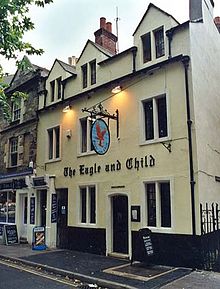
The Inklings discussed, among other things, myth, religion, and what we now call fantasy “world-building.”  Tolkien read chapters of Lord of the Rings and Lewis read his Narnia books.  They met on Thursday evenings in Lewis’s college rooms, and often shared lunch on Tuesdays at the Eagle and Child pub, commonly called, “The Bird and the Baby.”

The Eagle and Child Pub, Oxford

Nowadays we call such literary clubs, critique groups.  You often hear fans of fantasy literature say, “Oh, to have been a member of that group!”

Lately I’ve been thinking of the downside of such associations.  If you were C.S. Lewis, what would you have done when Tolkien told you not to publish Narnia?  “You will embarrass yourself,” he said.

I also think about the first Harry Potter book, which would never have been blessed by any critique group.  J.K. Rowling broke too many rules.  For starters, she mixed elements of middle-grade fantasy with young-adult fantasy, and by all conventional rules, that is a no-no.  The problem is, conventional rules lead to conventional books.  Check out some book-jacket blurbs at the local Barnes & Noble to see for yourself if that’s true.

I can clearly remember when it wasn’t like this.  In the eighties I used to hang out at a quirky fantasy bookstore.  I could go in with a theme in mind like, “spirit guides in contemporary urban fantasy,” and walk away with a couple of titles the owner pointed out to me.  Try that at the Barnes & Noble!

Learning and practicing conventional wisdom is a part of mastering any craft.  I went through it in art school.  It was necessary, but eventually became like wearing mental blinders that prevented me from appreciating or producing work that ventured beyond certain boundaries.  The problem was, I could not see past the filters even when I started wanting to, because I had spent so much effort learning the rules.  Only with the passage of time – a lot of time – did my rigid ideas relax and dissolve.

Is there any way to speed up the process now?  Because now I know what is really at stake:  it’s about recapturing a spirit of freshness and play as a reader and a writer.

***

This morning I found myself rereading notes I had taken in March when I attended a retreat with Edward Espe Brown, an event I posted about at the time.  No wonder!  Brown is one of the least doctrinaire people I have ever met.  Here is the story that really stuck with me:  Brown was leading a meditation session, and as leader, his role was rather formal.  One day he sat down and reviewed his inventory of meditation techniques – which was extensive – to choose one to practice that day.  A sudden inspiration arose in his mind – Why don’t you just touch what is inside with warmth and kindness?

That is a very revealing exercise.  One of the first things that comes up for me you could call the “inner achiever.”  I bet most of us learned early in life to be virtuous and hard working.  Play only after you get your work done, and so on.

It’s easier to see the dynamic in meditation where nothing else is going on.  I tend to procrastinate more in attempting such a strange (warmth and kindness?) exercise in writing.  Yet a timed period of freewriting in the morning, before the daylight mind is fully awake, can lead to a startling result – it can open a doorway into play and an unexpected abundance of ideas.

I do this freehand in spiral notebooks and tell the inner achiever these are “warm up exercises.”  And after repeating this for a few days, I’ve witnessed ideas pouring onto the page, in such a profusion that it’s sometimes hard to keep up.  Try it and see.  For me it was something of a revelation.  I’ve done free writing before without experiencing this, but I suspect I was secretly harboring agendas along the lines of self-improvement or self-discovery or something like that.

Where are all these ideas going?  I really don’t know, and I am determined not to ask.  It’s too adult a question – “Are you engaged in an educational form of play?  Is this leading toward a measurable goal?  I have no idea.  I don’t even know if these ideas are “mine” or if “me” and “mine” have any meaning while this is going on.

Here are some other notes I jotted down when Edward Brown was here:

  • What is precious in us doesn’t come and doesn’t go.  It is not dependent on performance.
  • You can’t figure it out.
  • Focus on what is beyond thinking – and that means what is in the heart.

Finally, he posed a stunningly simple question:  Are you going to be a rule follower or are you going to be you?

You can’t just make a simple decision on that one and then do some warm up exercises.  What was it that C.S. Lewis knew about himself and his work that kept him going when Tolkien told him Narnia wasn’t fit to publish?

That is a very important question for any writer who wants to listen to others without losing his or her own inner center of gravity.