A Science Thriller by Amy Rogers

I met Dr. Amy Rogers at the Sacramento branch of the California Writer’s Club where she is Web Site Coordinator, and an author of science thrillers. What is a science thriller? Think of Frankenstein, Jurassic Park, and Contagion, coming soon to a theater near you. You can learn a lot more about the genre and read a number of reviews at Roger’s blog, http://www.sciencethrillers.com.
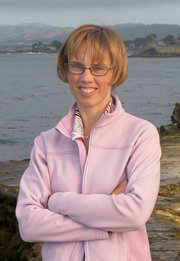
Dr. Amy Rogers

Dr. Rogers just published her debut thriller, Petroplague, in ebook format, with a paperback release due in November. She sent this synopsis:

UCLA graduate student, Christina Gonzalez, wanted to use biotechnology to free America from its dependence on Middle Eastern oil. Instead, an act of eco-terrorism unleashes her genetically-modified bacteria into the fuel supply of Los Angeles, turning gasoline into vinegar.

With the city paralyzed and slipping toward anarchy, Christina must find a way to rein in the microscopic monster she created. But not everyone wants to cure the petroplague – and some will do whatever it takes to spread it.

From the La Brea Tar Pits to university laboratories to the wilds of the Angeles National Forest, Christina and her cousin, River, struggle against enemies seen and unseen to stop the infection before it’s too late.

A former professor of microbiology, with a PHD from Washington University, Dr. Rogers has the background to make such a story plausible. In addition, Petroplague is one of two of her novels picked up by New York agents who were then unable to sell them. At this point, Rogers mentioned self-publishing, and her agent directed her to Diversion Books, which she says, “lies somewhere between self-publishing and a traditional Big Six contract. Diversion Books is loosely associated with a traditional literary agency – the first such publisher, though others have sprung up since.”

I plan to review Petroplague here, but you don’t have to wait for me. Click on the book cover photo above to go to the authors website, http://www.amyrogers.com, to view a trailer and read the first two chapters for free.

In addition, Amy has said she’ll be happy to write a guest post or answer interview questions here. So stop back soon, and visit Amy Rogers’ website and blog, for information on publishing, on scary microbes, and to check out what promises to be an exciting read!

Truth(s) in Blogging

Ever since I posted some notes on Anne Lamott (August 29), I’ve been mulling over her comments on the importance of truth in writing, and how that relates to blogging.  Overtly, her words do not have to do with the online world.  Bird by Bird, Lamott’s book on writing, was published in 1994.  By then, a few people had learned not trust everyone in a chatroom, but we were still years away from the need to decide what sorts of truth to reveal to what sorts of people in our Facebook profiles.

Conclusion 1:  If we didn’t know it before, we have learned online that there are many kinds of truths.  Some are for Friends and some are for Everyone, and it’s good to know the difference.

I don’t think I’m being picky; it’s just that when someone talks about “truth” I am never quite sure what they mean.  “Truth or reality, or whatever you want to call it is the bedrock of life,” says Lamott.  Hmmm.  Well we all agree that the sun sets in the west, but luckily for us bloggers, there is little consensus on truth beyond such “obvious” things.  If there were – if we learned any final realities in school, there would be little for us to write about.

Conclusion 2:  According to biologists, the cells in our bodies renew themselves in seven year cycles, and experientially, my beliefs/truths transform in a similar time frame.  I no longer believe several key stories I was convinced of just five years ago.  Even people’s core beliefs, often matters of faith, are subject to alteration:  the Jesus someone believed in at 3 is not the Jesus they know at 30 or 60.

To be fair, I think the kind of truth Lamott points to in her book on writing is “gut level honesty,” but still, what is that?  In her essays she uses a lot of self-revelation.  She walks that tightrope successfully because her personal stories fit and illustrate the points she is trying to make, but it’s one of those “don’t try this at home” kind of things.  Luckily, most bloggers I follow use self-revelation appropriately too.  Perhaps it’s because we know a post goes to Everyone, and that understanding makes us circumspect.

Conclusion 3:  I was lucky enough to find a reliable standard for self-revelation in writing when I came upon Black Elk Speaks, by John Niehardt when I was 18.  Though I may not always live up to it, I have always aimed at the standard set by the great Lakota medicine man.  If anyone had an interesting story to tell, it was Black Elk, who knew Crazy Horse and Sitting Bull, and witnessed the Little Bighorn and Wounded Knee.  Yet he begins his historic account with these words:

“My friend, I am going to tell you the story of my life, as you wish; and if it were only the story of my life I think I would not tell it; for what is one man that he should make much of his winters, even when they bend him like a heavy snow? So many other men have lived and and shall live that story, to be grass upon the hills. It is the story of all life that is holy and good to tell.”

For me, “truth in writing” is one of those abstractions, like “voice,” that it’s better not to worry about.  We may “know it when we see it,” but operationally, it’s better to simply write, then post, then write again.  If I “set out to find my voice,” I am guaranteed to be silly at best.

At least that is my truth for today.  Next week or next month it may be something different, but that’s ok.  Pretty natural, I believe.  When you really think about it, most “truths” do not have a very long half-life.

How Much is Too Much?

I have to thank Ceinwenn for this topic.  He or she (I can’t be sure, since the link takes me to a password protected forum) commented on my previous post, Three Requirements of a Book Review (?).  Ceinwenn felt I had given away too much plot info in my review of  David Baldacci’s First Family.  It’s entirely possible.  Several comments mentioned avoiding spoilers, something I have not considered as much as I will now.

In my own defense, I would cite the similarities of a synopsis, which you use as a design and advertising tool with your own fiction, and the plot exposition section of a book review.  In a synopsis, you must reveal what happens; you can’t leave an agent or editor guessing.  In a book review you must not.  Got it.  Thanks.

But that wasn’t what I really wanted to talk about here.  Ceinwenn’s comment spun me off thinking of several recent things I’ve said about blogging, and specifically my discovery that the public act of blogging is far more stimulating than the private act of writing in a journal.  The public nature of blogging makes it challenging in terms of deciding how much self-revelation is right.

My wife has commented on my tendency to get too academic and boring, which is an easy path for me to take.  On the other hand, I remember a psych teacher who was Mr. Sensitive-Self-Revelation, and it wasn’t a pretty sight!  A remember a very calm and poised young woman walking out of the class, shaking her head and making barfing noises.

You get what I’m saying.  As a blogger I want to be real and I enjoy the same quality in others, but I’ve used the delete key on posts that went to far.  I might write about an embarrassing moment, especially if there is humor involved, but I’m probably not going to post my most mortifying-ever experience.  You know the one – you’re driving along and it comes to mind and you slink down in your seat in case the nearby drivers can read your mind.

Some topics rouse caution immediately, notably politics and religion.  Mary and I have a couple of long-term friends that are long-term because we learned early on to stay off these topics.  Here on this blog I circle both politics and religion, but I keep more of a distance than I would personally like to.  Still, because I really dislike door to door religion or candidate salespeople, I don’t want to risk using this space to invade anyone’s right to decide for themselves.  Fortunately, tonight I get to quote someone brilliant on a political topic.

I’m traveling.  As a matter of fact, I’m attending a two day intensive teaching session let by a Tibetan Buddhist teacher of international renown (forbidden topic #1).  I got back to my room and flipped on the news just in time to see the President’s message that a compromise is in the works. (forbidden topic #2).  Whew!  No one with their head screwed on right could wish to see our country in default, and yet, the whole situation is icky!  Have you ever gone for a swim in a lake or river that was too full of alge?  You come out feeling slimy.

It’s far to easy to blame someone else, but none of us are innocent in this mess.  We elected these clowns, most of whom are doing what they think we want them to do in order to get re-elected.  It cuts a lot deeper than that, and once I get home, I may quote from an article I found that has a lot to say about this dance of the public and the politicians.

Meanwhile, here is the brilliant comment I promised, from Walt Kelly, creator of the wonderful comic strip, “Pogo.”  This particular panel was printed in 1971, on the occasion of the first Earth Day, but its message took on a life of its own that goes beyond any single issue.  If we could learn one thing from this latest crisis, this would be my vote.  We, as a nation, will not be destroyed from without, goes the common wisdom, often repeated over the last decade – but clearly we can do it to ourselves.

Thank You

I usually think of summer as the laid back season, but not this year.  The last few weeks have been a blur of major construction projects around the home, remedial training for our two rescue dogs, and unwanted interuptions such as the seeming immanent failure of Mary’s hard drive.  There hasn’t been a lot of time for quiet reflection, so I was all the more surprised and grateful when the good people at WordPress chose a recent post of mine to be Freshly Pressed:  https://thefirstgates.com/2011/06/27/a-year-of-blogging/.  I appreciate everyone who stopped by to look and those who left a comment.  I spent some wonderful hours reading and responding to comments and looking at blogs I had never seen before.

The comments that moved me most came from other bloggers, some just starting out, who said they found encouragement in what I had written.  No feedback I have ever gotten for writing means more to me than that.  A few said they were dipping their toes in the water, afraid their writing wasn’t good enough.  I think every writer feels like that on occasion.  Here is what T.S. Eliot, my favorite 20th century poet, had to say on the matter:

So here I am, in the middle way, having had twenty-years –
Twenty years largely wasted, the years of
l’entre deux guerres
Trying to learn to use words, and every attempt
Is a wholly new start, and a different kind of failure
Because one has only learnt to get the better of words
For the thing one no longer has to say, or the way in which
One is no longer disposed to say it.

But Eliot doesn’t stop there, and neither should we.  He goes on to say,  For us, there is only the trying.  The rest is not our business.  Elsewhere he said, Take no thought for the harvest, but only for the proper sowing. 

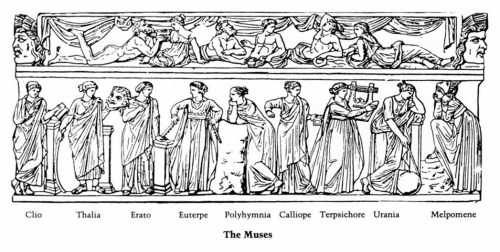
 At 18, in my first semester of college, I saw a phrase that has never left me:  the invocation at the start of Homer’s OdysseySing in me muse, and through me tell the story…  I remember and sometimes use that phrase because it reminds me that the ego, the small self of “me” and “mine” that worries about results is not the self that can bring them about.

Does anyone else find there is something impersonal about creativity?  It feels very much as if a muse or spirit of inspiration is there to take over the keyboard, if I can just get “me” out of the chair.  Carl Jung said it another way:  “I realized my thoughts were not really my own, but were more like animals I encountered on a walk through the forest.”

One summer when I did some freewriting every day I made a startling discovery – if I allow myself to be lousy, I seldom am.  This doesn’t mean there won’t be editing afterward if I find that one of my seed ideas is worth expanding.  It just means that while I am writing, everything goes better if I’m not looking over my own shoulder.

Several people who commented here said the same thing – their blogging took off when they realized they didn’t need to be perfect.  Thanks again to everyone who stopped by to encourage my imperfect progress!

Harry Potter Fan Fiction

Harry, Ron, and Hermione in The Sorcerer's Stone, 2001

Fan fiction did not begin with Harry Potter or the internet.  According to Lev Grossman’s article, “The Boy Who Lived Forever,” in the July 18, issue of Time, xeroxed fanzines appeared after the premier of “The Man from U.N.C.L.E.” in 1964, and really took off with “Star Trek.”

In the broader sense, telling original stories with borrowed settings and characters is nothing new at all.  Homer did not create the Trojan War, Achilles, or Odysseus.  Shakespeare did not make up either King Lear or Henry V.  But with the internet and Harry Potter, fan fiction has exploded.  There are more than 2 million pieces on fanfiction.net and more than a quarter of these are based on Potter – everything from short stories to full length novels.

The final movie will not be the end of original Potter creations

Grossman explodes most of the stereotypes of those who write and read these tales.  One 38 year old writer and actress says it’s like character improvisation.  A best selling fantasy writer whose novels have been optioned by Peter Jackson says, “Fanfic writing isn’t work, it’s joyful play.”  This raises the key question of why writer’s of fiction write.  Joyful play, a platform, and an appreciative audience are there – and it’s not like many creators of “original” stories get to leave their day-jobs.

Well known authors fall on both sides of the unanswered copyright issue.  J.K. Rowling and Stephanie Meyer encourage new fiction based on their characters and worlds.  Orson Scott Card, Anne Rice, and George R.R. Marin, author of A Game of Thrones do not, and threaten lawsuits.  It may or may not be coincidence that the authors Lev Grossman names as supporting fanfic are more recent and write for a younger audience than those who are in opposition and write for adults.  So far, all cease and desist requests have been honored, so there are no legal precedents in the world of fiction, though court cases involving music have been liberal in their interpretation of what constitutes “fair use.”

This begs the interesting question of who a character or world belongs to.  Groosman says that until recently:

Writers weren’t the originators of the stories they told; they were just the temporary curators of them.  Real creation was something the gods did…Today the way we think of creativity is dominated by Romantic notions of individual genius and originality and late-capitalist concepts of intellectual property, under which artists are businesspeople whose creations are commodities they have for sale.

Personally, I have always loved the poet’s invocation at the start of The Odyssey:  Sing in me, muse, and through me tell the story… 

In my experience, the “I” does not invent worlds or characters.  Whether you call it the muse, the gods, or the collective unconscious, fictional worlds and imaginal people come from somewhere else.  With a bit of luck and humility, the “I” may get to witness what happens, and may even get adept at finding new rabbit holes.  To me, the idea of “owning” a “product” of imagination smacks of hubris.

There is no real data on whether fanfic hurts an author economically.  Intuitively, I can only imagine it benefits Rowling and Meyer.  I hope so.  Creativity is creativity, regardless of what spark ignites it.  I’m thinking of dropping by some of the sites to see what these authors are up to.  For those who write for the joy of it, I wish them a lot more.

A Year of Blogging

Snoopy writing

During high school and college, I tried to keep journals, because that’s what writers are supposed to do, but I never got too much traction writing only for myself.

Far more important were the letters I wrote to several close friends during that time.  You could say I learned to write because of them, for they really encouraged me, and an appreciative audience was all it took to turn on an incredible flow of words.  I wrote page after page, jotting down ideas as I tried them on for size, and things that just came to me in mid-sentence.  What kept me going was the thrill of knowing someone wanted to read what I had to say.

I think you can see where I am going with this…

Fast forward a few decades and in June, 2010, I signed up for a day long blogging workshop because these days, “building a platform,” is what writers are supposed to do.  I had and have some fairly cynical thoughts on that proposition (for writers of fiction that is), but that is beside the point.  I simply would not have kept at it if blogging was nothing more than a means to an end.

Almost immediately, this endeavor took on a life of its own.  It continues to surprise me.  If I had to sum up what blogging means to me, I would say, “discovery.”  Not only because of all the things I get to research and learn about, but because I continuously surprise myself by finding things in the psyche I don’t know are there until I see them on the screen.

So I want to sincerely thank everyone who stops here and reads a post, and maybe even takes a moment to leave a comment.  You keep me going and I appreciate you very much

I’ve learned many things this year, chief among them, the seemingly inexhaustible way the mind generates ideas.  I don’t know how many times I’ve posted something and gotten up thinking, “Well, that’s it.  It was a nice run while it lasted, but I’m finally out of things to say.”  The experience is so common, that I get to see, at least once or twice a week, that if I just go do something else, the next idea will appear in it’s own time.

Ideas are common – they come and go, but once in a while one sinks deep, resonates, and even changes some aspect of your life.  Something stated very simply this spring by Edward Espe Brown, who I posted about at the time, had that effect.  It crystalizing themes that had been on the back burner for a very long time:

Are you going to be a rule follower or are you just going to be you? – Edward Espe Brown

Brown made the comment in the context of spiritual practice, but it has a much wider scope.  It certainly does in the field of writing.  Here’s a confession:  some two years ago, a critique group buddy said, “I’ve heard that editors don’t like colons.”  I am ashamed to admit that I went home and rewrote several sentences.  Blogging has sharpened my perception of the absurdity of pronouncements like that, and something else that Brown said cuts at the very motive for heeding “advice” of that sort:

What is precious in us doesn’t come, doesn’t go, and it does not depend on performance.

Edward Espe Brown

I am very fortunate indeed to have a forum like this where I get to pass along things of value like that when I come upon them.  And as for what’s coming up in the next year – I promise I’ll let you know as soon as I do.  Meanwhile, I very much hope you will stay tuned.

Dreaming Up Ideas

I have been busy working on several blog posts, but they are for later this summer.  Meanwhile, I found myself less than excited by any of my other topic ideas, so I drifted over to a blog filled with a wealth of advice and inspiration, “Writing On The Wall” (you can find it in my blogroll).  Out of all the tags, I chose a section called, “Getting Ideas.”  http://writingonthewallblog.blogspot.com/search/label/getting%20ideas

Most of the posts were by a contributor named Annette Lyon, who shares a number strategies for jump-starting the creative process in fiction, as well as some interesting facts, like Orson Scott Card’s moment of inspiration for Ender’s Game, and this great quote from Tom Clancy:  “The difference between fiction and reality?  Fiction has to make sense.”

I especially liked Ms. Lyon’s account of wrestling with the infamous cliche that she heard from a college creative writing teacher – the famously stupid advice to “Write what you know.”  I suspect that most fantasy authors have never believing that nugget.  Write what you can imagine is more accurate for writers and poets from Homer to H.G. Wells, to J.K. Rowling, but Lyon’s misguided professor actually forced his students to compile a list of 100 things they knew, and were thus qualified to write about.

Lyon, who had wanted to be an author since the second-grade, was initially paralyzed by the realization that she didn’t know anything on her list well enough to write about it.  Fortunately for her and for us, she round-filed the list as soon as she could and rephrased the motto as, Write what you are willing to learn about.  

Any writer who has ever researched anything will agree with her, and reading her post, I realized that learning new things is one of my greatest pleasures in blogging.  And speaking of learning, check out “Writing on the Wall.”  Scroll through the tags and you’re bound to learn something new and find this sort of inspiration.

My 100th Post

Trying to find something appropriate to say on the occasion of a fairly incredible milestone like this is about as hopeless as trying to really comprehend one of those big birthdays, like turning 30 or 50.  Experientially, it feels pretty much like the day before, just as this feels pretty much like post 99 or post 17 for that matter.

What I can very truthfully say is how much I appreciate all my readers, all the comments I have received, and all the links I have followed to find kindred spirits sharing their own ideas.  There is no longer any doubt that community can exist in cyberspace.  Earlier this morning, in regard to something else, Mary reminded me of a detail from Peter S. Beagle’s, The Last Unicorn: unicorns don’t have to be in each other’s immediate company – as long as they know there are other unicorns in the world, they do not feel lonely.  Thanks to all of you.

***

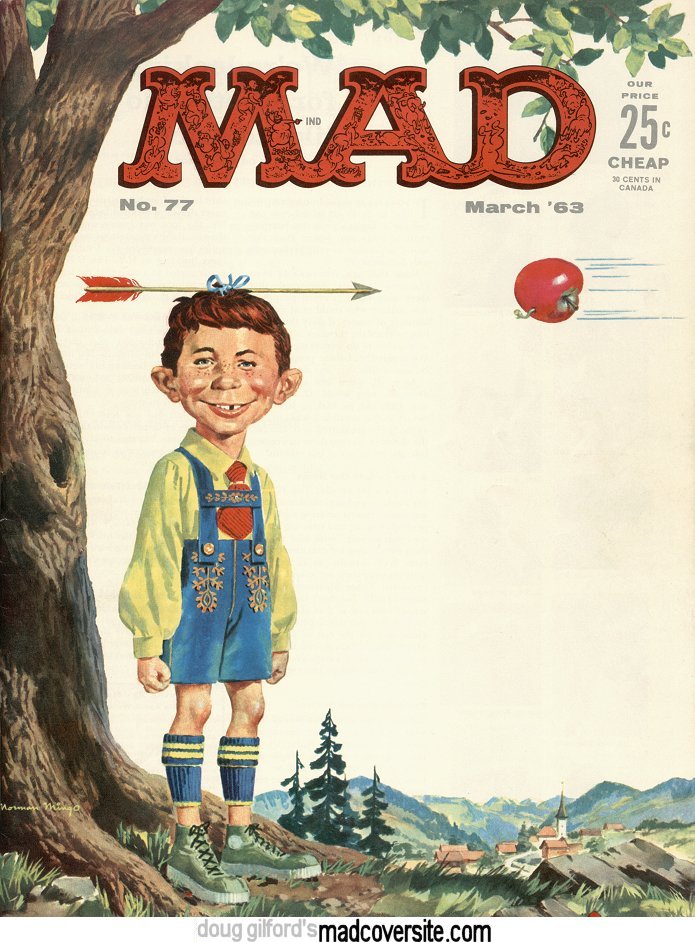
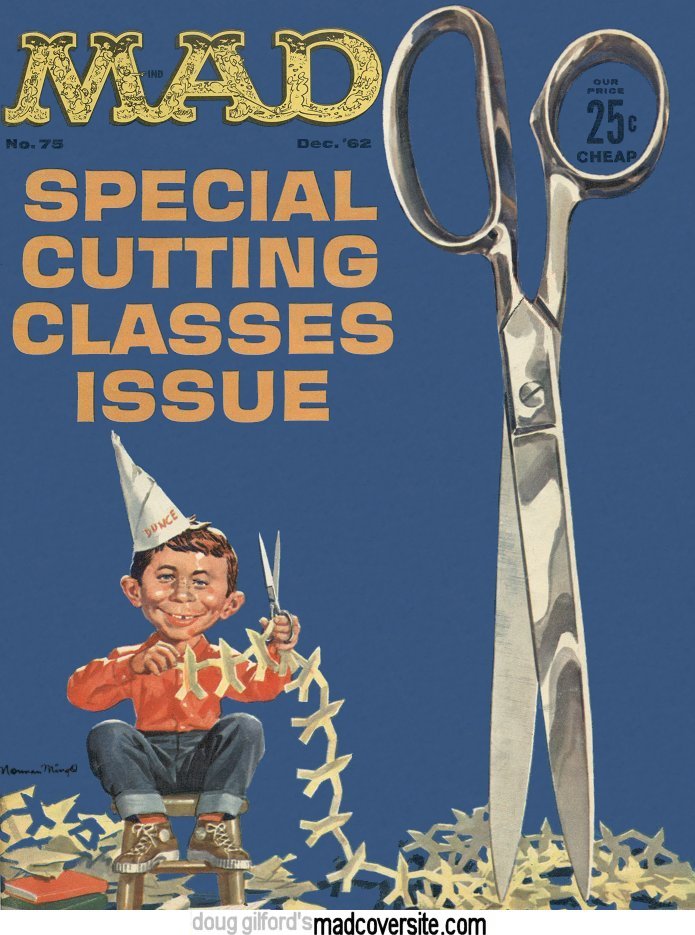
I started this post the way I started many others:  with an idea and the hope that it leads somewhere.  Very appropriately, I think, for such a significant milestone, the idea led me to Alfred E. Neuman.

This is because Jen left a comment on my “Deja Vue All Over Again” post, regarding the school bomb drills.  “I couldn’t imagine how afraid they all must have been,” she said.  That triggered several vivid memories of photos and caricatures in Mad Magazine.  Mad parodied Kennedy and Kruschev.  The editors didn’t shy away from pictures of mushroom clouds.  In a way, they taught us the same technique that Harry Potter and his friends learned when faced with a boggart, those magical creatures that take the shape of your greatest fear.  When faced with a boggart, you have to look it in the eye and say the magic word, “Riddikulus!”

Mad taught members of my generation to say “Riddiculus” to much more than just the cold war.  Nothing was out of reach of the parodies.  Mad took special aim at Madison Avenue, popular culture, politics, education – in fact most all the artifacts of the “normal” world of adults.  Appropriately, I learned about beatniks from Mad. I seem to remember a picture of William Gaines, the founder, sporting a goatee.

One day my mother caught me coming home with a copy of Mad.  “Let me see that!” she said.  She snatched it out of my hand and flipped through it, thinking, I guess, that it was some new kind of Playboy. She chuckled once or twice and handed the magazine back.  “I guess this is all right,” she said.  Yes and no.  In many ways, Mad was far more more subversive for a grade school kid than Playboy could every have been.

More than once over the years, I have seen articles on Mad Magazine’s influence on the ’60’s counterculture, for it taught a whole generation to laugh at the world they were going to inherit.  Few sacred cows escaped Mad’s satire.  I assumed there would be lots of dissertations on that subject by now, but when I did I a search, I could not find any.  What I did find – and this would have made Gaines laugh out loud – was a term paper on Mad for sale, that had its basic facts wrong in the synopsis.

Mad has, however, made a significant contribution to the field of computer science through the work of Donald Knuth, Professor Emeritus of Computer Programming at Stanford.  Knuth is:

Author of the seminal multi-volume work The Art of Computer Programming, [and] has been called the “father” of the analysis of algorithms, contributing to the development of, and systematizing formal mathematical techniques for, the rigorous analysis of the computational complexity of algorithms. http://en.wikipedia.org/wiki/Donald_Knuth

Knuth’s first scientific article, “The Potrzebie System of Weights and Measures,” was published in a school magazine in 1957.  In it, he defined the basic unit of length as the thickness of Mad issue #26, and named the fundamental unit of force, the “whatmeworry.”  Mad bought the article and published it in issue #33, in June, 1957.

Remember that fun PBS show called, “Connections?”  The host, James Burke, loved to show how events, separated by centuries and thousands of miles, influenced each other.  So here, for this weighty and significant 100th post, is a brand new connection!   Think of it:  the influence of Mad Magazine on the man who taught us to analyze the sort of programming algorithms that make blogging possible.  Now if that’s not a happy thought, I don’t know what is!