Drinking in America: Our Secret History by Susan Cheever

Drinking in America

The Pilgrims who came to America on the Mayflower were headed toward Virginia, where they had a land grant from King James.  Instead, they landed illegally in Massachusetts because they were running out of beer.  So says historian, Susan Cheever in her just-released Drinking in America: Our Secret History.  Cheever, a sober alcoholic, documents the pendulum swings of our national love-hate relationship with alcohol as she explores an important but little-known aspect of our past.

Alchohol was a factor at critical turning points in American history.  It is likely that the shot heard round the world was fired by one of the seventy militiamen awakened by Paul Revere, who passed the time while waiting three hours for British troops at the Buckman Tavern on Lexington Green.

According to Cheever, for all the volumes written on the civil war, no one has documented the considerable effect of alcohol on this conflict.  General George McClellan wrote, in February, 1862, “No one evil so much obstructs this army…as the degrading vice of drunkenness.”  McClellan, who did not drink, was relieved of command for indecisiveness in battle – or sanity, as Cheever suggests, while “His colleagues who succeeded on the battlefield – Grant, Meager, and Hooker, for example – were drinkers whose performance was often affected by their whiskey intake.” 

Most who have studied the war know about Grant, but not as many realize that because of the riotous condition of his camps, some credited General Hooker for lending his name as an epithet for prostitute.  General Thomas Meager fell off his horse while drunk as he led his troops into action at Antietam.  He drowned in 1867, after drunkenly falling off a riverboat in Montana.

Grant managed to sober up before his election as president, while Richard Nixon is revealed as an angry blackout drinker whom National Security Advisor, Henry Kissinger, Defense Secretary Melvin Laird, and White House Chief of Staff H.R. Haldeman had to protect from his own drunken rages.  They “danced around the president’s homicidal, drunken orders to bomb the shit out of this or nuke the shit out of that – orders usually not even remembered the next morning.  ‘If the president had his way,’ Kissinger told his aides, ‘there would be a nuclear war each week.‘”

Cheever’s survey not only covers political and military history, for drinking plays a part in our folklore and arts as well. John Chapman, aka, Johnny Appleseed, did not tramp around the countryside planting apples for pies, but for cider, and five of the seven 20th century American writers who won the nobel prize – Sinclair Lewis, Eugene O’Neill, William Faulkner, Ernest Hemingway, and John Steinbeck – were alcoholics. That there is no inherent connection between writing and alchohol is shown by a similar list of 19th century literary greats who did not drink to excess: “Melville, Emerson, Thoreau, Hawthorne, Longfellow, the Alcotts, and…Whitman.”

This underscores the paradox of the poles in our cultural history:  “temperance and intemperance, drinking and abstinence, liquor and sobriety, addiction and recovery.  Our country has been, at times, the drunkest country in the world; our country has been, at times, one of the least drunk countries in the world.”

As she sums up the “objective” view of modern historical authors, Susan Cheever notes that the “broad, dispassionate view,” often misses the “moments that make up our lives.” One of those things often missed by American historians is the effect of drinking on our history and national character.

“What is history?: a way to sift through the past in an effort to comprehend the world we live in; a way to understand ourselves; a way to make meaning of our lives by finding meaning in the past. How can we do that without acknowledging something many of us do every day, the thing that we use to punctuate our lives in celebrations and in sadness; how can we do it without acknowledging that glass of wine or whiskey neat or dry martini that has been such a powerful and invisible part of our life as a nation?”

Happy 90th Anniversary to…

…the Sacramento Branch of the California Writer’s Club, founded October 31, 1925.

IMG_0807

Here’s some info from the brochure at the celebration lunch last Saturday:

“Club history lore is that the founding of the California Writer’s Club emerged in part from picnics and companionship of Jack London and his writing friends up in the Oakland Hills, home of Joaquin Miller…”

Miller was a celebrated poet at the time.

“In 1909, those informal outdoor  salons (‘a blanket’ and a basket of chow’) evolved into the CWC.”

The Sacramento Branch was the first of a number of branches founded throughout the state.  CWC President, David George, presented us with a new charter, as the original one was long lost. Margie Yee Webb, our branch president, showed an archival print of the founding Sacramento members – the men in suits and tuxes, the women in dresses and evening gowns.  In those early days, they met for dinner and discussion, then adjourned to someone’s house for more conversation and drinking.

CWC old

The schedules, conventions, and mythologies of writer’s and poets have changed over the last 90 years; now we meet for breakfast or lunch, usually in jeans, and coffee is the libation of choice.

Jack London – who once worked as an oyster pirate and was jailed for a month for vagrancy – was the first creative artist, in any medium, to earn a million dollars from his work. One of my early blogging efforts, posted five years ago this month, was the account of a trip to Jack London State Park. I recommend a visit to all who enjoy his work.

The final presentation of the day was by literary agent, Laurie McLean, of the Fuse Literary Agency, who discussed why no writer needs an agent on the road to publication anymore. She also discussed those things an agent can do for us.

The gist of her talk was that we are only witnessing the start of the new forms of storytelling digital media will enable. She cited one example, popular in Japan, of serialized novels for cell phone apps that one can purchase 2,000 words at a time – a 21st century version of the way Conan-Doyle released Sherlock Holmes, a chapter at a time, in The Strand.

“What and who are you writing for?” Laurie asked.  If we need the assurance that comes from acceptance by a traditional publisher, then we need to play the traditional game, but if our goal to get our story into the hands of readers, then new, more direct avenues are opening all the time.

Despite Jack London’s success as a writer,  one of his greatest legacies may be the California Writers Club. It has nourished writers all over the state for the last 90 years, and hopefully will be here at the century’s end, encouraging those who have not been born yet, who will work in media that have not yet been invented.

A kinder, gentler, Jurassic World

psittacosaurus, at the Prehistoric Gardens, Port Orford, Oregon

psittacosaurus, at the Prehistoric Gardens, Port Orford, Oregon

Dinosaurs continue to fascinate. My first ambition in life, after a trip to the New York Museum of Natural History, was to become a paleontologist. Eventually, my life goals changed, and the T-Rex envy faded.

calvin-hobbes-dinosaur-005

Yet decades before Jurassic Park was a gleam in some screenwriter’s eye, Ernie Nelson, of Eugene, Oregon, did not outgrow his fascination with dinosaurs. He made them his life’s work in a most unusual way.

In 1953, Nelson gathered his family and left Eugene, where he worked as a CPA and owned a Mill supply company, to relocate to a valley near Port Orford, where rainfall averaged seven feet per year – he needed a rain forest.

In 1955, he opened the Prehistoric Gardens, and over 30 years, built 23 full size and anatomically correct dinosaurs. This unique roadside attraction is still in the family. Ernie’s granddaughter welcomed Mary and me in August, after we’d driven down from Bandon to see the dinos.

Not what you expect to see when you round the bend on the coast highway, but then, to paraphrase Monty Python, no one EVER expects a Tyrannosaurus!

Not what you expect to see when you round the bend on the coast highway, but then, to paraphrase Monty Python, no one EVER expects a Tyrannosaurus!

Nelson’s process was painstaking. His research was constant and thorough, and included a  trip back east to visit the Smithsonian. Each dinosaur began with a steel frame, which was then covered with a metal lath. A layer of concrete followed, and then another layer to define the visual features.  The Brachiosaurus, 86′ long snd 46′ high, took four years to complete and was his pride and joy.

Ernie working on the peterandon

Ernie working on the peterandon

The Prehistoric Garden’s website says the 23 sculptures were painted according to available scientific research. We normally don’t think of dinosaurs as colorful, though plenty of lizards, chameleons, and snakes in our world are.

I’m willing to trust Ernie on his color choices, but what I liked best was the aspect where I think imagination overrode research. Some of these critters are just so darn cute in, a wide-eyed sort of way.  I don’t want make Ernie turn over in his grave by calling his critters “cute,” but there’s just no other word for this triceratops, which has the same expression as one of my dogs!

triceratops small_edited-1

Some of us can remember the days of wacky roadside attractions on Route 66 or Hwy. 99 – giant oranges, strange animals, and gas stations designed to look like flying saucers.  There were animal parks, fairytale towns, and north pole villages in the days when Ernie Nelson moved his family to southern Oregon to shape his dream in concrete and steel.

The ichthyosaurus is suffering from the drought this year just like we are.

The ichthyosaurus is suffering from the drought this year just like we are.

Nowadays the most frequent sights, as we blow past towns on the interstate, are fast food joints and the same old big-box stores. Santa’s Village has long been shuttered, and the kids have video games and DVD’s to mitigate the boring view out the windows.

Like the dinosaurs, the Prehistoric Gardens speaks of a different era, one in which peace had come, America was unrivaled, and more people than ever before had jobs, cars, money, cheap gas, kids, health care, and paid vacations.

All those attributes can ebb and flow, but there is one precious thing we can always borrow from Ernie Nelson – the example of what an individual can do when he rolls up his sleeves, opens his mind and heart, and lets his creativity flow.

The medium is…

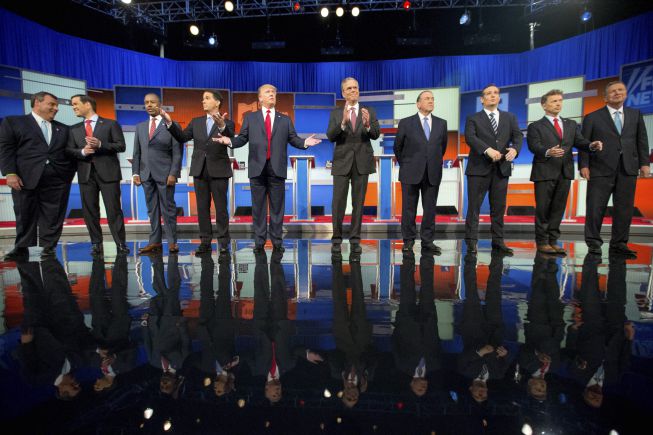
Republican debate

“The medium is the message”, said Marshall McLuhan in Understanding Media, 1964. Fifty-one years later, I’m still not certain we understand media, but a light bulb went on for me Thursday night regarding McLuhan’s iconic phrase. While watching the Republican presidential debate, I had a minor epiphany; that television cannot help transforming politics into entertainment.  

I am not suggesting that either party has a monopoly on show business.  Yes, the Republicans are likely to be funnier this year, with their Jerry Springer moments, and The Donald, who’s public persona is a weird combination of Rodney Dangerfield and Don Rickles.  I expect the Democrats to be far less interesting, more like infomercials on the home shopping channel.

There’s nothing new about politics as entertainment. If we believe television and movie depictions of pre-television and movie campaigns, there was plenty of bunting, and bluster, and brass bands in “the good old days.” But every now and then, wouldn’t it be refreshing to see something real happen on political TV?

The last time I saw reality break through was during the 2004 Democratic convention in Boston.  The Democrats had barred one of my heroes, the late Senator Robert Byrd, from the podium. Byrd could not be trusted to stay on script. Massachusetts Senator Kennedy invited Byrd to speak at the Old North Church, where Paul Revere worshipped, and his address was broadcast on Democracy Now. Byrd held up his well-worn pocket copy of the US Constitution and warned us that it was under attack…

Politics, of course, is not the only thing that TV flattens out. I recall several surreal moments with TV news. One early evening in college days, when I was living in an off-campus house, my roomies and I were watching a shoot out on Mod Squad on an old black and white TV. I went to the kitchen to fix a sandwich, and when I returned, the shootout had grown more intense; the house where the bad guys were hiding was on fire. But it looked different.  “Did somebody change the channel?” I asked.

“Nah, man,” said a house mate. “The news cut in. The cops are having a shootout with those guys who kidnapped Patty Hearst.” The visceral difference between watching a fictional versus a non-fiction firefight on TV was nonexistent without the dialog or voice over!

In a very real sense, that’s simply the nature of things according to both western depth psychology and Buddhist psychology. Every experience we have, noted James Hillman, begins as an event in the psyche. And Buddhist thinkers will tell you that our so-called realities are far more like the dreams we have at night than most of us dare to believe. Yet, as a practical matter, in order to make the right decisions, we have to be able to tell them apart, and that means turning a critical eye on the stuff we see on television.

I have recommended it before, but as we begin another presidential election mini-series, I can think of no better guidebook than Neal Gabler’s Life the Movie: How Entertainment Conquered Reality, 2000.  In it, he says:

“the deliberate application of the techniques of theater to politics, religion, education, literature, commerce, warfare, crime, everything, has converted them into branches of show business, where the overriding objective is getting and satisfying an audience.”

Unless we choose to live with the wolves, we’re going to be part of that audience, but at least we can remember that wonderful Buddhist bumper sticker:  “You don’t have to believe everything you think.”

Inside Inside Out, a review of sorts

In a culture that imagines a sharp mind-body split, it isn’t surprising to see images of a smart inner being controlling our physical “machinery.” Inside Out gives us a committee at the helm. Among feature length movies, it is unique in this respect, as far as I know.

Inside-Out-Meet-your-emotions-2

There are many points to ponder during the film’s 90 spectacular minutes of Pixar 3D animation, but given my background, I was especially caught by the movie’s alignment with a key post-Jungian view of the structure of the psyche.

Michael Ventura, a journalist who has written at length upon archetypal themes, and who co-authored We’ve Had 100 Years of Psychotherapy and the World is Getting Worse (1993) with James Hillman, said “There may be no more important project for our time than displacing the…fiction of monopersonality.” 

In Jung’s theory of archetypes, pre-eminent place goes to “The Self,” at once, the center of the psyche and it’s totality. The Self, for Jung, was the god image within us. The problem, according to both Ventura and Hillman, is that none of us ever experience ourselves this way. The idea of a unified, “monotheistic” Self is a longing rather than day to day reality, in Ventura’s words, “the longing of all the selves within the psyche that are starving because they are not recognized.”

Buddha came to a similar conclusion 2600 years ago, but Hillman, chose to rely on western models, and drew from Greek mythology to illustrate his conclusion that the psyche is “polytheistic,” with many archetypal centers.  A contemporary of Jung named these centers, “sub-personalities,” a term I have heard at least one Zen teacher use to illustrate the concept.

The Greek pantheon

The Greek pantheon

Thirty years ago, Michael Ventura wrote,  “It is crucial to every form of human effort that we forge a model of the psyche that is closer to our hour-to-hour experience, because, in the long run, as a society, we can share only what we can express.” (published in Shadow Dancing in the USA, 1985, now out of print but available used).

In the interim, nothing was actually forged – rather, a growing awareness of our “hour-to-hour” experience has emerged. How often do we say or hear others say, “Part of me wants to go left, but another part wants to go right?”

This awareness is now pervasive enough that it’s central to a summer blockbuster, aimed at a PG audience. Even if we don’t spend time studying differing models of the psyche, we understand Ventura perfectly when he says, “If you are alone in the room, it is still a crowded room.”

Thomas Hardy – take two

Let’s try this again…last time I pulled a classic not-paying-attention trick – I hit “Publish” instead of “Save,” and then trashed the previous draft.

So as I was I was saying….

A movie trailer for a new version of Far From the Madding Crowd got me thinking of Thomas Hardy. This is the fourth movie based on Hardy’s fourth novel and the first one that brought him critical acclaim and commercial success. The 1967 film version, starring Julie Christie, Alan Bates, and Terrance Stamp, launched me on a long Thomas Hardy reading jag.

This version of Far From the Madding Crowd is the movie I most clearly remember from my teenage years. Not only did Hardy’s melancholia mesh with my teenage angst, but I’m sure I wasn’t the only teenage boy to fall in love with Julie Christie.  Observe her gaping audience as she sings “Bushes and Briars:”

You can’t read Thomas Hardy without noting his stark vision of tragic fate in human affairs. The simplest act or coincidence can trigger chains of events that lead to disastrous outcomes. In Far From the Madding Crowd, an anonymous valentine, sent as a joke, leads to heartbreak, murder, and a hanging.

In Tess of the D’Urbervilles, also made into four movies, a snatch of conversation overheard at a crossroads by Tess’s drunken father leads to heartbreak, murder, and a hanging.

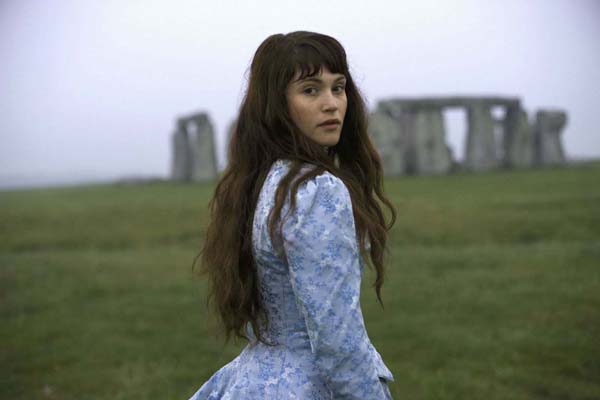
Gemma Arterton as the doomed Tess, 2008.

Gemma Arterton as the doomed Tess, 2008.

In Return of the Native, Hardy’s sixth novel, the beautiful Eustacia Vye, who longs for greater life than she can find on a remote heath, suffers the fate of a Greek tragic heroine. Her moves to escape her fate bring it upon her. Eustacia and her husband’s mother drown. In grief and despair, the husband becomes a preacher.

Catherine Zeta-Jones as Eustachian Vye in "Return of the Native," 1994

Catherine Zeta-Jones as Eustachian Vye in “Return of the Native,” 1994

With recurrent themes of the conflicting demands of culture versus nature for the individual, as well as liberal doses of illicit sexuality, Hardy’s 19th century works were popular with 20th century readers. Seeming to contrast with that is a tragic vision more purely classical than any other novelist I can think of.

And let’s face it, we Yanks love good British period dramas whenever we can get them, whether set in Camelot or on Egdon Heath. So you better believe I’ll be in line to see the new Far From the Madding Crowd when it’s released. It might even prompt me to take another foray into 19th century literature, something I thought I had long left behind. We never know where imagination will turn…

A “small” thing

I’ve read about this, but it never happened to me before.

Late yesterday afternoon I was driving home from the bay area. I’d been up at 6:30 to attend a second day of Dharma teachings. The weather was fine, traffic was moving, I was listening to a decent audio book, but a wave of fatigue overtook me, and all I could think of was stopping for a stretch and caffeine at a Starbucks up the road.

I pulled up behind a small truck and half a dozen cars at the Benicia Bridge tollbooth. The truck seemed to take forever getting through, as if there was an argument about the toll. With some mixture of fatigue and (hopefully) the wisdom I had absorbed from the teachings, I waited patiently, and finally reached the window. I handed a five dollar bill to the cashier.

“No need, sir,” she said. “The lady ahead of you paid your toll.”

As I said, previously, this was something I had only read about before. I was suddenly wide awake, wondering how I could pass the gift on. Carry $10 next time I came to that bridge and pay for the stranger behind me, yes, but what about day to day actions? I don’t cross toll bridges often, and as I felt the effect of that small gesture ripple through me, all I could think of was how to pass it on.

“Don’t bother trying to save the world,” one of the lamas had said. “What right choice is in front of you now?”

What a powerful question, and how worthwhile it is to keep it in mind!