An Era-less Era?

A critique group friend gives me back issues of The New York Times Book Review.  In the stack she gave me this week, I found a provocative article in the March 11, edition called “Convergences,” by Douglas Coupland.

Coupland noticed something unexpected during TV coverage of the 10th anniversary of 9/11:  nothing appeared very different than it had a decade ago.  The clothes, the cars, the hair, seemed pretty much the same.  This led him to speculate that:  “…we appear to have entered an aura-free universe in which all eras coexist at once – a state of possibly permanent atemporality given to us courtesy of the Internet.  No particular era now dominates.  We live in a post-era era without forms of it’s own powerful enough to brand the times.”

He then says, “The zeitgeist of 2012 is that we have a lot of zeit but not much geist.” (To Coupland’s credit, he does a mea culpa for this sentence).  He goes on to say there is something “psychically sparse” about the present, and writers and artists are creating new strategies to track it.  He then reviews Gods Without Men by Hari Kunzru, and calls it an example of “translit,” a new genre that fractures time and space while telling a single story.  In other words, it isn’t time-travel, or intercut parallel tales, like Pulp Fiction, but a singular narrative that unfolds all over the map.

Yet if Translit is a new genre, Once Upon A Time, a popular TV program, got there before Gods Without Men.   Though it doesn’t have as many sub-stories, structurally it’s the same.  Maybe part of our zeitgeist is a world where highbrow and lowbrow forms are equally likely sources of innovation.  (That sentence, containing the word, “zeitgeist,” was payback).

Once Upon A Time

Besides, who says this decade lacks “forms of its own powerful enough to brand the times?”

OK, when I was in grade school, my nightmares were not of winding up naked in public, but in my pajamas [this is true], so this particular fashion crime draws my attention.  But my reason for this post isn’t cultural artifacts – it’s something I’ve wondered about for a long time, that Coupland’s article brought to mind:  how and when the distinctive feel of a decade is formed?

Sometimes there’s a distinctive moment.  What we know as “the sixties” started the day John F. Kennedy was shot.  The last decade began on September 11.

Some decades don’t start with a single event; at a certain point, everyone simply knows the times have changed.  The eighties began when the good times started to roll.  In our current decade, something is rolling, but not good times.  We sense it, though it doesn’t yet have a name.  Read the paper or turn on the news, and you find a miasma of anger and greed, driven by fear and disillusionment.

This morning, with my coffee, I read details of how the New Orleans Saints bounties for injured opponents especially targeted head shots, even as overwhelming evidence points to concussive injuries as the source of higher than average rates of dementia in retired NFL players.  A little while ago I read of women arguing over a Facebook profile outside a waffle house.  Police arrived after shots were fired.  No external foe can destroy us, but we are doing pretty well on our own.

Lately politicians have been touting “American Exceptionalism.”  I first came across the term in Andrew Bacevich’s book, The Limits of Power:  The End of American Exceptionalism, 2008.  Both the politicians and Bacevich mean economic, political, and military superiority, things no country ever retains indefinitely, though they all believe they will when they have it.

President Obama got in trouble for speaking the truth when he said every nation thinks it’s exceptional.  Every nation has the potential to be, if you think in terms of character.  In those terms, our story might fall in the Translit genre – a narrative told across long reaches of time and place.  This decade would be a chapter set deep in the second act, when things are cascading downhill from bad to worse.  The darkness is pretty thick.  Who knows how the story is going to end?

Imagine by Jonah Lehrer: A Book Review

Update, July 31, 2012.

On July 30, author Jonah Lehrer admitted fabricating quotes in Imagine. He resigned his position as staff writer for The New Yorker, and Houghton Mifflin suspended sales of the book. You can read my full post on the topic here, which contains a link to the newspaper story. http://wp.me/pYql4-2hg

It is with much sadness that I’ve decided to remove the text of my review. Some of Lehrer’s observations on creativity remain insightful. At the same time, I think it is vital to stand up for ethics wherever we can find it in public life.

The Muppets Get Their Star

On March 20, the first day of spring, The Muppets received the 2466th star on Hollywood’s Walk of Fame.  The cast, which has charmed TV and movie viewers for 50 years, now joins a select group of “fictional” stars, which includes Mickey Mouse, Godzilla, Shrek, and The Simpsons.  Miss Piggy pointed out during the news conference, however, that all movie stars are fictional.

Photo by Frazer Harrison / Getty Images

Lisa Henson, CEO of Jim Henson Enterprises remarked that The Muppet’s star, in front of the El Capitan Theater, is very close to her father’s.  Henson created Muppet prototypes in 1955, for a show called Sam and Friends, which ran for six years on WRC-TV in Washington, DC.

Jim and Jane Henson with the cast of "Sam and Friends"

Henson died in 1990, at the age of 53, of complications from a severe strep throat infection.  Associates and family say he was so busy working, he didn’t seek medical help until it was too late.

During the last year of his life, Henson negotiated to sell the Muppets to Disney. The sale was finalized in 2004. The latest Muppet movie was released to DVD yesterday too, a seemingly successful effort to revitalize the cast and introduce Walter, a new character, who was present at the dedication ceremony.

Kermit received his own Walk of Fame star in 2002, but Henson’s little frog would be the first to say The Muppets are a group effort. The group finally has the recognition it deserves.

Doh! Now we (guys) are in for it!

NPR reports that in response to you know what, Democratic women legislators in six states have proposed new limits to male access to reproductive health care. http://www.npr.org/blogs/health/2012/03/15/148695307/in-protest-democrats-zero-in-on-mens-reproductive-health.   Consider:

House Bill 116 in Georgia states that:  “Thousands of children are deprived of birth in this state every year because of the lack of state regulation over vasectomies.”

An Oklahoma state senator proposed new legislation to regulate sexual acts:  “Any action in which a man ejaculates or otherwise deposits semen anywhere but in a woman’s vagina shall be interpreted and construed as an action against an unborn child.”

In Ohio, a female state senator sponsored a bill requiring men seeking drugs like viagra to:

  1. Have a cardiac stress test to ensure they are ready for sexual activity.
  2. Obtain written certification from a recent sexual partner that they are indeed experiencing erectile dysfunction.
  3. See a sexual therapist who would explain certain nonprescription lifestyle choices, such as celibacy, as alternate treatments for the problem.

***

It’s the very passion that people bring to these issues make them such effective smokescreens.  If “they” can get us asking the wrong questions…

We slide toward a third war in a decade with no hint of a national debate.  Recent news on Citigroup and Goldman Sachs reveal that the players who brought us the last financial meltdown are on track to do it again.  People know about Rush Limbaugh.  How many have heard of Greg Smith?

It used to be that “Nero fiddling while Rome burned” was the ultimate paradigm of irresponsible leadership.  Now it’s the 2012 presidential election.

And We Have A Winner!

That’s right, a winner in the: Caption the Condom Cartoon Contest  (announced here last week http://wp.me/pYql4-1MT).

There were at least a few positive outcomes after Rush Limbaugh’s slur of law student, Sandra Fluke, which inspired the contest.

1) One positive result:  I got to use some great alliteration in the contest name. 

2) Another bit of good news:  eleven sponsors bailed on Rush after his outburst.  Unfortunately, a Republican Super-Pac stepped in with bailout money.  Apparently some consider Limbaugh’s mouth too big to fail.

3) And best of all, at least for this blog, Camille w1ns a $10 Amazon gift card with her caption:

If only Rush’s parents had known how to use me properly… 

Please stop by Camilles blog and see what other clever things she is up to: http://poppycockandsomesuchnonsense.wordpress.com/

And thank you all for your entries and for stopping by to share a laugh!

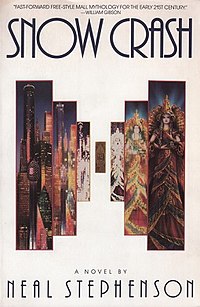
Snowcrash by Neal Stephenson – An Appreciation

Twenty years ago, Mary and I got our first real home computer (the Commodore 64 didn’t quite count).  With an Intel 486 processor, 500k of ram, an 8k external modem, and AOL memberships, we were wired!  Full-fleged members of the information age, at least by the standards of the day.

The same year, 1992, Neal Stephenson published a visionary novel called, Snowcrash. In retrospect, it merits the word, “prophetic,” for its sketch of life in the metaverse – a word Stephenson coined – and in the inconvenient world we call “reality.”

Consider:

In Snowcrash, Stepenson posits a world where nation states have transferred most of their power to corporations. Most people are corporate citizens and live in corporate enclaves, or less prestigious burbclaves.  The hero of Snowcrash, Hiro Protagonist, is a citizen of “Mr. Lee’s Greater Hong Kong.”  Military power belongs to private contractors, as do the roadways, which vie for driver/customers.  The post office is gone; private couriers deliver snail-mail.  The United States occupies a smallish territory centered in the Mohave Desert, and keeps it’s employees busy with make-work projects.  The former United States economy hinges on two industries – computer microcode and high speed pizza delivery, which has been revolutionized since the Mafia took control.

Though Hiro is a citizen of Hong Kong, as a pizza driver, he can’t afford to live in their enclaveclave.  Home is a self-storage unit under the flight path at LAX.  Like most of his hip and cyber-savvy generation, he spends most of his time online in the guise of his avatar, navigating virtual worlds.  But something is happening in the online world.  A strange new computer virus, when opened, generates a graphic pattern that scrambles the brains of the user.  They are dazed and speak in tongues.  With a young woman named YT, for Yours Truly, Hiro sets out to unravel the mystery.

The villain turns out to be a charismatic preacher.  In his attempt to secure both temporal and spiritual power, he has tapped into the ancient Sumerian glyphs that first scrambled human speech patterns in the event known as the Tower of Babel.

It’s been 20 years since I’ve read Snow Crash, so I’m writing this from memory.  I’m not necessarily recommending the whole novel.  The first jaw-dropping 100 pages, where Stephenson built his world, flew by and still leave me in awe.  I remember the rest of the book dragging in parts, but I still think of the story all the time.  Most futuristic fantasies prove as silly as the 1930’s movie shorts that show humans zipping along in their air cars between high rise buildings, happy and without any accidents.  This book is different.

In 1992 there were no virtual worlds.  Now there are, and you have to create an avatar to negotiate them.  These days, it isn’t so hard now to imagine a bright young man living in a self-storage shed.  But above all, Snow Crash comes to mind because in the wake of “citizens united,” it’s so easy to see corporate power growing while government power wanes.  With Super Pac money rolling the election year dice, does the government control corporations or do corporations control government?  Neal Stephenson saw this and other aspects of our world coming 20 years ago.

Snow Crash, is a visionary novel that all lovers of fantasy should know.

Quiz: Who Said These Words on the Senate Floor?

No prize for the answer to this one, but in today’s climate, it is an eye-opener to realize these words were spoken by an earlier generation’s, “severe conservative.”  Unlike today’s crop, this man was always respected for his integrity and the strength of his convictions:

“I’m frankly sick and tired of the political preachers across this country telling me as a citizen that if I want to be a moral person, I must believe in ‘A,’ ‘B,’ ‘C’, and ‘D.’ Just who do they think they are? And from where do they presume to claim the right to dictate their moral beliefs to me? And I am even more angry as a legislator who must endure the threats of every religious group who thinks it has some God-granted right to control my vote on every roll call in the Senate. I am warning them today: I will fight them every step of the way if they try to dictate their moral convictions to all Americans in the name of ‘conservatism.’” – Sen. Barry Goldwater, Sept. 16. 1981.

From Richard Brenneman’s blog, eats shoots ‘n leaves: http://richardbrenneman.wordpress.com/

My First Ever, Caption the Cartoon Contest!

My recent resolution to stay more positive on this blog is challenged almost every time I pick up a newspaper or turn on the evening news.  Believing that laughter is better than tears, and in keeping with this week’s headlines, I’m announcing a little contest:

Thanks to istockphoto.com for this royalty-free cartoon

I’m guessing that everyone who isn’t living with wolves knows why poor little Mr. Happy is sad. I will award a $10 Amazon gift card to the best caption for this cartoon, submitted as a comment to this post by midnight PST, Saturday, March 10.  Multiple entries are encouraged.

***

If you have been on vacation, or on a media fast, or if you live in a country that still has real political debate, you may not have heard of the controversy over rules that require health-care providers to cover contraception even if it violates the conscience of certain faith-based employers.  Throwing gasoline on the fire, conservative talk show host, Rush Limbaugh, called Sandra Fluke, a third-year law student, a “slut” and “a prostitute” after she testified in favor of insurance coverage of birth control. http://www.sacbee.com/2012/03/03/4307985/contraception-fight-intensifies.html

So now that you know the story, what are you waiting for? Get busy writing your captions!