Crazy Wisdom is No Bull!

Bull’s Head, 1942, by Pablo Picasso

“Crazy Wisdom” is an attribution given to certain “unconventional” holy men in eastern traditions, but it applies equally well to some of our western saints. Saint Francis preached to birds and wolves, while Aquinas, after a lifetime of scholarship, had a vision at the end of his life that caused him to declare that all of his writings “were so much straw.”

“Crazy Wisdom” is not some rarified, exalted state of mind, accessible only to the gifted few. Tenzin Wangyal Rinpoche, a Tibetan Bon Buddhist master with whom I have been privileged to study, says that when a person is able to cut through conditioning and begin to connect to their Source, their Inner Wisdom, one typical reaction is flexibility and freedom from our own “knee-jerk” reactions, as well as from cultural conventions that have lost their meaning or usefulness. No one said it better than Emily Dickinson:

Much Madness is divinest sense (620)

Much Madness is divinest Sense –
To a discerning Eye –
Much Sense – the starkest Madness –
‘Tis the Majority
In this, as all, prevail – 
Assent – and you are sane –
Demur – you’re straightway dangerous
And handled with a Chain –

I know of no simpler and better illustration of how this works than Picasso’s “Bull’s Head,” a found object sculpture he created in 1942. He was looking for “ready made” objects in a junkyard, and saw a bicycle seat lying near a pair of disconnected handlebars. In that instant, the Source of creativity within him saw a pattern no previous artist had.

Why Picasso but none of the bicyclists or sculptors before him? Tenzin Wangyal would say that he was present, fully aware, with a mind empty of other concerns. He wasn’t focused on what he was going to have for lunch or any of the other myriad concerns that occupy most of our waking hours.

Again, this vision of new connections is not reserved for famous artists, but is available to anyone who can find a way to clear their vision and mind and tune into the moment. Nothing, nothing, nothing may be more important at this time, when “the starkest Madness” rules our land.

To again quote Buckminster Fuller, in the previous post: “You never change things by fighting the existing reality. To change something, build a new model that makes the existing model obsolete.” 

An added benefit is that this kind of thing drives literalists nuts. Beancounters and most politicians can’t deal with this sort of ambiguity. “There’s something happening here, but you don’t know what it is, do you, Mr. Jones?” sang Bob Dylan 50+ years ago, and it may be even more true now.

So go out and have some fun and be subversive – find some connections you’ve never noticed before!

John Believer’s Prophecy

The Fool in the Tarot de Marseilles

When I was a college freshman in Oregon, a bearded fellow in a long black coat would sometimes harangue the crowds in the quad at lunch time. He’d bring a box to stand on and a Bible to wave. He called himself John Believer.

This was the late 60’s and though he tried for hell and brimstone, I think he’d done too much acid to pull it off. Out of his sometimes interesting theological mishmash, one of his ideas stuck with me and resonated with teachings I would hear later from two spiritual masters.

John Believer said the spiritual center of earth was right there in Oregon, (that’s why he’d moved north from Berkeley), but we should expect trouble. The spiritual center is always on the move, he explained, and it was about to head back to the orient. During it’s long Pacific crossing, humanity would experience an age of darkness.

In May, 1940, the Hindu master, Paramahansa Yogananda, gave one of several lectures predicting a coming time of travail for humanity.  The transcript of the May talk  is available as a pamphlet, World Crisis, published by Self-Realization Fellowship. Seventy-seven years ago, Yogananda said:

“A great crisis is going to come, a crisis such as never before has hit this country…There is a world revolution going on. It will change the financial system. In the karmic firmament of America, I see one beautiful sign; that no mater what the world goes through, she will be better off than most other countries. But America will experience widespread misery, suffering, and changes just the same. You are used to the better things of life, and when you are obliged to live simply, you won’t like it. It’s not easy to be poor after being rich. You have no idea how this change is going to affect you through the years. Never before in the history of this land has there been so deep a contrast in living standards as will visit this country – the contrast between riches and poverty.” (emphasis added)

Yogananda predicted that though the darkness would last several centuries and even threaten the future of life on the planet, it would likely pass and usher in a time of spiritual growth for humanity. Continue reading

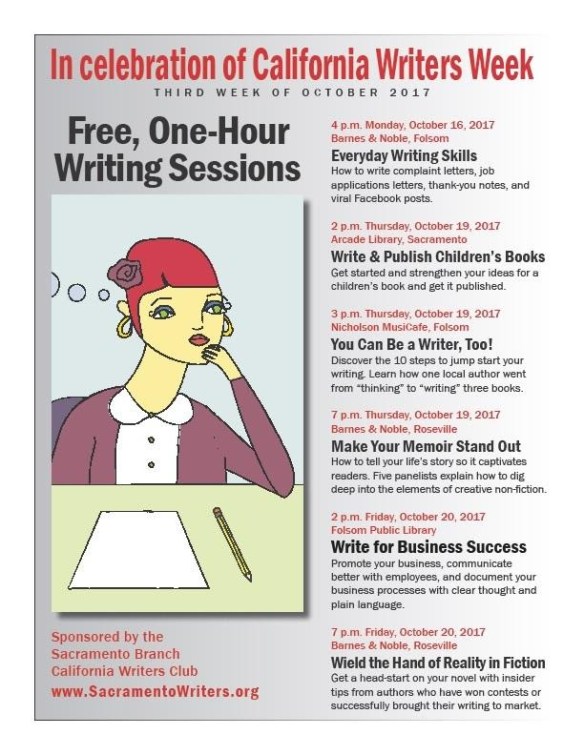
California Writer’s Week, Oct. 15-21 – Local Seminars

California Writer’s Week begins tomorrow. Created by Legislative Resolution Number 2170, it’s purpose is “teaching, encouraging and showcasing writing during…the third week in October.”

To honor this opportunity, the California Writer’s Club, Sacramento Branch, will host six writing seminars, led by members of the club, at different locations. All are encouraged to attend!

When real men speak

On Thursday morning, a Facebook post from India  announced the passing of Kyabje Gyalwa Trizin Rinpoche, 33d leader of the Tibetan Bon Buddhist tradition. I never met His Holiness, but the spiritual teachings of one of his senior students, Tenzin Wangyal Rinpoche, have been of supreme importance to me. For decades I’ve been a serious student of contemplative traditions, and have found no teachings of greater benefit.

The Dalai Lama with the 33d Menri Trizin, head of the Tibetan Bon Buddhist tradition

Later that Thursday, I saw a provocative post that quoted welterweight boxing champion, Floyd Mayweather, as saying that when Donald Trump spoke of grabbing pussy, “that’s the way real men speak.” 

The juxtaposition of these two posts – one about a man I greatly admire, and one from a man who claims to know about “real” men, highlights our collective confusion about almost everything.

What Joseph Campbell referred to as “the social function of myth” – the stories that teach us appropriate behavior, and our place in the larger culture, have completely broken down. Collectively, we agree on nothing, including, but not limited to, what a real man, a real woman, a real government, or a real president is like.

Few men and women in recorded history have had so much choice about their station in life, or greater anxiety about it.

Much of our our nation’s appeal, from colonial days on, was the hope that here you could reinvent yourself. From those who indentured themselves for passage across the ocean, to the westward expansion, to the “Do your own thing” rallying cry of my adolescence, this promise has been a sword that cuts both ways. Psychologists tell us that too many choices can be as stressful as too few.

In the late 80’s, Joseph Campbell suggested that the mandala of a future religion might be our world seen from space. In 1990, President George H. W. Bush revived a phrase used by Woodrow Willson and Winston Churchill, to speak of a “New World Order.” At the start of the tech boom and the end of the cold war, such dreams seemed feasible.

Now the world is contracted in fear. Nationalism, fundamentalist religion, and right wing conspiracy theories about “new world orders,” have replaced any near-term hopes of a greater good. With a reality TV star in the White House, the nature of “reality” itself has been twisted in ways unimaginable even a year ago.

The crumbling of outmoded concepts to make way for the is new isn’t always bad, but it’s usually painful. Going back is never an option. At this point, it’s good to remember that ideas of “real men” and “real women” are constructs with no essential connection to lived “reality.” If you want to know what a real man or real woman looks like, go look in a mirror. Only adolescents, or adults stuck in adolescence, have time to worry about such things.

The more important question is what do I want my life to be like? What attributes do I admire, and who embodies them?

I knew a ex-prizefighter at the gym. In his 60’s, he walked with a limp and was usually in pain from a lifetime of beatings he’d taken in the ring. “You have to be an idiot to make a living like I did,” he said. Though he was a nice guy, his was never a life I aspired to! Nor would I want to be a thin-skinned rageaholic, rising in the wee hours to fire off angry tweets.

On the other hand, after a lifetime of service to all living beings, when his time had come, Gyalwa Trizin, sat in meditation and left. Left his body, left this world. Over millennia, Tibetan masters have learned how to live and die in ways that lead to ideal or even enlightened rebirths.

I have been in the presence of a few such masters –  men and women, who live and act from the calm assurance that our difficulties are more like dreams than we know, and that there are paths that lead to life of service to beings, and when the time comes, a death that is free of fear. To my mind, this is something worth living for…

The Day of the Locust at Walmart

Nathanael West (1903-1940), author of “The Day of the Locust.”

USA Today reported that Friday, in a Detroit area Walmart, a woman with a concealed carry permit pulled a gun after two other women started pulling her 20 year old daughter’s hair in scuffle over the last available notebook in a back-to-school-sale.

The gun brought this to national attention, but after I got the snide comment about “well ordered militias” out of my system, I sat with the underlying question, far more mundane and depressing at the same time: why does violence over a notebook come as no surprise in our nation today?

I thought of Nathanael West , a little known author during his lifetime, who worked as a screenwriter on hack movies in Hollywood, and wrote four novels, filled with biting social satire. His friend, the poet, W.H. Auden coined the phrase, “West’s Disease,” for the angst that comes from realizing the spiritual and economic poverty of much of what passes for “the American Dream.” Continue reading

The Summer of Love, Repression, and Stuff.

USA. Washington DC. Seventeen year old Jan Rose Kasmir, confronts the National Guard outside the Pentagon during the 1967 anti-Vietnam march. This march helped to turn public opinion against the war in Vietnam.

Dissatisfaction with the status quo gave birth to our nation, and has been part of our heritage every since. Fifty years ago this summer, this undercurrent burst into the loud and colorful limelight as 100,000 people gathered in San Francisco’s Haight Ashbury with mottos like Timothy Leary’s, “Tune in, turn on, drop out.”

I was a high school kid in San Jose, wearing torn jeans and love beads, reading the literature of discontent by authors such as Thoreau, Sinclair Lewis, and Nathanial West. After Saturday excursions to the head shops on Haight Street, with their incense and posters of Lakshmi and Ganesh, I bought a copy Zen Mind, Beginner’s Mind, a book I still have, and one which, fifty years later, I more or less understand, because doing so became one of the core priorities of my life.

“We are all outlaws in the eyes of America,” sang Grace Slick, and in the explosion of new music, art, literature, and the ideas of change embodied in The Whole Earth Catalog, there was a sense of expansion, a sense that we could stop the war, and we could leave the world of ticky-tacky houses, and create a nation where Peace and Freedom would reign as supreme values.

We didn’t understand our own shadows. We didn’t knew that Charles Manson was roaming the Haight during the summer of ’67, winning friends and influencing people with techniques he had learned from Dale Carnegie’s book, which he studied in prison. We didn’t know that “Do your own thing” was a double-edged sword, and that we would see bitter fruits of that motto fifty summers later.

*****

When I turned 40 in 1990, I was halfway through a Masters program in Psychology, which I’d entered in part because in the wake of the Summer of Love, I’d discovered Jung, Joseph Campbell, and Tolkien, and I couldn’t get enough of that stuff. And also because, the ethos of “Sex, drugs, and rock ‘n roll” doesn’t really work very well.

Yet when in that course of study, we came to look at the psyche’s defense mechanisms, most of us thought repression was a bad thing, inhibiting self-expression and individuation. I gotta do my own thing, man!

“Don’t be so fast to put down repression” said the instructor. “It’s one of the glues that holds a culture together.”

I’ve thought of this statement many times since then, never more so than when I read a woman’s letter to the editor in the local paper sometime in the mid-nineties, reporting on an incident she’d seen at a local multiplex. For whatever reason, no one was behind the concession counter, so some of the patrons clambered over the counter, help themselves to popcorn and drinks and then dash into the theaters.

That’s not quite what we meant by “Do Your Own Thing,” but it’s a pretty telling, canary-in-the-coal-mine kind of snapshot of the kind of societal breakdown parading through our streets this summer.

One of the four major functions of a living myth, according to Joseph Campbell, is “the sociological function,” which teaches us the norms of living together. “Thou shalt not kill,” for instance. Other roles are more dicey – gender and class roles for instance. These get rigid as times change, and are then modified by pioneers or movements, or in extreme cases, by revolutions if leaders are really stupid and tell their starving masses to eat cake.

Perhaps with enough acts of popcorn theft, large and small, because we feel entitled and we want what we want and we want it now – perhaps the kind of president we have was inevitable. Sooner or later, just as inevitably, he’ll go.

What will we do then? Will we be sickened enough by current events to turn in another direction together? What does a culture do when it’s fragmented by so many contradictory stories that Campbell’s sociological function of myth has completely broken down? What will it take to restore a genuine sense of “us” in our national life, a sense that we’re all in this together? The most obvious and frightening answer is a shared disaster.

Ironic to realize that the youthful idealism that brought us the Summer of Love, and two years later, the high water mark at Woodstock, carried the seeds of its own demise, partly because of the self-righteous sense of “us and them” that still drives our national life. And yet, it is profoundly valuable to review those youthful ideals, that sense of a better world within reach. Without such dreams, we are left with little better to do than rail at each other on social media.

“It’s been a long time coming,” sang Crosby, Stills, and Nash. “It’s going to be a long time gone.” It will come around again, sooner or later, but the question is, how long a time will that be?


Beware the Trolls

NOT THAT KIND OF TROLL
John Bauer, 1912 illustration, public domain

Social media algorithms effectively isolate readers of one type of political news from opposing views; if you follow Fox News, you won’t see MSNBC pop up and vice versa. At the same time, you can usually judge the importance of the “breaking news” of the day by the number of profane, violent, vitriolic comments that follow. I have received, if not death threats, at least death wishes, for comments on Facebook I can’t even remember, and I know I’m not alone in this. Does such overheated rhetoric reflect the national mood? I’ve come to think that in many cases, it does not, though some interests would have us believe it does.

On July 11, in an opinion piece in the Washington Post, David Rothkopf, said, “Russia’s primary goal was not to get Trump elected. It was to weaken the United States(emphasis added).

That’s worth pondering at length. It crystalized my sense that a significant part of the national tension over our “house divided” is a creation of social media, and much of it may derive from the focused efforts of foreign trolls.

On the evening of July 11, the PBS Newshour aired a report by Nick Schifrin, with the help of the Pulitzer Center on Crisis Reporting, Inside Russia’sPropaganda Machine. Schifrin reports that for the past two years, the Russian military has run online recruiting adds, offering soldiers a chance to “put down their guns and fight a cyber-war.” 

Schifrin interviewed a former Russian troll, Marat Mindiyarov, outside of a large complex in St. Petersburg which Mindiyarov identified as the headquarters of this effort. He said he had “maybe 20, 30” online identities, but implied that some have hundreds.

At the end of May Newsweek reported that 900,000 blank twitter accounts had popped up as Trump followers that month. They were easy to spot – no photo, no byline, no tweet history. And no way for a casual viewer to determine their place of origin. I initially assumed they were created by Trump’s team. Now I have serious doubts.

Important stories on left leaning Facebook sites draw verbal conflict that is sometimes abusive enough to report. This morning I scrolled down the Fox News Facebook site, and noted similar trolling.

Again, I refer to Rothkopf’s piece, cited above. It’s very much worth considering that our external enemies no longer care if Trump stays or goes – as long as we as a nation stay angry and divided against each other, they have won…

Truth will out, murder will out – The Two Sisters

“Binnoire,” by John D. Batten, for “English Fairy Tales,” 1898

Our theme, over the next few posts, is folklore and ballads that feature the theme of, “truth will out,”  We begin with a popular Childe Ballad, “The Two Sisters,” that has been covered, under various names, by Bob Dylan, Jerry Garcia, Pentangle, Tom Waits, Loreena McKinnett, Clannad, Steeleye Span, Gillian Welch, and others.

“The Twa Sisters,” Childe ballad #10, was published as a broadside in Northumbria in 1656. A girl is drowned by her sister over love of the same man. Finding her body, a minstrel makes a harp of her breastbone and golden hair that will only play the tale of the murder. The theme is echoed in Swedish, Norwegian, and Icelandic ballads. There are 21 variants in the British isles, with names that include, “The Miller and the King’s Daughter,” “Binnoire,” “The Cruel Sister,” “The Wind and Rain,” “The Dreadful Wind and Rain,” and “The Bonny Swans.” (1)

Here’s my favorite version, from Jerry Garcia and Dave Grisman at the Warfield Theater in 1992:

From: The Twa Sisters,” Childe Ballads #10C

10C.22 He made a harp of her breast-bone,
Whose sounds would melt a heart of stone.
10C.23 The strings he framed of her yellow hair,
Whose notes made sad the listening ear.
10C.24 He brought it to her father’s hall,
And there was the court assembled all.
10C.25 He laid this harp upon a stone,
And straight it began to play alone.
10C.26 ‘O yonder sits my father, the king,
And yonder sits my mother, the queen.
10C.27 ‘And yonder stands my brother Hugh,
And by him my William, sweet and true.’
10C.28 But the last tune that the harp playd then,
Was ‘Woe to my sister, false Helen!

*****

In the east, we have the concept of karma. In the west we have a comforting theme in folklore, that behind even the most dire events and appearances, there’s a harmony, a natural order that tries to assert itself, the way our bodies, if conditions are right, will push out infection.

Now that our body politic is infected by an American president who would destroy the basic concept of Truth and Fact for his own ends, I find it refreshing to dwell on such tales. Weeds break through concrete. In the end, truth will break through lies and corruption.