A great story I neglected to post

I found this during a year-end cleaning of my “Drafts” folder – an unfinished post inspired by a newspaper article in July which details the life’s work of unsung folk artist, Arthur Harold Beal, garbage collector for the town of Cambria, CA.

Just down the road from the Hearst Castle, that world-famous monument to excess, lies Nitt Witt Ridge, the house on the hill that Beal lovingly crafted of driftwood, river stones, beer bottles, abalone shells, toilet seats, and other assorted junk.  Beal started work in the 30’s was still going in 1992, when he died at the age of 96.

Nitt Witt Ridge by megpi, CC BY-NC-SA-2.0

Nitt Witt Ridge by megpi, CC BY-NC-SA-2.0

Michael O’Malley, a plumber in town, bought the Ridge for $42,000 in 1999.  Unfortunately, the sale price did not include water rights, so he and his wife cannot live there, and because it is zoned residential, they can’t open the house for public tours.  Several times a week in the summer, O’Malley gives private tours, in return for donations, to people who contact him directly.  He is something of an expert on stories surrounding the Ridge’s creator.

Beal used to say he salvaged his wood from the ocean, but O’Malley points out the quality of the material, and suggests that Beal might have “salvaged” it from local construction sites late at night.  Beal seems to have been a curmudgeon.  Some people asked to visit the house while he was still living.  If he liked their looks, he’d let them in, if not, he would shake his fist and yell, “Move along, small change.”  O’Malley found a video of Beal on a 1981 TV episode of “Real People.”  At age 81, with a long beard and a walking staff, “he looked like a mix of John Muir and Dennis Hopper.”

Here’s a brief but informative clip of O’Malley giving a tour of the house:

Last summer, when I started this post, I added descriptions of other architectural oddities, like the Watt Towers and the Bottle House of Rhyolite, NV.  The story grew too long and languished until now.

The end of the year is a good time to contemplate things like Nitt Witt Ridge.  While others compile their lists of “The Best of 2013,” here is my contribution to a list of things wacky and weird.

Virtual dreams

A few nights ago I had a 21st century dream in which the key event was losing my cell phone.  In days of yore – say five or ten years ago – losing a wallet was the common dream image for a disruption to one’s persona.  Now my smart phone probably tells me more about my public life than a wallet.  It shows me where I am, where I’m going, when I need to be there, how to find my way, and it gives me multiple ways to connect with people I need to see when I arrive.  In a few years time, I’m sure we’ll all have digital ID’s and credit cards.

Though I still think of dreams in terms of archaic elements, clearly the psyche will use whatever it needs to make a point.  As technology is part of our lives now, it is also part of our dreams.  All of which leads me to the heart of this post:  we ain’t seen nothin’ yet! 

Last Wednesday, I caught an amazing segment on virtual reality on the PBS Newshour.  I didn’t expect to be interested.  Since I don’t play video games or World of Warcraft, VR seems like just one more distraction in an ADHD world.  It may well be, but the Newshour piece demonstrates the power of this technology, beyond anything I’d imagined.  I instantly thought of the “Feelies” – multi-sensory movies in Huxley’s Brave New World.  We aren’t there yet, but it would be foolish to rule out the possibility.  Watch the clip and see what you think.

The power of imagined experience has long been established.  In the early 20th century, Jung developed a technique he called “active imagination” and used it in therapy.  In the 50’s, research proved that imagined practice was as useful as “real” practice for improving basketball free throws.  In reference to meditation, Lama Thubten Yeshe, a prominent 20th century Tibetan teacher, said, “What we have to learn is that the experiences we have through imagination and those we have through our senses are actually the same.”

All of these applications involve self-generated imagery, but if and when VR comes into our living rooms, it will come through the same corporate interests that flood us with adds already.  Do we want them reaching even farther into the deep psyche?

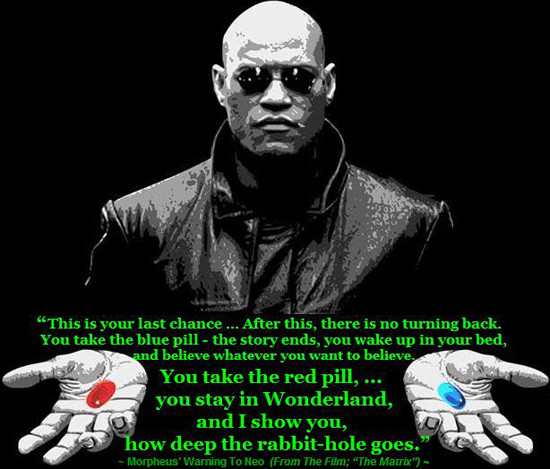
We’ll be clamoring for it!  If you have any doubt, check out Life, the Movie: How Entertainment Conquered Reality by Neal Gabler.  In terms of an obvious metaphor, The Matrix, once we have the ability turn our living rooms into personal holodecks, that blue pill of restless sleep will surge in popularity.

MorpheusWarning

To paint a huge subject in simple terms, over time, our race has transferred successive parts of our brain functions to technology.  Printed books marked the end of bards who could recite epic poems.  We don’t find the griots of Alex Haley’s Roots in literate cultures.  The imaginations of my parents’ generation got a better workout listening to The Lone Ranger on radio than mine did watching the masked man on TV.

I love technology, but I’m wary of it too, and not just the obvious stuff like the NSA.  I’m wary of all the ways we can use it to foster oblivion until, as T.S. Eliot put it, “Human voices wake us and we drown.”

Yule ~ The Beginner’s Guide To The Wheel Of The Year

Just in time for the solstice, here is another of Lily Wight’s wonderful “Wheel of the Year” posts, with beautiful illustrations and commentary on the Celtic and Nordic stories surrounding this ancient holiday. Enjoy her post and enjoy the return of light!

Lily Wight's avatarLily Wight

Updated 18/12/2014

     There are four Solar Quarter Days (two equinoxes and two solstices) on The Wheel of The Year calendar.  Yule or The Winter Solstice is celebrated during a twelve day period from December into January.

     Yule commemorates the demise and rebirth of the sun’s powers because The Wheel continues to turn and daylight hours begin to lengthen again beyond The Shortest Day.

     The name “Yule” is thought to derive from the Old Norse ” jólnar”  – a collective term for the gods or “Yule Ones”.   Jólfaðr (Yule Father – interchangeable with All-Father) is one of many names attributed to Odin.  In Old Norse poetry names and terms for Odin are frequently synonymous with celebration and feasting.  Odin The Gift-Giver is undoubtedly the origin of our Santa Claus.

     The Midwinter period between the last harvest (Samhain)…

View original post 390 more words

Queen Bothildur: an Icelandic Christmas folktale

I found this story in a beautifully illustrated book of Icelandic folktales for children, Tales of the Elves, that I brought back from that country after a visit in 2012.

Tales of the Elves 400

One Christmas Eve, a richly dressed woman knocked at the door of a farm house in Hrutafjord and asked for shelter. The sheriff lived there and said she could stay.  When people asked her name, she said it was Bothildur, but she would not say anything else about herself.

She stayed home while everyone else went to midnight mass, and when they returned, they had never seen the house so clean and beautifully arranged.  The sheriff invited her to stay on as housekeeper, and she excelled at her work.  The following Christmas Eve, she stayed home again, but this time, when the household returned, they found Bothildur’s eyes red from weeping.

On the third Christmas Eve, Gudmundur, the sheriff’s shepherd boy, vowed to discover her secret.  As everyone walked to church, he feigned illness and turned back.  Gudmundur possessed a magic stone that made him invisible.  Holding it in his hand, he slipped into the farmhouse, where he saw Bothildur dressed in the finest clothing he’d ever seen.  She took a green cloth from a chest and set off into the night, with Gudmundur following closely behind.  They came to a lake where Bothildur spread the cloth on the water and stepped onto it.  The shepherd boy just had time to step onto a corner before the cloth began to sink.

Bothildur

It seemed like they were passing through smoke as they sank deeper, but at last they came to a grassy plain in front of a fair city.  Bothildur entered the city where everyone cheered.  A man who wore a crown embraced her and then everyone entered the church for Christmas mass.  Bothildur’s three children ran around the pews playing with three golden rings, until the youngest dropped his and couldn’t find it because the invisible Gudmundur had slipped it into his pocket.

When the service was over and it was time for Bothildur to leave, everyone was sad.  She walked alone with her husband onto the plain before the city.  Both were in tears and Gudmundur heard them say this was the last time they would ever meet.  They parted with great sorrow as Bothildur stepped onto the green cloth with Gudmundur behind her.

Bothildur returned home and was cleaning when the sheriff and the rest of the household returned.  Gudmundur came home later.  When asked where he had been, he told the entire tale of his trip to the land below the waters.  When Bothildur asked if he had proof, Gudmundur withdrew her son’s golden ring.  At that she was joyous.  She explained that she’d been a queen in Elf Land until a witch cursed her.  She could only return home on Christmas eve, and only a human brave enough to follow her to the world below could break the spell.  “Now you have released me and you shall be richly rewarded,” she said.

After saying goodbye to the household, Bothildur vanished.  That night, Gudmundur dreamed she came to him and gave him coins and jewels which he found beside his pillow when he awoke.  Later, he used that money to buy a farm of his own and get married.  In time, he became known far and wide as the luckiest man alive.

***

In Iceland, winter solstice celebrations were huge events – understandably, for by mid-December, the southern part of the country gets only four hours of light each day, and the northern regions, above the arctic circle, get only three.  Icelanders embraced Christianity in 1000 AD, but to this day, Christmas is a dual holiday, celebrating both the birth of Christ and the return of the sun.

Charming as it is that the doorway to the Other World should open on Christmas Eve, it’s a safe guess that Christmas is peripheral to the tale.  Stories of release from enchantment are found in every culture and predate Christianity.  Sometimes love and compassion break the spell, as in “Beauty and the Beast.”  Sometimes it’s bravery and cleverness, and sometimes even violence – in the first version of “The Frog King” published by the Brothers Grimm, the frog is disenchanted not by a kiss, but when the princess becomes so annoyed with him that she hurls him against a wall.

Aside from its simple charm, what fascinates me about Queen Bothildur’s tale is that Gudmundur, the young disenchanter, brings his own magical implement for the task.  Where do shepherd boys pick up magical stones of invisibility?  Jung believed that stones are frequently symbols of the Self, his term for the fully integrated personality.

Babylonian stone seal, ca 1595-1155 BC.  Creative Commons

Babylonian stone seal, ca 1595-1155 BC. Creative Commons

 Normally, such psycho-spiritual integration is the task of a lifetime, but in stories, legend, and scripture, young heroes as diverse as King David, St. Patrick, and Krishna worked as shepherds or cow herders when they were young.  However simple this folktale may be, it reflects what can be done by a person with a noble cause who is not at war with himself.

Belief in the Huldufólk, or Hidden People, the Elves, is common to this day in Iceland; in a 2007 survey, 57% of the population said they “do not disbelieve” in Elves.  In 2004, Alcoa had to pay a government expert to survey their proposed site for an aluminum smelter to make sure it was Huldufólk free.  Last year, we travelled a highway that had been diverted around an Elven dwelling.  We saw many small houses built on remote hillsides as homes for the Hidden People, and some Icelanders build them churches, in hopes they will convert to Christianity.

That may be an iffy proposition.  “The Icelandic word for Christmas, Jól, contains no reference to Christ or to the church. It is a Norse word that also existed in Old English as Yule.” (1)

Even so, as we read and tell their stories, I suspect the Elves are wishing us a Gleðileg jól go farsælt komandi ár – a Merry Christmas and a Happy New Year.

.

Chicken Wrangling.

Here’s an inspirational post in which Doug goes windmill tilting instead of tending the chickens. If this doesn’t get you singing a rousing chorus of “Man of La Mancha,” nothing will!

johnkurth.com's avatarDoug Does Life

Thou hast seen nothing yet. ― Miguel de Cervantes Saavedra, Don Quixote

Another Saturday out and about. Saturdays are our busy days and our fun days. As I mentioned before, we keep some hens on our property. They don’t take much work and they provide lots of good yard eggs…

Doug stayed home today, so I asked him to take care of the chickens. By take care of, I meant feed them and give them some water…

I knew something was wrong when I saw the gate to the chicken coop standing open.

I found Doug heading across the yard on his chicken mount.

He wouldn’t tell me what he was doing but I think the chicken said something about windmills… It’s hard to understand chickens though.

I’m left to clean up after Doug once again.

At least the damage was confined to our yard this time, and didn’t…

View original post 40 more words

Neil Gaiman on libraries, reading, and daydreaming

Neil Gaiman, 2007, CC-BY-SA 2.0

Neil Gaiman, 2007, CC-BY-SA 2.0

Neil Gaiman visited China in 2007 for the first ever, party-approved, Science Fiction and Fantasy Convention.  He asked a top official what had changed; in the past, these genres had been disparaged.  The official said his government had realized they were good at making other people’s inventions, but they didn’t invent or imagine new things themselves.

“So they sent a delegation to the US, to Apple, to Microsoft, to Google,” Gaiman explained, “and they asked the people there who were inventing the future about themselves. And they found that all of them had read science fiction when they were boys or girls.”

Gaiman told this story while giving the 2013 Reading Agency annual lecture on the future of reading and libraries.  The Reading Agency is a British charity that supports libraries and literacy programs, with the mission of giving everyone “an equal chance in life by helping people become confident and enthusiastic readers.”  Another story Gaiman told underscores the importance of the Agency’s efforts.  In New York, he once attended a talk on private prisons – one of America’s growth industries.  In trying to predict the need for future facilities, prison industry officials have developed a simple algorithm based on one key factor – the percentage of 10 and 11 year olds who can’t read.

Gaiman spoke at length of fostering not just the ability to read, but the love of reading.  There are no bad authors or bad books for children, he said.  Adults can destroy a child’s love for reading by giving them “worthy-but-dull books…the 21st-century equivalents of Victorian “improving” literature. You’ll wind up with a generation convinced that reading is uncool and worse, unpleasant.”  Everyone is different and will find their way to the stories they like and need.

Because written fiction, as opposed to television or movies, requires our imagination to turn the authors words into a vivid world, we return to our own world as a slightly different person, with an awareness of other points of view.  Reading fosters empathy, Gaiman said, and:

“Empathy is a tool for building people into groups, for allowing us to function as more than self-obsessed individuals…You’re also finding out something as you read vitally important for making your way in the world. And it’s this: the world doesn’t have to be like this. Things can be different.”

In his inspiring lecture, Gaiman talked at length of his love for libraries and how critical it was for his own development to have supportive librarians at the small library near his home while growing up – librarians who simply wanted books to be read and showed him how to use inter-library loan when he finished all the local books on vampires, ghosts, and witches.  When government officials close libraries as cost saving measures, “they are stealing from the future to pay for today.”

Gaiman expressed what he believes to be our responsibilities to children and to our future.  Reminding the audience that everything made by humans begins with imagination, we have a responsibility to use and foster our imagination of a better world than the one we found.

Gaiman ended with a quote from Albert Einstein.  When asked how to foster intelligence in children, the great scientist said, “If you want your children to be intelligent, read them fairy tales. If you want them to be more intelligent, read them more fairy tales.”

The 2013 Ig Nobel Prizes

2013 Ig Nobel

Though I reported on last year’s Ig Nobel Prize ceremony, I missed the 2013 edition of this annual Harvard laugh fest, which was held in September.  I only heard the details yesterday, on NPR’s “Science Friday.”  Much better late than never for this look at the work of international scientists whose “research makes people laugh and then think,” according to Marc Abrahams, editor and co-founder of “The Annals of Improbable Research.”

The ten 2013 winners Ig Nobel winners, who received their prizes from (real) Nobel Laureates, include:

The Prize in Psychology, which went to a multinational team that confirmed empirically that “people who think they are drunk also think they are attractive.”  Their article, “Beauty is in the Eye of the Beer Holder,” was published in the May 15, 2012 issue of The British Journal of Psychology.

A Joint Prize in Astronomy and Biology, awarded to Marie Dacke, Emily Baird, Marcus Byrne, Eric Warrant, and Clarke Scholtz, proves that dung beetles use the Milky Way for navigation; they can push their balls in a straight line when the night sky is clear, but not when it is overcast.

A Probability Prize was given for two related findings: “First, that the longer a cow has been lying down, the more likely that cow will soon stand up; and Second, that once a cow stands up, you cannot easily predict how soon that cow will lie down again.”  Bert Tolkamp of the Netherlands accepted the award and expressed his team’s gratitude for the honor, noting that they need the laughs, since researching cows can be “really boring.”

The Prize in Medicine went to a joint team from China and Japan for proving that post-heart transplant mice survive longer when listening to the Verdi opera, La Traviata, than to the music of Enya. (1)  These findings were chronicled in The Journal of Cardiothoracic Surgery.

The Operatic Heart Transplant team

The Operatic Heart Transplant team

This year’s prize ceremony, like those in the past, sold out early. As South African entomologist, Marcus Byrne, who took part in the dung beetle study, said, “It shows how much people appreciate good science. It doesn’t have to make money. It doesn’t have to save lives. It’s just part of the human condition to be curious.” 

And, I would add, to enjoy a good laugh!

James Hillman on world change and political polarization

James Hillman, 1926-2011

James Hillman, 1926-2011

For decades, James Hillman brought us unique observations on modern life from the perspective of a depth psychology that embraced soul as its highest value.  Recently, I’ve wished I could hear his take on our current climate of political divisiveness, but Hillman, who died two years ago at the age of 85, wasn’t here to watch our most recent shenanigans.  Happily, I recently stumbled upon a pair of interviews in which Hillman discussed this very subject and set it in a context of massive cultural change.

Author and journalist Pythia Peay published the first interview on The Huffington Post in February, 2011 (Jungian Analyst Explains the Psychology of Political Polarization).  The occasion for their talk was the mass shooting in Tucson, which had happened a month earlier.  The most prominent victim was Representative Gabrielle Giffords.

Tragically, memory of that event, just two and a half years ago, has been lost in the wake of more recent carnage, including the Nevada school shooting earlier this week.  Though Hillman’s comments focused on the role of political divisiveness in the attempt to kill a congresswoman, his additional statements now seem eerily relevant to the 12 year old in Sparks who was so alienated that he ended his life with murder and suicide.

Hillman began with a general discussion of polarized thinking.  “Polarity,” he reminds us, is an electrical engineering term.  Batteries have poles; the psyche is far more nuanced than that, dwelling in shades of gray rather than black or white.  Ideological extremes subvert our ability to judge individual issues on their merit.

When asked if violently polarized politics caused the shootings, Hillman changed the focus to another kind of cultural rigidity and its effect on the Tucson shooter:

“I think that this kid was made a loner by an American educational system in which there is no room for the weird or the odd…We need to have an educational system that’s able to embrace all sorts of minds, and where a student doesn’t have to fit into a certain mold of learning. Our educational system has become so narrowed to a certain formula, that if you go through a weird phase, you’re dropped out — often at the age of schizophrenia, 19-23 — and that’s the danger.”

Arguments in the wake of gun violence bog down in specifics, like background checks and how many bullets a magazine should hold – we don’t ask why and how we’re producing more and more people prone to mass violence.  In the end, says Hillman, for a culture that pays so much lip service to “the individual,” we are terrified of real individuality, and attempt to stamp it out.

In the second interview, America and the Shift in Ages, Hillman suggests that much of that rigidity has to do with futile attempts to shore up outmoded systems and institutions during a period of massive change.  Not just one but “three or four” myths that are central to our culture are collapsing.

Everything we fear has already happened said Hillman:  “The fragility of capitalism, which we don’t want to admit; the loss of the empire of the United States; and American exceptionalism. In fact, American exceptionalism is that we are exceptionally backward in about fifteen different categories, from education to infrastructure. But we’re in a stage of denial.”  Other beliefs and structures are crumbling as well, he said.  White supremacy, male supremacy, the influence of monotheistic religions, and the belief that we are “the good people.”

If such institutions do not appear to be in decay, it’s because they are so staunchly defended, and that, Hillman says, is a sign of their lack of vitality — “If they were vital they wouldn’t need to be defended. And the fanaticism we’re witnessing goes along with the deterioration of the vitality of these myths.”

Many of our fundamental beliefs are under scrutiny and need to be.  Hillman mentions the meaning of “freedom.”  For many, freedom means, “I can do any goddamn thing I want on my property; that I am my own boss and don’t want government interference; that I don’t want anybody telling me what I can and can’t do.”  This, he says, is the freedom of an adolescent boy.  What of the different kinds of freedom, such as “freedom from the compulsions to have and to own and to be someone?”  What of the freedom Nelson Mandela found in prison?

Hillman cites economic assumptions that need to be questioned as well.  Falling demand needs to be stimulated, according to current assumptions, but from an ecological point of view, that’s exactly what the world needs at this time.  Sustainability models, which may be our hope for the future, terrify those in positions of power.

Many of our current fears, says Hillman – from fear of immigrants crossing our borders, to fear of failing education, to fear of cancer, to economic insecurity, terrorists, and of course fear of “the other” political party, results from the lack of a wider framework in which to understand the massive shifts that are already underway.

There is no going back, but as obsolete structures crumble, we can glimpse, if we look, new forms emerging.  Hillman gave the example of a “Bioneers” conference he attended where Paul Hawken showed a film that was simply the names of individuals and organizations involved in trying to innovate ways of building communities, economic systems, and ways of dealing with the natural world.  Hawken said there were thousands of names, and the film could roll for weeks.

Hillman said it’s important not to try to fit emerging structures into the patterns of the past.  For our peace of mind, a new kind of faith is required:   “I think it’s a matter of being free-wheeling, and trusting that the emerging cosmos will come out on its own, and shape itself as it comes. That means living in a certain open space — and that’s freedom.”

Dawn over Oostende, Belgium, 2007.  Photo by Hans Hillewaert, CC-BY-SA-3.0

Dawn over Oostende, Belgium, 2007. Photo by Hans Hillewaert, CC-BY-SA-3.0

Such words are a fitting conclusion to the lifework of a man who lived in defense of Anima Mundi, the World Soul and who taught that animals, trees, and rivers are intelligent and alive, and that at some deep level of the psyche, we can hear their voices.  In Hillman’s life work, observation of the modern psyche led to conclusions that mesh with the myths of the ancestors.

A thousand years from now, people will read of our times and shudder, as we do in contemplating the rigors of life in the middle ages.  A few visionaries stood out from the rest, those like Saint Francis, Dante, and Leonardo, who pointed toward a more benevolent and expansive future.

We cannot write our own history, but we can wonder how it will look to those in the future.  I am convinced that James Hillman will be remembered when most of what passes for news on TV is blessedly forgotten.