What is your quest?

Monty Python fans will recognize my title as a reference to Monty Python and the Holy Grail, a hilarious movie which is available on Netflix. Hero tales sometimes include riddles that must be solved or questions that must be answered in order to proceed. In Monty Python’s take on the Arthurian legend, the questions are: “What is your name? What is your quest? What is the airspeed velocity of an unladen swallow?”

On a more serious note…

The idea I want to discuss is that each soul comes into this world with with a purpose which is forgotten at birth and must be remembered for that life to be successful. This is an ancient notion that has appeared in written and oral form for millennia. We find the theme, with variations, in such places as “The Myth of Er” in Plato’s Republic, in The Silver Chair, one of C.S. Lewis’s Narnia Tales, and in James Hillman’s The Soul’s Code, the only one of his many books that became a bestseller.

The idea of such personal destinies came to mind recently as I watched a video by Michael Meade, a storyteller, mythologist, and former colleague of Hillman. He retold an African tale about souls in the Otherworld watching events on earth. When they are drawn to a particular place, situation, or family, they travel with a personal spirit guide to the place of birth. The guide is born with them, as an inner guardian, who will help that soul remember why it chose to be born, as it always forgets when it enters a womb.

In The Soul’s Code, Hillman proposes an “acorn theory” of human development, which he explains is more like a myth than a psychological axiom. As an acorn contains the pattern for the oak tree it will become if circumstances permit, so a child comes into this world with a destiny or “sense of fate.”

It’s important to note that in the first chapter of The Soul’s Code, Hillman explicitly says the book is not addressing questions of “the meaning of life…or a philosophy of religious faith…But it does speak to the feelings that there is a reason my unique person is here and that there are things I must attend to beyond the daily round.”

In an interview first published in 1998 and republished after his death in 2011, Hillman said of his acorn theory, “The same myth can be found in the kabbalah. The Mormons have it. The West Africans have it. The Hindus and the Buddhists have it in different ways — they tie it more to reincarnation and karma, but you still come into the world with a particular destiny. Native Americans have it very strongly. So all these cultures all over the world have this basic understanding of human existence. Only American psychology doesn’t have it.”

Hillman gives several examples of the difference between his “acorn theory” and the psychological theory of “compensation.” He mentions Manolete (1917-1947), a famous Spanish bullfighter who, as a child, was frail, shy, and “clung so tightly to his mothers apron strings” that even his sisters teased him. Traditional psychological theory would posit that he chose a macho profession to compensate for being a mama’s boy. Hillman turns that argument around. What if a dim awareness of his destiny was present during Manolete’s childhood (his acorn years)? No little boy could handle the intimation of facing charging, thousand pound bulls, so of course he stayed close to his mother!

Hillman never pretends to have a complete set of answers, especially to troubling questions like the origin of “bad seeds,” like Hitler, Manson, or serial killers. Hillman is also cautious of any formulation that would single out kids who are “troublemakers,” noting that Truman Capote was viewed as an “impossible child.”

Meade and Hillman are both concerned with how “ordinary” people find their inner calling, those of us who don’t begin to play the piano or chess at the age of four. Hillman said the “first step is to realize that each of us has such a thing [as a calling]. He then suggests we review our lives, looking especially at “coincidences” or “some of the accidents and curiosities and oddities and troubles and sicknesses and begin to see more in those things than we saw before. It raises questions, so that when peculiar little accidents happen, you ask whether there is something else at work in your life.”

One lifelong thread for me began in childhood, though I would only begin to understand its import years later.

I spent my first nine years in a semi-rural area, with trees to climb, woods to explore, and apples to snitch from the orchard of a farmer who lived over the hill. When my family moved to a quarter acre lot in a suburban California, it often felt claustrophobic. One late afternoon, after everyone had gone home, some impulse led me back to the schoolyard. I lay on my back in the grass of a baseball field and gazed into the clear sky. I don’t know how long I was there, but I didn’t want to get up. When I did, I experienced a refreshing sense of spaciousness and peace.

Several times over the years, at critical moments, I found that same peace and renewal in gazing into the sky, but it was only during the last decade that I learned from a Tibetan lama that sky gazing is a classic meditation practice, often used to teach students “the nature of mind” (clear, like the sky, and unaffected by passing “mental events,” just as the sky is not affected by clouds, rain, or smoke). Such practices became central during the second half of my life.

For both Hillman and Meade, the royal road to understanding and finding our deeper purpose is imagination, and with it, the willingness to listen to the “small” thoughts or impulses we often ignore. Like Joseph Campbell and the first generation Jungians before them, they both look to traditional stories, legends, and myths as means to unlock clues that are hidden within.

Finding our authentic selves, for our own good and the good of a world in transition is a key theme on Michael Meade’s website, Mosaic Voices, where he regularly presents writings, online workshops and podcasts that discuss this and related topics. (He’s presenting a free talk tomorrow, July 13, with a video available afterward – I have no personal stake in this, other than interest).

The consequences of ignoring inner promptings to discover our own authenticity can be devastating. In 1998 Hillman said:

“I think our entire civilization exemplifies that danger. People are itchy and lost and bored and quick to jump at any fix…They have been deprived of the sense that there is something else in life, some purpose that has come with them into the world.”

If this observation, made 25 years ago was relevant then, how much more it is now!!

A Contemplation of Heroes, Toilet Paper, John Wayne, and John Ford.

Paramahansa Yogananda told a story of two families, one Hindu and one Muslim, who were neighbors during the violence that preceded Indian independence in the late 1940’s. Food was scarce due to rioting, but the mother of the Hindu family got hold of a bag of rice. When she realized her neighbors had nothing to eat, she took half the rice to the Muslim family before lighting her own stove. When we were young, many of us aspired to that kind of heroism. Now we hoard toilet paper.

In all fairness, this is a manufactured crisis, driven by our online yellow press with so many pictures of empty paper good shelves that anyone paying attention might conclude that they better get some extra. But the TP story brings up one of our culture’s major living room elephants – our worship of individualism. Me first. I gotta be me. Do your own thing.

When I studied counseling psychology, we had a unit on “cross-cultural differences,” to learn not to project our biases onto people from other cultures or sub-cultures where identity rests as much on family and community membership as it does on our northern European focus on individuation. Without such training, we would have been ready to put labels like “enmeshed” and “codependent” on anyone who didn’t regard “self-development” as the pinnacle of psychological development.

Fun Fact: The Diagnostic and Statistical Manual of Mental Disorders, the DSM, the bible of mental health or its lack in our culture grew out of a study commissioned by the Marine Corps after WWI. They sought a personality test to filter out those who were most at risk of shell shock. In other words, our mental health norms in this country  are based on the attributes of a good combat soldier. Think about that for a while… Continue reading

1917: A Movie Review


Today I finally saw 1917. All the accolades for director Sam Mendes’ film about World War I, are deserved. Those who follow this blog know that the history of this tragedy continues to haunt and fascinate me.

A year ago, I posted a review of They Shall Not Grow Old, Peter Jackson’s documentary of the conflict, based on digitally enhanced film taken during the war, and recorded interviews with veterans. Jackson’s film is brilliant, but no movie I’ve ever seen gives as visceral a feel for life in the trenches as 1917. The mud, the rats, the bodies, the stench of dead horses in no man’s land and the constant shelling are vividly depicted. As Mary observed, it’s clear where Tolkien found the imagery for Mordor! Mendez includes key historical details, such as the chalky soil of Flanders and the sophistication of the German trenches, built with with reinforced concrete.

Although Mendez states that the story and central characters are friction, he grew up listening to stories told by his grandfather, Alfred, who carried a critical message across no-man’s land, under sniper fire, during the battle of Passchendaele in late 1917.

As many reviewers have noted, one detail of the cinematography is stunning – the entire movie is filmed with just one cut. The result is the feeling of being right with Blake and Schofield as they struggle to cross a deadly wasteland in their race against the clock, with a message that must be delivered by morning to save the lives of 1,600 of their comrades.

This is an unforgettable movie that I highly recommend!

The Hour of the Wolf

On Tuesday night, while I was watching the episode of Ken Burns’ Country Music that featured Hank Williams, my friend Randolph sent a text message about people who are up at 3 am – “writers, painters, poets, over thinkers, silent seekers and creative people.” He wondered if I was among them.

The answer is not very often, at least since the end of my misspent youth, but we can all feel that dark, haunted hour viscerally in the music of Hank Williams. I’m So Lonesome I Could Cry, for instance, has the feel of a shabby little room, lit by a bare lightbulb, at 3:00 am, reeking of stale cigarette smoke, when the whisky is gone and the liquor stores won’t reopen for a few more hours:

“I’ve never seen a night so long
When time goes crawling by
The moon just went behind the clouds
To hide its face and cry.”

Those times when I’m up and sleepless at 3:00 am I have always called “the hour of the wolf.” Google on the phrase and you mostly get reviews and analysis of Ingmar Bergman’s film of that name – not one of the best from his surrealist phase, IMO, but the trailer offers a good definition of Hour of the Wolf: “The hours between night and dawn. The hour when most people die, when sleep is deepest, when nightmares are most real. It is the hour when the sleepless are haunted by their deepest fears, when ghost and demons are most powerful, the hour of the wolf is also the hour when most children are born.”

In searching on the phrase, I discovered an earlier Hour of the Wolf post on this site, uploaded in July, 2012. In it, I quoted another good definition from the 1996 “Hour of the Wolf” episode of Babylon 5:

“Have you ever heard of the hour of the wolf? … It’s the time between 3:00 and 4:00 in the morning. You can’t sleep, and all you can see is the troubles and the problems and the ways that your life should’ve gone but didn’t. All you can hear is the sound of your own heart.”  – Michael J. Straczynski, writer, Babylonian Productions.

Any time I think of the Hour of the Wolf or 3:00 am, I think of Michael Ventura, a brilliant journalist, versed in Jungian and post-Jungian psychology, who co-wrote, with James Hillman, We’ve Had 100 Years of Psychotherapy and the World is Getting Worse.

I was fortunate enough to encounter Ventura over the course of a weekend when he was a visiting lecturer when I was studying psychology. My thoroughly worn copy of his book, Shadow Dancing in the USA contains a number of early essays from the series, “Letters at 3am” that he wrote over several decades, first for the LA Weekly, which he cofounded, and later for the Austin Chronicle.

Ventura is nothing short of a visionary. In 1986, when he published Shadow Dancing, a time that many recall as one of the “good old days” eras of this country, Ventura saw something darker, more tumultuous in the shadows. The title of the introduction to Shadow Dancing, It’s 3 a.m. Twenty-Four Hours a Day, refers to the malaise that everyone has come to feel clearly in the 33 years since the book was published:

“…what you are doing – standing in the dark, full of conflicting emotions – isn’t that what the whole world is doing now?

…the world’s clock is at about 3 a.m. of the new day, the new civilization. For the new day doesn’t start at midnight. The new day starts in darkness. Right now it’s 3 a.m. in whatever we will call that period of human history that comes after A.D.

When your clock reads 3 a.m. it’s a time of separateness, of loneliness, of restlessness. Nothing on television, nothing in the newspaper, nothing much anywhere that suggests that our restlessness, felt so privately, is part of something huge, something alive all over the world…”

I find that to be a very powerful thought – at 3 a.m., the Hour of the Wolf, it isn’t really that personal anymore…

Movie Review: This Beautiful Fantastic

This 2016 movie, available on Amazon Prime, is described as a “modern fairytale,” and is one of the most enjoyable movies I’ve recently watched.

Bella Brown, the quirky heroine, had an appropriately mythical birth – discovered in a cardboard box by the side of a waterway in London, having been raised by ducks, she grows up to be a recluse, frightened of the outdoors and other people. She dreams of writing children’s books, and works as librarian, where her OCD personality makes her a living, breathing card catalog.

When her landlord threatens to evict her for letting the garden go to ruin, she meets a group of equally quirky characters: her next door neighbor, a cranky widower who happens to be a master gardener; his cook, who continuously feuds with him; and a bumbling inventor, who has created a solar powered, mechanical flying bird.

Like The Secret Garden, this movie uses work with the “organized chaos” of a garden as a metaphor for delving into what’s true about one’s own nature. Never mind the generally mediocre reviews this movie received when it was released – watch the trailer and decide for yourself!

They Shall Not Grow Old – a movie review

These men were filmed as they sheltered in a road cut , waiting for the order to advance at the Somme. According to Peter Jackson, most of them died in the next 30 minutes.

Since its release last November, I’ve wanted to see Peter Jackson’s First World War documentary, They Shall Not Grow Old. On Monday I got my chance.

As the film opens, Jackson explains that in 2014, he was invited by the London Imperial War Museum to create a documentary using their 100 hours of archival footage from the Western Front. The only conditions were that he use their film in “unique” ways, and that the project be finished in time for the centennial of the armistice in November, 2018.

After the credits run, Jackson details the incredible effort and technology that transformed the jerky, black and white footage from film making’s infancy, into a movie that offers an intimate glimpse into the lives of the men who fought, suffered, and died because it seemed their patriotic duty, only to come home to signs reading, “No ex-military need apply” when they went to look for civilian jobs. Continue reading

The Crazy Wisdom of Mr. Rogers

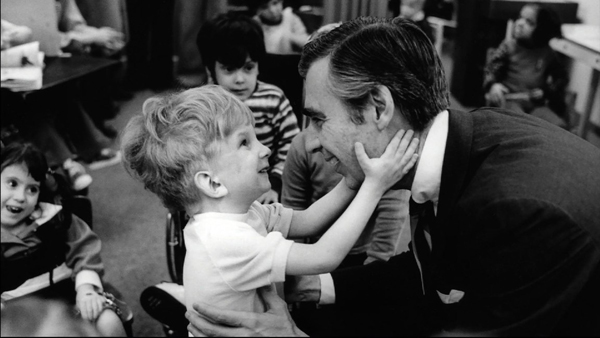
Fred Rogers and fan in “Won’t You Be My Neighbor?”

In “Won’t You Be My Neighbor,” this summer’s biographical film about Fred Rogers, he says “Love – or its absence, is all that really matters.” The sincerity and quiet strength of the man, an ordained minister who chose to express this philosophy through the medium of children’s television, is one of the reasons the movie won a 99% rating on Rotten Tomatoes.

As I watched Rogers’ interaction with children, the only comparison I could think of was clips I’ve seen of the Dalai Lama with young people. Both men – bodhisattvas by any reckoning – never lost their connection to the wonders and terrors of childhood.

I also thought of Saint Francis during the scene of Fred Rogers with Koko the Gorilla, who watched him on TV and was a fan.

At the end of the movie, we see a world that is changing for the worse. In a clip from a Fox News broadcast, commentators condemn Rogers for teaching children that they are all precious and lovable just the way they are. Let that sink in for a moment!

After his death, protestors gathered across from his memorial service to condemned him, not because they thought he was gay (he wasn’t), but because he accepted gays. One child in the crowd who looked miserable – in contrast to the children on Mr. Rogers’ show – held a sign reading, “God Hates America.” If Rogers had been there, he might have reminded the child and his parents that Jesus’ response to everyone he met was, “Neither do I condemn you.”

“Mr. Rogers’ Neighborhood” first aired 50 years ago this summer. Watching this movie, I thought of the voice-over during the opening scene of Gandhi: “People of the future will find it hard to believe that such a man existed.”

Fifty years ago, America felt like felt like a nation torn apart: an escalating war in Vietnam; the assassination of Martin Luther King and the riots that followed; the assassination of Robert Kennedy and the police riot at the Democratic convention, were punctuation marks in a year of one bad headline after another. Frightening times, yes, but no one living then would have ever imagined a summer in which we’d see children caged in concentration camps as a fascist administration, emulating the tactics of 20th century dictators, tries to stir up anger and fear at a people convenient to scapegoat. Fred Rogers would have been heartbroken!

What would he have done?

The movie showed Rogers’ testimony before a congressional committee that seemed determined to gut funding for PBS. With quiet sincerity, in a brief speech, he convinced them to do otherwise. He would have certainly found a way to speak before congress.

Beyond that, it’s impossible to say, but it seems that those who behave as heroes in the face of naked evil – people like Gandhi, Martin Luther King, the Dalai Lama, and others, find ways to avoid growing numb in the face of repeated outrage, while keeping the anger alive, but under control, so it can be harnessed as energy.

One thing Mr. Rogers would have certainly told us is this: in the 2014 midterm elections, only seven states saw a voter turnout higher than 50% (source: The United States Elections Project). He would have made certain that every child in the audience understood how important it is that this November be different.

Now that Rogers is gone, it’s up to us to figure it out for ourselves!

Mystic Mountain

Tsering Dhondup, born in Lhasa, Tibet, was 10 when he and his father walked over Himalayan passes to exile in India. Recalling the experience, he says, “In order to take my mind off the dangers that lurked beneath each step of the formidable Himalayan passes, my father told me a story so terrifying and riveting that it haunts me to this day!  Mystic Mountain is the story, it is also the rope that held me to life and helped me cross the Himalayas as a child.”

Dhondup now lives in San Jose, CA, where he translates Tibetan Buddhist teachings into English. He wrote and directed Mystic Mountain, a film version of the story his father told him, both because it’s a compelling psychological thriller, and “to help preserve the Tibetan language and enrich Tibetan oral storytelling.” Mystic Mountain was filmed in Nepal, close to the Tibetan border, where the often brooding landscape itself is a powerful presence.

After Kunga, the chief of a remote village is killed by sorcery and his body is stolen, his son, Tsewang, sets out to find the corpse. Everyone suspects Migmar, a sorcerer, who has gained black magic powers through worshipping Yama, the Lord of Death.

Everyone fears Migmar except a young girl, who understands how lonely he is, for she has the same feelings. The nature of the bond between the girl and the sorcerer is one of the core issues that unfolds as the movie progresses. You can watch the trailer here:

Mystic Mountain, produced by Snow Lion Films can be rented on Vimeo.

Additional information on the film and the filmmaker is available also. An 11 minute interview with Tsering Dhondup was broadcast in San Jose in 2015.

Anyone fascinated by the lore, the legends, and landscape of Tibet, as I am will enjoy this intimate glimpse into a land of mystery, legend, stark beauty, and people who live from the  heart.