Historical Novel Contest

I haven’t been posting writing contests recently, but a local author sent this one out, and I know several readers who may be interested.  Sponsored by The Historical Novel Society International, this contest has an $8000 prize plus ebook publication with professional editing and cover design.  Initial entry of a synopsis and first chapters, to 5000 words, due Sept. 30, 2012.  The fee is $25 for non-society members.  “Historical fiction of any kind admissible.”

http://historicalnovelsociety.org/hns-award/

What ho, ye valiant lads and lassies of the quill – go for it!

The Wind Through the Keyhole, by Stephen King: A Book Review

I recently said I look for “imaginative escapism” in summer reading, and Stephen King’s, The Wind Through the Keyhole, 2012, qualifies on both scores.

This book is a celebration of stories by a consummate storyteller.  It is structured as a frame tale, three levels deep – a story within a story within a story, something you find in some our oldest epics and story collections like The Odyssey and The Arabian Nights.

In case we we miss that connection, King says it another way through his main character, Roland Deschain, who tells his traveling companions, “There’s nothing like stories on a windy night when folks have found a warm place in a cold world.”  Later, during a story concerning his younger self, Roland says, “A person’s never too old for stories…Man and boy, girl and woman, never too old.  We live for them.”

This is the eighth of King’s Dark Tower Novels, and the first I have read, but the introduction caught me up well enough to proceed.  Roland Deschain is a gunslinger in Mid-World.  A gunslinger is a cross between a knight errant and an old west marshall.  Many gunslingers are descendants of “the old White King, Arthur Eld.”

Mid World borders our own and is “filled with monsters and decaying magic.”  In places, there are gates between the worlds, or places where “the veils are thin.”  Three of Roland’s companions come from New York.  The fourth is a billy bumbler, a talking, dog-like creature.

Roland and his companions – his ka-tet – barely have time to find shelter from a starkblast, a devastating storm, with winds like a hurricane, the sudden onset of a tsunami, and temperatures so cold that trees snap and explode.  While the friends shelter by the fire in the only stone building in a deserted town, Roland tells of one of his first assignments as a gunslinger.

In the first story, “The Skin-Man,” Roland rides with his partner, Jamie Red-Hand, to the desolate mining town of Debaria, where a shapeshifter has slaughtered dozens of people.  This a gritty western world, like the bleakest of early Clint Eastwood’s westerns, and the monster is more deadly than the bad and the ugly Clint faced down.

While talking to an 11 year old survivor of an attack, a boy whose father and a dozen others were slaughtered, young Roland tells the second tale, “The Wind Through the Keyhole,” about another 11 year old, Tim Ross, who goes on a dangerous quest to save his mother who has been injured by a treacherous step-father.  Tim sets off to find Maerlyn, aka Merlin, at the heart of The Endless Forest.

Picture an 11 year old on an Arthurian quest, who stumbles into a swamp filled with gators and is saved by a group of plant people who communicate telepathically and give him a strange disk with buttons and lights that speaks and answers his questions in a female voice.  Her name is Daria.  Once she tells him she’ll be “offline” for half an hour, “searching for a satellite link.”

Just when he’d begun to believe she really had died, the green light came back on, the little stick reappeared, and Daria announced, “I have reestablished satellite link.”

“Wish you joy of it,” Tim replied.

Well, why not?  Is a magical iPhone so different from an enchanted sword or magical ring?  A master storyteller like Stephen King can pull of escapades like this because he always has me asking the one question that really matters in storytelling.  To quote Neil Gaiman, that question is, “What happened next?”

There’s adventure, courage, cruelty, humor, horror and much more as Roland Deschain takes us in and leads us back out of three levels of story.  One constant throughout all the tales is the wind, and I think Roland speaks for King when he says:

In the end, the wind takes everything, doesn’t it?  And why not?  Why other?  If the sweetness of our lives did not depart, there would be no sweetness at all.

The Wind Through the Keyhole is a very satisfying summer read – and quite a bit more.

An Era-less Era?

A critique group friend gives me back issues of The New York Times Book Review.  In the stack she gave me this week, I found a provocative article in the March 11, edition called “Convergences,” by Douglas Coupland.

Coupland noticed something unexpected during TV coverage of the 10th anniversary of 9/11:  nothing appeared very different than it had a decade ago.  The clothes, the cars, the hair, seemed pretty much the same.  This led him to speculate that:  “…we appear to have entered an aura-free universe in which all eras coexist at once – a state of possibly permanent atemporality given to us courtesy of the Internet.  No particular era now dominates.  We live in a post-era era without forms of it’s own powerful enough to brand the times.”

He then says, “The zeitgeist of 2012 is that we have a lot of zeit but not much geist.” (To Coupland’s credit, he does a mea culpa for this sentence).  He goes on to say there is something “psychically sparse” about the present, and writers and artists are creating new strategies to track it.  He then reviews Gods Without Men by Hari Kunzru, and calls it an example of “translit,” a new genre that fractures time and space while telling a single story.  In other words, it isn’t time-travel, or intercut parallel tales, like Pulp Fiction, but a singular narrative that unfolds all over the map.

Yet if Translit is a new genre, Once Upon A Time, a popular TV program, got there before Gods Without Men.   Though it doesn’t have as many sub-stories, structurally it’s the same.  Maybe part of our zeitgeist is a world where highbrow and lowbrow forms are equally likely sources of innovation.  (That sentence, containing the word, “zeitgeist,” was payback).

Once Upon A Time

Besides, who says this decade lacks “forms of its own powerful enough to brand the times?”

OK, when I was in grade school, my nightmares were not of winding up naked in public, but in my pajamas [this is true], so this particular fashion crime draws my attention.  But my reason for this post isn’t cultural artifacts – it’s something I’ve wondered about for a long time, that Coupland’s article brought to mind:  how and when the distinctive feel of a decade is formed?

Sometimes there’s a distinctive moment.  What we know as “the sixties” started the day John F. Kennedy was shot.  The last decade began on September 11.

Some decades don’t start with a single event; at a certain point, everyone simply knows the times have changed.  The eighties began when the good times started to roll.  In our current decade, something is rolling, but not good times.  We sense it, though it doesn’t yet have a name.  Read the paper or turn on the news, and you find a miasma of anger and greed, driven by fear and disillusionment.

This morning, with my coffee, I read details of how the New Orleans Saints bounties for injured opponents especially targeted head shots, even as overwhelming evidence points to concussive injuries as the source of higher than average rates of dementia in retired NFL players.  A little while ago I read of women arguing over a Facebook profile outside a waffle house.  Police arrived after shots were fired.  No external foe can destroy us, but we are doing pretty well on our own.

Lately politicians have been touting “American Exceptionalism.”  I first came across the term in Andrew Bacevich’s book, The Limits of Power:  The End of American Exceptionalism, 2008.  Both the politicians and Bacevich mean economic, political, and military superiority, things no country ever retains indefinitely, though they all believe they will when they have it.

President Obama got in trouble for speaking the truth when he said every nation thinks it’s exceptional.  Every nation has the potential to be, if you think in terms of character.  In those terms, our story might fall in the Translit genre – a narrative told across long reaches of time and place.  This decade would be a chapter set deep in the second act, when things are cascading downhill from bad to worse.  The darkness is pretty thick.  Who knows how the story is going to end?

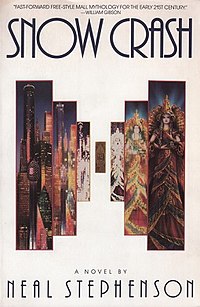
Snowcrash by Neal Stephenson – An Appreciation

Twenty years ago, Mary and I got our first real home computer (the Commodore 64 didn’t quite count).  With an Intel 486 processor, 500k of ram, an 8k external modem, and AOL memberships, we were wired!  Full-fleged members of the information age, at least by the standards of the day.

The same year, 1992, Neal Stephenson published a visionary novel called, Snowcrash. In retrospect, it merits the word, “prophetic,” for its sketch of life in the metaverse – a word Stephenson coined – and in the inconvenient world we call “reality.”

Consider:

In Snowcrash, Stepenson posits a world where nation states have transferred most of their power to corporations. Most people are corporate citizens and live in corporate enclaves, or less prestigious burbclaves.  The hero of Snowcrash, Hiro Protagonist, is a citizen of “Mr. Lee’s Greater Hong Kong.”  Military power belongs to private contractors, as do the roadways, which vie for driver/customers.  The post office is gone; private couriers deliver snail-mail.  The United States occupies a smallish territory centered in the Mohave Desert, and keeps it’s employees busy with make-work projects.  The former United States economy hinges on two industries – computer microcode and high speed pizza delivery, which has been revolutionized since the Mafia took control.

Though Hiro is a citizen of Hong Kong, as a pizza driver, he can’t afford to live in their enclaveclave.  Home is a self-storage unit under the flight path at LAX.  Like most of his hip and cyber-savvy generation, he spends most of his time online in the guise of his avatar, navigating virtual worlds.  But something is happening in the online world.  A strange new computer virus, when opened, generates a graphic pattern that scrambles the brains of the user.  They are dazed and speak in tongues.  With a young woman named YT, for Yours Truly, Hiro sets out to unravel the mystery.

The villain turns out to be a charismatic preacher.  In his attempt to secure both temporal and spiritual power, he has tapped into the ancient Sumerian glyphs that first scrambled human speech patterns in the event known as the Tower of Babel.

It’s been 20 years since I’ve read Snow Crash, so I’m writing this from memory.  I’m not necessarily recommending the whole novel.  The first jaw-dropping 100 pages, where Stephenson built his world, flew by and still leave me in awe.  I remember the rest of the book dragging in parts, but I still think of the story all the time.  Most futuristic fantasies prove as silly as the 1930’s movie shorts that show humans zipping along in their air cars between high rise buildings, happy and without any accidents.  This book is different.

In 1992 there were no virtual worlds.  Now there are, and you have to create an avatar to negotiate them.  These days, it isn’t so hard now to imagine a bright young man living in a self-storage shed.  But above all, Snow Crash comes to mind because in the wake of “citizens united,” it’s so easy to see corporate power growing while government power wanes.  With Super Pac money rolling the election year dice, does the government control corporations or do corporations control government?  Neal Stephenson saw this and other aspects of our world coming 20 years ago.

Snow Crash, is a visionary novel that all lovers of fantasy should know.

King of Morning, Queen of Day by Ian McDonald: An Appreciation

My recent discussion of unlikely mentors and guardians http://wp.me/pYql4-1J8 reminded me of Tireseas and Gonzaga, two “mystical vagabonds” (book jacket description) in one of the best fantasy novels I’ve ever read.

Ian McDonald, a visionary author who lives in Belfast, published  King of Morning, Queen of Day in 1991.  I still pick it up to read certain passages or a random chapter, to study and enjoy the ideas, the writing, and characters.

The narrative follows three women of three generations who are alternately attracted and attacked by creatures of the Mygmus, a technical name for the infinitely overlapping worlds of Faerie.

“The Mygmus may be viewed not so much as a place, a spatio-temporal relationship, a quasi-Euclidean geometrical domain, but as a state.  The concept is a familiar one in modern quantum physics, in which time is not considered a dynamic process, but a succession of recurring states eternally coexistent.  Such thinking liberates us from our essentially linear concepts of time, with past, present, and future.”  So reads a manuscript given to one of the women by a strange group of deformed, “Midnight Children.”

The first of the women, romantic, Edwardian Emily, dreams of a faerie lover and seeks him out.  First her rapes her, and then she disappears.

Gonzaga and Tireseas help Emily’s daughter, Jessica, battle free of the otherworld threat, which is personified by her mother, who has become a demonic force.

Jessica’s daughter, Enye, modern young woman in Dublin, battles Otherworld manifestations at night with martial arts swords.  Gonzaga and Tireseas charge her blades with high tech wizardry as well as ancient charms that allows her to win her way into Faerie, redeem her grandmother, Emily, and return to modern day Dublin.  The author gives the ending a contemporary twist that I won’t reveal here.

McDonald’s characters are among the most vivid in any novel I can remember, painted with a sure touch both in broad stroke and detail.  Every December, for instance, I reread “Enye’s soliloquy” – my name for it, with a nod to Molly Bloom.  It’s her internal monologue, in response to the question, “Wouldn’t it be nice if we could have Christmas all year long?”  It’s a long single sentence paragraph – not quite as long as the one that ends Joyce’s Ulysses, but then Joyce doesn’t make me laugh out loud.  I’ll quote the whole thing next December.

With his first book, Desolation Road, 1988, Ian McDonald won critical acclaim, and an Arthur C. Clarke award nomination.  Like other cyberpunk authors at the time, his vision of the impact of  technology at the birth of the internet age continues to amaze.  As a quick aside in King of Morning, Queen of Day, McDonald throws out a challenge to fantasy writers that has largely remained unanswered in the 21 years since it was written.  In the same manuscript that defined the Mygmus, Enye reads:

“I have this dread that…somehow we have lost the power to generate new mythologies for a technological age.  We are withdrawing into another age’s mythotypes, an age when the issues were so much simpler…and could be solved with one stroke of a sword called something like Durththane.  We have created a comfortable, sanitized pseudo feudal world of trolls and orcs and mages and swords and sorcery, big-breasted women in scanty armor and dungeon masters; a world where evil is a host of angry goblins threatening to take over Hobbitland and not starvation in the Horn of Africa, child slavery in Filipino sweatshops, Colombian drug squirarchs, unbridled free market forces, secret police, the destruction of the ozone layer, child pornography, snuff videos, the death of whales, and the desecration of the rain forests.

Where is the mythic archetype who will save us from ecological catastrophe, or credit card debt…where are the Translators who can shape our dreams and dreads, our hopes and fears, into the heroes and villains of the Oil Age?”

Ian McDonald

I haven’t kept up with the work of Ian McDonald in the two decades since I first read King of Morning but returning to the book via the characters of Tireseas and Gonzaga reminded me to do so. McDonald published Planesrunner, his first YA fantasy, in December, 2011. Here’s the blurb:

“When Everett Singh’s scientist father is kidnapped from the streets of London, he leaves young Everett a mysterious app on his computer. Suddenly, this teenager has become the owner of the most valuable object in the multiverse—the Infundibulum—the map of all the parallel earths, and there are dark forces in the Ten Known Worlds who will stop at nothing to get it.”

I don’t know about anyone else, but this is my very next read.
Gaia’s Secret by Barbara Kloss: A Book Review

I met Barbara Kloss a year ago at a California Writer’s Club workshop. We talked during the breaks, and later traded a few emails, based on a shared interest in young adult fantasy, but we lost touch when she and her husband moved to Phoenix.

Last fall, when Barbara emailed that she had published her first novel to Smashwords, I offered to review it here.  Due to the holidays and a penchant for multi-tasking, I am only getting to it now.

Daria Jones lives on a ranch outside of Fresno.  Her biggest worry is talking her overprotective father into letting her go away to college – that is, until her father disappears, and two non-human creatures show up at the ranch to kill her.  Family friends she has known all her life hustle her through a portal into Gaia, a world where magic not only works but can easily get you killed.

Gaia’s Secret introduces an appealing heroine whose 21st century sensibilities do not mesh well with the her destiny as a “special” child who was hidden away for her own safety.  Daria reacts as we might, with anger and fear, as all of her certainties crumble.  She doubts herself, her sanity, and her friends in turn.  It is her human failings, her pouts and impetuous actions, that make her so appealing, and save her from the “secret princess” cliche of so much YA fiction.

Early in the story, an ally of Daria’s father plays chess with her as her party hides from pursuit.  “You learn a lot about a person by their strategy,” he says.

“What about a person who has none?” Daria asks.

“Having no strategy is still a reflection of character,” her father’s friend replies.  “You’re impetuous and you don’t understand the consequences of your actions.  And you don’t have the patience to learn, which prevents you from making good decisions.”

Daria fumes but later admits that he’s right as her party ventures farther into a magical world where bad decisions become increasingly dangerous.

Structured along the lines of Joseph Campbell’s hero story, Gaia’s Secret also appeals as a quest tale and a romance, thought Daria’s temper and “bad decisions” lead to muddles on all fronts.  They ultimately deliver her into the hands of the traitor who started by sending assassins to kill her on earth.

Can Daria harness her newly emerging and uncontrolled magical powers in time to save herself, her father, and friends?  Since Ms. Kloss has said on her website that she is working on the sequel, I don’t think it’s a huge spoiler to say the answer is yes. http://scribblesnjots.blogspot.com/

Author, Barbara Kloss

Daria attains her quest in the end.  She and her father are reunited in safety.  She and her heart throb finally admit their love for each other, but that doesn’t mean things end happily ever after.

The world of Gaia is ruled by a king, and though it’s a magical world, as a young woman at court, Daria has far less freedom than she did in Fresno.  When temper overrules caution, and she mouths off to the king, she winds up with guards outside her door – for her “protection,” and no chance to marry the man she loves.  Good thing a sequel is coming.

A click on the book at the top of this post will take you to Smashwords where you can read the opening pages.  Those who enjoy  YA fantasy will probably choose to download the rest of this lively story with its feisty and endearing heroine.

The Lightning Thief by Rick Riordan: A Book Review

I’ve been less active on my blog this week because of the happy event of finding a book I couldn’t put down. Like most such discoveries, I came to it by word of mouth.  In December, we called my sister-in-law to ask what our fifth grade nephew might want for Christmas.  She said he had really enjoyed  The Lightening Thief by Rick Riordan, the first book in a middle grade series called Percy Jackson and the Olympians.  Without even stopping to read the blurb in that hectic season, we ordered the boxed set on Amazon, had it shipped as a gift, and forgot about it – until this month, when I spotted a display of the series at the local Barnes&Noble.

I was instantly impressed as I realized these books feature the 12 year old son of Poseidon and a mortal woman in a 21st century America where the figures of Greek mythology – and their numerous offspring – are on the loose.  If you remember your Greek myths, you recall that the gods were best avoided by mortals.  There was a lot of collateral damage in the Olympians’ constant bickering.  Think of Troy.

Percy Jackson, our half-blood (aka, demigod) hero, would not wish his fate on anyone.  Dyslexic, diagnosed with ADHD, and a D student, he has been shuffled from school to school six times in six years.  And that was when his life was easy – before one of the furies and the Minotaur try to kill him.  By sheer luck, he finds refuge in Camp Half-Blood, but not for long.  Zeus believes Percy has stolen his thunderbolt thrower.  If Percy does not return it in ten days time, a battle will erupt on earth, “that will make the Trojan war look like a water-balloon fight,” according to Chiron the centaur, Percy’s mentor.

Though this book is aimed at a young audience, it has all the attributes writers are taught to build into their novels:  an engaging protagonist, a unique premise, tension on every page, and ever-rising stakes.  I love the way this story encourages younger readers to explore the classics.  One of the items I saw on display at the Barnes & Noble was an illustrated summary of the figures of Greek myth, presented in contemporary form.  Zeus had shoulder length hair, a pin stripe suit, and the good looks that could land him on the cover of a romance novel.  Dionysus was a pudgy, middle-aged reprobate, given to loud Hawaiian shirts.  Such images make the gods more immediate than the older toga and grape-eating portraits.

I am late to this party.  The Lightning Thief was published in 2005. A movie version was made in 2010. I don’t know if it was ever released, but the Wikipedia summary shows it diverges significantly from the novel.  That makes me wary since I liked the book so much.

Most of the online reviews I read were written by adults who enjoyed Riordan’s stories as much as younger readers. Several mentioned the kind of pleasure they found in Harry Potter.  I can’t say for sure, since I’ve only read the first book, but I know I’m looking forward to reading the others.

Great Info on Charles Dickens From a Reader

I enjoy all the comments I receive, and sometimes they lead me down the trail to another post. One like that came in this morning, when blogger, Nixy43 (aka, Helen Nix) left a note on my recent post, Humbug Revisited:  http://wp.me/pYql4-1sF.

Ms Nix, a Londoner, is compiling a detailed list of 1000 interesting things to do in London for less than a tenner.  Any idiot can enjoy London on a large bankroll, she says, but it’s not so easy for the frugal tourist or people who live there.  She sent me a link to her marvelous post, “Thing 86:  Enjoy a literary evening at Foyles and bond with Dickens at Christmas.”  http://wp.me/p1I6Mp-5m

There is much information about Dicken’s, about changing attitudes to Christmas when he wrote A Christmas Carol, and links to much information about this classic.  London is gearing up for an all out celebration of Dicken’s in 2012, the 200th anniversary of his birth, so if there is any chance you will visit next year, this post is a must.

Stop by, enjoy the story, and thank Helen for posting it!

Charles Dickens