A change coming

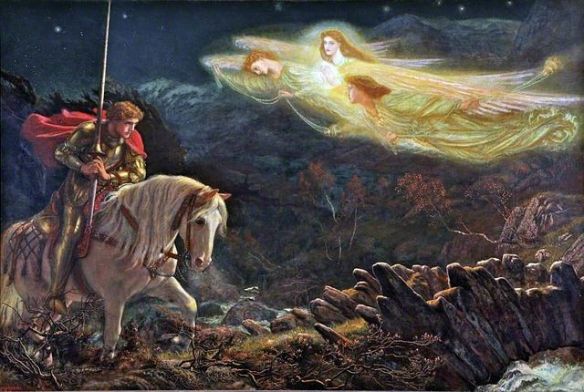
Sir Galahad, the Quest for the Holy Grail, by Arthur Hughes, 1870, public domain.

I’ve been enjoying the recording of a discussion at a conference with James Hillman and Michael Meade on literal, psychological, and mythological modes of understanding.

Hillman, a former director of the Jung Institute in Switzerland, has been the most prolific and influential of post-Jungian thinkers. He spent his life as champion of psyche, soul, and imagination in a world that has too few such champions. Hillman took particular aim at literalism, which he called “an idol that forgets it is an image and believes itself a God, taking itself metaphysically, seriously, damned to fulfill its task of coagulating the many into singleness of meaning which we call facts, data, problems, realities.” (Revisioning Psychology).

When I think of literalism, I recall the last lines of a poem a brilliant young poet I knew wrote about his high school principal:

His triple-breasted chin, arranged in folds upon his chest,
He blunts my life with a technicality.

Hillman also takes aim at much psychological thinking in books like The Soul’s Code. In this conference, he points to the 20th c. understanding that “The Gods now live in the psyche,” as a core statement of one of our greatest collective problems: the world and nature have lost their connection to the divine, and as such, are ripe for exploitation by greedy men who have traded their souls for profit. If you’ve seen one redwood, you’ve seen them all,” Ronald Reagan famously said when he was California’s governor.

Michael Meade noted that one of the hallmarks of myth is a sense of abundance. The current miasma of scarcity thinking – that there isn’t enough to go around, so you better get yours while you can – is a clear indication, if we need it, that we have no myth, no shared stories of who we are as a people. Continue reading

Must We Remain A Nation of Small Ideas?

Ursula K. Le Guin, 1929-2018

Ursula Le Guin died on January 23, at the age of 88. I first encountered her writing in the seventies. After multiple readings of The Lord of the Rings, I was hungry for more heroic-quest fantasy novels. There were plenty of them, but the only one I remember is Ursula Le Guin’s Earthsea Trilogy (1968-1972).

At a time when science fiction and fantasy were viewed as escapist genres, decades before YA become a lucrative fad, and before we knew about Jedi, Ursula Le Guin gave us the coming of age tale of Ged, who becomes a powerful wizard only after learning that his most powerful enemy is himself.

Many of this week’s online tributes and memorials have included excerpts from her acceptance speech at the 2014 National Book Awards Medal for Distinguished Contribution to American Letters. It is worth emphasizing this passage from her six minute address:

URSULA LE GUIN: I think hard times are coming, when we will be wanting the voices of writers who can see alternatives to how we live now, and can see through our fear-stricken society and its obsessive technologies to other ways of being, and even imagine some real grounds for hope. We will need writers who can remember freedom: poets, visionaries—the realists of a larger reality. …

Le Guin’s call for creative artists, and by extension, all of us, to imagine more life affirming ways to live on this planet underlines the poverty of our current public discourse, which confines our national imagination to ever more narrow ruts. We suffer not from fake news but from trivial news.

The last three administrations have spent $5.6 trillion on warfare since 9/11. We’ve killed more than 200,000 civilians (as of 2015) and lost more than 5,000 of our own troops (as of 2016), but none of us feel any safer. Where is our national debate on what we hope to accomplish and the nature of our exit strategy? It is non-existent. Instead, we argue on Twitter about whether football players taking a knee is disrespectful to troops…

The day Ursula Le Guin died, Amazon opened the prototype of an automated grocery store that doesn’t require cashiers. Two days later I saw the picture of Norway’s prototype, zero emissions, automated container ship, that will be entirely crewless by 2020. Panera and McDonalds are trying out order kiosks that could eliminate cashiers and – the list goes on and on. Where is the national debate on strategies for the near term, when automation eliminates millions of jobs before new technologies open up ways to replace them? That, conversation too, is non-existent. It’s more politically expedient to blame foreign nations and foreign nationals for “stealing” our jobs…

We can think of many more essential debates that are not taking place because of the cowardice of our leaders. Le Guin, of course, would shake her head at the notion that today’s politicians or CEO’s are remotely capable of being “the realists of a larger reality.”

Her legacy is a lifetime of visioning other worlds and other ways of living in this one. It’s up to people who care to move that vision forward. Sadly, it seems increasingly certain that the world we would wish to live in is one more thing that will not be “Made in America…”

What would James Hillman say about all this?

James Hillman (1926-2011)

James Hillman, a genius in the field of psychology, is largely unknown to the general public. Only one of his many books, The Soul’s Code (1997), is widely known, and only because Oprah featured it. Hillman’s long time friend and editor, Thomas Moore, wrote a tribute and summary of his life after his death in October, 2011. Moore said, “Jame’s books and essays, in my view, represent the best and most original thought of our times. I expect that it will take many decades before he is truly discovered and appreciated.”

Hillman, who was, for a time, director of the Jung Institute in Zurich, founded “Archetypal Psychology,” an extension of Jung’s thought, centered on the poetic, imaginal basis of psyche or soul: “Every notion in our minds, each perception of the world and sensation in ourselves must go through a psychic organization in order to ‘happen’ at all. Every single feeling or observation occurs as a psychic event by first forming a fantasy-image.”

He criticized most 20th century psychologies as materialistic and literal, giving no space to soul. With journalist, Michael Ventura, he co-authored We’ve Had a Hundred Years of Psychotherapy and the World Is Getting Worse (1992). He was vehement in his condemnation of the exclusive “inward” bent of most psychotherapies, which deprive the world of our outrage and our energy. He gave the example of a man who works eight or ten hours a day at a meaningless job, at an ugly, uncomfortable desk, under flickering florescent lights. When he goes to a therapist for relief from depression, he’s likely to be asked how he got along with his mother… Continue reading

The Hungry Ghosts of Washington

Hungry Ghost Scroll, Kyoto, late 12th c.

There are six realms of being in traditional Buddhist cosmology. Two of these, the human and the animal realms, are visible to our senses. The other four are not. Because all these regions are part of samsara, the world of “original ignorance,” (rather than original sin), even the apparently pleasant places are characterized by suffering, because, to quote the song by Iris Dement, “nothing good ever lasts.” We suffer until we learn to see through our illusions and delusions.

Traditional Buddhists regard the four non-physical regions as subtle astral planes where, just like the physical regions, beings sojourn for longer or shorter periods of time, depending on karma. It is possible to read them inwardly, as archetypal situations as well. Among the “lower realms,” where you don’t want to go, are the hell realms, where the dominant emotion is anger. Violent actions driven by anger can project beings into these regions after this life, yet when we see a person, or ourselves, seething with anger – red in the face, trembling, on the edge of violence, we see what a hell-being looks like, right then, without going anywhere else.

“Hungry ghosts” live in a world of insatiable craving, appetites that can never be satisfied. In eastern iconography, they are pictured with huge, distended bellies and tiny mouths that can never eat or drink enough. This is the realm of addiction, to anything or everything. In western art, Hieronymus Bosch shows us what hungry ghosts look like:

From “The Garden of Earthly Delights” by Hieronymus Bosch, c. 1500

We all have a sense of the ravages of addiction to food, drugs, or alchohol. In When Society Becomes an Addict, Anne Wilson Schaef says that life in the U.S. is so stressful that it is impossible not to become addicted to something. Some addictions will land you in jail. Some will win you applause. Some, like addiction to money and power can win you a seat in congress.

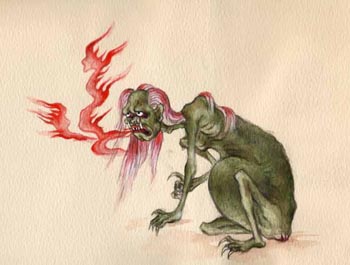
Beyond all the rationale, couched in economic terms and political rhetoric, there’s a greed that drives our current political strife that is an insatiable craving for wealth that can never be satisfied. When we read of American oligarchs trying to strip healthcare from millions for tax cuts for people who don’t even need it, remember this image of their inner nature:

Hungry Ghost, Japanese.

What are the odds that such beings can do anything good for their fellows or for the planet?

Beware the Trolls

NOT THAT KIND OF TROLL
John Bauer, 1912 illustration, public domain

Social media algorithms effectively isolate readers of one type of political news from opposing views; if you follow Fox News, you won’t see MSNBC pop up and vice versa. At the same time, you can usually judge the importance of the “breaking news” of the day by the number of profane, violent, vitriolic comments that follow. I have received, if not death threats, at least death wishes, for comments on Facebook I can’t even remember, and I know I’m not alone in this. Does such overheated rhetoric reflect the national mood? I’ve come to think that in many cases, it does not, though some interests would have us believe it does.

On July 11, in an opinion piece in the Washington Post, David Rothkopf, said, “Russia’s primary goal was not to get Trump elected. It was to weaken the United States(emphasis added).

That’s worth pondering at length. It crystalized my sense that a significant part of the national tension over our “house divided” is a creation of social media, and much of it may derive from the focused efforts of foreign trolls.

On the evening of July 11, the PBS Newshour aired a report by Nick Schifrin, with the help of the Pulitzer Center on Crisis Reporting, Inside Russia’sPropaganda Machine. Schifrin reports that for the past two years, the Russian military has run online recruiting adds, offering soldiers a chance to “put down their guns and fight a cyber-war.” 

Schifrin interviewed a former Russian troll, Marat Mindiyarov, outside of a large complex in St. Petersburg which Mindiyarov identified as the headquarters of this effort. He said he had “maybe 20, 30” online identities, but implied that some have hundreds.

At the end of May Newsweek reported that 900,000 blank twitter accounts had popped up as Trump followers that month. They were easy to spot – no photo, no byline, no tweet history. And no way for a casual viewer to determine their place of origin. I initially assumed they were created by Trump’s team. Now I have serious doubts.

Important stories on left leaning Facebook sites draw verbal conflict that is sometimes abusive enough to report. This morning I scrolled down the Fox News Facebook site, and noted similar trolling.

Again, I refer to Rothkopf’s piece, cited above. It’s very much worth considering that our external enemies no longer care if Trump stays or goes – as long as we as a nation stay angry and divided against each other, they have won…

JUNE 17, 1972- 5IVE MEN ARRESTED FOR BREAKING AND ENTERING DEMOCRATIC NATIONAL COMMITTEE HEADQUARTERS AT WATERGATE COMPLEX

As they say, those who forget the past…

hanspostcard's avatarslicethelife

150501114442-watergate-complex-exlarge-169

On this day in 1972 what turned into a two year and two month long ‘national nightmare’ began when five men were arrested for breaking and entering the Democratic National Headquarters at the Watergate Complex in Washington, D.C.

Shortly after midnight on June 17th a security guard at the Watergate, Frank Willis noticed there was tape covering the latches on some of the doors in the complex leading from the underground parking garage to some several offices. Willis removed the tape and gave it no more thought until an hour later when he returned and noticed someone had re-taped those locks again. He then called the police. Five men – Virgilio Gonzalez, Bernard Baker, James McCord, Frank Sturgis and Eugenio Martinez were found inside the DNC office and arrested and charged with attempted burglary and attempted interception of telephone and other communications.

At the time it was not a big…

View original post 51 more words

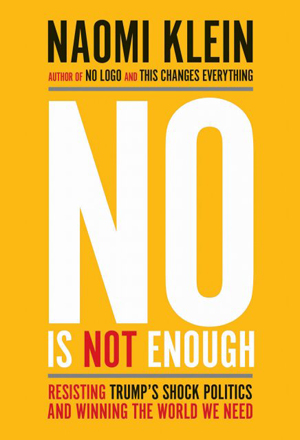
No Is Not Enough

Klein’s new book, “No is Not Enough,” will be released on June 13. http://www.naomiklein.org/main

James Hillman (1926-2011), who I regard as a mentor, always sought the fantasy, the imagination that underlies the literalism of what we take as facts. Quoting Jung, he said, “The psyche creates reality,” (Revisioning Psychology).

The Buddhist teachers I’ve met would agree. Here is an important discussion of some of the fantasies which underlie our current climate crisis, from an interview with Naomi Klein called “Capitalism versus Climate,” which appeared in the Fall, 2015 issue of Tricycle, The Buddhist Review.

Klein (b. 1970) is a Canadian author, climate activist, and critic of global capitalism who looks underneath the current climate debate. She was invited to the Vatican to give input during the formulation of the Pope’s encyclical on climate change.

In the Tricycle interview, Klein traced our current crisis to the western view of nature as an inert resource to be exploited for human convenience and profit, an outlook that emerged from the confluence of the Age of Reason and the first wave of industrialism. Climate change ultimately results from a false narrative, says Klein:

“It turns out that all this time that we were telling ourselves we were in charge, we were burning fossil fuels and greenhouse gases that were accumulating in the atmosphere. So now comes the earth’s response of climate change, which is a delayed response but a ferocious one that, frankly, puts us in our place. The response is this: ‘You’re just a guest here, and you never were in charge.’”

The vicious cycle that results from our sense of separation creates an insatiable hunger that can never be filled. We see it daily in our headlines. “Part of what fuels manic consumption is the desire to fill gaps in our lives that emerge because of severed connections of various kinds—with community, with one another, and also with the natural world.”

What can turn things around? Only a major shift in values and worldview, says Klein. Climate change is “already a moral catastrophe. We’re already writing off island nations because their GDP isn’t big enough. We’re already basically saying, Sub-Saharan Africa can burn.

Within that sacrifice zone mentality, it’s really easy to imagine the fortressing of our borders. Easy to imagine how our nations will seal themselves off from climate refugees. Climate change is not just about being afraid of sea levels rising. It’s not just about the weather. It’s about how an economic system that glorifies individualism—and one that is based on an often unstated but very real hierarchy of humanity—will respond to heavy weather. And it’s that cocktail that scares me.”

At the same time Klein says she’s hopeful:  “What powerful forces fear most is not what we do as individuals, like changing our lightbulbs or going vegan. They fear what we do when we act together as organized and mobilized groups. As groups we can go after the legitimacy of their profits. This is what the student-led fossil fuel divestment movement is doing, and it has these companies pretty panicked. They care when we come together to block their pipelines. They care when we demand that our governments build the infrastructure that will get us to 100 percent renewable energy.”

Naomi Klein

I’ve already pre-ordered her new book, No Is Not Enough: Resisting Trump’s Shock Politics and Winning the World We Need.

I’ve also added Naomi Klein’s website to the FirstGate blogroll – her’s is a voice we need to hear at a time when the ruling party of the United States offers only a steady diet of lies.

Signs of difficult times

March for Science, Sacramento, CA, April 22, 2017

It’s clear that a war for the soul of the nation is underway. The March for Science on Saturday reminded us that the stakes are even higher than that. I snapped this photo because I liked the right-hand sign, “Science – Because you can’t just make shit up.” Only later did I notice the sign to the left – “All Life on the Planet is Counting on US.”

That evening, I noticed a Denver Post article: junior Trump is off to Montana to help a GOP special election candidate by joining him in a prairie dog hunt. Greg Gianforte, the congressional candidate said, “What can be more fun than to spend an afternoon shooting the little rodents?” Apparently, real men think it’s fun to kill the animals during the season when the females nurse their young.

Prairie dogs are considered “agricultural pests,” and ranchers kill them because they damage crops. They are, however, listed as “a species of concern” by the Montana Department of Fish, Wildlife and Parks because their numbers are in decline.

The Humane Society of the United States has condemned the hunt, noting that prairies dogs are a key species in the ecology of the great plains, and “more than 100 other animals depend on the prairie dog as food or move into the burrows they dig.”

In response to HSUS concerns, congressional-hopeful, Gianforte says, “Clearly they’ve never shot a prairie dog. They don’t know how much fun it is.”

Think about that. Think about Gandhi’s words, “The greatness of a nation and its moral progress can be judged by the way its animals are treated.”

Gianforte’s opponent in the May 25 special election is Rob Quist, a popular musician. Who would you rather have in congress – who is more likely to move our country to greatness – a creative artist or someone who thinks killing small creatures is fun?

There are likely to be opportunities for online contributions to Quist’s campaign as the election approaches. I plan to give as much as I can.

The current president and all of his minions and congressional lapdogs represent the greatest threat to the physical, spiritual, and ecological health of this nation of my lifetime. Nothing is more important than resisting their agenda as vigorously as possible and removing them from office as soon as we can.