Terminal Time

The phrase, “Terminal Time” has a dire sound, but as the photo below should make clear, this post is not about terminal illness. It’s about terminal, as in airports; not the end of life, but the end of patience.

Neon passageway, O'Hare Airport, 2013 by Nicola. CC By 2.0

Neon passageway, O’Hare Airport, 2013 by Nicola. CC By 2.0

The subject comes from the WordPress Daily Prompt for June 10, You’re at the airport, your flight is delayed for more than six hours, and none of your electronic devices are working. How do you pass the time?

Like millions of others, I’ve been there on several occasions. I think I was still in my teens the first time I got snowed in at O’Hare. Since Chicago’s airport has been the scene of my most dramatic delays, let’s imagine what we can do there to pass the time in an unwired kind of way.

1) Buy a paperback. This almost goes without saying, but since most airport bookstores don’t carry Moby Dick, here is a chance to indulge our guilty pleasures, whatever they may be. No one blames you for reading trash when you’re stuck at O’Hare.

2) Walk or ride the escalator through the neon passageways. If you’re with a companion, one of you can say, “Whoa, dude!” and the other can reply, “Psycedelic!”

3) Eat something. O’Hare has a huge variety, from cinnabuns, to Big Macs, to build-your-own-salads. Go to a bar if it suits you, but before you dip into the beer nuts, remember the opening scene of Contagion, with Gwenneth Paltrow doing just that.

4) Work a puzzle. Mary and I spent a happy hour doing that on the ground in Philadelphia last summer. She is crossword fan, with much experience and several dictionaries. I know lots of nerd expressions and assorted trivia, so we compliment each other.

5) People watch #1: Spot an interesting character and work out the plot of your next (or first) novel.

6) People watch #2: Figure which of your fellow travelers are aliens, as in Men In Black extra-terrestrials. Like the woman I saw with a dog in a pink tutu. This is true! She was talking to the dog, who looked absolutely miserable, while everyone tried to look away. I’m sure the dog came from a more intelligent planet than its owner.

7) Walk around. What a concept! You’ll feel better, and if you decide to be brisk, you can even get in some aerobics to work off those pizza slices.

8) Practice meditation. It’s a challenge to stay focused when you’re tired, annoyed and distracted, but that makes it interesting for brief periods of time.

9) Buy a notebook and write your next blog post longhand. Soon enough you’ll get your smartphone recharged.

10) If you’re gregarious, strike up a conversation. I’ve mentioned a few opening line suggestions like,  “Snow sucks, huh?”  Or, “Psychedelic!”  Or, “That poor dog. I hate tutus!”

You get the idea, and I’m sure you can add many more of your own. Maybe this post will help someone during the summer travel season. Now all I have to do is hope the lords of karma are kind, and I won’t have to eat my own cooking anytime soon!

I’m not dead yet

My title, a line from Monty Python and the Holy Grail, came to mind during recent reflections on independent bookstores.

Shakespeare and Company bookstore, Paris. Wikimedia Commons

Shakespeare and Company bookstore, Paris. Wikimedia Commons

I used to go to bookstores to make discoveries. The best were quirky, and I loved to be surprised and find something new to read. My all time favorite was a sci-fi/fantasy specialty store in a low rent strip mall. The store was a labor of love for the owner, who made most of his income trading collectables – signed Robert Heinlein first editions and vintage comic books.

I could walk in and say, “I’m looking for urban fantasy that centers on spirit guides,” or, “I’m in the mood for a quest – got anything that’s not a dumb Tolkien ripoff?” Most of the time, I’d find what I was looking for and have an interesting chat on trends in the genre with someone who was steeped in that world. You never know what you’re going to find in a place like that. Sadly, independents are on the ropes, but as the Pythons put it, they’re not dead yet. Here is a link to indiebound.org, which has a tab at the top right to locate independent booksellers.

We don’t even have to abandon ebooks to shop at indies! In February, 2012, I wrote about The Book Seller, a great independent shop in Grass Valley, that encourages ebook fans to order through their website; that way they get a commission on each sale (the format is .epub, the standard all-but-Amazon format, which can be read on a Nook or any laptop, smartphone, or tablet using the free Nook app).

I’m pretty sure that for just about everyone reading this blog, books are a huge and treasured part of our lives. If anything good has come out of the Amazon-Hachette dispute, it’s information like this which can help me rethink the way I buy books.

As Mark Coker put it, the ideal is “a vibrant ecosystem of multiple competing retailers.” It’s good to know what I can do to help secure such a future.

From indiebound.org

From indiebound.org

Footnote, June 3:  Calmgrove, a blogging buddy, noted in a comment that the initials of my title, I’m Not Dead Yet, form a nice acronym, INDY. In addition to independent bookstores, he says it has something to do with fruit fly genetics – feel free to pursue that with him if you wish…

More notes on Buddhism

Prajnaparamita, Sanskrit for "The perfection of wisdom," is often personified as a goddess of transcendental wisdom in Buddhist iconography, as in this 13th c. stature from Java. Public domain.

Prajnaparamita, Sanskrit for “The perfection of wisdom,” is often personified as a goddess of transcendental wisdom in Buddhist iconography, as in this 13th c. stature from Java. Public domain

If you have not already done so, please read the previous post as an introduction to this one. I’m going to discuss two additional questions that are commonly asked about Buddhism. Then I’ll list some of my favorite references.

Is Buddhism a religion?

For some people it is and for some it’s not. There are Buddhist churches, similar to any other church, though westerners usually focus on the contemplative dimension with its “spiritual but not religious” nature.

The first long Zen retreat I attended was led by a Catholic priest at a Sisters of Mercy Retreat Center. This was not watered down Zen. The priest, who bears the title, Roshi (master) is member of a recognized Japanese lineage, as are other Catholic priests and nuns. The church allows this, holding that Zen is not a religion, but a means for exploring the nature of awareness. I’m not aware of any contemplative Buddhist tradition that requires members to drop their other religious affiliations.

Is Buddhism atheistic?

Buddha never talked about metaphysics. He focused on suffering and the path to enlightenment as the end of suffering. Often when he was asked about ultimate things, he refused to answer. Once a monk asked, and Buddha told “the parable of the arrow.” As Thich Nhat Hahn, a Vietnamese Buddhist monk explained it:

[Buddha] said, “Suppose a man is struck by a poisoned arrow and the doctor wishes to take out the arrow immediately. Suppose the man does not want the arrow removed until he knows who shot it, his age, his parents, and why he shot it. What would happen? If he were to wait until all these questions have been answered, the man might die first.” Life is so short. It must not be spent in endless metaphysical speculation that does not bring us any closer to the truth. (the parable of the arrow).

So it’s accurate to say Buddhism is non-theistic, but it isn’t explicitly atheistic either; Buddha never said one way or the other. As Brad Warner, a Zen priest for 30 years, puts it in his book on the subject, There is No God, and He is Always With You, it depends on what you mean by “God.” If we mean some large, powerful being “out there,” who created us at some finite point in time and pulls strings, then no, Buddhists don’t believe that. If we’re speaking of something like Paul Tillich’s “Ground of Being,” then I think it’s implied in much Buddhist writing and by many Buddhist teachers I’ve heard. To quote Anam Thubten as I did in the previous post:

There is Buddha in each of us right now who can never be defeated by the force of inner darkness, the force of greed, hate, attachment, and delusion, and that Buddha has no form, no image. That Buddha, indeed, is residing in all of us as our pure, quintessential being. We must always turn our attention inward whenever we have the desire to seek divinity, or Buddha, God, or Brahma. (The Magic of Awareness)

Japanese brush painting, by Lone Primate, 2007, CC By-NC-SA 2.0

Japanese brush painting, by Lone Primate, 2007, CC By-NC-SA 2.0

Buddhist Resources

The best resource of all is a nearby sangha (group of practitioners) or meditation group in one’s own area, if it’s a good fit. Meanwhile, here are a few books and websites that I find valuable.

Books:

A Path With Heart (1993) by Jack Kornfield.
This is the first book on Buddhism I’d recommend to someone wanting to learn more. Part spiritual autobiography and part introduction to Buddhist thought and practice by an influential teacher of Vipassana (Insight Meditation). Kornfield, a co-founder of Spirit Rock (web link below), gives fine descriptions of some of the difficulties westerners may have when approaching eastern traditions.

No Self No Problem (2009) by Anam Thubten
The most important single work in turning my attention to Buddhism. I found an earlier edition of the book and attended a daylong retreat (the first of many) with Anam Thubten a few weeks later. There’s a link to Anam Thubten’s website below.

An Introduction to Tantra: A Vision of Totality (1987) by Lama Thubten Yeshe
The best introduction I’ve found to Tibetan Buddhism by a renowned 20th century lama and member of the Dalai Lama’s tradition. “Dwelling deep within our heart, and within the hearts of all beings without exception, is an inexhaustible source of love and wisdom. And the ultimate purpose of all spiritual practices, whether they are called Buddhist or not, is to uncover and make contact with this essentially pure nature.”

Awakening Joy (2010) by James Baraz
James is a teacher at Spirit Rock. I bought this book several years ago, when he gave a local daylong retreat here, and just started reading it. It’s the most “ecumenical” of all these books. The author presents 10 themes, with exercises, to increase our wellbeing now, where we are, not at some future time when we are enlightened. The book meshes with an online course he teaches. Website below.

Online Resources:

Spirit Rock. An insight meditation center north of San Francisco that hosts retreats all year long. See especially the “Meditation101 tab” for the basics of insight meditation and dozens of talks by visiting instructors.

Dharmata Foundation. This is Anam Thubten’s home page. Well worth checking the calendar from time to time. From his home center in Point Richmond, CA, this Tibetan master travels extensively. In May he gave retreats in South Korea, Little Rock, AR, and Maine. In June, he will teach in Princeton, NJ, New York, NY, Maui, and Grass Valley, CA. Hearing him is well worth the effort (here is one account I’ve posted of a retreat with him).

James Baraz. Here is James’ website and teaching schedule with a link to his Awakening Joy course (available online).

Tricycle. The pre-eminent Buddhist magazine, with 20+ years of articles from all traditions. Check out a hard copy in a bookstore for a directory of dharma centers by region. There are always online retreats available to subscribers.

Peaceful Sea Sangha. Website for Edward Espe Brown, who I’ve posted about here several times. He also travels and teaches widely, with a trip to Prague, Austria, and Germany scheduled over the next month and a half. His audio teachings are wise and hilarious. I discovered a poem I recently referenced, “10,000 Idiots” by Hafiz, in one of them.

I could go on and on, but this is already long enough. These are only a few suggestions. Feel free to comment or email with any specific questions, observations, or resources of your own.


It’s In His Kiss by Vickie Lester: a book review

IIHKCover5x8final291p copy

Death is a sidewinder. It strikes from a place concealed and unthinkable, triggering a reality completely unexpected. – Vickie Lester

Anne Brown, a New York teacher and author of literary novels is on her way to Palm Springs in the middle of winter. Movie studio bigwigs are flying her out to renew the option on her first novel, a decade out of print. Why do the rich and beautiful people welcome her with open arms? Is it because she’s the out of wedlock daughter of a retired movie mogul?

No, it’s a bit more sinister than that, Cliff, the most beautiful person there, tells Anne. An acting agent, he fills her in and offers to help her navigate the proverbial shark infested waters. And draws her into a whirlwind affair that is hardly the norm for Anne, a confirmed bachelorette, who thinks of herself as the girl that guys just want to be friends with.

It seems too good to be true, but it is, until the following morning, when Cliff is found dead by the side of the road in his Ferrari. It looks like a tragic heart attack until the coroner finds he overdosed on the kind of drug cocktail used to enhance pleasure at the gay sex club up the road. Cliff hardly seemed gay to Anne, and everyone who knew him swears he was straight in every sense of the word.

Filled with grief, anger, and curiosity, Anne begins to ask questions. It soon becomes apparent that everyone at the Palm Springs house that weekend was hiding something. “Was there not one single normal person in all of L.A.?” she wonders. And then a black Escalade tries to chase her down on the freeway…

Vickie Lester, who blogs at Beguiling Hollywood, used to write screenplays, “Horrid, arty, little things,” she says, “that were…optioned again and again, but never made into movies. Perhaps, because they were neither commercial or cinematic?”

Now she has turned her considerable talent and insider’s knowledge of Hollywood into a gripping mystery, with an ending I never saw coming.  It’s In His Kiss is funny and smart and offers an insider’s view of a world of illusion that still fascinates.

The City of Angels was named for beings most often seen by children, visionaries, and the insane. The best novels out of LA are woven with a noir tone – all that sun and all those palm trees have to cast a shadow. Anne Brown and Phillip Marlowe are very different characters, and yet I imagine the spirit of Raymond Chandler is pleased. As a fan of both authors, I know I was!

Vickie Lester at Joshua Tree

Vickie Lester at Joshua Tree

The power of solitude

Beside the Dalai Lama, Pema Chödrön is probably the most widely known practitioner of Tibetan Buddhism. Born in New York City, she was ordained as a nun in 1974 and has written several popular books on Buddhist practice, including When Things Fall Apart (1996), The Places That Scare You (2001), and Start Where You Are (2004).

In 2006, Bill Moyers talked with Pema Chödrön as part of his Faith and Reason series. Here is the full interview, and below is segment, lasting just under five minutes. Chödrön, who spent a year in silent retreat, says everyone needs periods of solitude in life, even if just a brief time every day. Distraction, she says, is not just our phones and gadgets, but the distracted state of our ordinary minds. Just a little time out from this allows us to re-engage our lives with a “more spacious” awareness, and this makes it profoundly valuable.

Guarding the mind

guard mind 1

One summer when I was working in high-tech, I had the following experience for several weeks: I’d leave the house, enjoying the fine weather. After a pleasant enough commute, I’d grab some coffee at the cafe, greet co-workers who were doing the same, and then find myself, when I arrived at my cubicle, in a foul mood, angry, and/or depressed.

Finally, I began to notice the almost subliminal self-talk that started the moment I hit the parking lot: imagining negative outcomes for everything I had going on that day. I’d picture meetings, or presentation, or projects falling apart. A quiet but persuasive inner voice would label co-workers’ motives in the harshest light. My boss at the time was a friend who had just finished his MBA and was still finding his way by trial and error. This made him a perfect projection screen. I’d sometimes find myself wondering if he was now out to get me.

Once I caught this inner thought train and started to listen, it fell apart, as such things do in the light of day. This is one key result of mindfulness practice: attend to a thought – any thought – and it begins to shift and change, revealing its nature as something far less substantial than we think. Jung had a parallel insight when he realized, “My thoughts are not my own,” and compared them to animals encountered while walking in the forest.
Hist Center Window

Since that summer, I’ve learned to listen more closely for thoughts flying under the radar. That’s part of what prompted several posts this spring with the theme of consciously choosing where to place the attention. A recent post on the Shambhala Publications blog quoted a verse along these lines written more than 1200 years ago. A Guide to the Bodhisattva Way of Life by Shantideva (c. 685-763), a great Buddhist master and scholar, is still widely studied today (see note 1 below). In chapter 11, “Vigilance,” he deals with guarding the mind against against unwholesome states, for this is where all our actions are born. The chapter is composed of 109 quatrains. Here are the first three:

1.
Those who wish to keep a rule of life
Must guard their minds in perfect self-possession.
Without this guard upon the mind,
No discipline can ever be maintained.

2.
Wandering where it will, the elephant of the mind,
Will bring us down to pains of deepest hell.
No worldly beast, however wild,
Could bring upon us such calamities.

3.
If, with mindfulness’ rope,
The elephant of the mind is tethered all around,
Our fears will come to nothing,
Every virtue drop into our hands.
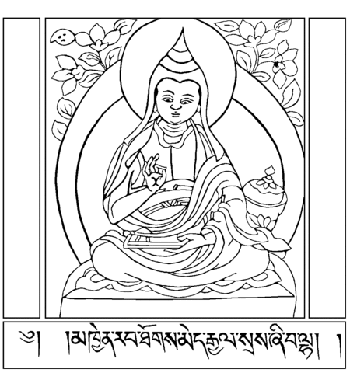
Shantideva. Public domain.

Shantideva. Public domain.

Guarding the mind is not just a Buddhist concern. When I Googled the phrase, most of the hits came from Christian websites and blogs. These discussions centered on Philippians 4:8, “Finally, brethren, whatsoever things are true, whatsoever things are honest, whatsoever things are just, whatsoever things are pure, whatsoever things are lovely, whatsoever things are of good report; if there be any virtue, and if there be any praise, think on these things”

Many of the thoughts, suggestions, and practices were similar to Shantideva’s writing as well as a more recent statement by the Dalai Lama. I am even aware of both Buddhist and Christian scriptural practices for wearing imaginal armor to shield the heart/mind from negative influence. I would not be surprised to find similar practices in other spiritual traditions.

I’ve been fortunate enough to have a few days away from my usual routines and concerns to consider these things. I’m struck again, as I was in the work episode I related above, by how subtle the negative inner voices can be.

Another bias I find in myself was articulated by James Baraz, a Buddhist meditation teacher in an article on the Huffington Post, Can We Afford Joy in a World of Suffering. Baraz describes “the Kumbaya factor,” as the fear that if we consciously turn away from what is negative, we may simply wind up “in La-La Land singing Kumbaya.”

Everyone has to work this out for themselves, but Baraz makes several key points. Depression saps our energy. No one benefits self or others while wondering, “what’s the use.” In the work experience I related above, I wasn’t the best of co-workers while imagining others were out to get me.

I’m reminded of a story I heard several times in college. In 1927, Buckminster Fuller walked to the shores of Lake Michigan, thinking to end his life. He had just lost his job and felt responsible for the death of his daughter a few years earlier. He would later tell lecture audiences that as he looked into the waters, he felt surrounded by light and heard an inner voice say:

“You do not have the right to eliminate yourself. You do not belong to you. You belong to the Universe. Your significance will remain forever obscure to you, but you may assume that you are fulfilling your role if you apply yourself to converting your experiences to the highest advantage of others.” (Fuller)

The experience led Fuller to re-examine everything and resolve to live his life as “an experiment, to find what a single individual [could] contribute to changing the world and benefiting all humanity” (see note 2 below). In this epiphany, Fuller locked onto the same truth that Shantideva articulated 1200 years before:

54.
Examine thus yourself from every side.
Note harmful thoughts and every futile striving.
Thus it is that heroes in the bodhisattva path
Apply the remedies to keep a steady mind.

55.
With perfect and unyielding faith,
With steadfastness, respect, and courtesy,
With modesty and conscientiousness,
Work calmly for the happiness of others.

Speaking in the same tradition for a 21st century audience, James Baraz summed up the idea this way: “So can we afford joy in a world of suffering? I believe, in a world of suffering, we can’t afford not to find joy.”

reflection 4

Notes: _____________________________________________________

(1) In Buddhist terminology, a Boddhisattva is one who vows to seek spiritual awakening not for self alone but for the benefit of others.

(2) Some historians, finding no account of Buckminster Fuller’s epiphany in his writings for 1927, have wondered if he made up the story later. I can only speak for myself and observe that I’ve never put my most profound experiences in a journal: the writing is too pale, and there’s no need, since the events themselves remain vivid.

A classic trickster woman

A blogging friend, Calmgrove, commented on my previous post, saying how strange it is that in modern times, despite an abundance of comediennes, there are no female tricksters. Then it struck me – and it’s so obvious, I can’t believe I didn’t think of this earlier.

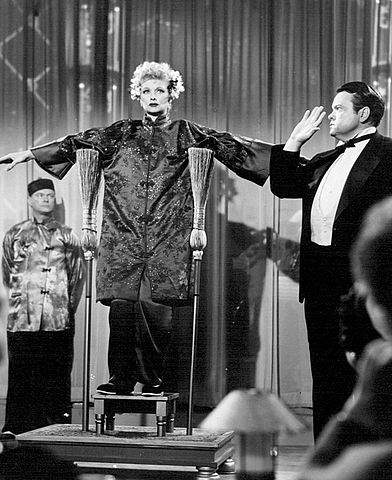
In an era when tricksters come to us on screens rather than stories told around a campfire, we cannot forget Lucille Ball’s role in “I Love Lucy.” The show ran from 1951 to 1957 and was the most watched the American television program during four of those six seasons. It is still in syndication in dozens of countries around the world.

Lucille Ball and Orson Welles.From a 1956 episode. Public domain.

Lucille Ball and Orson Welles.From a 1956 episode. Public domain.

Lucille Ball, with her clowning and physical comedy, set a tone that is still at the core of many sitcoms. Most of the best known women comics who followed cite her as a groundbreaker, an inspiration, a mentor, and often a friend. In terms of our “classic trickster” test, that is what she was, at all times. Never just a funny housewife, Lucy was an outrageous but charming disrupter, whose pioneering humor enlivened the spirits of millions who watched her.

I dare you to get through the chocolate factory scene with a straight face.

https://www.youtube.com/watch?v=8NPzLBSBzPI

Quite a few full episodes of the show are available on YouTube.

I think, therefore

The Thinker, Rodin. Public Domain

The Thinker, Rodin. Public Domain

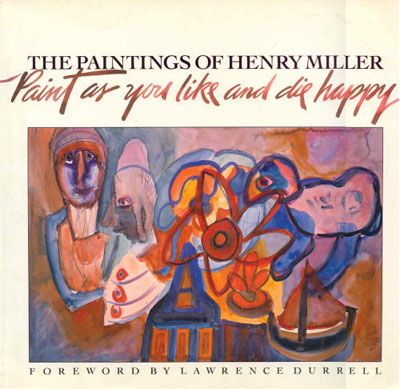
When I first started to write, in my teens and early 20’s, I was hugely influenced by an eclectic group of American writers that included vocal social critics from the earliest years of the 20th century. People like Theodore Dreiser, who wrote famously clunky prose, but whose An American Tragedy (1925) was a stinging indictment of greed in our culture. Main Street (1920) by Sinclair Lewis depicted the soul-crushing conformity of a milieu we often imagine as small town innocence. But greater than any other influence was Henry Miller, who demonstrated the power of personal essays. His books, like The Air Conditioned Nightmare (1945) shaped my view of our dominant culture.

It was natural that this kind of critique, along with that of more recent writers and essayists like Michael Ventura, should influence  my blogging. But this spring something strange happened. At the start of Lent, though I do not celebrate the season in any formal way, I announced that I would “give up” negative posts for the duration. As expected, the experiment was more interesting than I expected.

"Rodin's thinker?" by Patricia van Casteren, 2006, CC BY-NC-ND 2.0

“Rodin’s thinker?” by Patricia van Casteren, 2006, CC BY-NC-ND 2.0

I’ve already blogged about some of my findings, especially the obvious ones, like the preponderance of bad news in all varieties of media. And I knew in advance there would be less to say if I excluded negative themes. What I didn’t expect was to find myself wondering whether it mattered – it’s virtuous to write about things like climate change and income inequality – isn’t it? A very interesting question since I don’t really believe many writers and artists change social ills directly. Maybe Charles Dickens did, or Jacob Riis, with his photos of child labor, but Dreiser didn’t eliminate greed and Miller didn’t break the ruts of conformity. Writers and artists sometimes change individual hearts and minds, but how does that work? That is not a rhetorical question, but something I often wonder about. How does it work?

Perhaps it was this kind of question that moved Phil Ochs, one of the best of the 60’s protests singers, to write, “You must protest, you must protest they say, it is your diamond duty / Ah, but in such an ugly world, the only true protest is beauty.” Maybe it’s what led Henry Miller, in his last years, to write books like, My Bike and Other Friends, and to focus on his watercolors.

Henry Miller paintings

My biggest discovery, while turning away from negative stories during Lent, concerned inner dialog rather than outer events. I’ve attended to this in a focused way in the past at various times, but not for a while. Mindfulness practice appeared on the cover of Time, so it must be gaining fad status, but that does not diminish its worth. It’s an ancient contemplative discipline that involves simply watching the contents of consciousness. Not fixing, fighting, or merging with, but simply observing what flits through awareness (here’s a good introduction to the practice).

I don’t know about anyone else, but I often find a subtle but persistent stream of critical inner narrative on self, others, and events. The narratives tend grow in the darkness yet dissolve when observed, the way shadows disappear when you turn on the light in a room. Observation eventually leads one to suspect that thoughts have no more substance than shadows, and no more inherent reality, and yet they can have profound effects. I suspect we have all had interesting synchronicities, met things in the world corresponding to our inner states. And if one subscribes at all to notions of the effect of collective thoughts, an idea given names like, “tipping point” or “hundredth monkey,” then the contents of consciousness take on a meaning beyond their effect on oneself alone.

I follow the Dalai Lama on Facebook and often note that when he is asked about topical issues like climate change, he always gives a thoughtful answer, the tone of which is invariably, “I am hopeful.” If I learned anything with this Lenten experiment, it is how hard it can be to cultivate a hopeful attitude. I also cannot imagine anything more important. Can there be a more important seed to plant than this one – “I am hopeful?”