It almost seems like the world pauses around the time of the solstice, the way an out-breath stops for a moment before the next in-breath begins. To catch the stillness, we may have to make an effort to step outside the noise of the season, but it can be done.
People finally get to slow down on Christmas Eve. Maybe they go to church and look at the stars afterwards,or just step out for a breath of air when the family gathering gets too loud. Or take the dogs for a walk in the late afternoon, hands in pockets, and notice how quiet the park is, almost as if it is waiting for something. The soccer players and kids on the swings will be back soon, but now they’re gone.
This can be a hard season. Individually and collectively, many are wondering when the next blow is going to fall. And by this time of year, everyone is weary of trying to be as happy as people in Hallmark movies. Yet I believe that by some mystery, stillness surrounds and pervades our busy-ness, and silence permeates the noise. There is a well of renewal we can touch at this time of year. By whatever name you call it, may it be yours.
One of the books I treasure is a battered old trade paperback with yellowing pages. I value the book, Creative Mythology, because of the author’s inscription: “For Morgan with all my good wishes. Joseph Campbell, 3/13/79.”
You could say Campbell’s four day lecture series that spring did much to open the path my imagination has followed ever since. None of the stories Campbell unpacked in his lectures or books affected me more than Parzifal (or Parsifal) and his quest for the holy grail. The version of the grail story Campbell recounts is by Wolfram Von Eshenbach (1170 – 1220). Wolfram was a German knight and poet, and his Parzivalis regarded as one of the finest medieval German epics. Campbell looks to this version because it’s roots reach deeper than later Christianized versions where only the pious and chaste Galahad can attain the grail. What matters for this post are those echoes we can see in the tale of the ancient legends of sacred kingship, and the ways an unfit or weakened king can blight the land.
Wolfram Von Eshenbach from Codex Manasse
Sometimes in youth we receive a vision or powerful experience that shapes much of the rest of our lives. So it is with Parzival who finds his way to the mystical Grail Castle and meets its wounded king, Anfortas, who is also known as The Fisher King. As a young knight, a spear pierced the Fisher King’s “thighs” – a euphemism for testicles according to Campbell. In ancient times, the virility of the king and the fertility of the land were one. In the grail stories, Fisher King could not be healed and couldn’t die. All the realm was barren.
Robin Williams as the Fisher King in the 1991 movie of that name, a contemporary retelling of the story
While in the castle, during a mysterious ritual, Parzival has a vision of the grail, which is described as a stone, though its shape isn’t fixed, and it brings everyone “what their heart most desires.” Though he is intensely curious, Parzival does not ask the meaning of what he sees. In the morning, the castle is empty. All traces of life are gone. He rides away, and when he tells his story, listeners turn away in disgust. If Parzival had asked the right question, he would have healed the king and restored the land. The young knight wanders the blighted realm for 20 year, enduring hardships and contemplating his failure. Just like us, he watches time turn his youthful dreams of glory to ashes.
“Parsifal” by Odilon Redon
At last, one cold Christmas Eve, Parzival encounters a hermit, tells his tale, and learns the question he should have asked. After that, he achieves the castle again. When the ritual ends, Parzival asks, “Whom does the grail serve?” Everything hinges on asking the right question. Anfortas is healed, spring returns, and Parzival becomes the new Grail King.
***
Hearing this old tale, we have to ask how the story plays forward. “Wasteland” clearly describes the state of the world we read about in the papers, and “impotent” seems an apt description of most of the world’s governments. This perception is not even new, for T.S. Eliot named it ninety years ago in his poem, The Wasteland:
What are the roots that clutch, what branches grow Out of this stony rubbish? Son of man, You cannot say, or guess, for you know only A heap of broken images, where the sun beats, And the dead tree gives no shelter, the cricket no relief, And the dry stone no sound of water.
Giving mythical weight to our latest headlines, storyteller and mythologist, Michael Meade says: “Like Parsifal, the modern world has awakened from a deep sleep to find that the castle of abundance has disappeared, that the financial markets are in ruins, that blind religious beliefs are once again producing mindless crusades, and that great nature itself threatens to become a barren wilderness. Like Parsifal, we failed to ask the right questions when surrounded by abundance.”From “Parsifal, the Pathless Path, and the Secret of Abundance,” first published in Parabola, Fall 2009. http://www.mosaicvoices.org/index.php?option=com_content&view=article&id=72:essay4parsifal&catid=53:essays&Itemid=68
This has happened before, again and again, Meade reminds us – beginnings and endings, decay and renewal. The castle of abundance waits for us, individually and collectively, somewhere in the wilderness, but old pathways won’t take us there. There’s a time to do as Parsifal did – drop the reins and let the horse, an image of our instinctive wisdom, pick its way through the forest. The old stories were told in the winter, when the nights were long and the fires warm. This winter, I am drawn to look at some of these tales, to see what they are still whispering to our souls, for they are wiser than the daily ephemera that passes for wisdom but is really the source of our confusion.
As Michael Meade puts it: “Despite the current confusions of dogmatic religions and the literalism common to modern attitudes, the earthly world has always been a manifestation of the divine. Call it the Grail Castle, the Kingdom of Heaven, Nirvana, the Otherworld; it has many names and each is a representation of the eternal realm that secretly sustains the visible world. When time seems to be running out it is not simply more time that is needed, rather it is the touch of the eternal that can heal all time’s wounds and renew life from its source.”
On Saturday, Zen teacher, Edward Espe Brown, gave his second all-day retreat of the year for the Sacramento Buddhist Meditation Group. Zen is not exactly “my thing,” but like the SBMG as a whole, I’m ecumenical, ready to look for insight wherever I can find it, and I really enjoy Ed Brown. Zen is actually so free of doctrine that Catholic priests have become advanced practitioners, and Edward Brown is un-doctrinaire even for Zen. At the start of the retreat, after the hostess introduced him and listed his “credentials,” Brown said, “Yep, I’m certifiable.”
Edward Espe Brown
“I’m not going to give you very many instructions,” he said. “If I do, there’s the danger of wondering, ‘Am I doing it right?'” This is one of Brown’s constant themes: no one else can tell you the right way to do Zen or life. One statement framed both of Brown’s visits this year, a quote from his teacher, Shunryu Suzuki Roshi: “When you become you, Zen becomes Zen.” Zen is about “becoming authentically you,” Brown said.
Brown is an accomplished chef and uses lots of cooking metaphors. One time a group of his students was tasting a dish and one of them asked, “What am I supposed to be tasting?” To Edward Brown, that a question all of us ask in one form or another: “What am I supposed to be doing?” “What am I supposed to be feeling – or experiencing – or thinking?” “What am I supposed to be writing?”
Understanding the point takes a bit of subtlety; it does not deny that we have an “ordinary” self that must operate in “relative” reality and know how to balance a checkbook, check the oil, boil an egg, or get a job. Brown was directing remarks to that “unmanifest self,” the “big mind” within us, our Buddha nature. “It’s the sky not the weather,” he says. It’s the larger “us,” that can only say, “I am,” not “I am this or I am that.”
Because this silent knowing is so often drowned out by day to day concerns, it often requires a strategy to hear it. Meditation is one strategy. Another is learning to ask the right kind of question. Brown posed one such question: “What is your inmost request?” What do we want in our depths?
He did not mean our ordinary wants and needs, however pressing. He gave an example, saying that for many years, his inmost request was, “I want it to be ok for me to be here.” Questions like this do not come with fast or easy answers. There is nothing fast or easy about becoming authentic, especially in a culture that fears real individuals. If we’re looking for others to tell us what to do, they will be glad to oblige.
Yet failing to ask what we really are and what we truly long for carries a greater risk. William Stafford, the poet, put it this way: “a pattern that others made may prevail in the world and following the wrong god home we may miss our star.”
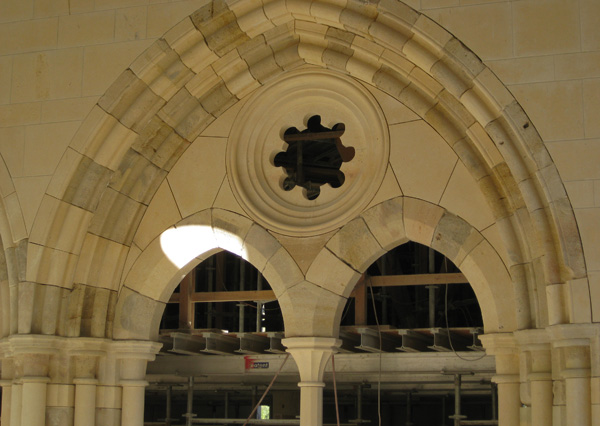
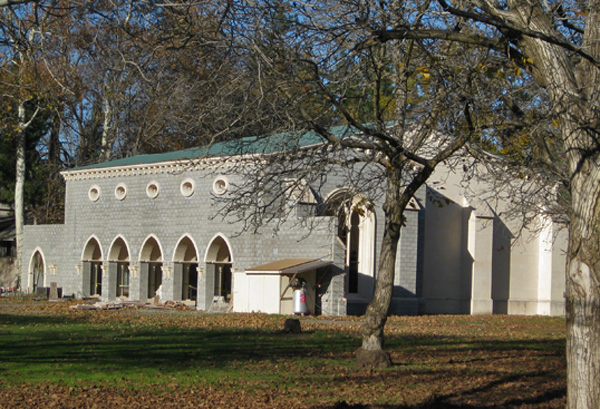
There are only two medieval structures in North America. Now a third is nearing the end of restoration in the small agricultural town of Vina, California, 100 miles north of Sacramento. It’s the 12th century Chapter House of Santa Maria de Oliva, a Spanish monastery that stood near Madrid. This building’s round the world journey makes an interesting tale.
The monks began their day in the Chapter House, where a chapter of the Rule of St. Benedict, an ancient guide to monastic living, was read and interpreted. This went on through the centuries until 1835, when the Spanish government closed all small monasteries and seized their lands. Santa Maria de Oliva was sold to a wealthy family that used the Chapter House to store farm equipment.
In 1931, William Randolpf Hearst bought the Chapter House for $285,000, intending to use the stones in the interior of a house he planned near Mt. Shasta. All the stones were marked for reassembly, and sent to California on 11 separate ships. The depression and WWII delayed Hearst’s plan, and in the end he donated the stones to the City of San Francisco to erect a Medieval museum in Golden Gate Park. This never happened and the stones lay outdoors in the park. Many were damaged, lost, or used for other projects
Meanwhile, the Cistercian Abbey of New Clarvaux was founded in Vina in 1955, and the first abbot began to make inquiries. In 1994, the Fine Arts Museums of San Francisco gave the stones to New Clarvaux with the stipulation that reconstruction begin in 10 years and the completed Chapter House be open to the public.
I first went to New Clarivaux in 1998 to stay for a few days at their retreat facilities. It’s an amazing place to unwind, and I have been there a number of times, so I saw the foundation of the Chapter House laid in 2001.
Section of New Clairvaux guest rooms
I had not been there recently, however, so when I drove up this past weekend, I found the structure was almost done – almost meaning another 18 months in a 10 year effort. Only 40% of the original stones were usable. The rest had to be repaired or replaced by stonemasons the abbey employed (they’ve raised $6.3 million to date, largely through small donations from across the country).
Master stonemason, Frank Helmholz, left Vina in November, bound for Luxor, Egypt, where he will spend the winter restoring a 3,400 year old temple. He plans to return to Vina next May. In an interview for the abbey newsletter, Helmholz said:
“In this modern age when everything is done fast and often doesn’t last long and serves no higher purpose, carving stones is a bit of a refuge. To create something that takes patience, dedication, and is lasting is very rewarding. And serving the monks in their spiritual lives gives a greater sense of meaning that is rare nowadays…to be part of something that has a higher purpose than one’s own comfort is inspiring in whatever form it takes.”
The abbey newsletter points out another significant point in the life of the Chapter House. It was built by Cistercians in Spain. Now it stands in another Cistercian abbey in the land that once was called New Spain. The stones have finally come home.
I have only alluded to the retreat facilities at New Clairvaux. In addition to nut crops and a vineyard, it’s one of the ways the monks earn their living, and it’s a marvelous place to spend some time apart. I will post about it later, but meanwhile, you can follow the link below for a summary.
It’s coming on Christmas They’re cutting down trees They’re putting up reindeer And singing songs of joy and peace Oh I wish I had a river I could skate away on – Joni Mitchell
I can’t get the name of Walter Vance out of my mind. He was the 61 year old pharmacist, with a history of heart problems, who collapsed in a West Virginia Target store shortly after midnight on Black Friday. Witnesses told MSNBC that many shoppers ignored Vance and walked around or even stepped over him as he lay on the floor.
When NPR held a call-in show to ask about listeners’s Black Friday shopping experience, one caller reported that a woman had grabbed an item out of her cart, saying, “It isn’t yours until you’ve paid for it.” The incident mirrors a scene in a commercial that ran incessantly in the days leading up to the event.
Sales receipts were no guarantee of safety either – just ask the shooting victims in several parking lot robberies.
Exhausted after an all-night shift, one Target employee drove her car into a canal.
All of these reports emerged after the infamous pepper spray story that had the media wagging its head – the very same media that helped whip crowds into a feeding frenzy during the previous days
None of this is new. Christmas has always been the church’s most problematic holiday. The Hallmark version we know today was in part, carefully crafted by early 19th century merchants, in a manner not different in essence, from the effort to persuade millions of seemingly sensible people to spend Thanksgiving night in big-box stores.
Santa Claus by Thomas Nast, 1865. Would you want this guy roaming around your home late at night?
The Bible does not give a date for the birth of Jesus. Apparently, birthdays were not a big issue back then. Origen of Alexandria, a 3d century theologian, wrote that “only sinners like Herod and Pharaoh celebrate their birthdays.” December 25 was not fixed as the date of Christmas until the 4th century, and the nativity was largely ignored until the 9th century reign of Charlemagne.
Through the early middle ages, Christmas was overshadowed by Epiphany, which commemorates the visit of the Magi. It was not until the high middle ages that Christmas emerged as a popular feast day. “Feast” is an understatement. In 1377, Richard II’s guests consumed 28 oxen and 300 sheep. Caroling became popular then, though chroniclers complained of lewd lyrics. The same writers blamed pagan holidays like Saturnalia and Yule for the “drunkenness, promiscuity, and gambling,” of the celebrations.
In 1645, in an effort to rid England of decadence, Oliver Cromwell and his Puritans banished Christmas in England. The Pilgrims on the Mayflower were even stricter. From 1659-1681, Christmas was outlawed in Boston. English customs were shunned after the revolution, and Christmas did not become an official American holiday until 1870.
We can read on history.com that, “The early 19th century was a period of class conflict and turmoil. During this time, unemployment was high and gang rioting by the disenchanted classes often occurred during the Christmas season.” The New York City police force was organized in 1828 in response to a Christmas Riot. History.com continues: “This catalyzed certain members of the upper classes to begin to change the way Christmas was celebrated in America.”
In the absence of television, one thing 19th century chambers of commerce used to push their version of Christmas was Washington Irving’s, The Sketchbook of Geoffrey Crayon, a series of stories of life in an English manor house. “The sketches feature a squire who invited the peasants into his home for the holiday. In contrast to the problems faced in American society, the two groups mingled effortlessly.” Historians now claim the book does not describe any actual customs, but ones that Irving wished for and thus invented.
Even more important to the evolution of Christmas was Charles Dickens’s, A Christmas Carol, with its strong message that celebrating this holiday can make you a better person. Dickens’s book meshed with the Victorian emphasis on family , as well as a new appreciation of children.
Referring to the 19th century upswing of Christmas popularity, history.com says: “Although most families quickly bought into the idea that they were celebrating Christmas how it had been done for centuries, Americans had really re-invented a holiday to fill the cultural needs of a growing nation.”
The optimism of “a growing nation” that we see in historical prints and Christmas cards seems as quaint these days as the cards themselves. For a sense of the collective mindset this year, I look at this photo of students at the Charles W. Howard Santa School in Midland, MI. This year the Santas are learning to gently lower children’s holiday expectations.
Photo by Fabrizio Constantini, New York Times
I wonder what Santa said to the boy who showed up with a multi-page spreadsheet, cross referencing all the toys he wanted to different stores and prices. (What was he doing on Santa’s lap to begin with)?
***
Even a little research reveals that there is no “right” way to celebrate Christmas. This holiday has been re-invented numerous times. If individuals and families opt out of what no longer works and try to create saner traditions, no one will ever miss them. I’ll go ahead and lead off with a clip from my favorite Christmas movie of all time, in the scene that inspired this post, and leads me to wonder if the pre-repentant Scrooge isn’t due for re-evaluation.
Meanwhile, Be Careful Out There, and in case you were wondering, I’m off to see the new Muppet Movie today. I’ll soon be back with a report.
I’ve spent the last 30 years deeply engaged in the study of Eastern and Western esoteric world views, so the topic of my last two posts, the legendary realm of Shambhala, does not seem impossible to me. No more so than astral worlds or Faerie, or any number of things our senses do not perceive. It’s not so often, however, that you hear a respected scientist support the existence of unseen realms, but I did this morning. Brian Green, a professor of physics and mathematics at Columbia, was nominated for a Nobel Prize for his first book, The Elegant Universe, 1999, a discussion of string theory for laypeople.
Brian Green
I heard him on NPR discussing alternate universes, in a January interview that was rebroadcast on the occasion of the paperback release of his latest book, The Hidden Reality: Parallel Universes and the Deep Laws of the Cosmos, 2011. (Link to the NPR Interview: http://www.npr.org/2011/11/04/141931728/exploring-the-hidden-reality-of-parallel-worlds ) According to Green, string theory is an attempt to bridge mathematical conflicts between Einstein’s theory of relativity, which accurately describes the behavior of large objects, and quantum mechanics, which details what is very small. String theory, however, posits ten physical dimensions – that’s seven that we cannot perceive.
Green says: “You almost can’t avoid having some version of the multiverse in your studies if you push deeply enough in the mathematical descriptions of the physical universe. There are many of us thinking of one version of parallel universe theory or another. If it’s all a lot of nonsense, then it’s a lot of wasted effort going into this far-out idea. But if this idea is correct, it is a fantastic upheaval in our understanding.”
In addition to the half-hour NPR interview referenced above, you can check out more of what Green has to say about string theory on The Elegant Universe, a three hour presentation he hosted on Nova: http://www.pbs.org/wgbh/nova/elegant/
As Mulder and Scully insisted, “The truth is out there.”
The fictional earthly paradise of Shangri-La, discussed in my previous post, derives from early Buddhist teachings about Shambhala, a remote realm of advanced spiritual practitioners. Shambhala is discussed in the Kalachakra Tantra, which Shakyamuni Buddha is said to have taught the Shambhala King, Dawa Sangpo, and 96 lesser rulers, over 2500 years ago. The King taught all the citizens, since this practice leads to rapid enlightenment, which he hoped would enable them to withstand a threatened invasion.
This is the same “Kalachakra for World Peace,” that the Dalai Lama conferred last July in Washington, DC. “World Peace,” does not mean it makes one a blessed-out pacifist. Kalachakra means, “Wheel of Time,” and explores the cycles that affect individuals and the world at large. It teaches that barbarian hordes periodically invade the civilized world and attempt to eliminate spiritual practice. Such an invasion, leading to world war, is predicted for the year 2424, at which time, the Kingdom of Shambhala will again manifest in this world to turn the tide.
Kalachraka Mandala
Proponents say that those who take the Kalachakra initiation will be reborn on the victorious side, and the end of this conflict will usher in a new golden age. (from, Alexander Berzin, Introduction to the Kalachakra Initiation, Snow Lion Publictions, 2010).
In common with the older Hindu epic, The Mahabharata, the warfare described in this teaching has inner and outer dimensions. To the authors of Kalachakra, “barbarians” were non-Sanskrit speaking people who ate beef, and like Alexander the Great, periodically launched literal invasions. The authors also understood “barbarians” to mean our own treacherous impulses like greed, hatred, and jealousy, which keep us bound to the wheel of suffering. This inner war is part of every individual’s spiritual path.
Scholars have located Shambhala near Mount Kailash in the Himalayas, a place sacred to Hindus, Buddhists, and Jains. They caution that only part of the journey is physical; arrival depends on knowing certain mantras and other spiritual techniques.
Shambhala is said to be near the 22,000' Mt. Kailash
A Western analogy that comes to mind is the Avalon of Marion Zimmer Bradley’s, Mists of Avalon. When the priestess, Morgaine, falls out of inner harmony, she cannot reach the sanctuary. In a similar way, some legends say King Arthur is not really dead. The story says he will rise again at the time of Britain’s greatest need, and numbers of people reported visions of mounted knights during the second world war.
Paramahansa Yogananda (1883 – 1952), born in India, came to this country in 1920. He was probably the most influential teacher of meditation and Eastern philosophy in America in the first half of the 20th century. Yogananda predicted a similar time of turmoil, followed by a higher age of spiritual and creative growth.
Eastern concepts of time are cyclical rather than linear. Yogananda outlined a 24,000 year cycle of four ascending and descending ages, analogous to what the Greeks called, gold, silver, bronze, and iron. Yogananda’s predictions are eerily similar to what the world is experiencing now: economic, climactic, and social disruptions. The good news is that in this view, like that of Kalachakra, we are on the cusp of a higher age. The bad news is, it’s not going to happen right away – as in, not in our grandchildren’s lifetime.
Still, a well known Tibetan teacher, speaking of our “degenerate” times, reminded his audience of how fortunate we are to live when profound spiritual teachings are available. If we don’t get to chose all our external circumstances, according to Kalachakra and the teachings of Yogananda, we do get chose how to shape our response and our inner condition.
As Gandalf told Frodo, “All we have to decide is what to do with the time that is given to us.”
I recently wrote a short story about a group of people trying to find Shangri-La. For decades, the name has stood for an earthly paradise, difficult to attain. The name was so popular in the 30’s and 40’s that before it was renamed Camp David, Franklin D. Roosevelt named the presidential retreat ground, Shangri-La. After my story was finished, I began to research this mythical place about which I realized I knew very little.
The name, “Shangri-La” entered public awareness through a novel and a movie, which I will discuss today. In my next post, I will explore the Tibetan legend of Shambhala from which core elements of the story may derive.
In David Hilton’s 1933 novel, Lost Horizon, Hugh Conway, a world-weary British diplomat and WWI veteran, along with three others refuges from an uprising in India, board a plane that is hijacked to the remote mountains of Tibet. They crash land in the snows and find their pilot dead. The group is rescued by a postulant lama named, Chang, who leads them to the hidden lamasery of Shangri-La, high above a fertile and temperate valley. Here Conway finds peace, the stirrings of love, and a sense of purpose when the High Lama tells him he has been chosen to oversee the mission of Shangri-La – to preserve the best of modern civilization during a world war the lama, (who is 300 years old), has seen in vision.
Did Hilton foresee WWII when he wrote his book in the early 30’s? Perhaps, but he also studied a 1931 National Geographic account of an expedition to the borders Tibet. Unexpectedly temperate valleys lie along the Nepalese border, and Hilton may also have read of the legend of Shambhala, with a similar prophesy of a world war. This prophesy is part of the Kalachakra teaching cycle the Dalai Lama presents, most recently in Washington, DC, last summer.
Lost Horizon won public notice only after Hilton published, Goodbye Mr. Chips, the following year. Because it was later published as Pocketbook #1, Lost Horizon has been mistakenly called the first American paperback.
Frank Capra read Hilton’s book and immediately decided to make the movie version. Production began in 1936, with a budget of $1.25 million, the largest for any film at the time. After a $777,000 cost overrun, Lost Horizon, was released in 1937 to critical acclaim. A New York Times reviewer called it, “a grand adventure film, magnificently staged, beautifully photographed, and capitally played.” It won Oscars for Art Direction and Film Editing, and was nominated for Best Picture.
Both the book and the movie seem dated now. The romantic vision of humans-as-noble-savage will not appeal to our modern sensibility. The idea that people will be good if freed from want echoes both the pacifism that flourished after the first world war and the socialism that grew in response to the hard times of the ’30’s. I believe in the “higher vibration” of certain places, yet when Chang tells Conway the healing properties of Shangri-La have even eliminated human jealousy, it breaks my “suspension of disbelief.”
Even with this kind of flaw, I enjoyed the book and the movie. The specifics of the Lost Horizon’s 75 year old vision may be dated, but the archetypal longing for a golden age and heaven on earth is not. The book and movie tap into this, and the tale of paradise found then lost evokes our longing for the Garden of Eden, Atlantis, Avalon, and Shangri-La. “We are stardust / We are golden / and we’ve got to get ourselves back to the Garden,” sang Joni Mitchell in her song about Woodstock, another manifestation of longing for a world of peace and joy.
This longing will not go away because it expresses our true nature, according to the view that gave birth to the legend of Shangri-La. Next time we’ll look at the legend of Shambhala, which carries predictions that will echo some we have seen in Lost Horizon.






 The First Gates