Seven Year Cycles, Part Deux

While reviewing my previous post on seven-year cycles, two other writings came to mind.  In their own ways, both hint that our concepts of time, and and things like cycles, are just that – concepts.

The first of these writings comes from T.S. Eliot’s epic poem, The Four Quartets.

T.S. Eliot

You cannot face it steadily, but this thing is sure,
That time is no healer: the patient is no longer here.
When the train starts, and the passengers are settled
To fruit, periodicals and business letters
(And those who saw them off have left the platform)
Their faces relax from grief into relief,
To the sleepy rhythm of a hundred hours.
Fare forward, travelers! not escaping from the past
Into different lives, or into any future;
You are not the same people who left that station
Or who will arrive at any terminus,

***

Rodney Smith says something similar in Stepping Our of Self-Deception:  The Buddha’s Liberating Teaching of No-Self (2010).   Smith founded the Seattle Insight Meditation Society and is the author of, Lessons from the Dying which grew out of his years of hospice work.

Rodney Smith

He says, “future and past have no reality outside thought…no true authenticity other than the validity we give an idea or image.”   Smith does not deny our experience of past and future, but suggests that it’s not what we usually imagine.  Past and future, he says, are ideas we entertain in the present moment:  how could they be anything else?

His comments remind me of crossing one state into another.  The sign says, “Welcome to Oregon,” but you find no lines on the earth as there are on the map: one instance of the difference between a concept and the experience made visible.

Seven Year Cycles

If you google on almost any topic related to “cycles,” you wind up with a flood of information.  Scientists define life cycles for everything from insects to stars.

Cycles abound in spiritual and esoteric traditions, ranging from newspaper horoscopes to “Days and Nights of Creation” lasting millions of years.

I was searching for something simpler than that.  Biologists say our bodily cells renew themselves every seven years.  Parallel to that, I’ve noticed my world of ideas, interests, and ambitions changing, sometimes radically, over a similar time frame.  I’m not the only one.  Google on, “seven year life cycle,” and you get 5,400,000 hits.  Although Rudolph Steiner wrote on the subject, most of the entries I found were generic, analogous to newspaper horoscopes.  Here is Aquarius.  Here are your life tasks between the ages of 21 and 28.

No doubt Gemini’s, and seven-year-olds, and seventy-year-olds each have things in common, but I was looking for individual accounts of people who find their ideas, concepts, and aspirations changing every seven years or so

What brought this to mind was thinking of 2005, a year in which I experienced many beginnings.  One night I woke up at 12:30am, grabbed a pen and a notebook, and wrote the opening pages of my first novel.  The momentum grew, and I finished the first draft five months later (in retrospect, it was pretty bad, though I doubt that I’ll ever have so much fun writing again).

Aided by a sabbatical from work, and energized by visits with family and friends I hadn’t seen in years, I was bursting with fresh energy, new ideas, and new ambitions.  Many threads in my life seemed to become clear.  I jotted some down in a notebook.  I underlined things I was very sure of.  A bit of skepticism remained, so I made  note in the margin:  “check back in five years.”

Six years later, in most respects, I am not the same person.  I don’t really read or aspire to write the books I cared about then.  My spiritual ideas have shifted.  What I value and want to accomplish are not the same.  My overall outlook is different.  I’ve noted these seven year changes before; this was just more pronounced.

Once again I have to conclude that most of the contents of consciousness are in flux and do not capture the “core” of who I am or who anyone else is.  The metaphor I use is the mirror.  A mirror is not defined by what it reflects from moment to moment.  “I” am not what passes through awareness, “I” am the indefinable awareness itself.

This is wisdom that’s thousands of years old but I believe it more and more as time goes on.  This is the koan:  what is a mirror beyond what it reflects?  What is the heart/mind beyond what it conceives?

The Ghost Star

Twenty-one million years ago, in the Pinwheel Galaxy – a close neighbor in cosmic terms – a white dwarf star exploded.  This week, as the moon sets early, we will have the rare chance to see this one-time sun’s final blaze of glory from our own back yards, with just a small telescope or a pair of binoculars.  Scientists are calling this a once in a generation event; type 1a supernovas like this are usually much farther away.

How do you find it?  Locate the last two stars on the Big Dipper’s tail, and imagine an equilateral triangle pointing north:

According to a Washington Post article, because type 1a supernovas are equal in intensity, astronomers use them to refine calculations of distance.  In the 1990’s, Robert Kirshner of Harvard:  “led a team that leveraged this property to make one of the biggest discoveries of the past century: The universe is flying apart, rapidly accelerating.

To explain this, cosmologists were forced into an uncomfortable conclusion. Either gravity does not work the way it is supposed to, or a mysterious force is pushing galaxies apart at a quickening pace. They called this unknown force “dark energy” and still have little idea what it is, even though they are able to calculate that it constitutes an astounding 73 percent of all mass and energy in the universe.”  http://www.washingtonpost.com/national/health-science/brightest-supernova-in-decades-serves-up-cosmic-clues-for-astronomers/2011/08/31/gIQA88CqwJ_story.html

Telescopes large and small, both on earth and in space (the Hubell) will be trained on this event, in the hopes that it may even clarify the nature of dark energy.  Though I don’t have a telescope, my father’s old film camera has a telephoto lens, and I’m hoping that on a tripod, we may be able to see the pinwheel galaxy.

I find this of interest from more than a scientific (or aging Trekkie) perspective.  The world’s religions tell us that things are not what they seem.  Most of the time we can only approach such truths through inference, faith, or meditation.  For the next few days we will have the chance to turn our physical eyes on something dramatic that has not existed physically for millions of years.

Something to think about…

Bird by Bird and Other Writing by Anne Lamott

“Thirty years ago my older brother, who was ten years old at the time, was trying to get a report on birds written that he’d had three months to write, which was due the next day…he was at the kitchen table close to tears, surrounded by binder paper and pencils and unopened books on birds, immobilized by the hugeness of the task ahead.  Then my father sat down beside him, put his arm around my brother’s shoulder, and said, “Bird by bird, buddy.  Just take it bird by bird.” – Anne Lamont 

While hunting for something else, I came upon my copy old of, Bird by Bird:  Some Instructions on Writing and Life,” 1994, by Anne Lamott.  Those who appreciate Natalie Goldberg’s reflections on writing will enjoy Lamott.

“I dropped out [of college] at nineteen to become a famous writer.  I moved back to San Francisco and became a famous Kelly Girl instead.  I was famous for my incompetence and weepiness.  I wept with boredom and disbelief.”

Two things strike you right away about Lamott on writing:  she is very funny and she is a firm believer in telling one’s own unique truth.  This is a theme she returns to again and again.  Lamott has been telling her truths since her first novel, Hard Laughter, 1980, a largely autobiographical portrait of her eccentric family as her father was dying of a brain tumor.

Getting published was something Lamott had dreamed of since she realized as a child, that her father, the writer, was neither “unemployed or mentally ill.”  When Hard Laughter was published, three years after her father’s death, Lamott realized that public success was not what nourished her:

“I believed, before I sold my first book, that publication would be instantly and automatically gratifying, an affirming and romantic experience…this did not happen for me.  The months before a book comes out of the chute are, for most writers, right up there with the worst life has to offer.”

“I…try to warn people who hope to get published that publication is not all that it is cracked up to be.  But writing is.  Writing has so much to give, so much to teach so many surprises.  That thing you had to force yourself to do – the actual act of writing – turns out to be the best part.  It’s like discovering that while you thought you needed the tea ceremony for the caffeine, what you really needed was the tea ceremony.  The act of writing turns out to be its own reward.” 

Lamott has taught writing at UC Davis and at various workshops.  Bird by Bird mirrors the advice and methods she gives her students.

Anne Lamott

I have not read all of her sections on the mechanics of writing.  Suffice to say that I find her introspective style better suited to illuminating the twists and turns of the process itself than conveying nuts and bolts information.  Like Goldberg, I think the essay is the medium where Lamott really shines, and in another parallel, her most recent writings on spirituality are what I value most.

In Travelling Mercies:  Some Thoughts on Faith, 2000, Lamott holds nothing back in describing how her alcoholic bottom led her to Christianity – the last place, as a life-long bohemian, that she wanted to be.

“I became aware of someone with me, hunkered down in the corner, and I just assumed it was my father, whose presence I had felt over the years when I was frightened and alone.  The feeling was so strong I actually turned on the light for a moment to make sure no one was there…after a while, I knew beyond any doubt that it was Jesus…and I was appalled.  I thought about my life and my brilliant hilarious progressive friends.  I thought about what everyone would think of me if I became a Christian…I turned to the wall and said out loud, “I would rather die.”

I felt him just sitting there on his haunches in the corner of my sleeping loft, watching me with patience and love, and I squished my eyes shut, but that didn’t help because that’s not what I was seeing him with.”

Travelling Mercies relates how Lamott, as a newly sober alcoholic and single mother who had never been to church, sets out to follow her truth where ever it may lead.  People raised as Christians may not have wrestled with all the questions Lamott has to face, beginning with how she’s supposed to find a church to nourish both her and her son.  It continues with all the issues we face in living day to day.  What do we make of the death of friends, of loss, of a son who doesn’t want to go to church, or announces, “I wish I had never been born?”  These and other questions about living her faith seven days a week have led Lamott to write two other books on spirituality, Plan B:  Further Thoughts on Faith, 2006, and Grace (Eventually): Thoughts on Faith, 2007.  My wife is reading that one now, and I’ve flipped through the contents and may borrow it when she is done.

In a prophetic passage in Bird by Bird, Lamott laid out a credo for her writing students that she continues to follow:

“Truth seems to want expression.  Unacknowledged truth saps your energy and keeps you and your characters wired and delusional.  But when you open the closet door and let what was inside out, you can get a rush of liberation and even joy.  If we can believe in the Gnostic gospel of Thomas…Jesus said, “If you bring forth what is inside you, what you bring forth will save you.  If you don’t bring forth what is inside you, what you bring forth can destroy you.”

If you haven’t discovered Anne Lamott’s work, I suggest you sample her titles in a bookstore or on Amazon, and see what she has to offer.  Her unique take on the life around her can bring you up short and shift your perspective on where you are and what you are doing.
The Wind In the Willows by Kenneth Grahame: An Appreciation

It was a golden afternoon; the smell of the dust they kicked up was rich and satisfying - Illustration for The Wind in the Willows by Arthur Rackham, 1940

Kenneth Grahame was a turn of the century British author who was Secretary of the Bank of England “in his spare time” (according to A.A. Milne).  In 1908, Grahame published The Wind in the Willows, his third novel.  Unlike his first two books, The Wind in the Willows was not an immediate success, though its early supporters included Theodore Roosevelt, who wrote to the author in 1909, “I have read it and reread it, and have now come to accept the characters as old friends.”

Arthur Rackham was perhaps the best known artist of “the golden age of illustration,” from 1870-1930.  His illustrations for The Wind in the Willows were his last work, published posthumously in 1940, a year after Rackham died of cancer.

Shove that under your feet, he observed to the mole, as he passed it down into the boat - Arthur Rackham, 1940

I cannot think of a more auspicious partnership in the history of book illustration, though I am biased.  I’m writing about The Wind in the Willows because I stopped by a blog that asked, “What is your favorite book?”  This has been mine since my mother read it to me when I was four.  When she finished, I begged her to start it again.  I began school determined to learn to read as soon as I could so I would not have to wait on anyone else’s convenience to row up the river with Rat and Mole.

The badger's winter stores, which indeed were visible everywhere, took up half the room - Arthur Rackham, 1940

I called this post an appreciation rather than a book review, because my intent is not to be systematic. Besides, in his introduction, A.A. Milne warns us not to dare anything so foolish:

One does not argue about The Wind in the Willows.  The young man gives it to the girl with whom he is in love, and if she does not like it, asks her to return his letters.  The older man tries it on his nephew, and alters his will accordingly.  The book is a test of character.  We can’t criticize it because it is criticizing us.

She arranged the shawl with a professional fold, and tied the strings of the rusty bonnet under his chin - Arthur Rackham, 1940

The magic of this volume lies in text as well as the illustrations.  This is story of friendship, of terror in the Wild Wood, of the ache of standing outside looking in on Christmas eve.  There is slapstick and comedy, and a battle against heavy odds to restore the natural order along the river bank, but the center of the story for me has always been Chapter 7, “The Piper at the Gates of Dawn.”

Otter’s son Portly has gone missing, and one mild summer evening, Rat and Mole row the backwaters trying to find him.  They catch the strains of a haunting tune:

“It’s gone!” sighed the Rat, sinking back in his seat again.  “So beautiful and strange and new!  Since it was to end so soon, I almost wish I had never heard it.  For it has roused a longing in me that is pain, and nothing seems worth while but just to hear that sound once more and go on listening to it for ever.  No!  There it is again!”

The animals follow the sound and it leads them to a place where a great Awe falls upon them and they are granted a vision:  [Mole] raised his humble head; and then, in that utter clearness of the imminent dawn, while Nature, flushed with fullness of incredible color, seemed to hold her breath for the event, he looked in the very eyes of the Friend and Helper.”

The animals find the baby otter and the vision fades, leaving them in misery as they feel what they have lost, but then, a capricious little breeze, dancing up from the surface of the water, tossed the aspens, shook the dewy roses, and blew lightly and caressingly in their faces, and with its soft touch came instant oblivious.  For this is the last best gift that the kindly demigod is careful to bestow on those to whom he has revealed himself in their helping:   the gift of forgetfulness.  Leset the awful remembrance should remain and grow, and overshadow mirth and pleasure, and the great haunting memory should spoil all the after-lives of little animals.

The minister in the church I attended when I was young once said from the pulpit that “The Piper at the Gates of Dawn,” was the best theology he knew outside the Bible.

Together, Kenneth Grahame and Arthur Rackham preserved and shared a vision of an older, idyllic England of quiet lanes and riverbanks and launched it into a new century that needed such a dream, after one World War and on the eve of a second.  Last time I looked for a gift for a friend, a facsimile edition was available (from Modern Library I believe).

There are other nice editions like the one illustrated by Michael Hague and published in 1980, for there are more ways than one into this dream.

Wind in the Willows cover by Michael Hague, 1980

I guess you could say I’ve been dreaming along with the great British storytellers all my life – with Rat and Mole, with Pooh and Piglet; in Middle Earth and Narnia; with King Arthur and his knights; with Welsh wizards and Irish warriors and Tam Lin in Faerie; Harry Potter is simply the latest feast from the cornucopia I first encountered when I was four years old.

If you have not yet discovered the magic of The Wind in the Willows (and I don’t mean Mr. Toad’s Wild Ride @Disney) I suggest you give it a look as soon as can.  In my experience (as in Bilbo’s) there is no telling where the road will take you.

The wayfarer saluted with a gesture of courtesy that had something foreign about it - Arthur Rackham, 1940

Two Poems by Rumi

I don’t know why, but I seem to think of Rumi in July.  In my second post, just over a year ago, I used his poem, “Story Water,” as a way of reminding myself of what I thought I was up to on this blog.  https://thefirstgates.com/2010/07/01/story-water/

In “Story Water,” this 13th century Persian poet, whose language leaves you speechless, suggests that most of the time we cannot apprehend truth directly – we need stories and poems as intermediaries.  They serve as messengers that both hide and reveal.  Here are two more of my favorite poems by Rumi.

***

“Love Dogs” speaks of the dark nights that contemplatives of all faiths experience in the quest to move beyond other people’s truths to direct experience.  Here it is in two forms – in the text, from the definitive translation by Coleman Barks, and read aloud by Barks to music – the way poetry was originally meant to be experienced.

The Essential Rumi - trans. by Coleman Barks with John Moyne

Love Dogs” by Rumi.  Translated by Coleman Barks

One night a man was crying,
“Allah, Allah!”
His lips grew sweet with the praising,
until a cynic said,
“So! I have heard you
calling out, but have you ever
gotten any response?”
The man had no answer for that.
He quit praying and fell into a confused sleep.
He dreamed he saw Khidr, the guide of souls,
in a thick, green foliage,
“Why did you stop praising?”
“Because I’ve never heard anything back.”
“This longing you express
is the return message.”
The grief you cry out from
draws you toward union.
Your pure sadness that wants help
is the secret cup.
Listen to the moan of a dog for its master.
That whining is the connection.
There are love dogs no one knows the names of.
Give your life to be one of them.

***

“The Seed Market,” defies almost any attempt to describe it.  I can’t think of anything else in all of literature that paints such a sweeping truth in such simple, everyday language.  Solemn and joyous at once, I read “The Seed Market” when I gave a eulogy at my father’s memorial service, and yet this poem never makes me sad.  Quite the contrary.

“The Seed Market” by Rumi.  Translated by Coleman Barks

Can you find another market like this?

Where,
with your one rose
you can buy hundreds of rose gardens?

Where,
for one seed
you get a whole wilderness?

For one weak breath,
the divine wind?

You’ve been fearful
of being absorbed in the ground,
or drawn up by the air.

Now, your waterbead lets go
and drops into the ocean,
where it came from.

It no longer has the form it had,
but it’s still water.
The essence is the same.

This giving up is not a repenting.
It’s a deep honoring of yourself.

When the ocean comes to you as a lover,
marry, at once, quickly,
for God’s sake!

Don’t postpone it!
Existence has no better gift.

No amount of searching 
will find this.

A perfect falcon, for no reason,
has landed on your shoulder,
and become yours.

Kalachakra For World Peace: In Washington, DC and in Sacramento

Did you know that the Dalai Lama is currently engaged in an 11 day ceremony in Washington DC, called  “The Kalachakra for World Peace?” Did you know that a Sacramento organization, the Lion’s Roar Dharma Center is giving a parallel ceremony from July 23, to July 30?  Please read on for the details.

Kalachakra Sand Mandala

Kalachakra, meaning Wheel of Time, is philosophy and set of practices that “revolve around the concept of cycles and time from the cycles of the planets, to the cycles of human breathing.  It teaches the practice of working with the most subtle energies within one’s body on the path to enlightenment.”  Kalachakra also refers to a Tibetan Yidam or meditational deity, who represents a Buddha.  http://en.wikipedia.org/wiki/Kalachakra

Yidam practice is complex and widely misunderstood, but here is a quick analogy: a kid who pretends to be Luke or Leah or Yoda is doing something similar – invoking a figure who represents and inspires bravery and wisdom.  Perhaps the child experiences an inflow of those qualities – except it is not really an inflow because it is already there, in seed form, inside all of us.  Imagination can awaken these latent potentials in a child and in a practitioner of Tibetan Buddhism.

I used to pretend to be Davy Crockett for the same reason.  There was never any real confusion, although my mother looked at me strangely the day I asked her to pick up some bear meat the next time she went shopping – but I digress.

Kalachakra is one of the most advanced Tibetan practices, but because of his perception of the urgent need for non-violence in the world, the Dalai Lama opened this series of teachings to anyone who was interested.  A Tibetan Sangha in Sacramento, the Lion’s Roar Dharma Center, is offering a similar series of classes, beginning with an introductory lecture, July 23, from 7:00-9:00pm, followed by classes and empowerments from July 24-July 30. http://events.r20.constantcontact.com/register/event?llr=rnxs8gcab&oeidk=a07e3puot1u6e5e5f26

Finally, here is a description of the ceremony by , a Tibetan nun who has been working in Washington since May, 2010 to prepare for the Dalai Lama’s performance of this ritual, which is now in progress.

http://www.npr.org/2011/07/14/137848121/in-washington-a-ritual-for-world-peace?ft=1&f=1003

A Retreat with Anam Thubten Rinpoche

I recently heard the results of a poll that I found surprising: 50% of Americans report having had a “spiritual experience,” but of that group, 80% say they never want to have another. That was exactly the opposite of the 70 or 80 people who gathered on Saturday for a daylong retreat with Anam Thubten Rinpoche, sponsored by the Sacramento Buddhist Meditation Group.

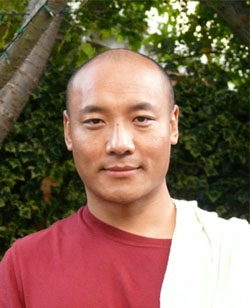
Anam Thubten Rinpoche

Rinpoche is a Tibetan word meaning, “precious one,” and is usually only applied to those recognized as reincarnations of spiritual leaders or teachers of the past, most famously, the current 14th Dalai Lama.

I first attended a retreat with Anam Thubten in December, 2005 and have been fortunate enough to get to a half-dozen more since then, for his home and teaching center, the  Dharmata Foundation in Point Richmond, CA, is not far away.  In the years since I first heard him, the clarity, resonance, and joy contained in his teachings have brought him greater renown:  his book, No Self, No Problem, originally published by the Dharmata Foundation, has been picked up by Snow Lion Press (a self-publishing success story!), and he was chosen to kick off the ongoing series of online retreats at Tricycle.com

In my own efforts to write of the concept of no-self last December, I quoted Anam Thubten for his simple, experiential way of presenting the concept:  “this ‘I’ is a fictitious entity that is always ready to whither away the moment we stop sustaining it.  We don’t have to go to a holy place to experience this.  All we have to do is simply sit and pay attention to our breath, allowing ourselves to let go of all our fantasies and mental images”

It should be clear that any culture like Tibet, that believes in Rinpoches, is not using the concept of “no-self” to tell us we don’t exist or that life does not continue after death.  In Anam Thubten’s vision, “no-self” means an end to the painful illusion of seperation, an end to isolation, an end to living in a friend-or-foe, fight-or-flight world.

Yet although he mentioned this concept, which first drew me to his teachings, on Saturday he had a different focus, “Primordial Mind,” the unconditioned and indefinable base of what we are, prior to concepts, prior to ego, prior to all delusions.  The experience of this spacious mind is surprisingly near if we are willing to let go of fixed concepts, and practice a simple meditation technique, and if we are motivated by devotion, by longing for union with the absolute the way a thirsty man longs for water.

Anam Thubten’s book elaborates the concepts we need to let go  of as well as his favorite meditation practice – the simple but difficult art of learning to relax and let go of effort, even the effort to meditate “well.”  This longing – for God or the guru or Buddha; for oneness, or emptiness or, selflessness, or enlightenment – however we conceive of the ultimate good, is finally a longing for love, he said, and this is what remains when our fixed ideas break down.  In Anam Thubten’s teaching, God is love, or Buddha Nature is love, as it is in the words of many other spiritual masters.

My description is close to being new-agey, which is why Anam Thubten is the teacher and I am not.  He didn’t gloss over the difficulty and struggles involved in a serious spiritual search, and in his quiet and understated way he noted that if one is not receptive, “this talk will be very strange.”

In the end, it is the person of the teacher himself that does the convincing.  Is this person really what he seems – genuinely centered, full of peace and compassion?  I believe Anam Thubten really is a man of peace and joy and I trust his message that what he has found is accessible to anyone willing to look and make the effort.   More information and his teaching schedule can be found at the Dharmata Foundation website,  http://www.dharmatafoundation.com/

Dharmata is a word that means, “the way things truly are.”