An Important Book You Can Only Buy on Amazon

News on ebooks seems to come in clusters, and it happened again today.  While having lunch at Fresh Choice, one of those build-your-own-salad type places, I was reading and enjoying a Donovan Creed novel by John Locke who I wrote about yesterday.

I’ve said many times that I think the burgeoning option of ebook publishing is important for readers and writers.  But there is important and there’s important.   Here’s something weightier than simply a good read.

After my lunch, I got in the car and turned on NPR to listen to, “Science Friday.”  Laurie Garrett was being interviewed about her book on 9/11 entitled, I heard the Sirens Scream.
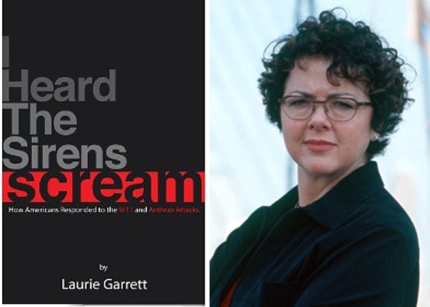
Ms Garrett is senior fellow for global health at the Council on Foreign Relations.  She’s the only journalist to win “the big three” prizes in her field, the Peabody, the Polk, and the Pulitzer, but you cannot get her book in a bookstore – it is only available on Amazon.

With all the impending chest thumping and flag waving on the occasion of the 10th anniversary of 9/11, I would suggest everyone listen to or read the transcript of this interview:  http://www.npr.org/2011/08/26/139972661/a-look-back-at-9-11-in-i-heard-the-sirens-scream

Garrett is furious that New York:  “became the reason to beat the drumbeats of war, that the attacks on our city were used by people who don’t live here to decide that we needed to invade Iraq, that the attacks on our city have been used by any number of politicians, misused, abused, with rewritten narrative, you know, the great lies told to justify all sorts of political things, everything from decreasing our civil liberties to building up a massive bioterrorism apparatus in this country, distorting our whole public health mission.

And I think the other thing is that as we approach the 10th anniversary, I should warn your listeners you’re going to be deluged with pathos.”

She contrasts this with the attempts of by Congress to deny funding to surviving Twin Towers rescue workers.  Garrett herself, who spent time near ground zero, was coughing up blood on her pillow at night, and talks of the way reports were massaged to remove the word, “asbestos.”

She summarizes worldwide response to 9/11 as unity or “singularity,” in outrage at the horror of the attacks, but goes on to say:  “You go out 120 days, that singularity has turned into the exact opposite: a moment of complete fracturing, of compete degeneration of the unity that was on one day…I think many of the ways that we responded, whether we’re talking about the public health response, the political response, the law enforcement, whatever aspect you look at, many of ways we responded set the seeds for this terrible, almost civil-war-type atmosphere that we live in in this country with such partisan dispute that the word compromise is considered evil, and the word governance is on nobody’s lips.”

You can see more of Laurie Garrett’s work on this and other topics at her blog: http://www.lauriegarrett.com

The Other eBook Superstar

Everyone remotely interested in ebook publishing knows Amanda Hocking’s story, but fewer, I am sure, have heard of John Locke.  No, not the 17th century philosopher.  I mean John Locke, the Louisville businessman who was the first self-published writer to sell a million ebooks on Amazon.  I first heard of him this week when a critique group friend handed me a clipping from the Aug. 23, print edition of The Wall Street Journal.

John Locke

Since 2009, Locke has written eight thrillers featuring former CIA assassin, Donovan Creed.  He has also written westerns and a self-help book for other writers who plan to publish digital books.  http://donovancreed.com/2011/06/lower-your-expectations-really/

The Journal article, “E-Book Author Tries New Format: Real Paperbacks,” described a contract Locke has signed with Simon & Schuster, to handle sales, distribution, and returns of eight paperback versions of existing digital books.  Locke will do the printing under his “Locke Books” imprint.  Simon & Schuster approached Locke’s New York agent to form the partnership.

Such distribution-only contracts are becoming more frequent as traditional publishers look for ways to compete with self-published books in the face of the loss of Borders as a major point of sale for printed books.  I heard a literary agent this spring confirm that successful ebook publishing is another possible avenue to traditional success, as measured by getting a New York agent and a contract with a “real” publisher.  On the other hand, only eight authors have sold a million books for Kindle – pretty long odds.

“For every John Locke, there are probably 5,000 authors trying and falling short,” says Arthur Klebanoff, CEO of RosettaBooks LLC, a digital publishing house.  But Klebanoff also says that, “The e-book world has created an opportunity in self-publishing that simply didn’t exist 18 months ago.”

The odds may be long on striking it rich and becoming a topic of cocktail party conversation, but the friend who gave me the article is going down the ebook road, as I may do someday.  I am a great believer in opportunities, and that is what Locke’s story represents.

Contests for Short-Short Stories and Poetry

Fall seems to be the busy time for writing contests and here are details on two new ones from Writer’s Digest.  How does $3000 for a 1500 word story sound?  Nice work if you can get it, and someone will!

The 12th annual Writer’s Digest Short-Short Story Competition has top prizes of $3000, $1500, and $500, plus prizes of $100 for the next six selections, and $50 WD book credits for those who place 11-25.  Names and story titles of the top 10 winners will be published in the magazine and posted online.  The deadline is is Nov. 15 and you can read the details at  http://www.writersdigest.com/competitions/short-story?et_mid=515537&rid=3017168

The 7th annual Writer’s Digest Poetry Competition has a similar schedule of prizes though they are less, for the maximum length is 32 lines.  All styles are welcome and names of the top 10 winners will be published in the magazine and published on the WD web site.  The deadline is December, 1 and details are here:  http://www.writersdigest.com/competitions/poetry?et_mid=515537&rid=3017168

Finally, don’t forget the ongoing WD contest for longer stories in six categories. Entries are due in September and October, with details available here in an earlier post:  https://thefirstgates.com/2011/07/21/six-writers-digest-short-story-competitions/

The Story of Charlotte’s Web by Michael Sims

In a recent interview on NPR, author Michael Sims discussed a project “that got really out of hand.”  He set out to do a natural history of children’s talking animal stories but became so fascinated by Charlotte’s Web that he never got beyond it.

Sim’s study, The Story of Charlotte’s Web: E.B. White’s Eccentric Life in Nature and the Birth of an American Classic, was published in June.  It’s interesting see what eccentricities and other facts Sims discovered about E.B. White.

White was quite a naturalist; on a farm in Maine, he studied spiders and raised pigs.  There really was a “Wilbur,” a pig that White was raising to slaughter in the fall, but it grew sick and died, despite all attempts to save it.  In his essay, “Death of a Pig,”  White recognized the irony of his sadness at the loss of an animal he had planned to kill, and his “sense of loss when the pig died, not as if he’d just lost some future bacon but as if he had lost…a fellow creature who was suffering in a suffering world.” 

Another time, while feeding the replacement Wilbur, White noticed a spider web with an egg sac.  The spider that wove the web disappeared, and White cut the egg sac down and carried it with him back to his apartment in New York.  He dropped it in a bureau drawer and forgot about it until the little spiders began to hatch.  According to Sims, White was delighted to watch them start to weave their webs in his room – that is, until the maid refused to work “in a spider refugee camp” and they had to go.

Sims explains that “eccentric” is a Greek word that originally meant, “off center.”  He goes on to say:

if ever there was a human being born off-center, it was E.B. White. He simply could not…follow in an established path if his life depended on it. And so he had his own quirky way. He was very fierce and funny hypochondriac. He liked to spend a lot of time alone. He loved working with animals, as much as possible. Even in New York City, even in writing for The New Yorker to begin with, he was off, you know, exploring what rats were doing in some alley.

Fans of E.B. White should enjoy listening to the interview or reading the transcript:  http://www.npr.org/2011/08/19/139790016/weaving-charlottes-web.  Of interest too, will be Michael Sims’s current project.  In keeping with his theme of “writing about how our imagination responds to nature in one way or another,” he is researching between the lines of Thoreau’s sojourn at Walden Pond to see how that great naturalist and philosopher filled up his days in ways we don’t yet know about.

Philip Levine: America’s New Poet Laureate

Philip Levine - Poet Laureate of the United States

Philip Levine was born in Detroit in 1928 and started writing poetry at 13.  He hated the “prissy” stuff he learned in school and modeled the language of his early work on preachers heard on the radio.  Levine wrote many of the poems that fill his 16 books in the evenings, after working by day in the auto plants. He has been called the “poet of the proletariat.”

In announcing Levine’s appointment, James H. Billington, of the Library of Congress, called Levine

“one of America’s great narrative poets. His plainspoken lyricism has, for half a century, championed the art of telling ‘The Simple Truth’—about working in a Detroit auto factory, as he has, and about the hard work we do to make sense of our lives.”  http://www.npr.org/blogs/thetwo-way/2011/08/10/139348573/philip-levine-named-as-americas-new-poet-laureate

Levine’s collection of poetry, The Simple Truth won a Pulitzer Prize in 1995.

Here is the title poem:

The Simple Truth by Philip Levine

I bought a dollar and a half’s worth of small red potatoes,
took them home, boiled them in their jackets
and ate them for dinner with a little butter and salt.
Then I walked through the dried fields
on the edge of town. In middle June the light
hung on in the dark furrows at my feet,
and in the mountain oaks overhead the birds
were gathering for the night, the jays and mockers
squawking back and forth, the finches still darting
into the dusty light. The woman who sold me
the potatoes was from Poland; she was someone
out of my childhood in a pink spangled sweater and sunglasses
praising the perfection of all her fruits and vegetables
at the road-side stand and urging me to taste
even the pale, raw sweet corn trucked all the way,
she swore, from New Jersey. “Eat,” she said,
“even if you don’t I’ll say you did.”
Some things
you know all your life. They are so simple and true
they must be said without elegance, meter and rhyme,
they must be laid on the table beside the salt shaker,
the glass of water, the absence of light gathering
in the shadows of picture frames, they must be
naked and alone, they must stand for themselves.
My friend Henri and I arrived at this together in 1965
before I went away, before he began to kill himself,
and the two of us to betray our love. Can you taste
what I’m saying? It is onions or potatoes, a pinch
of simple salt, the wealth of melting butter, it is obvious,
it stays in the back of your throat like a truth
you never uttered because the time was always wrong,
it stays there for the rest of your life, unspoken,
made of that dirt we call earth, the metal we call salt,
in a form we have no words for, and you live on it.

When he first heard of the appointment, Levine was skeptical.  “I’m fairly irreverent,” he said, “and an old union man.”  In the end he realized this was his chance to reach a wider audience than he has had in years, and he accepted.  Levine will hold the office of Poet Laureate for the coming year.

***

Learning of Levine’s appointment was not just exciting in the sense of finding a new author to read, but exciting because the central passage of “The Simple Truth,” contains a compelling challenge.  What are those things, the poem seems to ask, in my life and in yours, that are so simple and true they can stand by themselves, unadorned, beside the salt shaker and a glass of water in evening light as it falls across the table:

Some things
you know all your life. They are so simple and true
they must be said without elegance, meter and rhyme,
they must be laid on the table beside the salt shaker,
the glass of water, the absence of light gathering
in the shadows of picture frames, they must be
naked and alone, they must stand for themselves.

The Wind In the Willows by Kenneth Grahame: An Appreciation

It was a golden afternoon; the smell of the dust they kicked up was rich and satisfying - Illustration for The Wind in the Willows by Arthur Rackham, 1940

Kenneth Grahame was a turn of the century British author who was Secretary of the Bank of England “in his spare time” (according to A.A. Milne).  In 1908, Grahame published The Wind in the Willows, his third novel.  Unlike his first two books, The Wind in the Willows was not an immediate success, though its early supporters included Theodore Roosevelt, who wrote to the author in 1909, “I have read it and reread it, and have now come to accept the characters as old friends.”

Arthur Rackham was perhaps the best known artist of “the golden age of illustration,” from 1870-1930.  His illustrations for The Wind in the Willows were his last work, published posthumously in 1940, a year after Rackham died of cancer.

Shove that under your feet, he observed to the mole, as he passed it down into the boat - Arthur Rackham, 1940

I cannot think of a more auspicious partnership in the history of book illustration, though I am biased.  I’m writing about The Wind in the Willows because I stopped by a blog that asked, “What is your favorite book?”  This has been mine since my mother read it to me when I was four.  When she finished, I begged her to start it again.  I began school determined to learn to read as soon as I could so I would not have to wait on anyone else’s convenience to row up the river with Rat and Mole.

The badger's winter stores, which indeed were visible everywhere, took up half the room - Arthur Rackham, 1940

I called this post an appreciation rather than a book review, because my intent is not to be systematic. Besides, in his introduction, A.A. Milne warns us not to dare anything so foolish:

One does not argue about The Wind in the Willows.  The young man gives it to the girl with whom he is in love, and if she does not like it, asks her to return his letters.  The older man tries it on his nephew, and alters his will accordingly.  The book is a test of character.  We can’t criticize it because it is criticizing us.

She arranged the shawl with a professional fold, and tied the strings of the rusty bonnet under his chin - Arthur Rackham, 1940

The magic of this volume lies in text as well as the illustrations.  This is story of friendship, of terror in the Wild Wood, of the ache of standing outside looking in on Christmas eve.  There is slapstick and comedy, and a battle against heavy odds to restore the natural order along the river bank, but the center of the story for me has always been Chapter 7, “The Piper at the Gates of Dawn.”

Otter’s son Portly has gone missing, and one mild summer evening, Rat and Mole row the backwaters trying to find him.  They catch the strains of a haunting tune:

“It’s gone!” sighed the Rat, sinking back in his seat again.  “So beautiful and strange and new!  Since it was to end so soon, I almost wish I had never heard it.  For it has roused a longing in me that is pain, and nothing seems worth while but just to hear that sound once more and go on listening to it for ever.  No!  There it is again!”

The animals follow the sound and it leads them to a place where a great Awe falls upon them and they are granted a vision:  [Mole] raised his humble head; and then, in that utter clearness of the imminent dawn, while Nature, flushed with fullness of incredible color, seemed to hold her breath for the event, he looked in the very eyes of the Friend and Helper.”

The animals find the baby otter and the vision fades, leaving them in misery as they feel what they have lost, but then, a capricious little breeze, dancing up from the surface of the water, tossed the aspens, shook the dewy roses, and blew lightly and caressingly in their faces, and with its soft touch came instant oblivious.  For this is the last best gift that the kindly demigod is careful to bestow on those to whom he has revealed himself in their helping:   the gift of forgetfulness.  Leset the awful remembrance should remain and grow, and overshadow mirth and pleasure, and the great haunting memory should spoil all the after-lives of little animals.

The minister in the church I attended when I was young once said from the pulpit that “The Piper at the Gates of Dawn,” was the best theology he knew outside the Bible.

Together, Kenneth Grahame and Arthur Rackham preserved and shared a vision of an older, idyllic England of quiet lanes and riverbanks and launched it into a new century that needed such a dream, after one World War and on the eve of a second.  Last time I looked for a gift for a friend, a facsimile edition was available (from Modern Library I believe).

There are other nice editions like the one illustrated by Michael Hague and published in 1980, for there are more ways than one into this dream.

Wind in the Willows cover by Michael Hague, 1980

I guess you could say I’ve been dreaming along with the great British storytellers all my life – with Rat and Mole, with Pooh and Piglet; in Middle Earth and Narnia; with King Arthur and his knights; with Welsh wizards and Irish warriors and Tam Lin in Faerie; Harry Potter is simply the latest feast from the cornucopia I first encountered when I was four years old.

If you have not yet discovered the magic of The Wind in the Willows (and I don’t mean Mr. Toad’s Wild Ride @Disney) I suggest you give it a look as soon as can.  In my experience (as in Bilbo’s) there is no telling where the road will take you.

The wayfarer saluted with a gesture of courtesy that had something foreign about it - Arthur Rackham, 1940

Guest Post by Indie Author, Jayden Scott – Part 2

Yesterday, our guest blogger, Jayde Scott, spoke of what led her to publish her novels on Smashwords.  Today she describes all the work behind her growing success, (in addition to writing novels).  She cautions that:   Independent publishing isn’t an easy route to go and it’s certainly not a ‘get rich quickly’ scheme. Be prepared to invest more time than in a nine to five job.

She includes a link to her blog, Fiction and More, and I’ve added it to my blogroll, since her stated intent is to help writers promote and market their work.  

Also, If you have not already done so, please visit her Smashwords homepage to look at the full range of her books: http://www.smashwords.com/profile/view/JScott

My sincere thanks to Ms. Scott for sharing all she has done to champion her own work.  This is vital information to anyone thinking of following her path into print.

_______________________________________________________

So how did I do it? With lots and lots of marketing such as contacting blog hosts for reviews, giveaways, interviews and book spotlights. I don’t just copy and paste the information about my book into my emails to possible reviewers; I take the time to get to know their blogs and preferences and try to send them all information as requested in their review policies. Since they invest so much of their time and effort into reading my books, it’s only respectful that I at least try to make it easier for them to decide whether my book is something they might enjoy or not.

Independent publishing isn’t an easy route to go and it’s certainly not a ‘get rich quickly’ scheme. Be prepared to invest more time than in a nine to five job. Establishing a presence with all the fierce competition is tough work. Several times I changed the covers of my books, which involved days of searching sites like istockphoto.com and fotolia.com for the right digital art; once I changed the title, after which sales picked up. I also spend days on designing my print books and book trailers, and promoting those on various sites. As a very active Goodreads member, I devote a great amount of time to answering messages and updating my blog, http://jayde-scott.blogspot.com/, in case readers stop by to find out more about me and my books. And finally, I try to keep in touch with many author friends because, like in every job, connections matter. One of the most important tasks for any indie author, however, is writing and publishing a constant flow of well-edited quality work to keep up with fast moving trends. Even though I can’t afford paying a professional editor, I have two editor friends who proofread my work. My critique group helps with brainstorming and provides feedback on character development, story elements and pace. Even though my books are cheap, I try my best to give readers good quality for their money.

Writing has gifted me with a purpose in life, and nothing gives me more pleasure than hearing how much readers enjoyed my books. I’m a full time writer now who’s still sending out application forms to get a job, but the job market in the UK is shaky and doesn’t seem to want to recover any time soon. Independent publishing has at least helped ease my financial struggles and I know it’s helped many of my fellow authors, too.

Guest Post by Indie Author, Jayden Scott – Part 1

At the start of May, Jayde Scott, a young writer from England, invited me to review her eBook, A Job From Hell.  Based on the professional presentation of her Smashwords page,  http://www.smashwords.com/books/view/56864, I agreed, though with some trepidation:  vampire romance isn’t normally “my thing.”

To our mutual relief, I enjoyed A Job From Hell and posted my review here at the end of May:  https://thefirstgates.com/2011/05/25/a-job-from-hell-by-jayde-scott-book-review/.  During the process, we exchanged a few emails – enough for me to realize what a complex operation an ebook publishing and marketing venture can be.  I invited Ms. Scott to describe her process, and she found the time – despite publishing two new titles this summer – to send a very detailed reply.  So detailed, in fact, that I’ve split her post into two sections.

In this section, the author describes what led her to the world of Indie publishing.  The next section outlines the nuts and bolts of her procedure.  Anyone who is interested in ebook publishing will find a wealth of information in Ms. Scott’s account.

__________________________________________________

Jayde Scott

A year ago, I would never have thought I’d be an indie author one day. At that time, I was unemployed, like many people in the UK, and could barely afford paying the rent let alone meet the monthly repayments of my student loan. Even with two good degrees, I had been looking for a job for three years without much success. During breaks from filling out application forms and struggling to get freelance work, I kept myself sane by writing as much as I could. It was my way to deal with the stress and pressure of not having a regular job.

Writing had been a hobby of mine for more than ten years. I had six books ready for publication and was actively seeking an agent or publisher for my work. Several times I came very close to landing an agent and did the ‘suggested’ changes to my manuscripts, only to have my hopes dashed again. With publishers I had similar experiences, some rejected me because I wouldn’t cut down on a 94k manuscript, others because they didn’t like a particular character. There was a time when I just couldn’t afford the horrendous postage charges for sending a manuscript to the US, so I kept postponing sending off large parcels until I got a freelance gig and had some money left.

After reading about Amanda Hocking’s success, I realised publishing doesn’t start and end with landing an agent and selling one’s work to one of the big six publishers. Sure, that would be a nice accomplishment, but I figured I might be more likely to win the lottery. It took me a long time to take this step because I kept hoping someone might make an offer soon, but when the offer never came in and I was more and more struggling to get a job and pay the bills, I decided I had nothing to lose by going the independent route. At least I had tried my best.

So, instead of wasting yet more time, I spent two weeks getting my first manuscript, Alex Gonzo, Royal Spy, ready for publishing via Kindle. It took a few attempts (actually, more than I care to reveal), but I finally figured out how to format it correctly after which it became easier with every book published.

Needless to say, I knew next to nothing about self-publishing a book or the marketing involved. I had heard of authors using Twitter and Facebook to promote their work, but that about summed up my knowledge of social media. My first attempts at Tweeting were pretty much useless and Alex Gonzo, Royal Spy didn’t sell a single copy. Five months later, I had barely sold 100 copies of that book, but I wasn’t ready to give up and self published A Job From Hell, which is the first book in the Ancient Legends series. That book didn’t take off straight away. In fact, I only sold about 60 copies in the first month. However, the more time I spent researching on the Internet and reading as many blog on publishing as I could find, the more I was determined to succeed, not least because I still hadn’t found a job and it didn’t look like I would in the near future.

Three months and a few more books later, I sell a few thousand copies a month. My books aren’t doing as great on Amazon as those of some of my fellow authors and I’m thinking maybe my coverart isn’t that great, maybe my blurbs would benefit from a makeover. However, at a price of 99c a book, my earnings at least pay the monthly rent, which is more than I would’ve earned if I kept contacting agents and publishers only to have my confidence crushed.

TO BE CONTINUED