Going to the Canines

Today is the 20 year anniversary of several important events.  For starters, I had managed to last seven years in the corporate world, so on Friday, August 30, 1991, I was starting my first sabbatical:  ten weeks paid time off.  The tech industry was booming then, and they did things like that.

I was also finishing up a masters’s thesis for a degree in psych I’d been working on in my spare time – I did things like that.  But the most important thing we did on this day 20 years ago was bring home a dog.

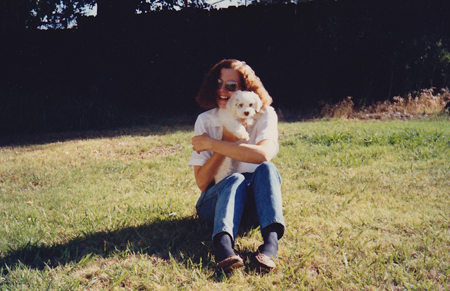
Charis negotiates a step - Aug. 30, 1991

We had her picked out and all the arrangements made ahead of time, but that day – leaving work for ten weeks and bringing home a puppy to celebrate was one of the most memorable of my life.  It was just a bit less memorable for Mary.  Charis was riding in a crate in the back seat, howling because she wasn’t used to cars, so Mary thought she might be happier riding on her lap, where the puppy promptly peed.  We laughed about it then and now – nothing a little soap and water couldn’t fix.

Mary and Charis, fall, 1991

We have shared every day for the last twenty years with one, or two, and recently three dogs (which is really too many but at the time we couldn’t say no).  We started this anniversary day with a walk in the park for our two rescue dogs, and then another class.  We’ve discovered that rescue dogs are analogous to foster kids – they have issues.  These two are doing pretty well with extra training (which I sometimes call, reform school, depending on their behavior).  A side benefit of the class is, it tires them out.  As I write this, they are sleeping like little angels.

Which is what they really are.  As William Stafford put it in his poem, “Choosing a Dog:”

“It’s love,” they say. You touch
the right one and a whole half of the universe
wakes up, a new half.

A few years after we got Charis, I spent some time as a volunteer for the Folsom City Zoo Sanctuary.  Vixen the fox had come there when she was four weeks old, so she got very used to humans.  So used to humans that she could milk it really well, and as a result, she was getting rather pudgy.  For her own health, some of the keepers and volunteers would leash her up and take her for walks.

Vixen the Fox, ca. 1995

Once or twice a week for several years, I would get there at 7:00 am and take this little wild animal for a walk through the rising dawn.  That was an unforgettable way to start the morning!  One day, someone at an 8:00 am meeting who hadn’t had his coffee said, “What the hell are you smiling about?”

“Long story,” I said.  And kept on smiling.  Through all of it, all of the ups and downs, the joys and the losses, that’s what it’s like when you share your life with dogs and their wild kin.

Bird by Bird and Other Writing by Anne Lamott

“Thirty years ago my older brother, who was ten years old at the time, was trying to get a report on birds written that he’d had three months to write, which was due the next day…he was at the kitchen table close to tears, surrounded by binder paper and pencils and unopened books on birds, immobilized by the hugeness of the task ahead.  Then my father sat down beside him, put his arm around my brother’s shoulder, and said, “Bird by bird, buddy.  Just take it bird by bird.” – Anne Lamont 

While hunting for something else, I came upon my copy old of, Bird by Bird:  Some Instructions on Writing and Life,” 1994, by Anne Lamott.  Those who appreciate Natalie Goldberg’s reflections on writing will enjoy Lamott.

“I dropped out [of college] at nineteen to become a famous writer.  I moved back to San Francisco and became a famous Kelly Girl instead.  I was famous for my incompetence and weepiness.  I wept with boredom and disbelief.”

Two things strike you right away about Lamott on writing:  she is very funny and she is a firm believer in telling one’s own unique truth.  This is a theme she returns to again and again.  Lamott has been telling her truths since her first novel, Hard Laughter, 1980, a largely autobiographical portrait of her eccentric family as her father was dying of a brain tumor.

Getting published was something Lamott had dreamed of since she realized as a child, that her father, the writer, was neither “unemployed or mentally ill.”  When Hard Laughter was published, three years after her father’s death, Lamott realized that public success was not what nourished her:

“I believed, before I sold my first book, that publication would be instantly and automatically gratifying, an affirming and romantic experience…this did not happen for me.  The months before a book comes out of the chute are, for most writers, right up there with the worst life has to offer.”

“I…try to warn people who hope to get published that publication is not all that it is cracked up to be.  But writing is.  Writing has so much to give, so much to teach so many surprises.  That thing you had to force yourself to do – the actual act of writing – turns out to be the best part.  It’s like discovering that while you thought you needed the tea ceremony for the caffeine, what you really needed was the tea ceremony.  The act of writing turns out to be its own reward.” 

Lamott has taught writing at UC Davis and at various workshops.  Bird by Bird mirrors the advice and methods she gives her students.

Anne Lamott

I have not read all of her sections on the mechanics of writing.  Suffice to say that I find her introspective style better suited to illuminating the twists and turns of the process itself than conveying nuts and bolts information.  Like Goldberg, I think the essay is the medium where Lamott really shines, and in another parallel, her most recent writings on spirituality are what I value most.

In Travelling Mercies:  Some Thoughts on Faith, 2000, Lamott holds nothing back in describing how her alcoholic bottom led her to Christianity – the last place, as a life-long bohemian, that she wanted to be.

“I became aware of someone with me, hunkered down in the corner, and I just assumed it was my father, whose presence I had felt over the years when I was frightened and alone.  The feeling was so strong I actually turned on the light for a moment to make sure no one was there…after a while, I knew beyond any doubt that it was Jesus…and I was appalled.  I thought about my life and my brilliant hilarious progressive friends.  I thought about what everyone would think of me if I became a Christian…I turned to the wall and said out loud, “I would rather die.”

I felt him just sitting there on his haunches in the corner of my sleeping loft, watching me with patience and love, and I squished my eyes shut, but that didn’t help because that’s not what I was seeing him with.”

Travelling Mercies relates how Lamott, as a newly sober alcoholic and single mother who had never been to church, sets out to follow her truth where ever it may lead.  People raised as Christians may not have wrestled with all the questions Lamott has to face, beginning with how she’s supposed to find a church to nourish both her and her son.  It continues with all the issues we face in living day to day.  What do we make of the death of friends, of loss, of a son who doesn’t want to go to church, or announces, “I wish I had never been born?”  These and other questions about living her faith seven days a week have led Lamott to write two other books on spirituality, Plan B:  Further Thoughts on Faith, 2006, and Grace (Eventually): Thoughts on Faith, 2007.  My wife is reading that one now, and I’ve flipped through the contents and may borrow it when she is done.

In a prophetic passage in Bird by Bird, Lamott laid out a credo for her writing students that she continues to follow:

“Truth seems to want expression.  Unacknowledged truth saps your energy and keeps you and your characters wired and delusional.  But when you open the closet door and let what was inside out, you can get a rush of liberation and even joy.  If we can believe in the Gnostic gospel of Thomas…Jesus said, “If you bring forth what is inside you, what you bring forth will save you.  If you don’t bring forth what is inside you, what you bring forth can destroy you.”

If you haven’t discovered Anne Lamott’s work, I suggest you sample her titles in a bookstore or on Amazon, and see what she has to offer.  Her unique take on the life around her can bring you up short and shift your perspective on where you are and what you are doing.
An Important Book You Can Only Buy on Amazon

News on ebooks seems to come in clusters, and it happened again today.  While having lunch at Fresh Choice, one of those build-your-own-salad type places, I was reading and enjoying a Donovan Creed novel by John Locke who I wrote about yesterday.

I’ve said many times that I think the burgeoning option of ebook publishing is important for readers and writers.  But there is important and there’s important.   Here’s something weightier than simply a good read.

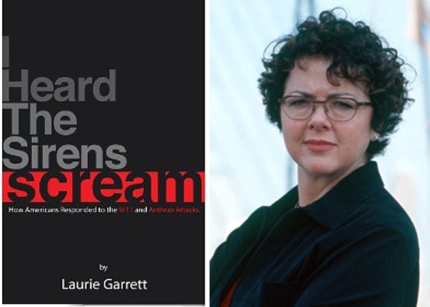
After my lunch, I got in the car and turned on NPR to listen to, “Science Friday.”  Laurie Garrett was being interviewed about her book on 9/11 entitled, I heard the Sirens Scream.

Ms Garrett is senior fellow for global health at the Council on Foreign Relations.  She’s the only journalist to win “the big three” prizes in her field, the Peabody, the Polk, and the Pulitzer, but you cannot get her book in a bookstore – it is only available on Amazon.

With all the impending chest thumping and flag waving on the occasion of the 10th anniversary of 9/11, I would suggest everyone listen to or read the transcript of this interview:  http://www.npr.org/2011/08/26/139972661/a-look-back-at-9-11-in-i-heard-the-sirens-scream

Garrett is furious that New York:  “became the reason to beat the drumbeats of war, that the attacks on our city were used by people who don’t live here to decide that we needed to invade Iraq, that the attacks on our city have been used by any number of politicians, misused, abused, with rewritten narrative, you know, the great lies told to justify all sorts of political things, everything from decreasing our civil liberties to building up a massive bioterrorism apparatus in this country, distorting our whole public health mission.

And I think the other thing is that as we approach the 10th anniversary, I should warn your listeners you’re going to be deluged with pathos.”

She contrasts this with the attempts of by Congress to deny funding to surviving Twin Towers rescue workers.  Garrett herself, who spent time near ground zero, was coughing up blood on her pillow at night, and talks of the way reports were massaged to remove the word, “asbestos.”

She summarizes worldwide response to 9/11 as unity or “singularity,” in outrage at the horror of the attacks, but goes on to say:  “You go out 120 days, that singularity has turned into the exact opposite: a moment of complete fracturing, of compete degeneration of the unity that was on one day…I think many of the ways that we responded, whether we’re talking about the public health response, the political response, the law enforcement, whatever aspect you look at, many of ways we responded set the seeds for this terrible, almost civil-war-type atmosphere that we live in in this country with such partisan dispute that the word compromise is considered evil, and the word governance is on nobody’s lips.”

You can see more of Laurie Garrett’s work on this and other topics at her blog: http://www.lauriegarrett.com

The Other eBook Superstar

Everyone remotely interested in ebook publishing knows Amanda Hocking’s story, but fewer, I am sure, have heard of John Locke.  No, not the 17th century philosopher.  I mean John Locke, the Louisville businessman who was the first self-published writer to sell a million ebooks on Amazon.  I first heard of him this week when a critique group friend handed me a clipping from the Aug. 23, print edition of The Wall Street Journal.

John Locke

Since 2009, Locke has written eight thrillers featuring former CIA assassin, Donovan Creed.  He has also written westerns and a self-help book for other writers who plan to publish digital books.  http://donovancreed.com/2011/06/lower-your-expectations-really/

The Journal article, “E-Book Author Tries New Format: Real Paperbacks,” described a contract Locke has signed with Simon & Schuster, to handle sales, distribution, and returns of eight paperback versions of existing digital books.  Locke will do the printing under his “Locke Books” imprint.  Simon & Schuster approached Locke’s New York agent to form the partnership.

Such distribution-only contracts are becoming more frequent as traditional publishers look for ways to compete with self-published books in the face of the loss of Borders as a major point of sale for printed books.  I heard a literary agent this spring confirm that successful ebook publishing is another possible avenue to traditional success, as measured by getting a New York agent and a contract with a “real” publisher.  On the other hand, only eight authors have sold a million books for Kindle – pretty long odds.

“For every John Locke, there are probably 5,000 authors trying and falling short,” says Arthur Klebanoff, CEO of RosettaBooks LLC, a digital publishing house.  But Klebanoff also says that, “The e-book world has created an opportunity in self-publishing that simply didn’t exist 18 months ago.”

The odds may be long on striking it rich and becoming a topic of cocktail party conversation, but the friend who gave me the article is going down the ebook road, as I may do someday.  I am a great believer in opportunities, and that is what Locke’s story represents.

Contests for Short-Short Stories and Poetry

Fall seems to be the busy time for writing contests and here are details on two new ones from Writer’s Digest.  How does $3000 for a 1500 word story sound?  Nice work if you can get it, and someone will!

The 12th annual Writer’s Digest Short-Short Story Competition has top prizes of $3000, $1500, and $500, plus prizes of $100 for the next six selections, and $50 WD book credits for those who place 11-25.  Names and story titles of the top 10 winners will be published in the magazine and posted online.  The deadline is is Nov. 15 and you can read the details at  http://www.writersdigest.com/competitions/short-story?et_mid=515537&rid=3017168

The 7th annual Writer’s Digest Poetry Competition has a similar schedule of prizes though they are less, for the maximum length is 32 lines.  All styles are welcome and names of the top 10 winners will be published in the magazine and published on the WD web site.  The deadline is December, 1 and details are here:  http://www.writersdigest.com/competitions/poetry?et_mid=515537&rid=3017168

Finally, don’t forget the ongoing WD contest for longer stories in six categories. Entries are due in September and October, with details available here in an earlier post:  https://thefirstgates.com/2011/07/21/six-writers-digest-short-story-competitions/

The Story of Charlotte’s Web by Michael Sims

In a recent interview on NPR, author Michael Sims discussed a project “that got really out of hand.”  He set out to do a natural history of children’s talking animal stories but became so fascinated by Charlotte’s Web that he never got beyond it.

Sim’s study, The Story of Charlotte’s Web: E.B. White’s Eccentric Life in Nature and the Birth of an American Classic, was published in June.  It’s interesting see what eccentricities and other facts Sims discovered about E.B. White.

White was quite a naturalist; on a farm in Maine, he studied spiders and raised pigs.  There really was a “Wilbur,” a pig that White was raising to slaughter in the fall, but it grew sick and died, despite all attempts to save it.  In his essay, “Death of a Pig,”  White recognized the irony of his sadness at the loss of an animal he had planned to kill, and his “sense of loss when the pig died, not as if he’d just lost some future bacon but as if he had lost…a fellow creature who was suffering in a suffering world.” 

Another time, while feeding the replacement Wilbur, White noticed a spider web with an egg sac.  The spider that wove the web disappeared, and White cut the egg sac down and carried it with him back to his apartment in New York.  He dropped it in a bureau drawer and forgot about it until the little spiders began to hatch.  According to Sims, White was delighted to watch them start to weave their webs in his room – that is, until the maid refused to work “in a spider refugee camp” and they had to go.

Sims explains that “eccentric” is a Greek word that originally meant, “off center.”  He goes on to say:

if ever there was a human being born off-center, it was E.B. White. He simply could not…follow in an established path if his life depended on it. And so he had his own quirky way. He was very fierce and funny hypochondriac. He liked to spend a lot of time alone. He loved working with animals, as much as possible. Even in New York City, even in writing for The New Yorker to begin with, he was off, you know, exploring what rats were doing in some alley.

Fans of E.B. White should enjoy listening to the interview or reading the transcript:  http://www.npr.org/2011/08/19/139790016/weaving-charlottes-web.  Of interest too, will be Michael Sims’s current project.  In keeping with his theme of “writing about how our imagination responds to nature in one way or another,” he is researching between the lines of Thoreau’s sojourn at Walden Pond to see how that great naturalist and philosopher filled up his days in ways we don’t yet know about.

Cowboys and Aliens: A Movie Review

Can you guess what this movie is about? I couldn’t, not with precision.  I was expecting something whimsical and set in contemporary times.  Instead, we are transported to 19th century New Mexico, with bad-ass cowboys, really bad-ass aliens (think, Sigourney Weaver aliens), noble Apaches, and a beautiful pistol packing mama who is – lets just say, not from around these parts.

We open with Daniel Craig as a western  badman, who brings the same cold-eyed killer vibe to this role as he does to his other life as James Bond.  True, his circumstances are a little bit odd – his memory is gone, he wears a strange bracelet, and his wound looks suspiciously like he’s been probed.  But after a lot of opening violence, and with Keith Carradine as marshal, Harrison Ford as the cattle baron, and several appealing secondary characters – the preacher, the kid, and the barkeep – I found my belief pretty well suspended by the time the saucers flew into town to harvest the good citizens.

Harrison Ford and Daniel Craig facing long odds

We get romance, redemption, coming of age, and finding one’s courage, but more than anything else, this is a good old fashioned shoot-em-up, with some nail-biting moments, and bad guys you can hate with abandon; they are despicable, disgusting, and slimy.

Like a phoenix, Olivia Wilde is reborn in flames

If you want to be stodgy and boring, you could ask why these creatures with intergalactic technology want gold so badly, but when you get right down to it, although they are big and tough, they are not the sharpest tools in the cosmic shed.  This is a job for good old American know-how and grit, and a wee bit of help from “beyond the stars.”

Leave the stodgy questions at home, and you’ll have a very good time.

The Magicians by Lev Grossman: A Book Review

Lev Grossman’s, The Magicians, 2009, was highlighted in a recent NPR feature on “Books for the Hogwart’s Grad.” It is an adult fantasy that begins with a 17 year old boy and does something no YA novel I’ve recently come upon has done – it nails what being 17 is really like.

On his way to a preliminary interview for admission to Princeton, Quentin Coldwater reflects on his life:  I should be happy, Quentin thought.  I’m young and alive and healthy.  I have good friends.  I have two reasonably intact parents…I am a solid member of the middle-middle class.  My GPA is a number higher than most people even realize it is possible for a GPA to be.  But walking along Fifth Avenue in Brooklyn…Quentin knew he wasn’t happy.  Why not?  He had painstakingly assembled all the ingredients of happiness…But happiness, like a disobedient spirit, refused to come.  He couldn’t think what else to do.

In a passage that reminds me of my own adolescence, Quentin believes that “his real life, the life he should be living, had been mislaid through some clerical error by the cosmic bureaucracy.  This couldn’t be it.  It had been diverted somewhere else, to somebody else, and he had been issued this shitty substitute faux life instead.”

When he finds the interviewer dead of a cerebral hemorrhage, events catapult Quentin into “the life he should be living,” with dizzying speed.  Walking by himself in the rain after finding the dead man, Quentin is transported to the upstate New York campus of the Brakebills College for Magical Pedagogy.

Grossman clearly has chutzpah to write of a school of magic in a decade dominated by Harry Potter, but Brakebills has little to do with Hogwarts.  After a grueling entrance exam, Quentin begins his even more grueling, five year course of study with a small group of nerdy prodigies like himself.  He’s as slammed by as much work as any freshman at Harvard or MIT.  Magic becomes truly serious for Quentin when he casts a minor spell as a joke that sets off a chain reaction resulting in another student’s death.  Like people in the real world who make such mistakes in youth, he learns to live with the guilt and “move beyond,” but it never entirely goes away.

Quentin and a few other students begin to bond, most notably, Alice who becomes his lover.  Quentin, Alice, and most of their friends at Brakebills have been entranced since childhood by the magical world of Fillory, the creation of a 1930’s reclusive English author.

Stories of Fillory are woven throughout The Magicians, but grow in importance after Quentin and his friends graduate.  They move to Manhattan, and though Alice buries herself in serious magical research, Quentin and the others settle into serious dissipation:  “They had all the power in the world, and no work to do, and nobody to stop them.  They ran riot through the city.”  Happiness still eludes Quentin until he and the others discover Fillory is real and they find the means to go there.

The Magicians belongs to the adult “urban fantasy” sub-genre, and one of the characteristics of such books is a very realistic portrait of the gritty, day-to-day world we share, which makes the magic seem real when it appears.  The Brakebills graduates pass the bottle while discussing what supplies they should pack for their expedition:  how about parkas in case it’s cold?  Food of course, and trade goods – what would they be?  And weapons – handguns, and body armor, and battle magic, which they have to create for themselves, since it is forbidden

By this point in the narrative, every reader who knows Narnia, which Fillory consciously echoes, must be cringing at the thought of a bunch of armed and boozy, world-weary twenty-somethings storming the gates.  It turns out the explorers were wise to arm themselves, for Fillory is a gritty realm where strange creatures kill each other for no clear rhyme or reason.  When a human size praying mantis fires an arrow at Quentin, they realize this magic is not magical in the way the stories we loved as children are magical.

“This isn’t a story,” Alice says.  “This isn’t a story!  It’s just one fucking thing after another!”

Aside from a page-turning narrative, there is much to ponder in Grossman’s tale, and I find myself thinking of Woody Allen’s movies about movies, especially, The Purple Rose of Cairo, where a movie hero get loose in our world and is hopelessly unable to cope.  In The Magicians, characters from our world are equally out of their depths in a fictional story world.

Clinically speaking, our lives (apparently) are just one thing after another, but making stories is an instinct we all are born with.  From a two year old with stick figures, to the water cooler at work, to Jesus and Buddha, to writers of fiction, making stories is how we make sense of things.  Lev Grossman offers a fascinating reflection on making stories in the shape of a story that keeps us turning pages.

***

Lev Grossman, whose day job involves reviewing books for Time, published the second book of his trilogy The Magician King, this summer, which has moved to the head of my book queue.   Grossman is a lover, connoisseur, and advocate for the fantasy genre.  He strongly resists the notion that fantasy is “less than” other types of literature in any way.

Lev Grossman