Notes from 2017 – William Stafford

William Stafford, from the announcement of the centennial celebration of his birth, 2014, at Lewis and Clark College

William Stafford, from the announcement of the centennial celebration of his birth, 2014, at Lewis and Clark College

Some poems are prophetic, though readers and the poet alike discover this only after the passage of time. William Stafford (1914-1993) wrote poems like this. Of his process, he said, “It’s like fishing,” and “A writer is not so much someone who has something to say as he is someone who has found a process that will bring about new things he would not have thought of if he had not started to say them.” (1)

Stafford was born and raised in Kansas. During WWII, as a contentious objector, he served in Civilian Public Service camps from 1942 t0 1946 for $2.50 a month. In 1947, he moved to Oregon to teach at Lewis and Clark College, a post he held for 30 years. He was a late bloomer, who did not publish the first of his 57 volumes of poetry until he was 46.

William Stafford was named “Consultant in Poetry to the Library of Congress” in 1970, a position now called Poet Laureate of the US. He was Poet Laureate of Oregon from 1975-1990. James Dickey said William Stafford was one of those poets”who pour out rivers of ink, all on good poems.” He wrote 22,000 of these in his lifetime, and published 3,000 of those.

He left an unfinished poem, “Are You Mr. William Stafford?” on August 28, 1993, the day he died of a heart attack, containing these lines:

“You can’t tell when strange things with meaning
will happen. I’m [still] here writing it down
just the way it was. “You don’t have to
prove anything,” my mother said. “Just be ready
for what God sends.” I listened and put my hand
out in the sun again. It was all easy.”

In an article in the New York Times Review of Books, Ralph J. Mills Jr. said, “Stafford’s work and attitudes say a good deal indirectly about contemporary modes of living that have lost touch with the earth and what it has to teach. He uncovers and keeps alive strata of experience and knowledge that his readers are in grave danger of losing, and without which, Stafford keeps saying, they will forget how ‘To walk anywhere in the world, to live / now, to speak, to breathe a harmless / breath.'”(1)

All these are reasons why Stafford’s work remains fresh, and seems even more timely as time goes on. One of my favorite poems, “A Ritual to Read to Each Other,” was published in 1962. It seems to me that out of time, he is speaking to us directly, urgently, pointedly at this solstice season of 2016:

A Ritual to Read to Each Other

If you don’t know the kind of person I am
and I don’t know the kind of person you are
a pattern that others made may prevail in the world
and following the wrong god home we may miss our star.

For there is many a small betrayal in the mind,
a shrug that lets the fragile sequence break
sending with shouts the horrible errors of childhood
storming out to play through the broken dyke.

And as elephants parade holding each elephant’s tail,
but if one wanders the circus won’t find the park,
I call it cruel and maybe the root of all cruelty
to know what occurs but not recognize the fact.

And so I appeal to a voice, to something shadowy,
a remote important region in all who talk:
though we could fool each other, we should consider–
lest the parade of our mutual life get lost in the dark.

For it is important that awake people be awake,
or a breaking line may discourage them back to sleep;
the signals we give–yes or no, or maybe–
should be clear: the darkness around us is deep.

–William Stafford, (from The Way It Is: New & Selected Poems)

Notes from 2017, part 1

Petroglyphs, Saguaro National Park, Arizona

Petroglyphs, Saguaro National Park, Arizona

This morning, at 2:44 am local time, the still point of the turning world became even more still. Like the gap between the end of an outbreath and the next inbreath, the earth paused.  From the depth of our longest night, her axis tilted back toward summer.

Darkness is metaphorical as well as physical. By many measures, our nation is in its darkest hour since the civil war. The inspiration for what will become a series of posts through the coming year was an article by Summer Brennan, called Notes From the Resistance: A Column on Language and Power. Ms Brennan begins by saying:

“In George Orwell’s 1984, the first act of rebellion undertaken by Winston, the protagonist, is to acquire a blank book and begin to write down his thoughts and memories.”

As Big Brother watches, Winston begins to reclaim words and celebrate truth. Big Brother is not yet as pervasive here, although security experts warn I should put a piece of tape over the camera on my laptop – just in case. In my estimation, I’m hiding in plain sight, betting that no one much cares about pics of an unshaven man in his 60’s, sitting in his bathrobe before dawn, swilling coffee and searching for words.

Although if Ken Bones could go viral…

But I digress. A minority of those Americans who voted chose a petty tyrant and reality TV star to become the most powerful man on earth. Lies are his currency. I will not repeat the lies here, but rather, use these posts to document my reality, and as much as I can sense it, the national reality, over the coming year.

Rather adding my saliva to the spitting contest between supporters and detractors, I will use this space, through the coming year, to ask the Dr. Phil question: “How’s this working for you?”

Here we will celebrate truth and truth-tellers.

Here I begin by celebrating Pope Francis, who so follows so beautifully in the footsteps of the apostle of peace for whom he is named. Yesterday, he declared that evolution and the Big Bang theory are correct. That God is not a magician who pulled the universe out of a hat 5000 years ago. That science can be a mode of truly appreciating the handiwork of the Creator.

Happy Solstice to all!

Back / Bart to the Future

Anyone who spends much time watching The Simpsons will likely agree that for 600 shows and counting, they’ve had the best writing in the history of television. Did you know that the show’s writers are sometimes prophetic? Sixteen years ago, in an episode called “Bart to the Future,” they showed us Donald Trump as president.

This shot from the episode shows Mr. Trump with a poster reading, “America you can be my ex-wife.” Think about that for a moment…

From "Bart to the Future" episode of the Simpsons, first aired March 19. 2000

From “Bart to the Future” episode of the Simpsons, first aired March 19. 2000

Homer is beginning to see what even those who voted for him will soon learn – that we’ve been screwed by a con man and pathological liar, who cares no more for us than he cared for the students at Trump University.

Voters had every reason to be angry with the status quo. When John Stumpf, the disgraced CEO of Wells Fargo, resigned with no jail time and $133 million, every working man or woman who is slipping further behind can see how those who play by the rules get shafted, and it is mainstream politicians of both parties who put the rules in place.

Donald Trump feigned concern for these workers just long enough to get elected. Union leaders aren’t stupid; five weeks before the inauguration, Richard L. Trumka, president of the AFL-CIO, said Trump’s cabinet appointments prove his campaign promises were hollow. Many other well meaning people who voted for the hope that Mr. Tump offered will learn soon enough they were conned. There won’t be much of a honeymoon.

Meanwhile, there is no room for compromise with evil and stupidity; it’s time for the majority of Americans who voted against our sociopathic president-elect to take a page from the Republican notebook, and prepare to defy and obstruct the incoming administration in every way we can.

When Barack Obama was elected, and the Republican party in seeming disarray, Mitch McConnell, senate minority leader, announced his party’s goal – to obstruct and insure that Obama was a one term president. It’s time for Democrats to adopt his playbook. The Tea Party taught us it doesn’t take that many people to stall a government.

sauron_blog

A good place to start is with this detailed outline, prepared by former congressional staffers, on how to influence members of congress: An Anti-Trump Guide.  The premise is simple – those who work closely with representatives report that they care about just one thing – reelection. The more personal our interaction, the better. None of them much care about social media or blogs. Personal emails are good, print letters are better, and best of all are direct questions at the public events and townhalls they host.

“Where do you stand on privatizing Social Security? Oh, so you really want to deliver seniors’ lifeblood to the tender mercies of the too-big-to-fail firms that gave us the great recession?”

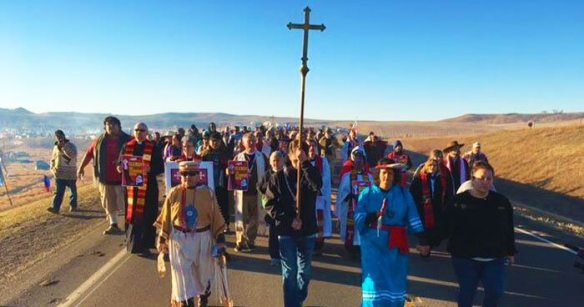
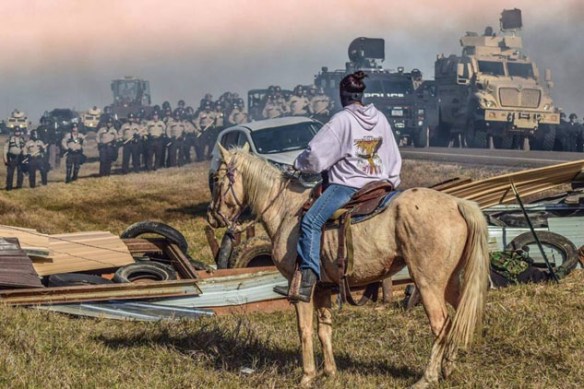
Those who stood firm at Standing Rock remind us of the lessons of Gandhi and Martin Luther King – the power of non-violent resistance. The tech engineers and CEO’s who refuse to work on a Muslim registry are also exemplars, as is Jerry Brown, Governor of California, who vows that we’ll launch “Our own damn satellite,” if Mr. Trump succeeds in defunding NASA climate monitoring. We can honor the administration of the EPA, which refused to submit a list of their people who attend climate conference, and Leonardo DiCaprio, who has made himself a spokesman, not only for the science of climate change, but for the economic opportunities clean energy holds.

There’s a lot of damage that Mr. Trump’s ship of fools can do in the near term, but a battle is on for the soul of the nation. Few things are more important than insuring that the incoming government is thwarted at every turn, and voted out of office, in the disgrace it deserves, as soon as possible.

Prayers for Standing Rock

prayer-for-standing-rock

At 10:00am Central time, on Sunday, December 4, there will be a world-wide half hour of prayer and meditation “with the water, the earth, and the global community of supporters” of the Standing Rock Sioux nation, of those whose lives depend on the Missouri River, and all who understand the importance to all beings, of clean drinking water and reverence for sacred space.

You can register to participate at praywithstandingrock.com, donate to the water protectors, and sign a petition to President Obama, requesting that he end the violence against unarmed, peaceful protestors, who understand that water is more important than oil.

Here is an interview with Wendy Egyoku Nakao, abbot of the Los Angeles Zen Center, on why she, her and her organization, and more than 500 clergy of all denominations support the Sioux nation:

“I think we are heading for more confrontation in the days ahead. The First Nation peoples are taking a ceremonial and prayerful stand for healing from historical trauma and declaring their right to live on this earth. The DAPL folks have continued their actions, with the support of the Morton County law enforcement, regardless of injunctions, and are poised to go under the Missouri River. The mainstream media all but ignores what is happening. The current POTUS has been weak on the issue; the future POTUS is invested in Energy Transfer Partners. I encourage everyone to Stand with Standing Rock and protect the Water. Water is Life.”

I want to apologize to someone, but I don’t know who

“I cross the Green Mountain
I sit by the stream
Heaven blazing in my head
I dreamed a monstrous dream
Something came up
Out of the sea
Swept through the land of
The rich and the free” – Bob Dylan

Lest We Forget: Eugene V. Debs and American Socialism

“The issue is Socialism versus Capitalism. I am for Socialism because I am for humanity. We have been cursed with the reign of gold long enough. Money constitutes no proper basis of civilization. The time has come to regenerate society— we are on the eve of a universal change.” -Eugene Debs

This is great reminder of the life of of a man, almost a hundred years ago, who put his life on the line for the cause of working people. He was jailed by Woodrow Wilson for criticizing America’s entry into the first world war, but nominated for president even while in prison. However halting it may be, it’s good sometimes to look back and see that we have made progress!

S.C. Hickman's avatarThe Dark Forest: Literature, Philosophy, and Digital Arts

eugene-v-debs-emerges-from-prison-1

 “Pray for the dead and fight like hell for the living.”

—Mother Jones

Most young people don’t even know who Eugene V. Debs (Socialist Populist, Founder of the IWW) is, much less that he was sent to prison for 10 years for criticising a sitting President (Woodrow Wilson, Progressive) for going to War (WW I):

Nearly a million Americans, in fact, voted for federal prisoner number 9653 in 1920, and many of them were odd comrades like my Republican grandfather: people who didn’t necessarily agree with Debs’ politics but who admired his devotion to the cause of labor and his courage in speaking out against the carnage of the First World War. According to my mother, my grandfather had once heard Debs speak from the caboose of his famous “Red Special,” the train that carried him across the Midwest during the election of 1908, and was appalled that” America’s conscience”…

View original post 1,608 more words

Hell or High Water: a movie review

Ben Foster and Chris Pine in “Hell or High Water’

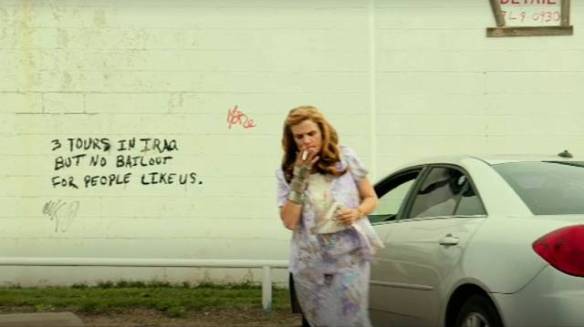
Hell or High Water came out last summer. It ran only briefly in one local theater, so I finally caught it on iTunes yesterday.  I’d planed to see it since reading an editorial that claimed Hell or High Water captured the mood of the country – at least the country between the coasts – better than any of the volumes of election year analyses.

Watching it, I remembered another great movie of hard times, Tender Mercies, 1983, but that was a film of redemption. There’s no redemption in Hell or High Water, just dry laughter at desperate measures aimed at overcoming desperate circumstance. “There’ll be no peace,” Jeff Bridges tells Pine in the closing scene. “This will  haunt you all the rest of your days. And me too.”

Two brothers, Toby (Chris Pine), a divorced father, and Tanner (Ben Foster), an ex-convict, begin robbing branches of the Texas Midland Bank. Their mother died owing the bank $32,000 and back taxes after taking out a reverse-mortgage to save her failing cattle ranch. When oil is discovered on the land, the bank issues a foreclosure notice. Toby and Tanner set out to steal money from the bank to redeem the mortgage it holds.

The robberies are too small to interest the FBI, so Texas Rangers, Marcus (Jeff Bridges)  and Alberto (Gil Birmingham) are assigned to the case. On the trail of the brothers, Alberto tells Marcus, “A hundred and fifty years ago, your great grandparents stole this country from my people. Now the banks are stealing it from you.”

Alberto’s ambivalence is mirrored by other people the rangers and the brothers encounter on their way to the inevitable showdown. Toby leaves a cafe waitress a $200 tip with stolen money. When the rangers arrive and demand the bills to check for fingerprints, the waitress says, “Get a damn warrant. This is half of a month’s mortgage. All I care about is keeping a roof over my daughter’s head.”

This is a country where hope for anything more than survival is missing. Thirty years ago, Tender Mercies showed Robert Duvall’s redemption from alchohol through the power of love and faith. In Hell or High Water, the only love is fast sex after a winning night at an Indian casino. The only reference to faith is Bridges’ comments on a TV evangelist – “He wouldn’t know God if God crawled up his pant leg and bit his pecker.”

Hell or High Water is not a depressing movie; it’s a sad movie. There’s a difference. The lonesome beauty of the land mirrors the towns that are falling apart, while the soundtrack, with songs from artists like Townes Van Zandt and Ray Wiley Hubbard, echoes the mood. Bridges’ world weary humor, and the brothers’ awareness of the irony of robbing the bank to pay the bank give us humor and moments of laughter even as a darker story unfolds.

Movies set in rural Texas have long depicted dying towns and troubled times. Think of The Last Picture Show, 1971, or No Country for Old Men, 2007. This one is filled with more topical references than any of the others. In one scene, the rangers stop as a couple of cowboys drive a small herd of cattle across the blacktop, fleeing a prairie fire that paints the sky an ugly black behind them. “It’s the 21st century,” one of the cowboys tells Bridges, “No wonder my kid doesn’t wanna do this shit!”

I’m not sure a single a single political pundit has captured as accurately the reasons this country voted the way it did in the recent election. At the same time, there’s a power in this movie I think will endure beyond any socio-economic circumstance. As Jeff Bridges character puts it, I think it will haunt the viewer for a long time.

hell-or-high-water-graffiti

Timely quotes from Reinhold Niebuhr

Reinhold Niebuhr,By Source, Fair use, Link

Reinhold Niebuhr,By Source, Fair use, Link

Reinhold Niebuhr (1892-1971) was an American theologian, ethicist, commentator on politics, and professor at Union Theological Seminary for 30 years. Among his most acclaimed books are, Moral Man and Immoral Society, and The Nature and Destiny of Man, which Modern Library named as one of the 20 best nonfiction books of the 20th century.

Neibuhr’s  best known work, however, is the Serenity Prayer: “God, grant me the serenity to accept the things I cannot change, the courage to change the things I can, and the wisdom to know the difference.”

In the wake of this year’s election cycle, his musings on history and politics have a special poignancy and relevance:

“The tendency to claim God as an ally for our partisan value and ends is the source of all religious fanaticism.”

“Frantic orthodoxy is never rooted in faith but in doubt. It is when we are unsure that we are doubly sure. ”

“Religion, declares the modern man, is consciousness of our highest social values. Nothing could be further from the truth. True religion is a profound uneasiness about our highest social values.”

“Religion is so frequently a source of confusion in political life, and so frequently dangerous to democracy, precisely because it introduces absolutes into the realm of relative values.”

Neibuhr’s most haunting observation to me is this, which implies that not a single one of the countless empires that have risen and fallen before ours made much of their greatness until it was gone:

“One of the most pathetic aspects of human history is that every civilization expresses itself most pretentiously, compounds its partial and universal values most convincingly, and claims immortality for its finite existence at the very moment when the decay which leads to death has already begun.”

Harbor Scene with Roman Ruins, Leonardo Coccorante (1680-1750), public domain

Harbor Scene with Roman Ruins, Leonardo Coccorante (1680-1750), public domain