A great story I neglected to post

I found this during a year-end cleaning of my “Drafts” folder – an unfinished post inspired by a newspaper article in July which details the life’s work of unsung folk artist, Arthur Harold Beal, garbage collector for the town of Cambria, CA.

Just down the road from the Hearst Castle, that world-famous monument to excess, lies Nitt Witt Ridge, the house on the hill that Beal lovingly crafted of driftwood, river stones, beer bottles, abalone shells, toilet seats, and other assorted junk.  Beal started work in the 30’s was still going in 1992, when he died at the age of 96.

Nitt Witt Ridge by megpi, CC BY-NC-SA-2.0

Nitt Witt Ridge by megpi, CC BY-NC-SA-2.0

Michael O’Malley, a plumber in town, bought the Ridge for $42,000 in 1999.  Unfortunately, the sale price did not include water rights, so he and his wife cannot live there, and because it is zoned residential, they can’t open the house for public tours.  Several times a week in the summer, O’Malley gives private tours, in return for donations, to people who contact him directly.  He is something of an expert on stories surrounding the Ridge’s creator.

Beal used to say he salvaged his wood from the ocean, but O’Malley points out the quality of the material, and suggests that Beal might have “salvaged” it from local construction sites late at night.  Beal seems to have been a curmudgeon.  Some people asked to visit the house while he was still living.  If he liked their looks, he’d let them in, if not, he would shake his fist and yell, “Move along, small change.”  O’Malley found a video of Beal on a 1981 TV episode of “Real People.”  At age 81, with a long beard and a walking staff, “he looked like a mix of John Muir and Dennis Hopper.”

Here’s a brief but informative clip of O’Malley giving a tour of the house:

Last summer, when I started this post, I added descriptions of other architectural oddities, like the Watt Towers and the Bottle House of Rhyolite, NV.  The story grew too long and languished until now.

The end of the year is a good time to contemplate things like Nitt Witt Ridge.  While others compile their lists of “The Best of 2013,” here is my contribution to a list of things wacky and weird.

Getting rid of those pesky memories

In my previous post, I wrote of advances in the field of virtual reality, and posted a video clip that brought to mind the dystopian landscape of Aldous Huxley’s Brave New Word (1932).  Huxley imagined life in “The World State” in 2540, where children are born in “hatcheries.”  They are raised in “conditioning centers” and learn to be avid consumers and abhor the thought of solitude.

Happy face thumbs up

One of the World State’s tools for keeping people docile are “the feelies,” multi-sensory movies, most often centered on sex.  The connection to virtual reality should be obvious.  Another conditioning tool was “soma,” a side-effect free hallucinogenic drug that World State citizens used to go on “holidays.”  Soma relates to the subject of this post – a potential advance in the technology of feeling happy, happy.

In “Unwanted Memories Erased in Experiment,” an article in The Wall Street Journal (12/23/13, p. A1), Gautam Naik writes that scientists used electrical currents to erase memories they had implanted earlier.  Someday doctors may be able to zap painful memories and leave the rest in tact.  Assuming the technology becomes (relatively) safe, would this be a wise thing to do?

In a few cases it might be – the 39 patients who volunteered for the experiment were already undergoing electroshock therapy for severe clinical depression after all other treatments had failed.  But the article’s assertion that memory erasing might be useful to remove “associations linked to smoking, drug-taking, or emotional trauma” suggests the kind of social engineering Huxley wrote about.

Last year at a Buddhist teaching, I met an elderly woman who had spent her youth in a Soviet gulag.  As difficult as the hardship was, she had written a memoir for her family to read, “So they’ll know who I really am.”  Her core identity, as well as her later practice of Buddhism were direct results of those years of suffering.

In my late 20’s, I knew a woman who lost her closest male friends over a short period of time; they died of cancers related to Agent Orange exposure in Vietnam.  After surviving a deep depression, my friend enrolled for training to work in a hospice.  Without the pain of loss, she wouldn’t have found her calling.

The poet, Rilke, declined Jung’s offer of therapy work saying, “If you take away my devils, I fear my angels might flee.”  

The disowned parts of ourselves are especially important in scripture.  When Jesus offers living water (Jn 4:10-13), only those who know they are thirsty will hear him.  When Buddha teaches a path beyond suffering, we won’t listen if we’ve deadened ourselves with soma or reality TV.

A tour of America 80 years ago sparked Huxley’s vision of an economic and political culture at war with soul values.  Now that another “holiday season” has run its course, as the media waits for the next distraction, I am reminded once again of the cautionary words in this wonderful poem that William Stafford published in 1960:

A Ritual to Read to Each Other

If you don’t know the kind of person I am
and I don’t know the kind of person you are
a pattern that others made may prevail in the world
and following the wrong god home we may miss our star.

For there is many a small betrayal in the mind,
a shrug that lets the fragile sequence break
sending with shouts the horrible errors of childhood
storming out to play through the broken dyke.

And as elephants parade holding each elephant’s tail,
but if one wanders the circus won’t find the park,
I call it cruel and maybe the root of all cruelty
to know what occurs but not recognize the fact.

And so I appeal to a voice, to something shadowy,
a remote important region in all who talk:
though we could fool each other, we should consider–
lest the parade of our mutual life get lost in the dark.

For it is important that awake people be awake,
or a breaking line may discourage them back to sleep;
the signals we give–yes or no, or maybe–
should be clear: the darkness around us is deep.

Virtual dreams

A few nights ago I had a 21st century dream in which the key event was losing my cell phone.  In days of yore – say five or ten years ago – losing a wallet was the common dream image for a disruption to one’s persona.  Now my smart phone probably tells me more about my public life than a wallet.  It shows me where I am, where I’m going, when I need to be there, how to find my way, and it gives me multiple ways to connect with people I need to see when I arrive.  In a few years time, I’m sure we’ll all have digital ID’s and credit cards.

Though I still think of dreams in terms of archaic elements, clearly the psyche will use whatever it needs to make a point.  As technology is part of our lives now, it is also part of our dreams.  All of which leads me to the heart of this post:  we ain’t seen nothin’ yet! 

Last Wednesday, I caught an amazing segment on virtual reality on the PBS Newshour.  I didn’t expect to be interested.  Since I don’t play video games or World of Warcraft, VR seems like just one more distraction in an ADHD world.  It may well be, but the Newshour piece demonstrates the power of this technology, beyond anything I’d imagined.  I instantly thought of the “Feelies” – multi-sensory movies in Huxley’s Brave New World.  We aren’t there yet, but it would be foolish to rule out the possibility.  Watch the clip and see what you think.

The power of imagined experience has long been established.  In the early 20th century, Jung developed a technique he called “active imagination” and used it in therapy.  In the 50’s, research proved that imagined practice was as useful as “real” practice for improving basketball free throws.  In reference to meditation, Lama Thubten Yeshe, a prominent 20th century Tibetan teacher, said, “What we have to learn is that the experiences we have through imagination and those we have through our senses are actually the same.”

All of these applications involve self-generated imagery, but if and when VR comes into our living rooms, it will come through the same corporate interests that flood us with adds already.  Do we want them reaching even farther into the deep psyche?

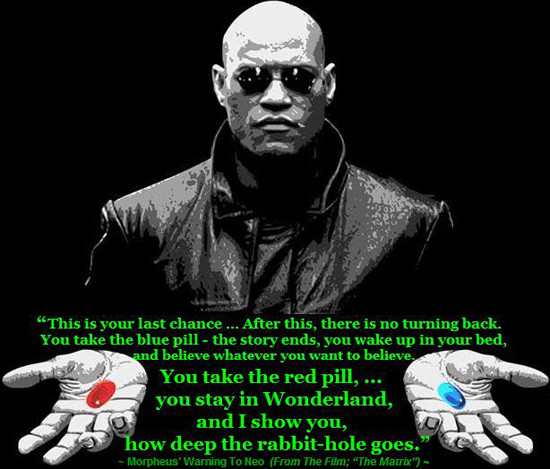
We’ll be clamoring for it!  If you have any doubt, check out Life, the Movie: How Entertainment Conquered Reality by Neal Gabler.  In terms of an obvious metaphor, The Matrix, once we have the ability turn our living rooms into personal holodecks, that blue pill of restless sleep will surge in popularity.

MorpheusWarning

To paint a huge subject in simple terms, over time, our race has transferred successive parts of our brain functions to technology.  Printed books marked the end of bards who could recite epic poems.  We don’t find the griots of Alex Haley’s Roots in literate cultures.  The imaginations of my parents’ generation got a better workout listening to The Lone Ranger on radio than mine did watching the masked man on TV.

I love technology, but I’m wary of it too, and not just the obvious stuff like the NSA.  I’m wary of all the ways we can use it to foster oblivion until, as T.S. Eliot put it, “Human voices wake us and we drown.”

Yule ~ The Beginner’s Guide To The Wheel Of The Year

Just in time for the solstice, here is another of Lily Wight’s wonderful “Wheel of the Year” posts, with beautiful illustrations and commentary on the Celtic and Nordic stories surrounding this ancient holiday. Enjoy her post and enjoy the return of light!

Lily Wight's avatarLily Wight

Updated 18/12/2014

     There are four Solar Quarter Days (two equinoxes and two solstices) on The Wheel of The Year calendar.  Yule or The Winter Solstice is celebrated during a twelve day period from December into January.

     Yule commemorates the demise and rebirth of the sun’s powers because The Wheel continues to turn and daylight hours begin to lengthen again beyond The Shortest Day.

     The name “Yule” is thought to derive from the Old Norse ” jólnar”  – a collective term for the gods or “Yule Ones”.   Jólfaðr (Yule Father – interchangeable with All-Father) is one of many names attributed to Odin.  In Old Norse poetry names and terms for Odin are frequently synonymous with celebration and feasting.  Odin The Gift-Giver is undoubtedly the origin of our Santa Claus.

     The Midwinter period between the last harvest (Samhain)…

View original post 390 more words

We were hopeful once, and young

Bob_Dylan_-_The_Times_They_are_a-Changin

I just came upon a high quality clip of an unbelievably young Bob Dylan at Newport in 1963, singing one of his best early songs.  Watching it, I’m reminded of a line from another early Dylan song, “We never much thought we could get very old.”  I guess no one ever does.

Change a few particulars and the song is as timely today as it was 50 years ago.  What’s missing is the collective hope/dream/prayer of those days that music could change the world.

Maybe it can, in the sense of planting seeds.  Maybe, but if so, those seeds take longer to germinate than anyone who is young can possibly imagine.

Enjoy a great clip of “North Country Blues.”  And maybe water the seed.

Daily Prompt: Memories of Holidays Past

What is your very favorite holiday? Recount the specific memory or memories that have made that holiday special to you.

3d - 400 - christmas_edited-1

Here is a story my father loved to tell. Even in the early stages of Alzheimer’s, when we’d take a Christmas tree to his assisted living place, he’d tell us about the electric trains.

One year he ran short of track on Christmas eve, so he hopped in the chevy and drove through the snow to a hobby shop in downtown Poughkeepsie that was open until midnight.  The place was filled with other fathers on similar missions:  picking up extra track, boxcars, and engines.  Trains were the thing that year.  That little store overflowed with camaraderie, humor, and joy.  Fifty years later, his eyes lit up when told this story.  I think it embodied the Christmas spirit for him, as he embodied the joy of giving for me.

As a depression kid, money was scarce while he was growing up.  One year someone gave him a silver dollar on his birthday.  His grandmother said he should put it in the church collection plate.  He did, but when he reached in to get change, his grandma slapped his hand, knocking the plate to the floor.  Undaunted, my dad crawled under the pews and recovered every penny, but made sure to collect his ninety cents change.

Prosperity finally came.  After a stint in the navy as a radar technician, he went to work for IBM, and after that, if anyone asked for a dollar, he’d offer them two.  After he got sick, I had the chance to return some of those favors, in both large ways and small.

The first winter he was up here, we happened to drive past a train store.  “Wanna check it out?” I asked.  He did, and we found a 19th century train that called his name.  We took it back to his apartment, and I set it up on his kitchen table.  Mary took him shopping for those Christmas village buildings which matched the scale of the train.  He talked about it so much to the other residents that sometimes when were visiting, they’d knock on his door and ask to see the trains.

Mary recently asked I if hated Christmas – a reasonable question, given the tone of my comments on Black Friday and what passes for “holiday music” in stores.  I don’t hate Christmas.  I do hate the machinery of media and advertising that cynical interests use to paint a mirage of joy that can be ours if only we buy enough stuff.

I learned from my father that stuff isn’t the problem.  Grasping for stuff, out of greed or a fear that I need it to be ok is the problem.  My father taught me that stuff can be a medium of generosity, and generosity lies at the core of what Christmas is truly about.

Robots ‘R Us, installment 2

The Steam Man of the Prairies, 1868.  Public Domain.

The Steam Man of the Prairies, 1868. Public Domain.

An obscure author, Edward S. Ellis, who published a dime novel called The Steam Man of the Prairies 145 years ago, may prove to have been a visionary according to two recent news articles.

The first, in the New York Times, reports that Google quietly acquired seven robotics companies over the last six months (Google Puts Money on Robots).  The scale of the investment is huge and appears to be aimed at automating manufacturing processes.  “The opportunity is massive,” chirped Andrew McAfee, an M.I.T. research scientist.  “There are still people who walk around in factories and pick things up in distribution centers and work in the back rooms of grocery stores.”

The second article I noticed bears an uncanny relation to the cover of  The Steam Man.  The California DMV has set rules for companies aiming to test automated cars (Driverless Cars Could be Cruising California Roads by Spring).  To put it in the terms of the M.I.T scientist, we may soon be able to robotize trucks and remove even more inefficient humans from the workforce.

The problem with this manufacturer’s wet dream should be obvious.  Robert Reich, former Secretary of Labor under Bill Clinton puts it simply: “the economy remains lousy for most people. It will likely remain that way: As technology and globalization take over the economy, the U.S. has no national strategy for creating more good jobs in America.” (The True Price of Great Holiday Deals).

Economic discussion, with few exceptions, focuses on how to get back to the good old days of (relatively) full employment and opportunity for those who work hard.  Politicians bicker over which levers to pull, but no one dares to ask the fundamental question: has the structure of the world economy changed too much to recapture that particular sort of past “good times?”

A few years ago, news got out of worker mistreatment at Foxconn, the huge Chinese assembly plant where much of our high-tech gear is assembled.  Foxconn agreed to reforms, and the CEO announced plans to deploy a million robots.  By December 2011, robotic arms had reduced the number of workers on certain assembly lines from “20 or 30 down to 5.”  As we argue over fair wages for fast food workers, it’s a good bet their employers are working on ways to automate the task of making a burger, which can’t be harder than plugging components into a motherboard.

The problem, of course, is that downsized workers will not be buying either Happy Meals or iPhones.

Last March, in a post called Robots ‘R Us (?), a first look at such issues, I quoted a blogger named Orkinpod who was already considering them in depth.  On Feb. 27 he said:  “When the future arrives (and I believe that it is very, very close), and machines can supply all the things that humans could possibly ever want, what is everybody going to do?”

One thing many may wind up doing is working on food production.  Last summer I wrote of a compelling PBS NewsHour series, “Food for 9 Billion” (1).  That’s the total number of hungry humans who will occupy the planet in 2050 as the amount of arable land continues to shrink.  One of several examples given of coming change was Singapore, where five million people live on an island with only 240 acres of undeveloped land.  A 50 year old Singapore engineer developed a revolutionary type of vertical greenhouse that prompted the Directer of the National Institute of Education to say, “I think, eventually, urban factories for vegetable production will take the place of electronic factories in Singapore.”

It’s a grand irony to reflect that industrialism, which began by channeling people out of agriculture, may have succeeded too well; its end game my involve shifting some of them back into food production again.  But what about everyone else?  What happens as robotics and marvels like 3D printers leave ever more people idle?  Insiders aren’t even asking the question, though science fiction writers have since the mid 20th century.

robot3

Unfortunately, in stories where humans go up against robots, the outcomes are usually not the ones we would like to see.

Queen Bothildur: an Icelandic Christmas folktale

I found this story in a beautifully illustrated book of Icelandic folktales for children, Tales of the Elves, that I brought back from that country after a visit in 2012.

Tales of the Elves 400

One Christmas Eve, a richly dressed woman knocked at the door of a farm house in Hrutafjord and asked for shelter. The sheriff lived there and said she could stay.  When people asked her name, she said it was Bothildur, but she would not say anything else about herself.

She stayed home while everyone else went to midnight mass, and when they returned, they had never seen the house so clean and beautifully arranged.  The sheriff invited her to stay on as housekeeper, and she excelled at her work.  The following Christmas Eve, she stayed home again, but this time, when the household returned, they found Bothildur’s eyes red from weeping.

On the third Christmas Eve, Gudmundur, the sheriff’s shepherd boy, vowed to discover her secret.  As everyone walked to church, he feigned illness and turned back.  Gudmundur possessed a magic stone that made him invisible.  Holding it in his hand, he slipped into the farmhouse, where he saw Bothildur dressed in the finest clothing he’d ever seen.  She took a green cloth from a chest and set off into the night, with Gudmundur following closely behind.  They came to a lake where Bothildur spread the cloth on the water and stepped onto it.  The shepherd boy just had time to step onto a corner before the cloth began to sink.

Bothildur

It seemed like they were passing through smoke as they sank deeper, but at last they came to a grassy plain in front of a fair city.  Bothildur entered the city where everyone cheered.  A man who wore a crown embraced her and then everyone entered the church for Christmas mass.  Bothildur’s three children ran around the pews playing with three golden rings, until the youngest dropped his and couldn’t find it because the invisible Gudmundur had slipped it into his pocket.

When the service was over and it was time for Bothildur to leave, everyone was sad.  She walked alone with her husband onto the plain before the city.  Both were in tears and Gudmundur heard them say this was the last time they would ever meet.  They parted with great sorrow as Bothildur stepped onto the green cloth with Gudmundur behind her.

Bothildur returned home and was cleaning when the sheriff and the rest of the household returned.  Gudmundur came home later.  When asked where he had been, he told the entire tale of his trip to the land below the waters.  When Bothildur asked if he had proof, Gudmundur withdrew her son’s golden ring.  At that she was joyous.  She explained that she’d been a queen in Elf Land until a witch cursed her.  She could only return home on Christmas eve, and only a human brave enough to follow her to the world below could break the spell.  “Now you have released me and you shall be richly rewarded,” she said.

After saying goodbye to the household, Bothildur vanished.  That night, Gudmundur dreamed she came to him and gave him coins and jewels which he found beside his pillow when he awoke.  Later, he used that money to buy a farm of his own and get married.  In time, he became known far and wide as the luckiest man alive.

***

In Iceland, winter solstice celebrations were huge events – understandably, for by mid-December, the southern part of the country gets only four hours of light each day, and the northern regions, above the arctic circle, get only three.  Icelanders embraced Christianity in 1000 AD, but to this day, Christmas is a dual holiday, celebrating both the birth of Christ and the return of the sun.

Charming as it is that the doorway to the Other World should open on Christmas Eve, it’s a safe guess that Christmas is peripheral to the tale.  Stories of release from enchantment are found in every culture and predate Christianity.  Sometimes love and compassion break the spell, as in “Beauty and the Beast.”  Sometimes it’s bravery and cleverness, and sometimes even violence – in the first version of “The Frog King” published by the Brothers Grimm, the frog is disenchanted not by a kiss, but when the princess becomes so annoyed with him that she hurls him against a wall.

Aside from its simple charm, what fascinates me about Queen Bothildur’s tale is that Gudmundur, the young disenchanter, brings his own magical implement for the task.  Where do shepherd boys pick up magical stones of invisibility?  Jung believed that stones are frequently symbols of the Self, his term for the fully integrated personality.

Babylonian stone seal, ca 1595-1155 BC.  Creative Commons

Babylonian stone seal, ca 1595-1155 BC. Creative Commons

 Normally, such psycho-spiritual integration is the task of a lifetime, but in stories, legend, and scripture, young heroes as diverse as King David, St. Patrick, and Krishna worked as shepherds or cow herders when they were young.  However simple this folktale may be, it reflects what can be done by a person with a noble cause who is not at war with himself.

Belief in the Huldufólk, or Hidden People, the Elves, is common to this day in Iceland; in a 2007 survey, 57% of the population said they “do not disbelieve” in Elves.  In 2004, Alcoa had to pay a government expert to survey their proposed site for an aluminum smelter to make sure it was Huldufólk free.  Last year, we travelled a highway that had been diverted around an Elven dwelling.  We saw many small houses built on remote hillsides as homes for the Hidden People, and some Icelanders build them churches, in hopes they will convert to Christianity.

That may be an iffy proposition.  “The Icelandic word for Christmas, Jól, contains no reference to Christ or to the church. It is a Norse word that also existed in Old English as Yule.” (1)

Even so, as we read and tell their stories, I suspect the Elves are wishing us a Gleðileg jól go farsælt komandi ár – a Merry Christmas and a Happy New Year.

.