Jung’s Tower: simplicity and the inner life

Jung's Tower House, Bollingen, Switzerland, by Andrew Taylor, 2009.  CC BY-SA-2.0

Jung’s Tower House, Bollingen, Switzerland by Andrew Taylor, 2009. CC BY-SA-2.0

Recent news of technological incursions into consciousness itself (virtual reality and altered memories); almost daily revelations about NSA spying; suggestions that social media “isolates people from reality;” it’s enough to make you want to unplug all the gadgets – at least for a while!

Renowned psychologist, Carl Jung (1875-1961) did just that, for months at a time, in a tower-house complex he started building in 1923 and continued to work on for the rest of his life.  He often spent months each year living as simply as possible, without electricity or running water.  It’s easy to think he lived in a simpler time and couldn’t have imagined modern complexity, but consider these words he wrote in his autobiography, Memories, Dreams, Reflections, published in 1961, the year he died:

“We rush impetuously into novelty, driven by a mounting sense of insufficiency, dissatisfaction, and restlessness.  We no longer live on what we have, but on promises, no longer in the light of the present day, but in the darkness of the future, which, we expect, will at last bring the proper sunrise.  We refuse to recognize that everything better is purchased at the price of something worse; that, for example, the hope of greater freedom is canceled out by increased enslavement to the state, not to speak of the terrible perils to which the most brilliant discoveries of science expose us.
………………………
…new methods or gadgets, are of course impressive at first, but in the long run they are dubious and in any case dearly paid for.  They by no means increase the contentment or happiness of people on the whole.  Mostly they are deceptive sweetenings of existence, like speedier communications which unpleasantly accelerate the tempo of life and leave us with less time than ever before.”

The tower, phase 1, 1923.  Creative Commons

The tower, phase 1, 1923. Creative Commons

Ten years before starting the tower, Jung had a painful break with Freud that precipitated a period of disorientation and a huge uprush of the kind of unconscious contents he had witnessed in schizophrenic patients.  Feeling that his experience was purposeful, he chose to submit to the unconscious with writing, art, and the effort to understand.  Out of this phase of turmoil and uncertainty, his unique psychological insights were born.  Paper and ink, he said, did not seem “real” enough to represent his discoveries, so in 1922 he purchased land on Lake Zurich for a “representation in stone” of his “innermost thoughts.”

Phase II, 1927.  Creative Commons

Phase II, 1927. Creative Commons

Jung wrote at length of the parallel developments of his inner life and the tower, over more than three decades, saying things like:

“At Bollingen I am in the midst of my true life, I am most deeply myself”

“At times I feel as if I am spread out over the landscape and inside things, and am myself living in every tree, in the plashing of the waves, in the clouds and the animals that come and go, in the procession of the seasons.”

“I pump the water from the well.  I chop the wood and cook the food.  These simple acts make man simple; and how difficult it is to be simple!”
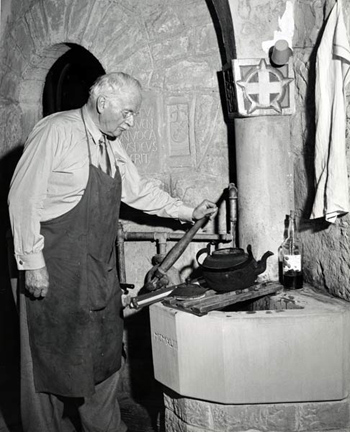
Jung pumping water at Bollingen ca. 1960.  Library of Congress

Jung pumping water at Bollingen ca. 1960. Library of Congress

While drawing inspiration from Jung, an obvious question becomes, how do I connect with this kind of depth in the midst of my own too-hectic life?  The good news is, we don’t need a tower to live in for months at a time.  The bad news is we need to unplug every day and tune into activities that nourish the soul; this is often hard arrange.  It takes focus, intention, and experimentation to find those things that center us and we are drawn to.  Any number possibilities come to mind:

  • “Spend an hour a day in a quiet room by yourself reading old stories that you find nourishing.”  That’s what Joseph Campbell said when Bill Moyers asked this question during the “Power of Myth” interviews.
  • Meditation, of almost any kind.  This my own core practice.  Zen teacher, Cheri Huber said, “If you start by watching your breath for as little as five minutes a day, it can change your life.”
  • Sports that allow one to get in “the zone,” especially walking, running, or bicycling.
  • Keeping a dream notebook.
  • Writing, though I suspect most bloggers will have the same difficulty I have in putting words at the service of psyche – how do I turn off the writing sophistication I’ve worked so hard to gain?  Can I ever truly use words in a “purposeless” manner, allowing them to go where the wish, without thinking, “Gee, this would make a good blog post?” For any chance of success, I need a definite strategy, like writing fast with a rollerball pen in cheap notebooks.
  • Visual arts or crafts.  Training or skill is not required for this kind of work, and in fact, can get in the way.  Those with artistic training may find it useful to paint or draw with the non-dominant hand.  Jung had no formal art training, but his private journal, The Red Book, only recently published, gives an idea of what may emerge if one is determined to honor the psyche.
Red Book, p. 131.  Courtesy Ox Aham, Creative Commons

Red Book, p. 131. Courtesy Ox Aham, Creative Commons

When I truly examine my own habits, it’s clear that I fritter away enough time with gadgets each day to find the space for this kind of exploration.  It doesn’t need to be with the kinds of activities I outlined above.  I find it’s ok to schedule “time for inner work” the way I schedule time at the gym, but the most powerful new discoveries seem to emerge from those quiet voices at the edge of consciousness, the tiny impulse it is so easy to overlook in our busy lives.

Such an impulse woke me one night at 1:00am one morning.  Instead of going back to sleep, I got up and wrote down a sentence.  That led to a paragraph, and then a page, and then another.  That was the start of the first (and so far only) novel I’ve finished.

Something similar happened to Jung at his tower.  He gave the stonemason at a quarry precise measurements for blocks he needed to build a new wall, but one of the stones arrived in error; it was square, about 20″ on each side.  When Jung saw it, he said, “That is my stone, I must have it!”  Over time, he carved a testament to his life and work on stone which “stands outside the Tower, and is like an explanation of it.  It is a manifestation of the occupant.”

Bollingen stone, main face, CC-BY-SA-3.0

Bollingen stone, main face, CC-BY-SA-3.0

In a seminar in 1939, Jung said:

“We have no symbolic life, and we are all badly in need of the symbolic life. Only the symbolic life can express the need of the soul – the daily need of the soul, mind you! And because people have no such thing, they can never step out of this mill – this awful, banal, grinding life in which they are “nothing but.”

The Bollingen Tower became a vital way for Jung to live the symbolic life, but he would have been the first to insist that we don’t need to carve stone or build houses to find it for ourselves.  All we need is the hunger.  And the will to begin.

What’s coming to TheFirstGates in 2014?

Courtesy Emma Paperclip, Creative Commons

Courtesy Emma Paperclip, Creative Commons

Thanks to everyone who visited this year, old friends and new.  Here are a few year end musings on where this blog may be going in 2014.   These are not resolutions.  Remembering Yoda’s words to Luke, “Do or do not, there is no try,” I don’t make resolutions.  These are sort-of-predictions, aka guesses, based on a line from a Grateful Dead song, “I can tell your future / just look what’s in your hand.”

In the case of theFirstGates, it should probably read, “look at what books are piled up on the table beside you.”  Looking at the titles in the stack, I predict more of the same, only new and (hopefully) better.

I’m currently reading a book I got for Christmas, Grimm’s Complete Fairy Tales.  The key word is complete – I haven’t read all the tales before.  The other great feature is the Arthur Rackham illustrations.  No one has ever painted Faerie like Rackham, and it’s a place I never tire of visiting.

Another new title is Trickster Makes this World by Lewis Hyde.  Not only is Trickster an ongoing object of fascination, but he pervades blogging just like the rest of life.  I’m reminded of this every time I hit Publish while meaning to click on Save.

And perhaps most important for TheFirstGates, I’m rereading The Dream and the Underworld, one of James Hillman’s important early works.  Here he turns the tables on psychology’s habit of translating the night world of dreams into the language of daylight; serving the ego, in other words.

Dream and the Underworld

Instead of asking what a dream means, Hillman asks what it wants.  This shift is fundamental to all of Hillman’s thought – psychology, the science of the psyche, in service to soul and soul-in-the-world.

Of great interest to me as a blogger is Hillman’s effort to see through literal events to the fantasies, the mythical layers that underly the stories we tell ourselves and the ones we see on the evening news.  The reality in our fantasies and the fantasy in all our realities.

The coming year is unique in one respect: 2014 marks the centennial of the start of that worldwide disaster misnamed “The Great War.”  The first world war has haunted me for years with its end-of-an-age immensity and sadness.  There are millions of stories to tell, and I’ll try to post a few here, from the bumbling youths who sparked the conflict to a young lieutenant named Tolkien who was sent to Mordor in 1916, though the generals called it The Somme.

And finally, as always I will continue to be on the lookout for those stranger-than-fiction events that leave us shaking our heads, wanting to laugh or cry or both at the strangeness of it all.

I wish you all a joyous New Year, and I hope we will all continue to share the emerging wonders of this online experience!

Neil Gaiman on libraries, reading, and daydreaming

Neil Gaiman, 2007, CC-BY-SA 2.0

Neil Gaiman, 2007, CC-BY-SA 2.0

Neil Gaiman visited China in 2007 for the first ever, party-approved, Science Fiction and Fantasy Convention.  He asked a top official what had changed; in the past, these genres had been disparaged.  The official said his government had realized they were good at making other people’s inventions, but they didn’t invent or imagine new things themselves.

“So they sent a delegation to the US, to Apple, to Microsoft, to Google,” Gaiman explained, “and they asked the people there who were inventing the future about themselves. And they found that all of them had read science fiction when they were boys or girls.”

Gaiman told this story while giving the 2013 Reading Agency annual lecture on the future of reading and libraries.  The Reading Agency is a British charity that supports libraries and literacy programs, with the mission of giving everyone “an equal chance in life by helping people become confident and enthusiastic readers.”  Another story Gaiman told underscores the importance of the Agency’s efforts.  In New York, he once attended a talk on private prisons – one of America’s growth industries.  In trying to predict the need for future facilities, prison industry officials have developed a simple algorithm based on one key factor – the percentage of 10 and 11 year olds who can’t read.

Gaiman spoke at length of fostering not just the ability to read, but the love of reading.  There are no bad authors or bad books for children, he said.  Adults can destroy a child’s love for reading by giving them “worthy-but-dull books…the 21st-century equivalents of Victorian “improving” literature. You’ll wind up with a generation convinced that reading is uncool and worse, unpleasant.”  Everyone is different and will find their way to the stories they like and need.

Because written fiction, as opposed to television or movies, requires our imagination to turn the authors words into a vivid world, we return to our own world as a slightly different person, with an awareness of other points of view.  Reading fosters empathy, Gaiman said, and:

“Empathy is a tool for building people into groups, for allowing us to function as more than self-obsessed individuals…You’re also finding out something as you read vitally important for making your way in the world. And it’s this: the world doesn’t have to be like this. Things can be different.”

In his inspiring lecture, Gaiman talked at length of his love for libraries and how critical it was for his own development to have supportive librarians at the small library near his home while growing up – librarians who simply wanted books to be read and showed him how to use inter-library loan when he finished all the local books on vampires, ghosts, and witches.  When government officials close libraries as cost saving measures, “they are stealing from the future to pay for today.”

Gaiman expressed what he believes to be our responsibilities to children and to our future.  Reminding the audience that everything made by humans begins with imagination, we have a responsibility to use and foster our imagination of a better world than the one we found.

Gaiman ended with a quote from Albert Einstein.  When asked how to foster intelligence in children, the great scientist said, “If you want your children to be intelligent, read them fairy tales. If you want them to be more intelligent, read them more fairy tales.”

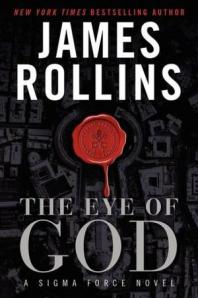
The Eye of God by James Rollins: a book review

The eye of God

In a post in August, It’s mostly insubstantial, I discussed an interview with James Rollins that I read on Sciencethrillers.com.  The title for my post came from some mind-blowing conversations Rollins described with quantum physicists while researching his latest thriller, The Eye of God.  The gist of what Rollins learned involved the insubstantial nature of our apparently solid physical world.  “If you remove all the space within the atoms making up the human body, every person that’s ever lived would fit inside a baseball,” said physicist, Brian Greene.

I heard Rollins speak in September at a writer’s lunch where he gave a lively talk on the nuts and bolts of his process.  Afterwards, I hurried home with a copy of The Eye of God.  Sadly, I didn’t finish the book until this week.  It doesn’t speak well for a thriller when it takes me weeks to “get through” it.

The book opens with a compelling synchronicity between the discovery of an ancient prophecy and the last transmission of a NASA satellite nicknamed “The Eye of God,” launched to study a comet as it passes close to earth.  Before it crashes, the satellite transmits an image of the eastern United States as a ruin of smoking craters.

Astrophysicist, Dr. Jada Shaw, theorizes that dark matter associated with the comet is bending time as well as space in the atmosphere, and the image shows our world in four days time.  Simultaneously, a priest in the Vatican receives a package containing a copy of The Gospel of Thomas, bound in human skin, and a skull inscribed with prophecy of the end of the world in four days.

Soon Dr. Shaw, the priest and his niece, and members of the Sigma Force, a covert group of ex-special forces soldiers, converge on Mongolia, where the Eye of God went down.  An asteroid storm in Antarctica is a prelude to what is coming if the satellite can’t be recovered and if it offers no clue to reversing the space-time distortion that is opening earth’s atmosphere to deadly “near-earth objects.”  Integral to the effort is a legendary black cross, made from an earlier NEO that struck earth.  The cross belonged to St. Thomas the Apostle, who evangelized in Asia, according to the apocryphal “Acts of Thomas” and ancient Christian communities in southern India.

So what’s not to like about the story?

I enjoyed elements of The Eye of God, not the least, an appendix in which Rollins’ discussed what was fact and what was fiction in the book, including a real comet that will pass near the earth this winter.

If it doesn’t break up as it swings by the sun, Comet ISON, one of the brightest comets in history, will pass so close to the earth in November and December that it may be visible during the day.

Comet ISON, via NASA Hubble telescope, will make it's closest pass to the earth on Dec. 28.

Comet ISON, via NASA Hubble telescope, will make it’s closest pass to the earth on Dec. 28.

My biggest problem with The Eye of God is that I never truly felt the danger.  The threat was arcane and not clearly articulated until midway through the book.  The solution (which I won’t give away) remained rather abstract.  The constant reminders of danger and the way out that we find in other page-turners would have helped, as would the disaster film convention of showing a few ordinary people who don’t yet know they are doomed.

Rather than keeping us focused on the real threat, restating it until it was vivid, Rollins threw in distracting subplots which included six major gunfights with Chinese triads, North Korean soldiers, and Mongolian nationalists.  Obstacles while the clock is ticking is a proven way to ramp up tension, but the repetitive nature of these firefights – bad guys who can’t shoot versus outnumbered, crack-shot good guys – was the equivalent of digital special effects at the expense of story in the movies.

The Eye of God received good reviews, especially from established fans of James Rollins. That may be the difference.  This is the ninth Sigma Force novel, and those who read the others are probably bonded with the characters and care more than I if they get shot at.  Next time I read this author, I’ll start at the beginning, though I don’t think that will be any time soon.

Jane Eyre – Charlotte Brontë

Thanks to the ever-beguiling Vickie, who blogs at Beguiling Hollywood, for the best online laugh in quite a while! She turned her readers on to Dr. Sparky, who offers 21st century literary summaries and analysis at Thug Notes. Watch his take on Jane Eyre and see why it leaves Cliff Notes in the dust!

Vickie Lester's avatarBEGUILING HOLLYWOOD

still-of-mia-wasikowska-in-jane-eyreMy favorite screen adaptation was directed by Cary Joji Fukunaga in 2011, starring Mia Waikowska and Michael Fassbender, screenplay by Moira Buffini.

Now, Thug Notes is a new fascination – I especially liked their recap and analysis of Moby Dick, but we covered that a couple of weeks ago.

Thug Notes – Classical Literature. Original Gangster..

Napkin Note Productions | Thug Notes.

View original post

Things you may not know about Winnie- the- Pooh

When I was young, I loved Winne-the-Pooh. There was a time when I carried my little volume – illustrated by Shephard, of course – everywhere. This fine article was posted on “The View from Sari’s World” on August 21, Christopher Robin Milne’s birthday. It’s filled with interesting facts about the historical Pooh and Christopher Robin, as well as the real Hundred Acre Wood and Poohsticks bridge. Enjoy!

sarij's avatarThe View From Sari's World

Christopher Robin Milne was born on August 21, 1920, so what better day to celebrate the world’s favorite bear!

Winnie-the-Pooh is unarguably one of the most recognizable characters in children’s literature, as are his friends: Christopher Robin, Piglet, Eeyore, Tigger, Rabbit, Kanga, Roo, and Owl. Generations of children (including my own) have loved Winnie-the-Pooh, the Best Bear in All the World.  To celebrate the birthday of the little boy Christopher Robin Miline and his favorite toy I give you:

Things you may not know about Winnie- the- Pooh

Winnie -the- Pooh was the name of the “Bear of little brain” in the stories created by A.A. Milne. A.A Milne’s son Christopher had a teddy bear who Winnie the Pooh was created after. He named his teddy Winnie after a Canadian black bear he saw at the Zoo in London. The real life bear was actually from the town of Winnipeg…

View original post 602 more words

Dreaming with animals

Bobcat, Folsom City Zoo Sanctuary - M.Mussell

Bobcat, Folsom City Zoo Sanctuary – M. Mussell

“What is the single greatest predictor of a hero’s success in folktales around the world?”

A professor who had studied the subject at length once posed that question in a psychology class. The answer, he said, was finding an animal helper. More than any other human or supernatural guide, an animal ally can lead the hero or heroine through trials and dangers to the end of their quest.

The professor was a friend and colleague of James Hillman (1926-2011) who loved animals and began collecting animal dreams in 1956.  Toward the end of his life, Hillman helped compile and update five decades of essays and lecture transcripts for a ten volume collection of his work.  Five volumes have been published to date, including Animal Presences, 2012, which I am currently reading.

Vixen the fox, Folsom City Zoo Sanctuary - M. Mussell

Vixen the fox, Folsom City Zoo Sanctuary – M. Mussell

After serving in the US Navy, Hillman studied at the Sorbonne, at Trinity College, Dublin, and in Zurich, where he received a PhD from the University of Zurich and an analyst’s diploma from the C.G. Jung Institute where he served as Director of Studies until 1969.  Versed in Jungian psychology, he charted his own path which he named “Archetypal Psychology.”  His first major work, Revisioning Psychology, 1975, was nominated for a Pulitzer Prize.

With 18 volumes in Jung’s Collected Works, and 10 in Hillman’s, it is clearly beyond the scope of a blog post to compare and contrast these two complex approaches to the depth psychology.  That said, several broad generalizations are possible:

Jung’s psychology can be characterized as “monotheistic,” aiming at a realization of the “Self,” as the supreme archetypal principle.  Jung understood the Self as “the God image within.”  Hillman, by contrast, called the psyche “polytheistic,” and considered the Self as simply one of many psychic centers within us.  Our nature, as we experience it moment by moment, is more like a pantheon of many gods than the kingdom of single inner supreme being.

As a corollary to these differing models of the psyche, development for Jung was often imagined as an ascent, a kind of upward climb toward spiritual clarity.  For Hillman, growth was often a descent, leading to contact with the “Soul,” which for him was more like the “soul” of a blues musician or an artist than the “immortal soul” of organized religion.

Hillman was also concerned with anima mundi, the soul of the world.  How can people be healthy when the world is ailing?  Hillman had little patience with ego psychologies that pretend human health is possible when our cities are blighted and we work in sterile, windowless offices bathed in florescent light?  As a result, his method of approaching dream and fantasy was unique.  He shunned methodologies that seek to aggrandize ego by asking what the figures of dream mean.  He insisted we treat the beings who visit us nightly with the same courtesy we would show to a guest in the waking world.

“the animals are right here. You have to be careful you don’t say something stupid because the animals are listening. You can’t interpret them; you can’t symbolize them; you can’t do something that is only human about them.”

Sage the wolf, Folsom City Zoo Sanctuary - M. Mussell

Sage the wolf, Folsom City Zoo Sanctuary – M. Mussell

“the image is the teacher. We have to endure a laboriously slow method of dreamwork…A dream brings with it a terrible urge for understanding. We want dreams decoded for their meanings. But the dream, like the animal in it, is a living phenomenon. It goes on displaying itself, pointing beyond itself to ever further interiority if we can hold back the hermeneutical desire so that the image can elaborate itself.”

“I am suggesting that the dream animal can be amplified as much by a visit to the zoo as by a symbol dictionary.”

Something within us mourns the animals missing from our lives.  We wear their pictures on t-shirts and sometimes collect little animal figurines.  We cherish domestic pets in ways that might seem bizarre to earlier generations who weren’t as estranged from the natural world.  We thrill at the sight of Coyote or Deer moving through twilight woods at the edge of the housing tract, and we mourn them dead on the road as we drive to work.

Sly the Fox, Folsom City Zoo Sanctuary - M. Mussell

Sly the Fox, Folsom City Zoo Sanctuary – M. Mussell

We are energized when animals visit our dreams – sometimes.  We’d rather they weren’t fierce, threatening, or slimy.  We prefer majestic and noble: an eagle, a dolphin, or wolf will do nicely. We’re not so fond of ants or mice, pigs or slugs, skunks or rats.

With the natural world in tatters, however, anima mundi is not dreaming of Disney creatures and love and light.  That’s all right.  Black Elk said the Lakota people knew every being has it’s place in the medicine wheel.  And if we don’t know what’s broken in ourselves and in the world, said Hillman, we don’t have the slightest idea of who and what and where we are.

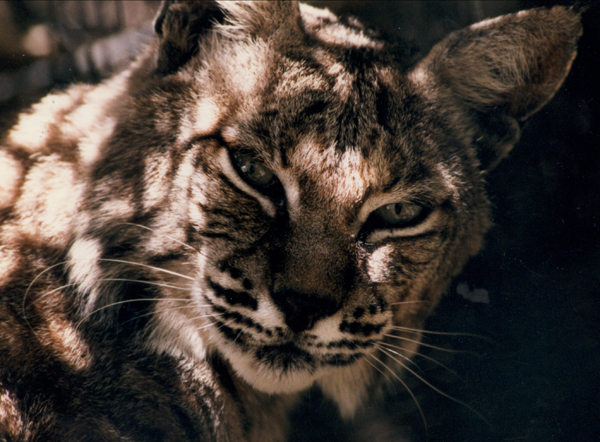
Aiko the bobcat, Folsom City Zoo Sanctuary - M. Mussell

Aiko the bobcat, Folsom City Zoo Sanctuary – M. Mussell

What animals have recently come to your dreams?  What did they seem to want? Don’t remember any animal dreams? Just ask. If you mean it, if you are truly interested and repeat the suggestion until it brings results; if you prime the pump by leaving a notebook and pen you your bed stand, the creatures will visit.

They want to be heard and are looking for those who will listen.

Longmire

Wallpaper_Longmire_S02a

Thanks to a tip from our niece, Theresa, we’ve discovered a promising mystery show on A&E.  Longmire, based on a series of award winning novels by Chris Johnson, premiered in June, 2012.  Now in its second season, the first years’ shows are available on Netflix.

In the pilot, we find Walt Longmire (played by Australian actor, Robert Taylor), sherif of the fictional Absaroka County, Wyoming, returning to work a year after his wife’s death.  He gets a call from his deputy, Vic (aka Victoria, played by Katee Sackhoff), formerly a Philadelphia homicide detective.  Joining her on a remote ridge, they discover a dead sheep and a dead man, both killed by bullets from an antique Sharps rifle.

The victim is a teacher whose wife thought he was in Laramie.  With more digging and the help of his Cheyenne Indian friend, Henry Standing Bear (Lou Diamond Phillips), Longmire discovers the dead man was the father of a 16 year old girl whose Cheyenne mother reported her missing three months earlier.  That could present new problems; Longmire isn’t popular on “the Res,” having jailed the tribe’s chief for extortion.  A gun expert warns Longmire that the Sharps rifle can kill a horse at 500 yards.  Such an antique sniper’s weapon would only be used “by a coward or a professional, and both can be very dangerous.”

Longmire echoes the square-jawed defenders of justice from earlier era westerns – he reminds me of the McLoud mysteries that starred Dennis Weaver from 1970-77. This show, like our times, is darker and more full of angst than the earlier series. Look for the show on Monday’s on A&E, or on Netflix.  I plan to.