Posts I haven’t yet written

Quite a few of my posts begin with ideas that rattle around until research or mulling them over generates enough interest to get me writing.  Time for contemplation and research have been in short supply recently and are likely to be for the next week, so grabbing this moment, I decided to mention a few things I am working on that may or may not get posts of their own in the future.

Water

With the drought on everyone’s mind, I was tempted to write a piece on the symbolism of water.  The problem is, (1) the subject is huge, (2) it’s already been done, and (3) a Star Trek episode keeps me from starting.  Every time I remember the silicon creatures who called humans, “ugly bags of mostly water,” all my attempts to stay focused and serious fail.  According to Mr. Data, it’s an accurate description of our species.  Thanks, dude.

http://www.youtube.com/watch?v=paH97dYR6Lg

There’s another approach to discussing water in California that centers on economics and politics.  I could discuss the millions of gallons we pour into fracking wells.  Or I could mention the president’s three hour visit to Fresno, complete with a photo-op in a dry field before jetting off to Rancho Mirage, but I don’t think I will.  If I want to get depressed over water, it’s easier just to rent Chinatown.

I’m writing a letter

Not just any letter.  I’m writing a letter of condolence to someone whose dog recently died.  It’s one paragraph forward and two back.  Those who have lost a beloved pet will understand how this letter is siphoning off most of the emotional energy I’m willing to invest in writing at this time.

Too many choices

A chain of associations based on some of my own experiences led to a fascinating but huge subject, the difficulty of having too many choices.

photo by Alexander Acker, 2010, CC BY-ND-2.0

photo by Alexander Acker, 2010, CC BY-ND-2.0

In his 2004 book, The Paradox of Choice – Why More is Less, psychologist Barry Schwartz writes that seeking the “perfect” choice is “a recipe for misery.”  Other researchers say, “The current abundance of choice often leads to depression and feelings of loneliness,” and “Americans are paying for increased affluence and freedom with a substantial decrease in the quality and quantity of community.”

This kind of subject deserves elaboration, but if you don’t want to wait for me to get around to it, just Google on “too many choices” and see what you find.

I’m learning Spanish

Yup, I started last summer on Rosetta stone, for a variety of reasons, including (but not limited to, or necessarily in order of importance):

  1. It seemed like a good idea at the time.
  2. Languages are supposed to be good for the brain.
  3. One night, flipping through the TV listing, it seemed like it would be fun to watch El Codico DaVinci on the Spanish station.

One of my Facebook friends who knew me back when, reminded me that in 7th grade Spanish, I was a class clown.  The reason was simple.  I believed I was “no good at languages,” and it became a self-fulfilling prophecy.  There’s a lot of satisfaction in erasing that misperception.  I came upon the Spanish version of book I have in English yesterday and flipped through it before deciding I’d better start in the children’s section.  I wonder if they have cartoons on Saturday morning on the Spanish channels?

Meanwhile, I don’t know why mid-February should be so busy, but it is, and I have to move on to the next thing, so let me summarize this post.

  1. Water is good, though flooding is bad.
  2. Few things are harder than losing a dog.
  3. Choosing things can be iffy.
  4. Learning a language sometimes carries the kind of excitement that learning to read must have done when we were kids.

Feel free to quote me.  Until next time, when maybe I’ll manage to write a real post…

Causes for happiness according to Carl Jung

Recently I thought of a chain of events in my life that I first considered unfortunate, though eventually they led to better results than I ever imagined. This got me thinking of “happiness,” and how wrong our ideas about it can be.

A few years ago I saw one of those lists of “10 factors for happiness” that both confirmed popular hunches (good health is factor #1) and contained surprises (children or no children makes no statistical difference in life satisfaction surveys).  Searching Google for “10 factors of happiness” led to 32 million hits.

I didn’t find the one I was after, but many of those I scanned were interesting.  None pretended to guarantee a sense of wellbeing – there are too many intangibles, such as personal outlook.  We’ve probably all known healthy, well to do, miserable people, as well as those who find satisfaction in overcoming adversity.

Public domain

Public domain

I am also attuned to Buddha’s warning, that any sense of wellbeing that depends on outside conditions is subject to change because those conditions are subject to change. I view these lists not as suggestions on where to look for the ultimate good, but as factors that can improve our odds of feeling satisfied much of the time.  The list I found most interesting gave five conditions for happiness according to Carl Jung.

  1. Good physical and mental health.
  2. Good personal and intimate relationships, such as those of marriage, the family, and friendships.
  3. The faculty for perceiving beauty in art and nature.
  4. Reasonable standards of living and satisfactory work.
  5. A philosophic or religious point of view capable of coping successfully with the vicissitudes of life.

I was especially interested to read “satisfactory work” in item #4, as “settling” for “satisfactory” work (rather than following my bliss) was the life choice I referred to at the start of this post. From what I’ve observed, following bliss is a slow, long term process, filled with trial and error, because most of us don’t know our bliss till we stumble over it in the dark – but that is a topic for another day.

In the Psychology Today article I’m quoting from, Jung observed that “No matter how ideal your situation may be, it does not necessarily guarantee happiness.” He also suggested that chasing happiness doesn’t work.  I agree in part. I think happiness is a by product of other actions rather than something we can grasp directly, but I know from personal experience that numerous actions and attitudes can improve or worsen my odds.  For instance, I find it helpful to limit TV news viewing to the PBS Newshour two or three times a week, and sometimes even that is too much. Dwelling on bad news we cannot change doesn’t appear on anyone’s happiness list.

Perhaps the best advice I received on happiness came from a high school English teacher, one the most important mentors I’ve had in this life. His was a one item list: “I think life is satisfying only when we’re committed to something greater than ourselves.” In the decades since then, I’ve found lots of elaborations, but nothing superior to that as a way to orient my inner compass.

What do you think?  What works for you or makes your glass half full and occasionally running over?

Jung’s Tower: simplicity and the inner life

Jung's Tower House, Bollingen, Switzerland, by Andrew Taylor, 2009.  CC BY-SA-2.0

Jung’s Tower House, Bollingen, Switzerland by Andrew Taylor, 2009. CC BY-SA-2.0

Recent news of technological incursions into consciousness itself (virtual reality and altered memories); almost daily revelations about NSA spying; suggestions that social media “isolates people from reality;” it’s enough to make you want to unplug all the gadgets – at least for a while!

Renowned psychologist, Carl Jung (1875-1961) did just that, for months at a time, in a tower-house complex he started building in 1923 and continued to work on for the rest of his life.  He often spent months each year living as simply as possible, without electricity or running water.  It’s easy to think he lived in a simpler time and couldn’t have imagined modern complexity, but consider these words he wrote in his autobiography, Memories, Dreams, Reflections, published in 1961, the year he died:

“We rush impetuously into novelty, driven by a mounting sense of insufficiency, dissatisfaction, and restlessness.  We no longer live on what we have, but on promises, no longer in the light of the present day, but in the darkness of the future, which, we expect, will at last bring the proper sunrise.  We refuse to recognize that everything better is purchased at the price of something worse; that, for example, the hope of greater freedom is canceled out by increased enslavement to the state, not to speak of the terrible perils to which the most brilliant discoveries of science expose us.
………………………
…new methods or gadgets, are of course impressive at first, but in the long run they are dubious and in any case dearly paid for.  They by no means increase the contentment or happiness of people on the whole.  Mostly they are deceptive sweetenings of existence, like speedier communications which unpleasantly accelerate the tempo of life and leave us with less time than ever before.”

The tower, phase 1, 1923.  Creative Commons

The tower, phase 1, 1923. Creative Commons

Ten years before starting the tower, Jung had a painful break with Freud that precipitated a period of disorientation and a huge uprush of the kind of unconscious contents he had witnessed in schizophrenic patients.  Feeling that his experience was purposeful, he chose to submit to the unconscious with writing, art, and the effort to understand.  Out of this phase of turmoil and uncertainty, his unique psychological insights were born.  Paper and ink, he said, did not seem “real” enough to represent his discoveries, so in 1922 he purchased land on Lake Zurich for a “representation in stone” of his “innermost thoughts.”

Phase II, 1927.  Creative Commons

Phase II, 1927. Creative Commons

Jung wrote at length of the parallel developments of his inner life and the tower, over more than three decades, saying things like:

“At Bollingen I am in the midst of my true life, I am most deeply myself”

“At times I feel as if I am spread out over the landscape and inside things, and am myself living in every tree, in the plashing of the waves, in the clouds and the animals that come and go, in the procession of the seasons.”

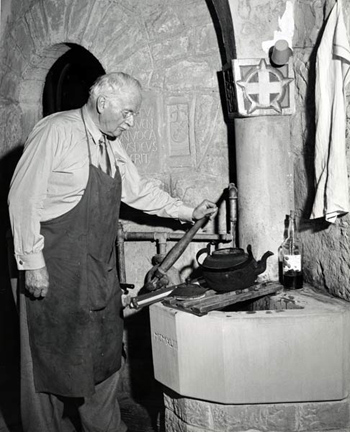
“I pump the water from the well.  I chop the wood and cook the food.  These simple acts make man simple; and how difficult it is to be simple!”

Jung pumping water at Bollingen ca. 1960.  Library of Congress

Jung pumping water at Bollingen ca. 1960. Library of Congress

While drawing inspiration from Jung, an obvious question becomes, how do I connect with this kind of depth in the midst of my own too-hectic life?  The good news is, we don’t need a tower to live in for months at a time.  The bad news is we need to unplug every day and tune into activities that nourish the soul; this is often hard arrange.  It takes focus, intention, and experimentation to find those things that center us and we are drawn to.  Any number possibilities come to mind:

  • “Spend an hour a day in a quiet room by yourself reading old stories that you find nourishing.”  That’s what Joseph Campbell said when Bill Moyers asked this question during the “Power of Myth” interviews.
  • Meditation, of almost any kind.  This my own core practice.  Zen teacher, Cheri Huber said, “If you start by watching your breath for as little as five minutes a day, it can change your life.”
  • Sports that allow one to get in “the zone,” especially walking, running, or bicycling.
  • Keeping a dream notebook.
  • Writing, though I suspect most bloggers will have the same difficulty I have in putting words at the service of psyche – how do I turn off the writing sophistication I’ve worked so hard to gain?  Can I ever truly use words in a “purposeless” manner, allowing them to go where the wish, without thinking, “Gee, this would make a good blog post?” For any chance of success, I need a definite strategy, like writing fast with a rollerball pen in cheap notebooks.
  • Visual arts or crafts.  Training or skill is not required for this kind of work, and in fact, can get in the way.  Those with artistic training may find it useful to paint or draw with the non-dominant hand.  Jung had no formal art training, but his private journal, The Red Book, only recently published, gives an idea of what may emerge if one is determined to honor the psyche.
Red Book, p. 131.  Courtesy Ox Aham, Creative Commons

Red Book, p. 131. Courtesy Ox Aham, Creative Commons

When I truly examine my own habits, it’s clear that I fritter away enough time with gadgets each day to find the space for this kind of exploration.  It doesn’t need to be with the kinds of activities I outlined above.  I find it’s ok to schedule “time for inner work” the way I schedule time at the gym, but the most powerful new discoveries seem to emerge from those quiet voices at the edge of consciousness, the tiny impulse it is so easy to overlook in our busy lives.

Such an impulse woke me one night at 1:00am one morning.  Instead of going back to sleep, I got up and wrote down a sentence.  That led to a paragraph, and then a page, and then another.  That was the start of the first (and so far only) novel I’ve finished.

Something similar happened to Jung at his tower.  He gave the stonemason at a quarry precise measurements for blocks he needed to build a new wall, but one of the stones arrived in error; it was square, about 20″ on each side.  When Jung saw it, he said, “That is my stone, I must have it!”  Over time, he carved a testament to his life and work on stone which “stands outside the Tower, and is like an explanation of it.  It is a manifestation of the occupant.”

Bollingen stone, main face, CC-BY-SA-3.0

Bollingen stone, main face, CC-BY-SA-3.0

In a seminar in 1939, Jung said:

“We have no symbolic life, and we are all badly in need of the symbolic life. Only the symbolic life can express the need of the soul – the daily need of the soul, mind you! And because people have no such thing, they can never step out of this mill – this awful, banal, grinding life in which they are “nothing but.”

The Bollingen Tower became a vital way for Jung to live the symbolic life, but he would have been the first to insist that we don’t need to carve stone or build houses to find it for ourselves.  All we need is the hunger.  And the will to begin.

What’s coming to TheFirstGates in 2014?

Courtesy Emma Paperclip, Creative Commons

Courtesy Emma Paperclip, Creative Commons

Thanks to everyone who visited this year, old friends and new.  Here are a few year end musings on where this blog may be going in 2014.   These are not resolutions.  Remembering Yoda’s words to Luke, “Do or do not, there is no try,” I don’t make resolutions.  These are sort-of-predictions, aka guesses, based on a line from a Grateful Dead song, “I can tell your future / just look what’s in your hand.”

In the case of theFirstGates, it should probably read, “look at what books are piled up on the table beside you.”  Looking at the titles in the stack, I predict more of the same, only new and (hopefully) better.

I’m currently reading a book I got for Christmas, Grimm’s Complete Fairy Tales.  The key word is complete – I haven’t read all the tales before.  The other great feature is the Arthur Rackham illustrations.  No one has ever painted Faerie like Rackham, and it’s a place I never tire of visiting.

Another new title is Trickster Makes this World by Lewis Hyde.  Not only is Trickster an ongoing object of fascination, but he pervades blogging just like the rest of life.  I’m reminded of this every time I hit Publish while meaning to click on Save.

And perhaps most important for TheFirstGates, I’m rereading The Dream and the Underworld, one of James Hillman’s important early works.  Here he turns the tables on psychology’s habit of translating the night world of dreams into the language of daylight; serving the ego, in other words.

Dream and the Underworld

Instead of asking what a dream means, Hillman asks what it wants.  This shift is fundamental to all of Hillman’s thought – psychology, the science of the psyche, in service to soul and soul-in-the-world.

Of great interest to me as a blogger is Hillman’s effort to see through literal events to the fantasies, the mythical layers that underly the stories we tell ourselves and the ones we see on the evening news.  The reality in our fantasies and the fantasy in all our realities.

The coming year is unique in one respect: 2014 marks the centennial of the start of that worldwide disaster misnamed “The Great War.”  The first world war has haunted me for years with its end-of-an-age immensity and sadness.  There are millions of stories to tell, and I’ll try to post a few here, from the bumbling youths who sparked the conflict to a young lieutenant named Tolkien who was sent to Mordor in 1916, though the generals called it The Somme.

And finally, as always I will continue to be on the lookout for those stranger-than-fiction events that leave us shaking our heads, wanting to laugh or cry or both at the strangeness of it all.

I wish you all a joyous New Year, and I hope we will all continue to share the emerging wonders of this online experience!

Getting rid of those pesky memories

In my previous post, I wrote of advances in the field of virtual reality, and posted a video clip that brought to mind the dystopian landscape of Aldous Huxley’s Brave New Word (1932).  Huxley imagined life in “The World State” in 2540, where children are born in “hatcheries.”  They are raised in “conditioning centers” and learn to be avid consumers and abhor the thought of solitude.

Happy face thumbs up

One of the World State’s tools for keeping people docile are “the feelies,” multi-sensory movies, most often centered on sex.  The connection to virtual reality should be obvious.  Another conditioning tool was “soma,” a side-effect free hallucinogenic drug that World State citizens used to go on “holidays.”  Soma relates to the subject of this post – a potential advance in the technology of feeling happy, happy.

In “Unwanted Memories Erased in Experiment,” an article in The Wall Street Journal (12/23/13, p. A1), Gautam Naik writes that scientists used electrical currents to erase memories they had implanted earlier.  Someday doctors may be able to zap painful memories and leave the rest in tact.  Assuming the technology becomes (relatively) safe, would this be a wise thing to do?

In a few cases it might be – the 39 patients who volunteered for the experiment were already undergoing electroshock therapy for severe clinical depression after all other treatments had failed.  But the article’s assertion that memory erasing might be useful to remove “associations linked to smoking, drug-taking, or emotional trauma” suggests the kind of social engineering Huxley wrote about.

Last year at a Buddhist teaching, I met an elderly woman who had spent her youth in a Soviet gulag.  As difficult as the hardship was, she had written a memoir for her family to read, “So they’ll know who I really am.”  Her core identity, as well as her later practice of Buddhism were direct results of those years of suffering.

In my late 20’s, I knew a woman who lost her closest male friends over a short period of time; they died of cancers related to Agent Orange exposure in Vietnam.  After surviving a deep depression, my friend enrolled for training to work in a hospice.  Without the pain of loss, she wouldn’t have found her calling.

The poet, Rilke, declined Jung’s offer of therapy work saying, “If you take away my devils, I fear my angels might flee.”  

The disowned parts of ourselves are especially important in scripture.  When Jesus offers living water (Jn 4:10-13), only those who know they are thirsty will hear him.  When Buddha teaches a path beyond suffering, we won’t listen if we’ve deadened ourselves with soma or reality TV.

A tour of America 80 years ago sparked Huxley’s vision of an economic and political culture at war with soul values.  Now that another “holiday season” has run its course, as the media waits for the next distraction, I am reminded once again of the cautionary words in this wonderful poem that William Stafford published in 1960:

A Ritual to Read to Each Other

If you don’t know the kind of person I am
and I don’t know the kind of person you are
a pattern that others made may prevail in the world
and following the wrong god home we may miss our star.

For there is many a small betrayal in the mind,
a shrug that lets the fragile sequence break
sending with shouts the horrible errors of childhood
storming out to play through the broken dyke.

And as elephants parade holding each elephant’s tail,
but if one wanders the circus won’t find the park,
I call it cruel and maybe the root of all cruelty
to know what occurs but not recognize the fact.

And so I appeal to a voice, to something shadowy,
a remote important region in all who talk:
though we could fool each other, we should consider–
lest the parade of our mutual life get lost in the dark.

For it is important that awake people be awake,
or a breaking line may discourage them back to sleep;
the signals we give–yes or no, or maybe–
should be clear: the darkness around us is deep.

Remembering James Hillman

James Hillman died two years ago today.  As a culture, we have yet to appreciate the depth and range of his thought, but without any doubt, that will come.  I’m going to post a brief interview with him that I just discovered.

Toward the end of his life, Hillman wrote extensively on character, in The Soul’s Code, 1996, and The Force of Character, 1999.  In this 1999 interview on the Legacy of Aging, he said true character emerges most clearly in maturity.

When our culture attempts to mask the process, through plastic surgery and other means, we deprive ourselves, and especially the young, of the authenticity of elders, people who simply are what they are.  “As Hemingway said, ‘Life breaks everyone,’ and if we can’t see those breaks, we’re living in a false world.”

Hillman says the physical deterioration of age is real and can be difficult, but he believes it is purposeful, “no accident,” and growing old is not a disease to be cured or quarantined.  Using the metaphor of waking up more frequently at night, he speaks of “waking up to the night.”  As physical eyesight grows dim, the eyes of the soul open.

http://www.youtube.com/watch?v=ja02wofquG8

People who study Hillman’s work will also want to read this memorial piece that Thomas Moore wrote for the Huffington Post.  Moore, a friend who corresponded with Hillman for decades, offers a wonderful summary of one of the key themes of his work:

“I was taken by [Hillman’s] loyalty to Jung expressed through his original and fresh re-working of key ideas. He calmly removed unnecessary gender issues from Jung’s ideas of the anima and soul. He advocated a view of the person as made up of multiple, dynamic faces that should be kept in tension rather than “integrated” into some sentimental notion of wholeness.”

Hillman spent his long life defending such values as soul, authenticity, and imagination.  I could find any number of worthwhile posts about his life and work, but these are enough for now.  They’re enough to allow us to pause and remember the life and work of an exceptional man.

James Hillman on world change and political polarization

James Hillman, 1926-2011

James Hillman, 1926-2011

For decades, James Hillman brought us unique observations on modern life from the perspective of a depth psychology that embraced soul as its highest value.  Recently, I’ve wished I could hear his take on our current climate of political divisiveness, but Hillman, who died two years ago at the age of 85, wasn’t here to watch our most recent shenanigans.  Happily, I recently stumbled upon a pair of interviews in which Hillman discussed this very subject and set it in a context of massive cultural change.

Author and journalist Pythia Peay published the first interview on The Huffington Post in February, 2011 (Jungian Analyst Explains the Psychology of Political Polarization).  The occasion for their talk was the mass shooting in Tucson, which had happened a month earlier.  The most prominent victim was Representative Gabrielle Giffords.

Tragically, memory of that event, just two and a half years ago, has been lost in the wake of more recent carnage, including the Nevada school shooting earlier this week.  Though Hillman’s comments focused on the role of political divisiveness in the attempt to kill a congresswoman, his additional statements now seem eerily relevant to the 12 year old in Sparks who was so alienated that he ended his life with murder and suicide.

Hillman began with a general discussion of polarized thinking.  “Polarity,” he reminds us, is an electrical engineering term.  Batteries have poles; the psyche is far more nuanced than that, dwelling in shades of gray rather than black or white.  Ideological extremes subvert our ability to judge individual issues on their merit.

When asked if violently polarized politics caused the shootings, Hillman changed the focus to another kind of cultural rigidity and its effect on the Tucson shooter:

“I think that this kid was made a loner by an American educational system in which there is no room for the weird or the odd…We need to have an educational system that’s able to embrace all sorts of minds, and where a student doesn’t have to fit into a certain mold of learning. Our educational system has become so narrowed to a certain formula, that if you go through a weird phase, you’re dropped out — often at the age of schizophrenia, 19-23 — and that’s the danger.”

Arguments in the wake of gun violence bog down in specifics, like background checks and how many bullets a magazine should hold – we don’t ask why and how we’re producing more and more people prone to mass violence.  In the end, says Hillman, for a culture that pays so much lip service to “the individual,” we are terrified of real individuality, and attempt to stamp it out.

In the second interview, America and the Shift in Ages, Hillman suggests that much of that rigidity has to do with futile attempts to shore up outmoded systems and institutions during a period of massive change.  Not just one but “three or four” myths that are central to our culture are collapsing.

Everything we fear has already happened said Hillman:  “The fragility of capitalism, which we don’t want to admit; the loss of the empire of the United States; and American exceptionalism. In fact, American exceptionalism is that we are exceptionally backward in about fifteen different categories, from education to infrastructure. But we’re in a stage of denial.”  Other beliefs and structures are crumbling as well, he said.  White supremacy, male supremacy, the influence of monotheistic religions, and the belief that we are “the good people.”

If such institutions do not appear to be in decay, it’s because they are so staunchly defended, and that, Hillman says, is a sign of their lack of vitality — “If they were vital they wouldn’t need to be defended. And the fanaticism we’re witnessing goes along with the deterioration of the vitality of these myths.”

Many of our fundamental beliefs are under scrutiny and need to be.  Hillman mentions the meaning of “freedom.”  For many, freedom means, “I can do any goddamn thing I want on my property; that I am my own boss and don’t want government interference; that I don’t want anybody telling me what I can and can’t do.”  This, he says, is the freedom of an adolescent boy.  What of the different kinds of freedom, such as “freedom from the compulsions to have and to own and to be someone?”  What of the freedom Nelson Mandela found in prison?

Hillman cites economic assumptions that need to be questioned as well.  Falling demand needs to be stimulated, according to current assumptions, but from an ecological point of view, that’s exactly what the world needs at this time.  Sustainability models, which may be our hope for the future, terrify those in positions of power.

Many of our current fears, says Hillman – from fear of immigrants crossing our borders, to fear of failing education, to fear of cancer, to economic insecurity, terrorists, and of course fear of “the other” political party, results from the lack of a wider framework in which to understand the massive shifts that are already underway.

There is no going back, but as obsolete structures crumble, we can glimpse, if we look, new forms emerging.  Hillman gave the example of a “Bioneers” conference he attended where Paul Hawken showed a film that was simply the names of individuals and organizations involved in trying to innovate ways of building communities, economic systems, and ways of dealing with the natural world.  Hawken said there were thousands of names, and the film could roll for weeks.

Hillman said it’s important not to try to fit emerging structures into the patterns of the past.  For our peace of mind, a new kind of faith is required:   “I think it’s a matter of being free-wheeling, and trusting that the emerging cosmos will come out on its own, and shape itself as it comes. That means living in a certain open space — and that’s freedom.”

Dawn over Oostende, Belgium, 2007.  Photo by Hans Hillewaert, CC-BY-SA-3.0

Dawn over Oostende, Belgium, 2007. Photo by Hans Hillewaert, CC-BY-SA-3.0

Such words are a fitting conclusion to the lifework of a man who lived in defense of Anima Mundi, the World Soul and who taught that animals, trees, and rivers are intelligent and alive, and that at some deep level of the psyche, we can hear their voices.  In Hillman’s life work, observation of the modern psyche led to conclusions that mesh with the myths of the ancestors.

A thousand years from now, people will read of our times and shudder, as we do in contemplating the rigors of life in the middle ages.  A few visionaries stood out from the rest, those like Saint Francis, Dante, and Leonardo, who pointed toward a more benevolent and expansive future.

We cannot write our own history, but we can wonder how it will look to those in the future.  I am convinced that James Hillman will be remembered when most of what passes for news on TV is blessedly forgotten.

Stories that make the world

Photo by Manel, 2011, CC BY-ND 2.0

Photo by Manel, 2011, CC BY-ND 2.0

 On saturday, an acquaintance and I met at a local park to discuss some things of mutual interest.  It was a stunning fall day, with temperature in the low 80’s, so we sat for several hours at a picnic bench surrounded by tall oaks.

I met this man just a few months ago, and during the conversation, it became clear that his political views and mine are polar opposites.  We mentioned them but didn’t argue, for we had other things to discuss.  Besides, by then some people nearby had a birthday barbecue going, and we were both distracted from politics by the smells.  When someone said, “Anyone else want a burger?” I was sorely tempted to raise my hand.

Later though, I reflected on how the two of us could hold such different narratives of the same recent events.  The poet, Muriel Rukeyser’s phrase, “The universe is made of stories” came to mind, as it often does, for it summarizes a key observation of two disciplines that have deeply shaped my world view, eastern philosophy and depth psychology:

  • “The Buddhist does not inquire into the essence of matter, but only into the essence of the sense perceptions and experiences which create in us the idea of matter.” – Lama Angarika Govinda, 1969.
  • “Every notion in our minds, each perception of the world and sensation in ourselves must go through a psychic organization in order to “happen” at all.” – James Hillman, 1975. 

Such statements may seem too lofty for a number of common experiences, especially things like physical pain, even the sliver I have in a finger from hauling firewood onto the back porch.  Not long ago, however, I came upon a concrete example of how the mind creates reality.

A contemporary Tibetan lama spoke of an experience we all went through in learning to read.  One day when we were young, a teacher drew three marks on the board (or our parents did, or we saw it on Sesame Street).  That teacher then said something that changed our world forever:  “This is the letter A.”

a-elmo-alphabet 200

From that moment on, the letter “A” existed for us, and it always appears to exist “out there,” in the world, when in fact, all that’s “out there” are three lines in a specific pattern.  “A” exists only in the minds of those who have learned certain alphabets – a person who doesn’t read or only reads Chinese would not be able to find it.

This small story about the letter “A” parallels the complex stories we create, borrow, and use to make the sense of the world.  Sometimes, like this past saturday, when it seems like the person you’re talking to comes from an alternate universe, it’s because they do – not a universe we could travel to with  warp drive, but one that is simply constructed of very different stories.