Reflections on Crazy Wisdom

So far in this 21st century, much of our conventional wisdom has failed us. Crazy times demand a matching wisdom, and these are crazy times. That made it all the more strange that I couldn’t seem to write a followup piece to my last post, Crazy Wisdom is No Bull, which I thought would be the start of a series.

I’ve come to believe it’s because Picasso and the others I’d planned to feature were exemplars in their fields, people we think of as “special,” a breed apart from the rest of us. This is the opposite of the real point I want to make. The modern concept of “genius” was born in the 18th century. Of far more use to us now is the original meaning of this Latin word:

Genius of a family. Roman, 1st c. Photo by Luis Garcia, 2009. CC-by-sa-3.0

“In ancient Rome, the genius (plural genii) was the guiding spirit…of a person, family, or place. The noun is related to the Latin verb, genui, genitus, ‘to bring into being, create, produce’, as well as to the Greek…word for birth.” [1]

The genius of a man, or Juno of a woman, was similar to our modern idea of a guardian angel – a protective spirit as well as a creative guide to our individual destiny  and life’s meaning [2].

From this perspective the difference between you and me and the great creative spirits of history is not that they have a genius and we don’t. It is more a matter of degree – “The Force is strong in that one.”

Since none of us really believe that some white-hatted genius is going to ride into town and save us from ourselves, it is more important than ever for as many as possible to find their genius or juno within and begin to listen and cultivate its wisdom. Continue reading

Crazy Wisdom is No Bull!

Bull’s Head, 1942, by Pablo Picasso

“Crazy Wisdom” is an attribution given to certain “unconventional” holy men in eastern traditions, but it applies equally well to some of our western saints. Saint Francis preached to birds and wolves, while Aquinas, after a lifetime of scholarship, had a vision at the end of his life that caused him to declare that all of his writings “were so much straw.”

“Crazy Wisdom” is not some rarified, exalted state of mind, accessible only to the gifted few. Tenzin Wangyal Rinpoche, a Tibetan Bon Buddhist master with whom I have been privileged to study, says that when a person is able to cut through conditioning and begin to connect to their Source, their Inner Wisdom, one typical reaction is flexibility and freedom from our own “knee-jerk” reactions, as well as from cultural conventions that have lost their meaning or usefulness. No one said it better than Emily Dickinson:

Much Madness is divinest sense (620)

Much Madness is divinest Sense –
To a discerning Eye –
Much Sense – the starkest Madness –
‘Tis the Majority
In this, as all, prevail – 
Assent – and you are sane –
Demur – you’re straightway dangerous
And handled with a Chain –

I know of no simpler and better illustration of how this works than Picasso’s “Bull’s Head,” a found object sculpture he created in 1942. He was looking for “ready made” objects in a junkyard, and saw a bicycle seat lying near a pair of disconnected handlebars. In that instant, the Source of creativity within him saw a pattern no previous artist had.

Why Picasso but none of the bicyclists or sculptors before him? Tenzin Wangyal would say that he was present, fully aware, with a mind empty of other concerns. He wasn’t focused on what he was going to have for lunch or any of the other myriad concerns that occupy most of our waking hours.

Again, this vision of new connections is not reserved for famous artists, but is available to anyone who can find a way to clear their vision and mind and tune into the moment. Nothing, nothing, nothing may be more important at this time, when “the starkest Madness” rules our land.

To again quote Buckminster Fuller, in the previous post: “You never change things by fighting the existing reality. To change something, build a new model that makes the existing model obsolete.” 

An added benefit is that this kind of thing drives literalists nuts. Beancounters and most politicians can’t deal with this sort of ambiguity. “There’s something happening here, but you don’t know what it is, do you, Mr. Jones?” sang Bob Dylan 50+ years ago, and it may be even more true now.

So go out and have some fun and be subversive – find some connections you’ve never noticed before!

A change coming

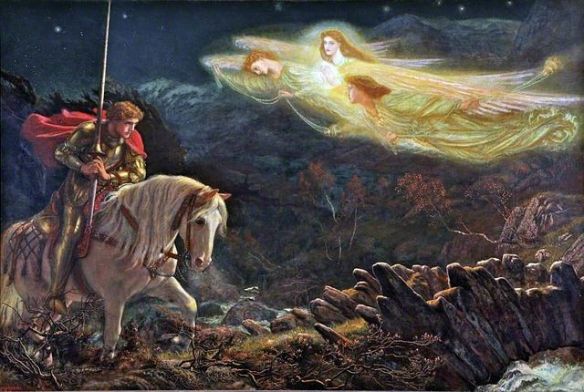
Sir Galahad, the Quest for the Holy Grail, by Arthur Hughes, 1870, public domain.

I’ve been enjoying the recording of a discussion at a conference with James Hillman and Michael Meade on literal, psychological, and mythological modes of understanding.

Hillman, a former director of the Jung Institute in Switzerland, has been the most prolific and influential of post-Jungian thinkers. He spent his life as champion of psyche, soul, and imagination in a world that has too few such champions. Hillman took particular aim at literalism, which he called “an idol that forgets it is an image and believes itself a God, taking itself metaphysically, seriously, damned to fulfill its task of coagulating the many into singleness of meaning which we call facts, data, problems, realities.” (Revisioning Psychology).

When I think of literalism, I recall the last lines of a poem a brilliant young poet I knew wrote about his high school principal:

His triple-breasted chin, arranged in folds upon his chest,
He blunts my life with a technicality.

Hillman also takes aim at much psychological thinking in books like The Soul’s Code. In this conference, he points to the 20th c. understanding that “The Gods now live in the psyche,” as a core statement of one of our greatest collective problems: the world and nature have lost their connection to the divine, and as such, are ripe for exploitation by greedy men who have traded their souls for profit. If you’ve seen one redwood, you’ve seen them all,” Ronald Reagan famously said when he was California’s governor.

Michael Meade noted that one of the hallmarks of myth is a sense of abundance. The current miasma of scarcity thinking – that there isn’t enough to go around, so you better get yours while you can – is a clear indication, if we need it, that we have no myth, no shared stories of who we are as a people. Continue reading

Winter Feast for the Soul, 2018

The Winter Feast for the Soul, now in it’s 11th year, is a 40 day, worldwide online meditation intensive that encourages people to begin or deepen a spiritual practice. Instructors from all spiritual traditions suggest simple practices that fit into the schedules of busy people.

I am delighted to see that Anam Thubten, the Tibetan master who inspired me to explore this tradition a dozen years ago, continues to be an active participant. On his page, you can listen to simple but profound guided meditations he recorded for the Feast in 2016 and 2017.

Anam Thubten

I encourage everyone who is interested to explore this rich practice opportunity!

John Believer’s Prophecy

The Fool in the Tarot de Marseilles

When I was a college freshman in Oregon, a bearded fellow in a long black coat would sometimes harangue the crowds in the quad at lunch time. He’d bring a box to stand on and a Bible to wave. He called himself John Believer.

This was the late 60’s and though he tried for hell and brimstone, I think he’d done too much acid to pull it off. Out of his sometimes interesting theological mishmash, one of his ideas stuck with me and resonated with teachings I would hear later from two spiritual masters.

John Believer said the spiritual center of earth was right there in Oregon, (that’s why he’d moved north from Berkeley), but we should expect trouble. The spiritual center is always on the move, he explained, and it was about to head back to the orient. During it’s long Pacific crossing, humanity would experience an age of darkness.

In May, 1940, the Hindu master, Paramahansa Yogananda, gave one of several lectures predicting a coming time of travail for humanity.  The transcript of the May talk  is available as a pamphlet, World Crisis, published by Self-Realization Fellowship. Seventy-seven years ago, Yogananda said:

“A great crisis is going to come, a crisis such as never before has hit this country…There is a world revolution going on. It will change the financial system. In the karmic firmament of America, I see one beautiful sign; that no mater what the world goes through, she will be better off than most other countries. But America will experience widespread misery, suffering, and changes just the same. You are used to the better things of life, and when you are obliged to live simply, you won’t like it. It’s not easy to be poor after being rich. You have no idea how this change is going to affect you through the years. Never before in the history of this land has there been so deep a contrast in living standards as will visit this country – the contrast between riches and poverty.” (emphasis added)

Yogananda predicted that though the darkness would last several centuries and even threaten the future of life on the planet, it would likely pass and usher in a time of spiritual growth for humanity. Continue reading

A Fake World

“All that we see or seem is but a dream within a dream.” – Edgar Allen Poe

The world’s spiritual traditions tend to agree with these words Poe wrote in 1849, the year of his death. To Hindus, this world is “maya,” meaning “a magic show, an illusion where things appear to be present but are not what they seem.” (1)

Buddhists call it “samsara,” a Sanskrit word for “wandering through, flowing on, aimless and directionless wandering,” signifying the involuntary cycle of death and rebirth that continues until we grasp the true nature of appearances (2).

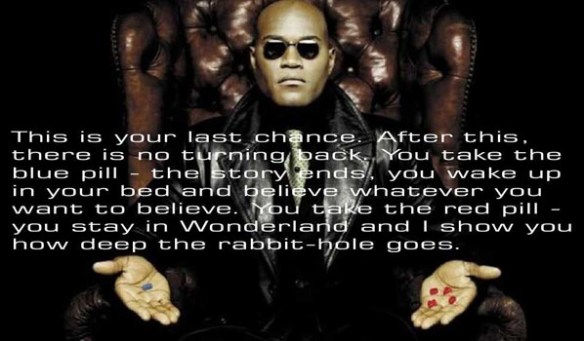
Jesus warned his followers that this is not the place to store up riches. In 1999, the Matrix reframed the appearance/reality question for the twenty-first century.

Being spiritual, doesn’t give anyone a pass on consensus reality. As Ram Dass put it, “We have to remember our Buddha nature and our social security number.” 

Navigating samsara has never been easy. Truth is hard enough to discover when we are sincere, let alone when we are not. That’s one reason why Buddha placed a special emphasis on truth as a core value. Not lying was one of his Five Precepts. He said, “When anyone feels no shame in telling a deliberate lie, there is no evil, I tell you, they will not do” (3). Continue reading

You Will Get Through This

I spotted this wonderful painted stone in the bushes near the entrance of our local library, on an early morning dog walk this week. How many smiles did this artist generate? How many people’s days were brightened?

The message is simple but intriguing. Get through what? This day? This period of crisis in the life of our nation? This life? Samsara? Whatever other personal burdens each one of us carries?

Such an attitude is a choice, and most of us have to practice long and hard to cultivate such a view, for negativity is easy, especially in times of rapid change like these.

Maybe the question this stone really asks is how do we want to live? The joyful colors of both the paint and the surrounding plants give us a hint of the most skillful answer.

Notes from 2017: A Winter Feast for the Soul

Lotus flowers. Public domain.

Lotus flowers. Public domain.

The aphorisms in my previous post, on causes of happiness and unhappiness, are simple to say and understand, but not very easy to put into practice in the “thick of things.” I think that’s why the Dalia Lama speaks of practicing compassion – what we need to do to become skilled at anything.

At the same time, Buddhists believe compassion is part of our innermost nature, but it’s buried under the detritus of day to day living. That’s one reason why a core image is the lotus flower, which eventually blooms in original purity, but only after rising from the mud in which it germinates.

To aid in such practice, an international and multi-denominational contemplative practice begins tomorrow, Sunday January 15, A Winter Feast for the Soul. The event began about 10 years ago, and the intro page outlines the mission as:

  1. To support individuals in experiencing the benefits of establishing a daily spiritual practice.
  2. To create a global community of individuals committed to sustaining a daily spiritual practice for 40 days from January 15 to February 23 each year.
  3. To honor all forms of spiritual practice and to make them welcome to our Winter Feast for the Soul. These include meditation, yoga, tai chi, chi gong, journaling, reading spiritual texts from all traditions and philosophies.

One of the teachers participating is Anam Thubten, a Tibetan master I’ve mentioned numerous times on this blog. Here is his statement on why this is so important, especially at this critical time. Please have a look, and follow the link to the site, given above, to learn more and to register..