Fall seems to be the busy time for writing contests and here are details on two new ones from Writer’s Digest. How does $3000 for a 1500 word story sound? Nice work if you can get it, and someone will!
The 12th annual Writer’s Digest Short-Short Story Competition has top prizes of $3000, $1500, and $500, plus prizes of $100 for the next six selections, and $50 WD book credits for those who place 11-25. Names and story titles of the top 10 winners will be published in the magazine and posted online. The deadline is is Nov. 15 and you can read the details at http://www.writersdigest.com/competitions/short-story?et_mid=515537&rid=3017168
The 7th annual Writer’s Digest Poetry Competition has a similar schedule of prizes though they are less, for the maximum length is 32 lines. All styles are welcome and names of the top 10 winners will be published in the magazine and published on the WD web site. The deadline is December, 1 and details are here: http://www.writersdigest.com/competitions/poetry?et_mid=515537&rid=3017168
I just received a notice from Writer’s Digest, announcing six short story competitions in six different genres: http://tinyurl.com/3bdoueq.
In each genre, the first prize is $1000, plus $100 worth of Writer’s Digest books, and the 2012 Novel & Short Story Market. Second prize is $500, $100 worth of books and the Novel & Short Story Market. Honorable Mentions receive the Novel & Short Story Market. The three top entries in each genre will be published in “a Writer’s Digest outlet.”
Stories must be previously unpublished and not accepted by any other publication at the time of submission. WD retains “one time publication rights” for the “outlet” mentioned above, their website or magazine, I imagine, though they are not specific. Entries are $20 each, and the maximum length for all genres is 4000 words. The genre competitions have different deadlines:
In addition to a number of annual contests, Writer’s Digest hosts a monthly short-short fiction challenge. They provide a prompt, often just an opening sentence. Interested writers submit a story of 750 words or less. The WD judges select five finalists, and the winner is chosen by votes of registered members of the Writer’s Digest forum. You need to register for the forum, but once you do, you can read the current finalists as well as the stories of past winners, which is an education in itself. There is no money involved but winnning entries are posted in the print magazine and on writersdigest.com
I had the notion that I could never write this kind of story until last fall, when I really needed a mini-vacation from my major project. It was mid-October so my thoughts turned to ghosts, and over the next few months I wrote several very short stories. Now I find them rewarding, like quick sketches, like a way to test ideas or try out another genre. A chance to visit Mars, or Paris, or Hoboken.
Save the link. One day it may be just the change or breath of fresh air you’ve been wanting.
It seems like the “contest scene” picks up steam during the second half of the year. I know there are round-the-calendar listings, but I tend to jot the URL’s on postIt notes and lose them, so I mostly wait for the listings to come to me. Here’s one from the Gotham Writer’s workshop: http://tinyurl.com/3zbt3op (contest listings near the bottom of the newsletter).
Of note is the Zoetrope All-Story Short Fiction contest: 5000 word limit, all genres, $15 entry fee, multiple entries fine, prizes of $1000, $500, $250, and the top ten entries will be considered for representation by several literary agencies. The deadline is Oct. 3, 2011.
There is also a contest for train stories between 2,000 and 20,000 words long. There are two contests for non-fiction, one for screenplays. In celebration of the 1950’s Sci-Fi Magazine, Galaxy there’s a contest for novellas between 15,000 and 20,000 words in length to be published in ebook format.
Unfortunately, some of the deadlines have passed, and others are only good through July 4, but there will certainly be more opportunities, especially for writers who like short fiction. I’ve read several articles saying that while some of the print magazines that featured short fiction have folded, others are popping up in online form. Let’s hope so. This is something to watch.
It may finally be summer. Or spring. Or whatever we’re calling it this year. A week ago it was hailing, and today it’s in the mid-80’s. By itself I would probably not notice since it’s gone back and forth from hot to cold so many times, but this week there were other changes as well
We cut down a huge liquid amber tree that was big when we moved in 25 years ago, and had grown huge over the last quarter century. None of the neighbors could agree on how tall it was, but most guesses came in at 70′ – 80′. The shade in the summer was enough of a bonus to make up for having to trim the limbs every few years, but this winter, which went on forever, it got to be too much. The sap and the birds in the bare branches did a number on my car every night for weeks and weeks and weeks, and weeks and weeks. Did I say it went on for weeks and weeks? That plus the need to replace our roof this summer made up our mind, for we always eyed this behemoth tree warily during storm season. Especially the last few years.
Now two small maple trees about 10′ high stand in the front yard, all staked and watered and fertilized. They seem hopeful and sad at the same time. Hopeful in the golden light of morning and evening, for they carry a promise for the future. Sad in the flat light of noon which seems to emphasize the bare dirt where the stumps and roots of the old tree stood. No amount of wisdom ever entirely gets your gut ready for change.
That’s nothing compared to what the guts of the graduates from the local high school are doing right now. The school is just around the corner. This morning, just after 7:00am they started to drift up the street with parents and grandparents and friends. By 11:00 it was over and all the cars were gone from the curbs. I found myself remembering my own graduation and the biker who led us into the ceremony with a psalm.
As we stood in our caps and gowns in alphabetical order, one of the “A’s” at the front of the line raised his voice and said, “Bretheren and Sisteren, I have a few words to share with you!” Now this was a large biker guy who seldom spoke; he usually just sat around and glowered. But just as they struck up Pomp and Circumstance, this guy pulled out a bible and read the 23d psalm. When all the other memories of high school have faded, that may be the one I remember. Well, maybe not, but it will be right up there.
This morning I found myself watching people returning from the ceremony. A few were laughing and joking, but in general, no one seemed especially upbeat or inspired. School officials mean well, but how can a bit of speechifying while you sit on folding chairs really commemorate what happened, or represent any useful guidance for what comes next?
Too bad the graduates cannot experience the vision quests the plains indians held for their young people. Coming of age should be a time for discerning the themes of one’s life, and the nature of one’s guiding spirits, but that is very seldom what happens these days. Or rather, we all still go on a vision quest, it just is not so well organized or safe. If we are lucky, after a few decades, we begin to get a clue. I found myself wishing the new graduates well, and wishing them a fruitful voyage into the wilderness.
It’s easy to see why I was drawn to the Ballad of Jesse James as a kid; the song paints Jesse as an American Robin Hood:
Jesse James was a lad, he killed many a man,
He robbed the Glendale train.
He stole from the rich and he gave to the poor,
He’d a hand, and a heart, and a brain.
Jesse James
Not surprisingly, singers who have covered this ballad include Woodie Guthrie, Pete Seeger, and Bruce Springsteen. The song also has those elements of mystery I believe are central to stories that take up permanent residence in imagination:
Oh, Jesse had a wife who mourned for his life, Three children they were brave, But that dirty little coward, that shot Mr. Howard, Has laid Jesse James in his grave.
The notes in the book of ballads I found as a kid explained that “Howard” was the alias Jesse James used when he married, settled down, and tried to leave his life of crime behind. The dirty little coward was Robert Ford a friend of Jesse, who shot him as he straightened a picture on the wall of his home. Something in us recoils at that and wants to know how Ford could do it. We know in our bones why Dante assigned traitors to the lowest circle of Hell. I am not the only one who wonders, for the story has been dramatized several times, most recently in 2007, when Brad Pitt played Jesse in The Assassination of Jesse James by the Coward Robert Ford.
With Jesse James we get to witness a legend in formation, for unlike the Child ballads, this story is just over a hundred years old. We can see how imagination shapes facts the way the ocean smooths pebbles, and something in us prefers the legend – we want to know who the heroes and villains are and we want them larger than life. If you are like me, you’ll be disappointed to learn that no historical record shows the James gang ever using its loot to benefit anyone but themselves.
Jesse James, (1847-1882), and his older brother Frank, came of age during an especially bloody phase of the Civil War – the guerilla conflicts that raged across the border state of Missouri. The James brothers rode with William Quantrill, one of the most notorious guerillas; we would call him a terrorist now. Sixteen year old Jesse joined Quantrill in 1864, and supposedly took part in the Centralia massacre, where the band killed 22 unarmed Union troops then scalped and dismembered them.
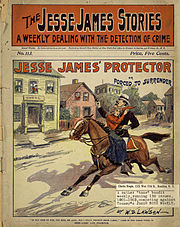
After the war, Missouri freed its slaves, but forbade ex-Confederate soldiers from voting, serving on juries or even preaching from pulpits; it was a fertile ground for outlaws. The James brothers joined with Cole, John, Jim, and Bob Younger, and went on decade long spree of robberies that spread from Iowa to Texas, and from Kansas to West Virginia. John Newman Edwards, an editor of the Kansas City Times, published Jesse’s letters and presented him as a symbol of Confederate resistance to Reconstruction. The James-Younger gang was adept at publicity, often hamming it up before crowds during escapes from stagecoach and bank robberies. Because they took safes and strongboxes and did not rob passengers, Edwards’s editorials painted Jesse as Robin Hood.
Jesse James dime novel cover
The Pinkerton Detective Agency was hired in 1874 to stop the James-Younger gang, and after numerous setbacks, Allan Pinkerton took on the case as a personal vendetta. In 1875 he staged a raid on the James homestead and threw an incendiary device into the home. It exploded, killing Jesse’s half-brother, and blowing off one of his mother’s arms. This, more than any editorial, won public sympathy for Jesse James. A bill granting the James and Younger brothers complete amnesty was narrowly defeated in the Missouri legislature.
Jesse married his cousin Zee in 1874, and two of their children survived to adulthood. The downfall of the gang came in 1876, when they raided the First National Bank in Northfield, Minnesota. All of the Younger brothers were killed or captured. Only Frank and Jesse escaped.
Jesse tried to live quietly with his wife after that, in a home near St. Joseph, but he invited Charley Ford, a former gang member, to move in with the family for protection, and Charley brought in his younger brother Bob. Both Ford brothers had been in contact with the governor of Missouri about his reward for Jesse, dead or alive. One day, in 1882, as the three men were getting ready to leave for a robbery, as Jesse stopped to clean dust from a picture on the wall, Bob Ford shot him twice in the back of the head.
***
Memory, both individual and collective, is always mixed with imagination, increasingly so with the passage of time. And if ours is not an era that treats the reputation of heroes well, at least we grasp human complexity. Could Jesse James have been a loving father and a cold blooded killer and sympathetic to the poor? Of course. What was he really like? We are never going to know, and besides, if there was a simple answer, I would not still be researching the legend and listening to the song. Here is Pete Seeger’s version:
When I was six years old, my mother’s cousin, Junie, got married. The two had been lifelong friends, and for the service, I was chosen to be the ring-bearer, and my sister, the flower girl. That summer we drove from our home in upstate New York, to Kalamazoo, where Junie lived. I’m happy to say that recently, Mary and I travelled to Oregon to celebrate Junie’s 50th anniversary.
Junie’s father, the uncle who later taught me to play poker, was a renowned surgeon and they had a beautiful house with a separate guest cottage on a bluff above Lake Michigan. There were lots of adventures along the shore of the lake, like capturing a snapping turtle I recognized as such from my Pocket Guide to Reptiles and Amphibians, but one that stayed with me to the present day involved discovering a treasure trove of ballads.
The guest cottage had a box of old 78 recordings, and a book of lyrics and sheet music for a collection of American ballads. There were two I listened to again and again because they haunted me with questions I didn’t understand then, and still can’t answer now. The two were, “The Ballad of Barbara Allen,” and “The Ballad of Jessie James.”
Barbara Allen, which exists in as many as 92 versions, was first mentioned as “a little Scottish song” in 1666. It came to our shores with the first settlers and was almost certainly popular well before the first printed versions appeared in England in 1750 and in America in 1836. Barbara Allen is classified as Child Ballad 84.
In most versions, Sweet William lies on his death bed and sends his servant to fetch Barbara Allen, who reluctantly comes and says, “Young man, I think you’re dying.” He says he is dying of love for her, but she will not have him, often because he bought a round of drinks for all the girls at the tavern a week before but not for her. Sweet William dies of love for Barbara, and she dies the next day of sorrow. Out of William’s heart there grows a rose and out of Barbara’s, a briar. They grow and grow and finally form a lover’s knot above the graves.
The first thing you notice about this ballad is the lovely melody. Then the haunting and tragic lyrics. And then you realize it makes no sense.
Why is Barbara so cruel, I wondered as a kid and I wonder now. Over a drink in the tavern? Really? I mean, really? Even if, in that day and age, these kids were 14 or 15, and Barbara was a high school prima-donna, I’m not fully satisfied, and I bet you aren’t either.
And then you wonder, if William liked her so much, why did he buy drinks for all the girls except Barbara? As in, “Dude, isn’t that playing a little too hard-to-get?”
There is also the mystery of Barbara’s change of heart and her subsequent death of sorrow. I also wonder what real event or pair of star-crossed lovers might have inspired the song.
The supreme question, of course – and I chewed on this when I first heard the song at age six, is whether people really die of love? Could it happen in the past, in simpler times, before eHarmony? Especially for those like the Celts, who possess a genius for melancholy?
As a kid, I thought no. Later, as a morose teenager, (I used to read Thomas Hardy for “fun”), I would have said yes, pining away is not that hard to believe. As an adult, my response would have been, “Come on, William, get a grip.” Now, from the Buddhist perspective of the ultimate power of mind, I would say, if you really believe you can’t live without a particular person, sooner or later it will come to pass.
This or that answer is not the point – the point is the questions. I’ve recently been mulling over stories I have loved all my life, and so far I think they possess one of two qualities (or both) – one is characters I love so much they seem like a part of me, like Ratty and Mole. The other is mysteries or questions I cannot solve.
Not surprisingly, I have collected quite a few versions of “Barbara Allen,” and this, by Emmy Lou Harris, I think is the best:
“Like many children, I read to be scared witless, to be less lonely, to believe in other possibilities.” – Amy Tan
When I was young, I spent hours devouring a ten volume set of stories and poems called, Journeys Through Bookland: A New and Original Plan for Reading Applied to the World’s Best Literature for Children , 1939.
The illustrations alone could transport you to other worlds, and the world I most liked to visit was that of the Norse gods. Interesting choice for a kid, since this was a world that was destined to end badly. At Rangarok, the last battle, the forces of chaos and darkness would win the day. No doubt this mythic cycle influenced Tolkien’s Silmarillion, and just like our mortal lives or a fleeting sunset, the certainty of an ending lends these northern stories a haunting beauty. Within that canon, there is one story that fascinated me more than others and pops into mind whenever I think of the root stories of my life.
The Death of Balder:
Balder, the god of light and summer, was the second son of Odin and Frigg and beloved of mortals and gods alike. Because he was associated with truth, his mother worried when he was plagued with nightmares of his own death. Frigg travelled the nine worlds, extracting vows from humans, immortals, plants, and metals not to hurt her son. Because Balder was popular, every creature agreed – except the mistletoe, which Frigg considered too insignificant to ask. ( Oops!!!!! )
Now Loki was the trickster and the most fascinating and multi-faceted character of the lot. He wasn’t one of the ruling family of gods, though sometimes humans prayed to him and he helped. As a sower of chaos, he kept things in motion. Coyote did the same for Native Americans, but Loki was much darker and proved deadly to Balder.
Loki and Rhinemaidens, by Arthur Rackham, 1910
Balder was asking for trouble the day he stood before the gods and challenged them to throw their spears and weapons at him. “Gimme your best shot!” In a color plate in Journey’s Through Bookland, there he was, the curly-haired golden boy, strutting his stuff like a star quarter back. Ten years later, reading the Illiad in college, I would learn the word, hubris, but even without the vocabulary, I knew he was asking for trouble. I knew I was supposed to like him, but I honestly thought him a moron. You wanted to slap Balder – and Loki did worse that that.
Balder’s blind brother, Hodr wanted to join the fun, so Loki, in the shape of Thokk, a giantess, offered to help. Did I mention Loki was a shapeshifter? Loki/Thokk handed Hodr a dart made of mistletoe and guided his throw so it pierced Balder’s heart. Thokk also refused to weep at Balder’s funeral, thus preventing him from returning from Hel.
The gods caught Loki and his punishment was terrible: he was chained beneath the earth with a serpent above him dripping searing venom on his face and there he will stay until the bones of the earth are shattered at Ragnarok. Sometimes the pain is so fierce, Loki writhes in agony and the earth shakes. Without the god of light, the final battle draws near, and Fenris the Wolf, strains against the chains he will break at the start of Ragnarok.
Odin battles Fenris at Ragnarok
So why did the story fascinate me so? When I was younger and imagined myself to be wiser, I might have tried to concoct some plausible explanation, but now I agree with Heraclitus (as quoted by James Hillman) who observed that one can never plumb the depths of the soul or be certain of its shifting landscapes and cast of characters. But I am certain that one thing that keeps this story alive for me in imagination is mystery: all the questions I cannot answer.
Why was Balder such a jerk? Well over the years I sort of got a handle on this with the understanding that mythological gods are do not have well-rounded personalities. It is a function of the god of summer to die – though most often in annual cycles.
Why, in spite of my best efforts, did I secretly identify with Loki even as I feared and loathed him? I have no clear idea, except now I suspect that is a common reaction. Somehow it is necessary, and we know it in our bones.
Why such a cruel and unusual punishment for Loki? Isn’t it out of proportion to the crime? I remember I thought so as a kid.
Why did I enjoy a story and illustrations that frightened me out of my wits? That too, I think, is necessary. That’s why we like Stephen King and Mary Shelley and why I’m betting Bram Stoker will outlive Twilight. I believe well meaning people who would clean up fairy tales for children have it all wrong – life itself will sometimes be more scary than any story, and the old tales are like inoculations.
Ultimately, “The Death of Balder” just leaves me wondering – wondering about all kinds of things. About the kind of people who would tell such a story. About how they found their courage in a cosmology in which their gods were doomed to go down in defeat in the end. Wondering if they really believed that or if, like the classical Greeks, they told these as beautiful wisdom tales without thinking they were literally true?
My wondering about a story like this could go on forever, which is probably why it still lives and breathes for me all these decades later.





 The First Gates