Petroplague by Amy Rogers: A Book Review

Dr. Amy Rogers

Dr. Amy Rogers

Neil, a disaffected eco-activist, meets an explosives expert at 2:00am.  They drive to a deserted gas station in south-central LA.

Christina Gonzales, a PHD student at UCLA, volunteers at the La Brea tar pits.  After monstrous gas bubbles burst over the tar, Christina and her co-worker smell vinegar, which doesn’t make any sense.

An elderly woman spots a huge puddle of “drain cleaner” in the alley behind her house.  She blames the neighbors and calls the police because this could injure her cats.  A moment later, explosions rock the entire block.

Christina learns that an apparent methane explosion at a deserted gas station has ruined her PHD project, an attempt to use genetically altered bacteria to break down heavy crude oil into easy-to-harvest natural gas.

If you think these events are coincidence, you have probably never watched a disaster film.  Like the best movies in the genre, or the novels of Stephen King, Amy Rogers takes a mixed group of people, with their individual hopes, plans, secrets, and strengths, and puts them in an impossible situation.  By the time I had read this far, I was hooked.  From here, Petroplague just gets better and better – meaning the tribulations of Rogers’s characters get worse and worse.

Imagine Los Angeles, or the largest car-dependant megalopolis you know.  Imagine a mutant bacteria in the underground oil supply and the local refineries that breaks down hydrocarbons, reducing petroleum  into acetic acid and highly flammable hydrogen, among other things.  Cars stall on the freeway.  Airplanes fall from the sky.  The acid corrodes gas tanks and lines, releasing hydrogen that the smallest spark can ignite.  Nothing that runs on gasoline moves:  no firetrucks or ambulances or police cruisers.  No food deliveries or garbage pickups.  The looting begins.  Instability under the Santa Monica fault leads to bigger and bigger earthquakes.  The La Brea Tar Pits “erupt.”   When Christina and her PHD supervisor discover an antidote for the plague, both an eco-terrorist network and ruthless corporate interests are willing to go to any lengths to suppress it.

Are you scared yet?  If not, as Yoda told Luke, You will be!  Because this is just the beginning.  Now that we care about Christina, the real chills and thrills begin.  Eco-terrorists smuggle the petroplague out of the LA quarantine area and plot to release it worldwide in a matter of days.  Christina and her allies face virtually every danger you can think of as LA spins into chaos – and some you can’t.  Think of all the seat gripping you do watching James Cameron movies like,  The Terminator and Titanic.  This is what Amy Rogers does; she throws the good guys into a tight situation and keeps cranking up the pressure.

I read lots of thriller/action adventure stories.  When you become familiar with a genre, you begin to recognize conventions and trends.  As anyone who has glanced at this week’s movie listings can attest, epidemics are a standard disaster scenario, but as far as I know, Rogers’s story question is unique – what would happen in our oil-dependant world if a petroleum-destroying plague got loose?

A lot of books in this genre suffer from forgettable heroes and two-dimensional villains.  Psychopaths are a dime a dozen these days, but not in Petroplague.  Several of the bad guys are idealists-gone-wrong, sometimes-conflicted fanatics of conscience, who you cannot hate even as you cringe at their actions.  One of the evil-doers is a corporate higher-up, willing to screw anyone or everyone in the name of profit.  Even if that is a stereotype, it is not hard to imagine in our post-economic meltdown world.

We bond with the heroes of the story because they are very human, even as events evoke courage they didn’t know they had.  When Christina first learns of the plague, all she can think of is her ruined dissertation, but her circle of concern and her actions rapidly grow beyond self-interest.  Her cousin, River, and River’s boyfriend, Mickey, are ready to run when things get tough – but they don’t.  A politician who survived a helicopter crash in Iraq, finds the courage to pilot another chopper filled with fuel that might have been compromised by the plague.

It’s always a pleasure to post here about a book I really enjoyed.  I couldn’t put this one down.  I urge you to stop by Amy Rogers’s web site to learn more about the author and the various formats in which you can read Petroplague.  http://www.amyrogers.com/
A Science Thriller by Amy Rogers

I met Dr. Amy Rogers at the Sacramento branch of the California Writer’s Club where she is Web Site Coordinator, and an author of science thrillers. What is a science thriller? Think of Frankenstein, Jurassic Park, and Contagion, coming soon to a theater near you. You can learn a lot more about the genre and read a number of reviews at Roger’s blog, http://www.sciencethrillers.com.

Dr. Amy Rogers

Dr. Rogers just published her debut thriller, Petroplague, in ebook format, with a paperback release due in November. She sent this synopsis:

UCLA graduate student, Christina Gonzalez, wanted to use biotechnology to free America from its dependence on Middle Eastern oil. Instead, an act of eco-terrorism unleashes her genetically-modified bacteria into the fuel supply of Los Angeles, turning gasoline into vinegar.

With the city paralyzed and slipping toward anarchy, Christina must find a way to rein in the microscopic monster she created. But not everyone wants to cure the petroplague – and some will do whatever it takes to spread it.

From the La Brea Tar Pits to university laboratories to the wilds of the Angeles National Forest, Christina and her cousin, River, struggle against enemies seen and unseen to stop the infection before it’s too late.

A former professor of microbiology, with a PHD from Washington University, Dr. Rogers has the background to make such a story plausible. In addition, Petroplague is one of two of her novels picked up by New York agents who were then unable to sell them. At this point, Rogers mentioned self-publishing, and her agent directed her to Diversion Books, which she says, “lies somewhere between self-publishing and a traditional Big Six contract. Diversion Books is loosely associated with a traditional literary agency – the first such publisher, though others have sprung up since.”

I plan to review Petroplague here, but you don’t have to wait for me. Click on the book cover photo above to go to the authors website, http://www.amyrogers.com, to view a trailer and read the first two chapters for free.

In addition, Amy has said she’ll be happy to write a guest post or answer interview questions here. So stop back soon, and visit Amy Rogers’ website and blog, for information on publishing, on scary microbes, and to check out what promises to be an exciting read!

Truth(s) in Blogging

Ever since I posted some notes on Anne Lamott (August 29), I’ve been mulling over her comments on the importance of truth in writing, and how that relates to blogging.  Overtly, her words do not have to do with the online world.  Bird by Bird, Lamott’s book on writing, was published in 1994.  By then, a few people had learned not trust everyone in a chatroom, but we were still years away from the need to decide what sorts of truth to reveal to what sorts of people in our Facebook profiles.

Conclusion 1:  If we didn’t know it before, we have learned online that there are many kinds of truths.  Some are for Friends and some are for Everyone, and it’s good to know the difference.

I don’t think I’m being picky; it’s just that when someone talks about “truth” I am never quite sure what they mean.  “Truth or reality, or whatever you want to call it is the bedrock of life,” says Lamott.  Hmmm.  Well we all agree that the sun sets in the west, but luckily for us bloggers, there is little consensus on truth beyond such “obvious” things.  If there were – if we learned any final realities in school, there would be little for us to write about.

Conclusion 2:  According to biologists, the cells in our bodies renew themselves in seven year cycles, and experientially, my beliefs/truths transform in a similar time frame.  I no longer believe several key stories I was convinced of just five years ago.  Even people’s core beliefs, often matters of faith, are subject to alteration:  the Jesus someone believed in at 3 is not the Jesus they know at 30 or 60.

To be fair, I think the kind of truth Lamott points to in her book on writing is “gut level honesty,” but still, what is that?  In her essays she uses a lot of self-revelation.  She walks that tightrope successfully because her personal stories fit and illustrate the points she is trying to make, but it’s one of those “don’t try this at home” kind of things.  Luckily, most bloggers I follow use self-revelation appropriately too.  Perhaps it’s because we know a post goes to Everyone, and that understanding makes us circumspect.

Conclusion 3:  I was lucky enough to find a reliable standard for self-revelation in writing when I came upon Black Elk Speaks, by John Niehardt when I was 18.  Though I may not always live up to it, I have always aimed at the standard set by the great Lakota medicine man.  If anyone had an interesting story to tell, it was Black Elk, who knew Crazy Horse and Sitting Bull, and witnessed the Little Bighorn and Wounded Knee.  Yet he begins his historic account with these words:

“My friend, I am going to tell you the story of my life, as you wish; and if it were only the story of my life I think I would not tell it; for what is one man that he should make much of his winters, even when they bend him like a heavy snow? So many other men have lived and and shall live that story, to be grass upon the hills. It is the story of all life that is holy and good to tell.”

For me, “truth in writing” is one of those abstractions, like “voice,” that it’s better not to worry about.  We may “know it when we see it,” but operationally, it’s better to simply write, then post, then write again.  If I “set out to find my voice,” I am guaranteed to be silly at best.

At least that is my truth for today.  Next week or next month it may be something different, but that’s ok.  Pretty natural, I believe.  When you really think about it, most “truths” do not have a very long half-life.

Bird by Bird and Other Writing by Anne Lamott

“Thirty years ago my older brother, who was ten years old at the time, was trying to get a report on birds written that he’d had three months to write, which was due the next day…he was at the kitchen table close to tears, surrounded by binder paper and pencils and unopened books on birds, immobilized by the hugeness of the task ahead.  Then my father sat down beside him, put his arm around my brother’s shoulder, and said, “Bird by bird, buddy.  Just take it bird by bird.” – Anne Lamont 

While hunting for something else, I came upon my copy old of, Bird by Bird:  Some Instructions on Writing and Life,” 1994, by Anne Lamott.  Those who appreciate Natalie Goldberg’s reflections on writing will enjoy Lamott.

“I dropped out [of college] at nineteen to become a famous writer.  I moved back to San Francisco and became a famous Kelly Girl instead.  I was famous for my incompetence and weepiness.  I wept with boredom and disbelief.”

Two things strike you right away about Lamott on writing:  she is very funny and she is a firm believer in telling one’s own unique truth.  This is a theme she returns to again and again.  Lamott has been telling her truths since her first novel, Hard Laughter, 1980, a largely autobiographical portrait of her eccentric family as her father was dying of a brain tumor.

Getting published was something Lamott had dreamed of since she realized as a child, that her father, the writer, was neither “unemployed or mentally ill.”  When Hard Laughter was published, three years after her father’s death, Lamott realized that public success was not what nourished her:

“I believed, before I sold my first book, that publication would be instantly and automatically gratifying, an affirming and romantic experience…this did not happen for me.  The months before a book comes out of the chute are, for most writers, right up there with the worst life has to offer.”

“I…try to warn people who hope to get published that publication is not all that it is cracked up to be.  But writing is.  Writing has so much to give, so much to teach so many surprises.  That thing you had to force yourself to do – the actual act of writing – turns out to be the best part.  It’s like discovering that while you thought you needed the tea ceremony for the caffeine, what you really needed was the tea ceremony.  The act of writing turns out to be its own reward.” 

Lamott has taught writing at UC Davis and at various workshops.  Bird by Bird mirrors the advice and methods she gives her students.

Anne Lamott

I have not read all of her sections on the mechanics of writing.  Suffice to say that I find her introspective style better suited to illuminating the twists and turns of the process itself than conveying nuts and bolts information.  Like Goldberg, I think the essay is the medium where Lamott really shines, and in another parallel, her most recent writings on spirituality are what I value most.

In Travelling Mercies:  Some Thoughts on Faith, 2000, Lamott holds nothing back in describing how her alcoholic bottom led her to Christianity – the last place, as a life-long bohemian, that she wanted to be.

“I became aware of someone with me, hunkered down in the corner, and I just assumed it was my father, whose presence I had felt over the years when I was frightened and alone.  The feeling was so strong I actually turned on the light for a moment to make sure no one was there…after a while, I knew beyond any doubt that it was Jesus…and I was appalled.  I thought about my life and my brilliant hilarious progressive friends.  I thought about what everyone would think of me if I became a Christian…I turned to the wall and said out loud, “I would rather die.”

I felt him just sitting there on his haunches in the corner of my sleeping loft, watching me with patience and love, and I squished my eyes shut, but that didn’t help because that’s not what I was seeing him with.”

Travelling Mercies relates how Lamott, as a newly sober alcoholic and single mother who had never been to church, sets out to follow her truth where ever it may lead.  People raised as Christians may not have wrestled with all the questions Lamott has to face, beginning with how she’s supposed to find a church to nourish both her and her son.  It continues with all the issues we face in living day to day.  What do we make of the death of friends, of loss, of a son who doesn’t want to go to church, or announces, “I wish I had never been born?”  These and other questions about living her faith seven days a week have led Lamott to write two other books on spirituality, Plan B:  Further Thoughts on Faith, 2006, and Grace (Eventually): Thoughts on Faith, 2007.  My wife is reading that one now, and I’ve flipped through the contents and may borrow it when she is done.

In a prophetic passage in Bird by Bird, Lamott laid out a credo for her writing students that she continues to follow:

“Truth seems to want expression.  Unacknowledged truth saps your energy and keeps you and your characters wired and delusional.  But when you open the closet door and let what was inside out, you can get a rush of liberation and even joy.  If we can believe in the Gnostic gospel of Thomas…Jesus said, “If you bring forth what is inside you, what you bring forth will save you.  If you don’t bring forth what is inside you, what you bring forth can destroy you.”

If you haven’t discovered Anne Lamott’s work, I suggest you sample her titles in a bookstore or on Amazon, and see what she has to offer.  Her unique take on the life around her can bring you up short and shift your perspective on where you are and what you are doing.

An Important Book You Can Only Buy on Amazon

News on ebooks seems to come in clusters, and it happened again today.  While having lunch at Fresh Choice, one of those build-your-own-salad type places, I was reading and enjoying a Donovan Creed novel by John Locke who I wrote about yesterday.

I’ve said many times that I think the burgeoning option of ebook publishing is important for readers and writers.  But there is important and there’s important.   Here’s something weightier than simply a good read.

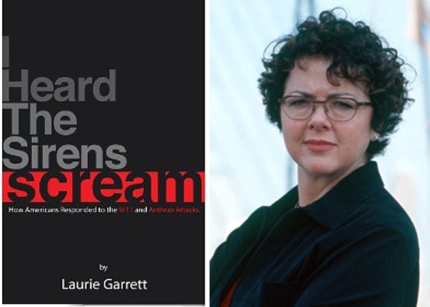
After my lunch, I got in the car and turned on NPR to listen to, “Science Friday.”  Laurie Garrett was being interviewed about her book on 9/11 entitled, I heard the Sirens Scream.

Ms Garrett is senior fellow for global health at the Council on Foreign Relations.  She’s the only journalist to win “the big three” prizes in her field, the Peabody, the Polk, and the Pulitzer, but you cannot get her book in a bookstore – it is only available on Amazon.

With all the impending chest thumping and flag waving on the occasion of the 10th anniversary of 9/11, I would suggest everyone listen to or read the transcript of this interview:  http://www.npr.org/2011/08/26/139972661/a-look-back-at-9-11-in-i-heard-the-sirens-scream

Garrett is furious that New York:  “became the reason to beat the drumbeats of war, that the attacks on our city were used by people who don’t live here to decide that we needed to invade Iraq, that the attacks on our city have been used by any number of politicians, misused, abused, with rewritten narrative, you know, the great lies told to justify all sorts of political things, everything from decreasing our civil liberties to building up a massive bioterrorism apparatus in this country, distorting our whole public health mission.

And I think the other thing is that as we approach the 10th anniversary, I should warn your listeners you’re going to be deluged with pathos.”

She contrasts this with the attempts of by Congress to deny funding to surviving Twin Towers rescue workers.  Garrett herself, who spent time near ground zero, was coughing up blood on her pillow at night, and talks of the way reports were massaged to remove the word, “asbestos.”

She summarizes worldwide response to 9/11 as unity or “singularity,” in outrage at the horror of the attacks, but goes on to say:  “You go out 120 days, that singularity has turned into the exact opposite: a moment of complete fracturing, of compete degeneration of the unity that was on one day…I think many of the ways that we responded, whether we’re talking about the public health response, the political response, the law enforcement, whatever aspect you look at, many of ways we responded set the seeds for this terrible, almost civil-war-type atmosphere that we live in in this country with such partisan dispute that the word compromise is considered evil, and the word governance is on nobody’s lips.”

You can see more of Laurie Garrett’s work on this and other topics at her blog: http://www.lauriegarrett.com

The Other eBook Superstar

Everyone remotely interested in ebook publishing knows Amanda Hocking’s story, but fewer, I am sure, have heard of John Locke.  No, not the 17th century philosopher.  I mean John Locke, the Louisville businessman who was the first self-published writer to sell a million ebooks on Amazon.  I first heard of him this week when a critique group friend handed me a clipping from the Aug. 23, print edition of The Wall Street Journal.

John Locke

Since 2009, Locke has written eight thrillers featuring former CIA assassin, Donovan Creed.  He has also written westerns and a self-help book for other writers who plan to publish digital books.  http://donovancreed.com/2011/06/lower-your-expectations-really/

The Journal article, “E-Book Author Tries New Format: Real Paperbacks,” described a contract Locke has signed with Simon & Schuster, to handle sales, distribution, and returns of eight paperback versions of existing digital books.  Locke will do the printing under his “Locke Books” imprint.  Simon & Schuster approached Locke’s New York agent to form the partnership.

Such distribution-only contracts are becoming more frequent as traditional publishers look for ways to compete with self-published books in the face of the loss of Borders as a major point of sale for printed books.  I heard a literary agent this spring confirm that successful ebook publishing is another possible avenue to traditional success, as measured by getting a New York agent and a contract with a “real” publisher.  On the other hand, only eight authors have sold a million books for Kindle – pretty long odds.

“For every John Locke, there are probably 5,000 authors trying and falling short,” says Arthur Klebanoff, CEO of RosettaBooks LLC, a digital publishing house.  But Klebanoff also says that, “The e-book world has created an opportunity in self-publishing that simply didn’t exist 18 months ago.”

The odds may be long on striking it rich and becoming a topic of cocktail party conversation, but the friend who gave me the article is going down the ebook road, as I may do someday.  I am a great believer in opportunities, and that is what Locke’s story represents.

Contests for Short-Short Stories and Poetry

Fall seems to be the busy time for writing contests and here are details on two new ones from Writer’s Digest.  How does $3000 for a 1500 word story sound?  Nice work if you can get it, and someone will!

The 12th annual Writer’s Digest Short-Short Story Competition has top prizes of $3000, $1500, and $500, plus prizes of $100 for the next six selections, and $50 WD book credits for those who place 11-25.  Names and story titles of the top 10 winners will be published in the magazine and posted online.  The deadline is is Nov. 15 and you can read the details at  http://www.writersdigest.com/competitions/short-story?et_mid=515537&rid=3017168

The 7th annual Writer’s Digest Poetry Competition has a similar schedule of prizes though they are less, for the maximum length is 32 lines.  All styles are welcome and names of the top 10 winners will be published in the magazine and published on the WD web site.  The deadline is December, 1 and details are here:  http://www.writersdigest.com/competitions/poetry?et_mid=515537&rid=3017168

Finally, don’t forget the ongoing WD contest for longer stories in six categories. Entries are due in September and October, with details available here in an earlier post:  https://thefirstgates.com/2011/07/21/six-writers-digest-short-story-competitions/

The Story of Charlotte’s Web by Michael Sims

In a recent interview on NPR, author Michael Sims discussed a project “that got really out of hand.”  He set out to do a natural history of children’s talking animal stories but became so fascinated by Charlotte’s Web that he never got beyond it.

Sim’s study, The Story of Charlotte’s Web: E.B. White’s Eccentric Life in Nature and the Birth of an American Classic, was published in June.  It’s interesting see what eccentricities and other facts Sims discovered about E.B. White.

White was quite a naturalist; on a farm in Maine, he studied spiders and raised pigs.  There really was a “Wilbur,” a pig that White was raising to slaughter in the fall, but it grew sick and died, despite all attempts to save it.  In his essay, “Death of a Pig,”  White recognized the irony of his sadness at the loss of an animal he had planned to kill, and his “sense of loss when the pig died, not as if he’d just lost some future bacon but as if he had lost…a fellow creature who was suffering in a suffering world.” 

Another time, while feeding the replacement Wilbur, White noticed a spider web with an egg sac.  The spider that wove the web disappeared, and White cut the egg sac down and carried it with him back to his apartment in New York.  He dropped it in a bureau drawer and forgot about it until the little spiders began to hatch.  According to Sims, White was delighted to watch them start to weave their webs in his room – that is, until the maid refused to work “in a spider refugee camp” and they had to go.

Sims explains that “eccentric” is a Greek word that originally meant, “off center.”  He goes on to say:

if ever there was a human being born off-center, it was E.B. White. He simply could not…follow in an established path if his life depended on it. And so he had his own quirky way. He was very fierce and funny hypochondriac. He liked to spend a lot of time alone. He loved working with animals, as much as possible. Even in New York City, even in writing for The New Yorker to begin with, he was off, you know, exploring what rats were doing in some alley.

Fans of E.B. White should enjoy listening to the interview or reading the transcript:  http://www.npr.org/2011/08/19/139790016/weaving-charlottes-web.  Of interest too, will be Michael Sims’s current project.  In keeping with his theme of “writing about how our imagination responds to nature in one way or another,” he is researching between the lines of Thoreau’s sojourn at Walden Pond to see how that great naturalist and philosopher filled up his days in ways we don’t yet know about.