A Kindle for Christmas: Thoughts on Ebooks

I wasn’t a stranger to ebooks.  I have apps on the iPod that I use for reading in places like doctors’ waiting rooms, but the screen is too small to look at for long at a time; it would never do on an airplane, for instance.  I have Kindle, Stanza, and Nook apps on my laptop as well.  It’s  great for reference materials, but not for kicking back on the couch with a mystery.

This year, after a lot of vacillation, I sent my letter to Santa, and he brought me a Kindle.  So far, I love it.  This no more negates my love of “real” books than enjoying an apple means I’m about to give up oranges, but it does raise some interesting questions.

After charging the device and reading the instructions, I jumped on Amazon to find something new to read, and I wound up downloaded half a dozen free Kindle books in rapid fire – indulging the rare guilty-pleasure of judging books by their covers.  Unfortunately, I deleted most of them after the first few pages; they were simply not very well written.

On one hand, I was reminded of the predictions of Laura Roberts, a literary agent who cautioned that the eBook revolution is not necessarily going to be a simple egalitarian paradise for creative people too long repressed by the publishing establishment.  In an article I quoted here in July, she said that when paid agents and editors no longer serve as screeners, we’ll have to do it for ourselves, on our own time and our own dime:   https://thefirstgates.com/2010/07/08/the-brave-new-world-of-epublishing

I find my somewhat ambivalent judgements interesting too.  (“Not very well written” in this case, a euphemism for “this book sucks.”)

I have often encouraged people by saying, “Everyone has a story to tell.”  That is, everyone. Is it a bad thing that anyone who wants to can now post their ebook to Amazon?  Aren’t many of my judgements arbitrary and conditioned by the literary and publishing status quo?

I suppose it boils down to something simple.  Everyone may have a story to tell, but that doesn’t mean I’m going to pay money to read it.  And given a finite amount of time, there are some books I want to read before the others.

My first new rule of thumb for managing the Kindle is this:  never pay for (an unfamiliar) book that does not have a print edition I can search through first.  I really understand why editors and agents emphasize the importance of the opening pages.

I’m sure there will be further revelations.

The Dream-Maker’s Magic

I have loved fantasy since I was little, growing up on a diet of Norse Mythology, British folklore, and Godzilla.

For years, I helped bankroll the fantasy genre; I patronized specialty bookstores, and even (introvert that I am) went to conferences and Renaissance Faires.  I probably ate up every Tolkien-spinoff quest series ever written.  Eventually, I burned out and wandered to other sorts of reading, but over the last decade, several wonderful books revived my love of fantasy.  One of those gems was Sharon Shinn’s, The Dream-Maker’s Magic.

Shinn’s first book, The Shape-Changer’s Wife, (1995)was critically acclaimed. With her Samaria series, she went on to make a name for herself as an author of adult fantasy. In 2004 she launched a trilogy of thematically connected young-adult fantasies, publishing one a year: The Safekeeper’s Secret in 2004, The Truth-Teller’s Tale, 2005, and The Dream-Maker’s Magic in 2006.

The stories are set in the same world, where magic is part of the fabric of life, and yet it plays a surprisingly minor role. These are not sword-and-sorcery tales. They are more akin to Shakespearean comedy. They are coming of age stories with romantic intrigue, complicated by plot twists and questions of identity, some even resulting from babies swapped at birth.

In The Dream-Maker’s Magic, Kellen Carmichael’s mother almost dies in childbirth. Two weeks later, when she is well enough to care for Kellen, she becomes hysterical, convinced beyond reason, that she gave birth to a boy – and Kellen is a girl.

Kellen says: I was that baby. I was that strangely altered child. From that day on, my mother watched me with a famished attention, greedy for clues. I had changed once; might I change again?  Into what else might I transform, what other character might I assume?  As for myself, I cultivated a demeanor of sturdy stoicism…It was as if I hoped my unvarying mildness would reassure my mother, convince her to trust me.  It was as if she was some animal lured from the wild lands and I was the seasoned trainer who habitually made no sudden moves.

But, Kellen concludes, She never did learn to trust me…or accept me for who I was. It was my first lesson in failure, and it stayed with me for the rest of my life.

If life is hard for her as a child – growing up in boy’s clothing, with sugar-bowl haircuts and a mother who refuses to acknowledge what she is – it becomes even worse in adolescence. Luckily, Kellen begins to meet allies, none more important than Gryffin, a boy who was born lame, whose legs are getting worse, and whose uncle periodically beats him.  Kellen initially scoffs at his unquenchable optimism, at his belief that with an education, he can be anything he desires.  Several days after they meet, however, these two broken people are inseparable friends.

Betsy Palmer, an innkeeper, and her daughter, Sarah, also befriend Kellen, and teach her such arcane mysteries as how to sew a dress that fits and how to do her hair, yet that alone does not end Kellen’s confusion:

…there was one person who was not fooled by my new looks or my modulated personality, and that was Gryffin…He did not seem to notice what I was wearing or how I had arranged my hair…I did not bewilder or surprise him.  He did not think I was trying to be something I was not, as my mother did; he did not think I was trying to break a chrysalis and become something I was meant to be, as Betsy and Sarah surely believed.  He just thought I was Kellen.

I found this the most comforting thing that had ever happened to me.  At times, when I lay awake at night, confused myself about what role I should take and what direction I should try to follow, all that kept me from slipping into tears was knowing I was not completely lost if Gryffin knew how to find me.

That was the point where I put the book down on my first reading, and have every time since, to marvel at the simple way Shinn breaks through all the limits of genre, to evoke something everyone probably longs for:  I was not completely lost if Gryffin knew how to find me.

The Dream-Maker’s Magic is about magic, but it cuts both ways when it appears, and separates Kellen and Gryffin.  The story is a lyrical romance, though you have to watch for the two kisses that Kellen and Gryffin exchange at the very end of the book.  It is a novel whose ending surprises Kellen and the reader; she is not the person she and we imagine her to be.

The ending satisfies in the way that Shakespearean comedies satisfy: what was lost is found, those who were separated are reunited, and poetic justice is meted out.  The story ends on Wintermoon, the holiday when people attach tokens of their hopes and dreams to a wreath, and burn it at midnight, to let the smoke carry their desires to heaven.  Kellen asks Gryfinn what he wishes.  “That every Wintermoon be better than the last,” he says.

Not a realistic wish, as anyone could have told him – but I would not be the one to say so.  Why limit your dreams, after all?  Why not hope for the grandest and the best?  I watched Chase throw the wreath into the bonfire, and I saw the flames scrawl secrets on the sky, and I closed my eyes and knew no end of dreaming.

Be sure to check out Sharon Shinn’s website.  There’s a permanent link in my Blogroll.

Donald Maass and the Breakout Novel

I first heard about Writing the Breakout Novel by Donald Maass in a notice from Amazon, but dismissed the book, reasoning that writing a novel is hard enough without the added burden of trying to invent the next Harry Potter.

Later, a friend in one of my critique groups recommended the book and passed around his copy. I found it interesting enough to order and  give a quick read, but it wasn’t until a few months later that I really started to pay attention.   In that time, my friend’s fiction improved so dramatically that I gave the book a second reading and ordered its companion, the Writing the Breakout Novel Workbook.

As a literary agent for 25 years, and the author of 14 novels (under pseudonyms), Maass knows the publishing industry. In the Breakout Novel introduction, he says good enough is not good enough anymore: “the midlist has been in crisis since I was a green editorial assistant in 1977. Its demise has been pronounced many times. I never believed it…until now.”

The reasons he cites pale beside the experience of another critique group friend, author of ten published biographies for children.  She passed around a rejection letter she had received from an editor for a novel she recently submitted:  I loved your story.  I stayed up late to finish it.  Unfortunately, I do not think it has the qualities that will allow it to break out.

It’s not hopeless, according to Maass, and as a matter of fact, we not simply pawns at the mercy of the publishing industry, or demographics, or new technologies spinning out of control.  In a 2007 interview, Maass insists that “99% of success is in the manuscript.  Everything else flows from that.” http://writerunboxed.com/2007/11/30/interview-donald-maass-part-1/.  Not that he claims that anything about it is easy.

One of Maass’ motives in writing these books was to explore why some novels, regardless of genre, are dramatically successful and others are not.  What are the qualities of those stories we come back to read and reread?  The ones we can’t wait to share with our friends?

I actually prefer the Breakout Novel Workbook, since it breaks the humongous task of creating “cut above” fiction into manageable chunks. Here is one from the second part of that interview, an exercise he presents at his fiction seminars, which are clearly not for beginners, but for those who actually have a manuscript in hand and want to take it to “the next level:”

Maass: The absolutely essential exercise that everyone should do, with every novel, is to toss the manuscript pages in the air and collect them again in random order. (The pages must be randomized or this won’t work.) Next, go through the manuscript page-by-page and on each page find one way to add tension. Now, that sounds easy enough but most people are quickly stymied. That is because they do not truly understand what tension means. In dialogue, it means disagreement. In action, it means not physical business but the inner anxiety of the point-of-view character. In exposition, it means ideas in conflict and emotions at war. Study your favorite novelists. If they make you read every word, even while turning pages rapidly, it is because they are deploying tension in a thousand ways to keep you constantly wondering what’s going to happen. Tension all the time is the secret of best selling fiction, regardless of style, genre or category. If it sells big, it’s got tension on every page. http://writerunboxed.com/2007/12/07/interview-donald-maass-part-2/

One page at a time – the same way any writing is going to happen.  I got hooked on the Workbook in the first exercise, which starts with the importance of a character we can identify with and care about.  From Winnie the Pooh on, the books in my life that have mattered have all had living characters that shaped my imagination and personality. How does that come about?

Who are your heroes? What are their special qualities? How can your own fictional characters manifest those qualities? These are the first exercises in the workbook, and…hey, I can do that!

For anyone writing fiction, in any genre, I seriously recommend that you take a look at both of these books.

Annual “Bad Sex in Fiction” Prize Winner Announced

And now for something completely different:

British author, Rowan Somerville, has been awarded the annual “Bad Sex in Fiction Prize,” for his stunning use of animal and insect imagery in his novel, The Shape of Her.  Judges said they were especially impressed by a passage comparing lovemaking to “a lepidopterist mounting a tough-skinned insect.”

http://www.usatoday.com/life/books/news/2010-11-29-bad-sex-in-fiction-prize_N.htm

Somerville, who beat out such luminaries as Jonathan Franzen, noted during the award ceremony that, “There is nothing more English than bad sex.”   The Shape of Her is not yet available in this country, although I suspect Amazon.UK could ship in time for a holidays.

Rowan Somerville joins an select group of past winners, which includes Tom Wolfe, Norman Mailer, and the late John Updike, who was awarded a “lifetime achievement bad sex prize in 2008.”

Last year’s winner was Jonathan Littell for his novel, The Kindly Ones, in which he described the sex act as “a jolt that emptied my head like a spoon scraping the inside of a soft-boiled egg.”

Show, don’t tell in action…

Hint Fiction Contest Winners – and Two More Competitions

I almost missed the email, but here is a link to the winner and some of the runner-up entries from the Gotham Writer’s Workshop 25 word story contest that I mentioned here earlier.

In addition to enjoying the stories, scroll down to the bottom of the page for links to two more competitions.   There is a 30 word (that is 30 words exactly) story contest that is underway – entry deadline is Nov. 30.   There is also a “YA Discovery Novel Contest” with a deadline of Nov. 30.  For $15 you can submit the first 250 words of a YA novel for prizes including an invitation to submit the full manuscript to a YA agent in New York, a free writing workshop, and critiques by editors at Candlewick, Scholastic, Harlequin, MacMillan, Viking, Roaring Brook Press, and Sourcebooks, who will judge the finalists.

Why not give it a shot?

http://www.writingclasses.com/InformationPages/index.php/PageID/720?utm_source=streamsend&utm_medium=email&utm_content=12936417&utm_campaign=An%20Editor%27s%20Advice%20to%20Writers%20+%202011%20Guide%20to%20Literary%20Agents

Of High-Concepts and Strange Attractors

I get a lot from reading and listening to screenwriters.  Today, while skimming some of the links posted below, I happened upon, Wordplay, the site for Scheherazade Productions, the company of screenwriters/producers, Ted Elliott and Terry Rossio. http://www.wordplayer.com/

The heart of the site, according to the Intro page, is the Columns tab, a growing collection of essays where Elliott and Rossio share some of what they learned during the five years it took them to earn their first paycheck as screenwriters.  I was hooked at the start of Column 01, A Foot in the Door.

Somewhere in my own efforts, I stumbled upon a stunningly simple and vital concept: before setting pen to paper (or fingers to keys), I should be able to describe my story in a single sentence. Trial and error (error meaning tens of thousands of words of meandering prose) has made it an article of faith.

In his essay, Terry Rossio brings the concept alive in graphic detail as “The Warner Bros. Hallway Test:”

As a screenwriter, your choice of film premise is your calling card. Not your witty dialog, not your clever descriptions. Not your knowledge of structure and subplot and subtext.  The very first decision you make as a writer — ‘what is my film about?’ — will define your creative instincts in the eyes of the industry.

Rossio asks us to imagine a busy producer and director stopping by an office where a first reader is 40 pages into our screenplay. “What’s it about?” they ask.  What will the reader say?  What brief reply would catch and hold a director’s attention?

Once I heard a screenwriter try to describe, “High Concept,” which he claimed was a necessary ingredient for a story these days. Like most of the audience, I didn’t quite get what he was talking about. In Column 02, Rossio says that as a matter of fact, a story that can be summed up in a sentence is High Concept, but for him, that does not convey the special mojo that lifts a story above its peers. He “stole” a phrase from the mathematics of fractals: Strange Attractor.

I know this sounds a bit silly, but bear with me. Put ‘strange’ (meaning ‘unique’) and ‘attractor’ (from ‘attractive,’ meaning ‘compelling’) together and you get ‘strange attractor,’ or ‘something unique that is also compelling.’

Which would be just another, forgettable, “yeah, yeah,” bit of advice, if the author didn’t go on to give some examples:

“A group of ex-psychic investigators start a commercial ghost extermination business in New York City.”

“A defense attorney falls in love with her client. As the trial progresses, she doesn’t know if she’s sleeping with an innocent man, or a murderer.”

It begins to make sense. What is unique is not ghost stories, or love stories, or murder mysteries, per se, but the unexpected or quirky slants that were central to these movies. I remember coming across this “high concept” description of The DaVinci Code online some time ago – so simple yet so forceful I remember it without even trying:  A late night murder in the Louve leads to the discovery of a secret the Vatican has tried to suppress for two-thousand years.”

When he starts to outline specific qualities these strange attractor stories seem to share, Rossio begins with this image:

It’s as if thousands of people in Hollywood are combing the beach for that next great film idea, magnifying glasses out, checking every facet on every tiny grain of sand they come across. And then somebody points at a big, beautiful conch shell laying right out in the bright sun and says, “Hey, let’s make that!” You look at that big glorious pink and white crustacean and can’t believe you missed it.

If there were a magic formula, it wouldn’t be magic for very long. There are, however, some fifty essays on this site that promise to offer a lot of ideas and food for contemplation about the special qualities that can make a story come alive.

Of Words and Wolves: Thoughts on Jack London

By the end of grade school, I knew, or sensed, that vast forces – parents, teachers, and church – were arrayed against me in a vast conspiracy to civilize me. My relationship with them had become one of wariness and secrets. I had friends of course, but after changing schools fairly often, I regarded friendship as a tenuous thing, subject to disruption at any time. I tended not to get too close to anyone.

My one constant companion was Ranger, the German Shepherd I had grown up with since the age of six. Once, alone in the woods in my coonskin hat, something exploded out of the brush at my back – a buck, with Ranger at his heels. The twentieth century vanished. We were back in the era when Daniel Boone would pack up and move when things got so crowded he could see the smoke of a neighbor’s chimney.

By the sixth grade, there weren’t any woods. We had moved from rural New York to the San Jose suburbs, where you had to look hard to find a decent tree to climb. Ranger hadn’t fared well either – he grew listless in our little fenced in yard, and within a year, developed a tumor. We put him down when he was six.  I was on my own and largely clueless.  And then, something wonderful happened.

They used to bring carts of inexpensive books into the sixth grade class, and one day I spent my lunch money on a paperback because the dog on the cover looked like Ranger. I hadn’t heard of Jack London or Call of the Wild, and though I loved to read, I didn’t yet know how deeply an author could speak to your soul.

For several years I followed Jack London through his dreams of silent forests, solitary men, dogs, and wolves.  I read everything of his I could find, but especially his tales of the Klondike – Call of the Wild, White Fang, and the collected of stories.  This past week I finally got to visit Jack London State Park and learn much I didn’t know about this author.  I didn’t realize what a toll his various adventures took on his health.  During his year in the Klondike, he:

” developed scurvy. His gums became swollen, leading to the loss of his four front teeth. A constant gnawing pain affected his hip and leg muscles, and his face was stricken with marks that always reminded him of the struggles he faced.” http://en.wikipedia.org/wiki/Jack_London

London tried to live out the dream of sailing to tropical islands.  He built a ship, the “Snark,” to carry him and his second wife, Charmian, on a seven year, round the world voyage.  Instead, plagued by mechanical problems with the ship, and health problems of his own, London sold the “Snark” after 27 months.  That was one of his heartbreaks.  http://www.parks.sonoma.net/JLStory.html Another was the miscarriages that prevented him and Charmian from having children.   A third was the fire that destroyed “Wolf House,” the 27 room, rustic mansion he and Charmain were building, at a cost of $80,000 pre-WWI dollars.  The house was nearly complete, and London remained severely depressed after its destruction.


Wolf House Ruins


In addition to these travels, London was constantly on the go. He’d been a war correspondent twice, had an active social life, tried unsuccessfully to make his ranch profitable, and wrote more than 50 books. For long stretches, he slept only 4 or 5 hours a night. His flesh could not keep up with his spirit, and he died in November, 1916, at the age of 40. The certificate lists the cause of death as uremic poisoning, complicated by hepatitis and kidney problems. The morphine he took for the pain of his other conditions apparently played a part, and though there was talk of suicide at the time, most historians now agree that if there was an overdose, it was accidental.  His correspondence and papers were always full of plans and projects for the future – his dreams were far bigger than his human capacity.


OF JACK LONDON’S WOLVES.


Sage at the Folsom City Zoo, ca. 1994


His best friend called him “Wolf.”  He named his dream home, “Wolf House.”  James Dickey notes how closely London identified with his totem animal, and says:

The reader should willingly…conjure up the animal in the guise of the mysterious, shadowy, and dangerous figment that London imagines it to be. We should encounter the Londonian wolf as we would a spirit symbolic of the deepest forest, the most extremely high and forbidding mountain range, the most desolate snowfield: in short, as the ultimate wild creature, supreme in savagery, mystery, and beauty.” – (Dickey’s intro to the Penguin edition of The Call of the Wild, White Fang, and Other Stories_

The “reality” of wolves as observed by biologists is very different, and Dickey says:

The mythic wolf that London “found” in his single winter spent…in the Klondike Gold Rush…bears in fact little resemblance to any true wolf ever observed. In studies…the wolf emerges as a shy and likable animal with a strong aversion to fighting. There is no evidence that any wild wolf has ever killed a human being in North America.

Reality and Truth can appear in different places depending on where and how we look for them. I don’t think I would have stayed up late as a kid – the old flashlight under the blanket trick – to read stories of lost trappers whose fires burn low while packs of shy, likable, creatures pace the perimeter.

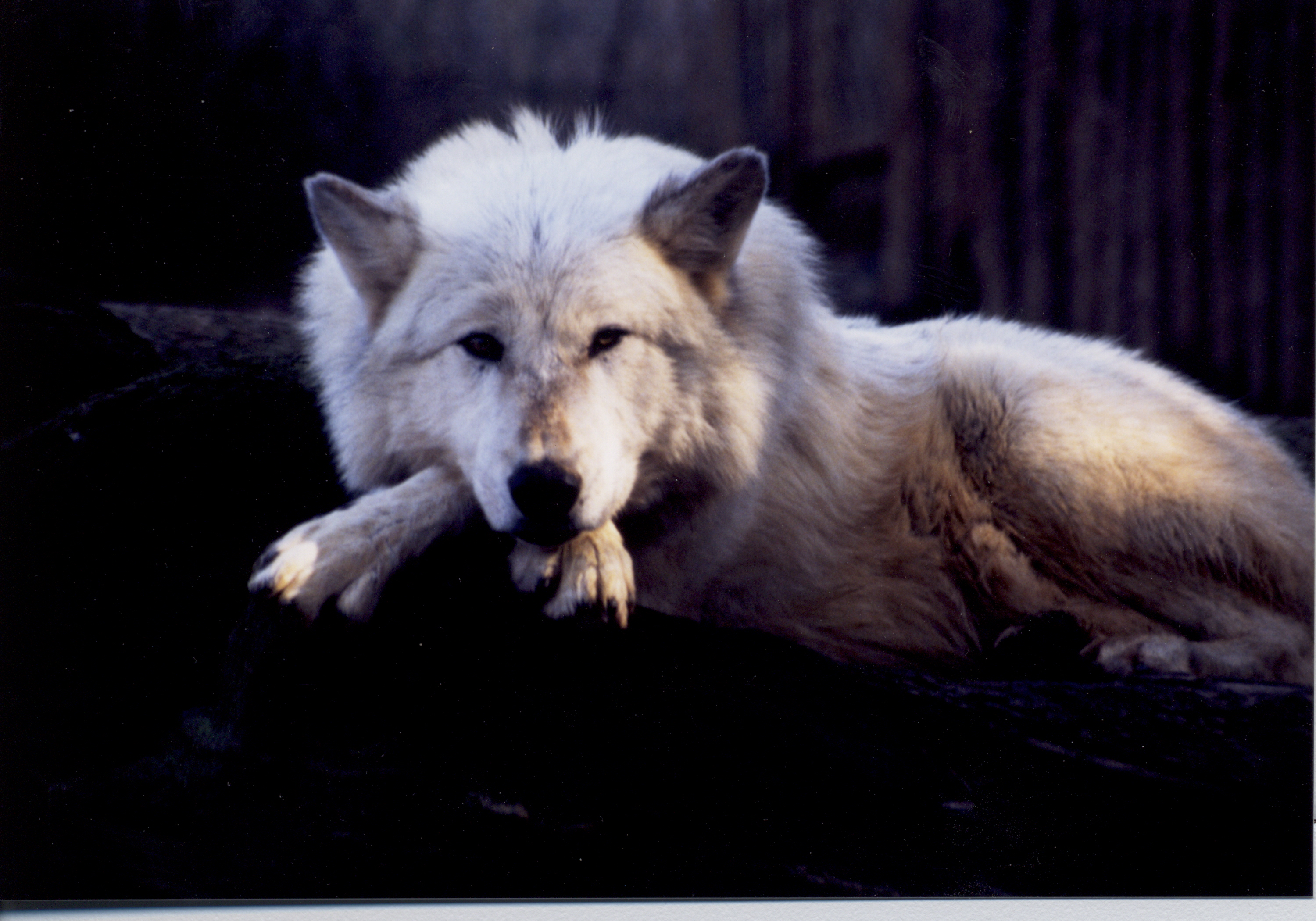
Besides, it is the fact that wolves, like dogs, can accept humans as members of their pack, that allowed me to bond with several wolves when I was a volunteer at the Folsom City Zoo Sanctuary.  This was a marvelous opportunity I stumbled into – right place at the right time – and I often thought of Jack London, and imagined it as an inoculation of wildness – I got my fix without having to risk scurvy on the tundra.


A kiss from Redbud, a wolf pup, ca. 1996


OF JACK LONDON’S WORDS

Sometimes a degree of sophistication is a real pain in the ass.  I’d long lost my copies of Jack London’s books, so I picked up a collection on our visit.  I sat back that evening and looked at some of the stories, and noticed things I never saw as a kid:  in George Orwell’s words, “the texture of the writing is poor, the phrases are worn and obvious, and the dialog is erratic.” Yep – the agents at any writing conference would hammer him today.  And yet…

“The key to London’s effectiveness is to be found in his complete absorption in the world he evokes.  The author is in and committed to his creations to a degree very nearly unparalleled in the composition of fiction.  The resulting go-for-broke, event-intoxicated, headlong wild-Irish prose-fury completely overrides a great many stylistic lapses and crudities that would ordinarily cause readers to smile….Once caught in London’s swirling, desperate, life-and-death violence, the reader has no escape.” – James Dickey.

Fifty of Jack London’s stories and books have been made into movies. I’m not sure that can be said of any other author, let alone one whose youth was spent in abject poverty, and whose life was over at 40. And even those facts pale when the sight of a cold winter moon, or the scent of a pine, or the yip of a coyote in the distance sends shivers down the spine and spins you off, just for a moment, into arctic dreams.


Grave of Jack and Charmian London

 

More on, “So Cold the River”

(Warning: spoilers ahead)

It is rare and delightful to find a book I hate to see end.  It is rarer to find a creepy book I hate to see end, and this is the first time ever I have hated to see a story end when the most compelling character is the villain.

Campbell Bradford, the villain of Michael Koryta’s,  So Cold the River, is no ordinary bad guy; he not just a bad man, he is evil. This important distinction is made by eighty-something, Edgar Hastings.  “He [Bradford] put a chill in your heart. My parents saw it; hell, everybody saw it. The man was evil.” The only fictional villain I can think of in his class – as evil and fascinating – is Hannibal Leckter in Silence of the Lambs

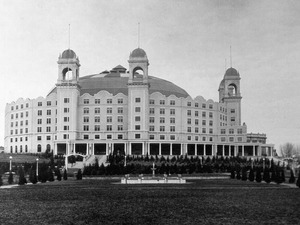
The evil Campbell Bradford is not the ninety-five year old Campbell Bradford who freaks out when hero, Eric Shaw, shows him a bottle of haunted “Pluto Water.”  This faux Bradford whispers, “So Cold the River,” and dies a short time later, sending Eric, a failed Hollywood filmmaker, to West Baden, Indiana, to learn the story of Bradford, Pluto water, and the newly restored West Baden hotel, (which actually exists), a once famous spa that was the domain of presidents, prize fighters, royalty, and gangsters.

The West Baden Hotel

The evil Campbell Bradford is a ghost, a very malevolent ghost, who possesses his great-great-grandson, Josiah, and later tries to possess Eric.  Bradford’s era is the roaring twenties, but his voice and tone suggest an earlier time.  Perhaps it is his fictional distance, the sepia toned feel of the old west that surrounds this villain, that works like the glass that allows us to watch a cobra in a zoo with an equal degree of fascination.  Imagine the Clint Eastwood of the sphagetti westerns as an angry psychopath, ready to sacrifice anything and anyone for his ambitions.  The ambitions of Campbell Bradford’s ghost drive the story.

“Look for the artifacts of their ambitions.”  That is Eric Shaw’s philosophy of documentary filmmaking, announced at the opening of the book.  The artifacts of Bradford’s ambitions are dead people. In the end, the mysterious Pluto Water, which carried Bradford’s spirit back to West Baden, allows Eric to survive his onslaught to tell the tale.

But Eric stops short of trying to unravel the whole story.  He will not seek the honey-flavored spring where Bradford lost his life.  Is the spirit really gone? Apparently. And yet, as Anne McKinney, who has devoted her life to watching the weather and waiting for the big storm cautions, “You can’t be sure what hides behind the wind.”

Sequeul anyone? I will definately read it if it comes.