What Do 20% of Us Have in Common?

Not long ago, I read a Los Angeles Times article saying 20% of Americans suffered from mental illness in 2010.  The article ended with a warning:  “…we need to continue efforts to monitor levels of mental illness in the United States in order to effectively prevent this important public health problem and its negative impact on total health.”  The story did define what was meant by “mental illness.”  Do I have to keep an eye on every fifth guy in the Post Office line?

Not necessarily.

The Times’ source was a January 19 report by SAMSHA, the Substance Abuse and Mental Services Administration, which said 45.9 million Americans suffered from mental illness in 2010.  Their definition of mental illness is, “a diagnosable mental, behavioral, or emotional disorder (excluding developmental and substance use disorders)” in the DSM-IV, the 4th edition of The Diagnostic and Statistical Manual of Mental Disorders (1994).

Here’s how the DSM works: there are numerous schools of psychotherapy that differ in their approach to treating different disorders, but all have agreed to agree on the definitions of those disorders.  One of my psych professors insisted that the DSM says more about our cultural “norms” than about the health of the population.  For instance, in 1987, homosexuality was dropped from the list of disorders.  Prior to 1987, gays and lesbians were “mentally ill.”  After that, they were not.

Anyone who visits a psychotherapist and wants to submit an insurance claim will receive one of these diagnoses, most commonly, “Anxiety,” or “Adjustment Disorder.”  This fits the vast numbers of clients who are able to cope with life, but seek help with problems at work or problems at home or issues of self-actualization.  The SAMSHA report gave no mention of efforts to factor in the seriousness of the diagnosis.  There is no way to know how many of the 45.9 million Americans who are “mentally ill” suffer from anxiety vs. schizophrenia.

To the best of my knowledge, the rise of “insanity” coincided with the Industrial Revolution.  The US Census first noted the incidence of “idiocy/insanity” in 1840.  By 1880, there were seven types of insanity:  mania, melancholia, monomania, paresis, dementia, dipsomania, and epilepsy.

According to my psych professor, the DSM grew out of a research collaboration between the American Psychiatric Association (APA) and the US military between the world wars.  Soldiers in WWI suffered high rates of shell shock.  The military sought screening methods for those who would hold up in combat.  Although the screens later proved not to have the predictive power hoped for, the DSM came from this research.  In other words, our current definition of sanity is based the attributes of a good combat soldier.

Voices were raised in protest, almost from the start, notably by Thomas Szasz in The Myth of Mental Illness (1961) and a 1973 article by David Rosenham, “On Being Sane in Insane Places.”

I am not trying to minimize the suffering of those with mental afflictions that cause them to harm themselves or others.  First, I am questioning a report that excludes all forms of substance abuse from its definition of “mental illness.”  I also question defining “anxiety” as “mental illness,” when anyone who was paying attention in 2010 felt anxious.

I have often been struck, since I studied psychology, that our concept of sanity, modeled on the good soldier, also defines the “productive” member of our consumer culture.  It brings to mind a favorite line from a poem by Theodore Roethke:  What’s madness but nobility of soul at odds with circumstance?:

In a Dark Time

In a dark time, the eye begins to see,
I meet my shadow in the deepening shade;
I hear my echo in the echoing wood–
A lord of nature weeping to a tree,
I live between the heron and the wren,
Beasts of the hill and serpents of the den.

What’s madness but nobility of soul
At odds with circumstance? The day’s on fire!
I know the purity of pure despair,
My shadow pinned against a sweating wall,
That place among the rocks–is it a cave,
Or winding path? The edge is what I have.

A steady storm of correspondences!
A night flowing with birds, a ragged moon,
And in broad day the midnight come again!
A man goes far to find out what he is–
Death of the self in a long, tearless night,
All natural shapes blazing unnatural light.

Dark,dark my light, and darker my desire.
My soul, like some heat-maddened summer fly,
Keeps buzzing at the sill. Which I is I?
A fallen man, I climb out of my fear. 
The mind enters itself, and God the mind,
And one is One, free in the tearing wind.
– Theodore Roethke

The Year in Rearview and Words of Hope From Gary Snyder

Now is when writers compose their summaries of the outgoing year, and I wanted to weigh in too.  Problem was, I kept discarding drafts as my inner parental voices chimed in with, “Quit whining.”  Eliminate whining, and it’s hard to come up with things to say about 2011.

Fortunately, I found a spot-on analysis by another blogger, badlandsbradley, who wrote:  “2011 sucked. It was a big stupid year full of big stupid things. All around, it was just stupid.”  http://badlandsbadley.wordpress.com/2011/12/27/2012-a-look-ahead/

Now that we have that out of the way, what’s left?  I sometimes compose gratitude lists at turning points in the year, and I find it a worthwhile practice, but I think people have to do this for themselves.  I started one list by writing, “We survived,”  which brought to mind several good people who didn’t.  Sometimes the things we are grateful for are weighty, things to “ponder in our hearts,” as the Christmas story puts it.

In the middle of these reflections, a phrase I hadn’t thought of for years came to mind:  “Drown their butts, crush their butts.”  This stanza comes from Gary Snyder’s marvelous, Smokey the Bear Sutra. When found it online, I stopped to appreciate these words at the end of the poem:

(may be reproduced free forever).

Those five simple words of generosity opened a real wellspring of gratitude for me, so now I want to share this poem, one of my favorite by this Pulitzer Prize winning poet.  May reproducing it here benefit beings everywhere.

*****

Gary Snyder

Smokey the Bear Sutra

Once in the Jurassic about 150 million years ago,
the Great Sun Buddha in this corner of the Infinite
Void gave a Discourse to all the assembled elements
and energies: to the standing beings, the walking beings,
the flying beings, and the sitting beings — even grasses,
to the number of thirteen billion, each one born from a
seed, assembled there: a Discourse concerning
Enlightenment on the planet Earth.

“In some future time, there will be a continent called
America. It will have great centers of power called
such as Pyramid Lake, Walden Pond, Mt. Rainier, Big Sur,
Everglades, and so forth; and powerful nerves and channels
such as Columbia River, Mississippi River, and Grand Canyon
The human race in that era will get into troubles all over
its head, and practically wreck everything in spite of
its own strong intelligent Buddha-nature.”

“The twisting strata of the great mountains and the pulsings
of volcanoes are my love burning deep in the earth.
My obstinate compassion is schist and basalt and
granite, to be mountains, to bring down the rain. In that
future American Era I shall enter a new form; to cure
the world of loveless knowledge that seeks with blind hunger:
and mindless rage eating food that will not fill it.”

And he showed himself in his true form of

SMOKEY THE BEAR

  • A handsome smokey-colored brown bear standing on his hind legs, showing that he is aroused and
    watchful.

  • Bearing in his right paw the Shovel that digs to the truth beneath appearances; cuts the roots of useless
    attachments, and flings damp sand on the fires of greed and war;

  • His left paw in the Mudra of Comradely Display — indicating that all creatures have the full right to live to their limits and that deer, rabbits, chipmunks, snakes, dandelions, and lizards all grow in the realm of the Dharma;

  • Wearing the blue work overalls symbolic of slaves and laborers, the countless men oppressed by a
    civilization that claims to save but often destroys;

  • Wearing the broad-brimmed hat of the West, symbolic of the forces that guard the Wilderness, which is the Natural State of the Dharma and the True Path of man on earth: all true paths lead through mountains —

  • With a halo of smoke and flame behind, the forest fires of the kali-yuga, fires caused by the stupidity of
    those who think things can be gained and lost whereas in truth all is contained vast and free in the Blue Sky and Green Earth of One Mind;

  • Round-bellied to show his kind nature and that the great earth has food enough for everyone who loves her and trusts her;

  • Trampling underfoot wasteful freeways and needless suburbs; smashing the worms of capitalism and
    totalitarianism;

  • Indicating the Task: his followers, becoming free of cars, houses, canned foods, universities, and shoes;
    master the Three Mysteries of their own Body, Speech, and Mind; and fearlessly chop down the rotten
    trees and prune out the sick limbs of this country America and then burn the leftover trash.

Wrathful but Calm. Austere but Comic. Smokey the Bear will
Illuminate those who would help him; but for those who would hinder or
slander him,

HE WILL PUT THEM OUT.

Thus his great Mantra:

Namah samanta vajranam chanda maharoshana
Sphataya hum traka ham nam

“I DEDICATE MYSELF TO THE UNIVERSAL DIAMOND
BE THIS RAGING FURY DESTROYED”

And he will protect those who love woods and rivers,
Gods and animals, hobos and madmen, prisoners and sick
people, musicians, playful women, and hopeful children:

And if anyone is threatened by advertising, air pollution, television,
or the police, they should chant SMOKEY THE BEAR’S WAR SPELL:

DROWN THEIR BUTTS
CRUSH THEIR BUTTS
DROWN THEIR BUTTS
CRUSH THEIR BUTTS

And SMOKEY THE BEAR will surely appear to put the enemy out
with his vajra-shovel.

  • Now those who recite this Sutra and then try to put it in practice will accumulate merit as countless as the sands of Arizona and Nevada.

  • Will help save the planet Earth from total oil slick.

  • Will enter the age of harmony of man and nature.

  • Will win the tender love and caresses of men, women, and beasts.

  • Will always have ripe blackberries to eat and a sunny spot under a pine tree to sit at.

  • AND IN THE END WILL WIN HIGHEST PERFECT ENLIGHTENMENT.

    thus have we heard.

    (may be reproduced free forever)

The Wasteland

One of the books I treasure is a battered old trade paperback with yellowing pages.  I value the book,  Creative Mythology, because of the author’s inscription: “For Morgan with all my good wishes. Joseph Campbell, 3/13/79.”  

joseph_campbell_4

You could say Campbell’s  four day lecture series that spring did much to open the path my imagination has followed ever since.  None of the stories Campbell unpacked in his lectures or books affected me more than Parzifal (or Parsifal) and his quest for the holy grail. The version of the grail story Campbell recounts is by Wolfram Von Eshenbach (1170 – 1220).  Wolfram was a German knight and poet, and his Parzivalis regarded as one of the finest medieval German epics.  Campbell looks to this version because it’s roots reach deeper than later Christianized versions where only the pious and chaste Galahad can attain the grail.  What matters for this post are those echoes we can see in the tale of the ancient legends of sacred kingship, and the ways an unfit or weakened king can blight the land.

Wolfram Von Eshenbach from Codex Manasse

Sometimes in youth we receive a vision or powerful experience that shapes much of the rest of our lives.  So it is with Parzival who finds his way to the mystical Grail Castle and meets its wounded king, Anfortas,  who is also known as The Fisher King.  As a young knight, a spear pierced the Fisher King’s “thighs” – a euphemism for testicles according to Campbell.  In ancient times, the virility of the king and the fertility of the land were one.  In the grail stories, Fisher King could not be healed and couldn’t die.  All the realm was barren.

Robin Williams as the Fisher King in the 1991 movie of that name, a contemporary retelling of the story

While in the castle, during a mysterious ritual, Parzival has a vision of the grail, which is described as a stone, though its shape isn’t fixed, and it brings everyone “what their heart most desires.”  Though he is intensely curious, Parzival does not ask the meaning of what he sees.  In the morning, the castle is empty.  All traces of life are gone.  He rides away, and when he tells his story, listeners turn away in disgust.  If Parzival had asked the right question, he would have healed the king and restored the land.    The young knight wanders the blighted realm for 20 year, enduring hardships and contemplating his failure.  Just like us, he watches time turn his youthful dreams of glory to ashes.

“Parsifal” by Odilon Redon

At last, one cold Christmas Eve, Parzival encounters a hermit, tells his tale, and learns the question he should have asked. After that, he achieves the castle again.  When the ritual ends, Parzival asks, “Whom does the grail serve?”   Everything hinges on asking the right question.  Anfortas is healed, spring returns, and Parzival becomes the new Grail King.

***

Hearing this old tale, we have to ask how the story plays forward.  “Wasteland” clearly describes the state of the world we read about in the papers, and “impotent” seems an apt description of most of the world’s governments.  This perception is not even new, for T.S. Eliot named it ninety years ago in his poem, The Wasteland:

What are the roots that clutch, what branches grow Out of this stony rubbish? Son of man, You cannot say, or guess, for you know only A heap of broken images, where the sun beats, And the dead tree gives no shelter, the cricket no relief, And the dry stone no sound of water.

Giving mythical weight to our latest headlines, storyteller and mythologist, Michael Meade says: “Like Parsifal, the modern world has awakened from a deep sleep to find that the castle of abundance has disappeared, that the financial markets are in ruins, that blind religious beliefs are once again producing mindless crusades, and that great nature itself threatens to become a barren wilderness. Like Parsifal, we failed to ask the right questions when surrounded by abundance.” From “Parsifal, the Pathless Path, and the Secret of Abundance,” first published in Parabola, Fall 2009.  http://www.mosaicvoices.org/index.php?option=com_content&view=article&id=72:essay4parsifal&catid=53:essays&Itemid=68

This has happened before, again and again, Meade reminds us – beginnings and endings, decay and renewal.  The castle of abundance waits for us, individually and collectively, somewhere in the wilderness, but old pathways won’t take us there.  There’s a time to do as Parsifal did – drop the reins and let the horse, an image of our instinctive wisdom, pick its way through the forest. The old stories were told in the winter, when the nights were long and the fires warm.  This winter, I am drawn to look at some of these tales, to see what they are still whispering to our souls, for they are wiser than the daily ephemera that passes for wisdom but is really the source of our confusion.

As Michael Meade puts it: “Despite the current confusions of dogmatic religions and the literalism common to modern attitudes, the earthly world has always been a manifestation of the divine. Call it the Grail Castle, the Kingdom of Heaven, Nirvana, the Otherworld; it has many names and each is a representation of the eternal realm that secretly sustains the visible world. When time seems to be running out it is not simply more time that is needed, rather it is the touch of the eternal that can heal all time’s wounds and renew life from its source.”

Robinson Jeffers: An American Stonecutter

My previous post, on the restoration of a medieval Chapter House, reminded me of two renowned people who worked in other fields but turned to stonework for renewal.  One was the great Psychoanalyst, Carl Jung, who viewed stone as a symbol of the True Self, and carved stone as a means of self-discovery.

Jung’s Bollingen Stone

The other was the renowned poet, Robinson Jeffers (1887 – 1962), who studied geology in college, and worked in stone all his life.  In 1914, Jeffers and his new wife, Uma, moved from Los Angeles to Carmel, CA.  To build a home, Jeffers first hired a local builder and then worked alongside the man, learning the art of stonemasonry.  By 1919, Jeffers was hauling  boulders up from the beach, shaping them, and using them to add rooms to the home, which he named Tor House.  Later, he built the four story, Hawk Tower, as a gift for his wife, who loved Irish literature and stone towers.

Tor House and Hawk Tower, built by Robinson Jeffers in Carmel

The tower was named for a hawk that appeared while Jeffers worked on the structure, and disappeared the day it was finished.  After his death, Jeffers’ oldest son finished the construction then deeded the buildings to the Tor House Foundation, which was formed by Ansel Adams for their preservation.  The Foundation maintains the grounds and offers excellent guided tours.  You can even climb by a secret stairway to the very top of the tower.  There’s a wealth of information on Jeffers and Tor House at the Foundation website, where you can also schedule tours in advance:  http://www.torhouse.org/.

Jeffers work with stone is central to his austere poetic vision of a human spirit that longs to fly like a hawk and find something that lasts, but must finally acknowledge that in this life, it can do neither.

***

To the Stonecutters
by Robinson Jeffers.

Stone-cutters fighting time with marble, you fore-defeated
Challengers of oblivion
Eat cynical earnings, knowing rock splits, records fall down,
The square-limbed Roman letters
Scale in the thaws, wear in the rain. The poet as well
Builds his monument mockingly:
For man will be blotted out, the blithe earth dies, the brave sun
Die blind, his heart blackening:
Yet stones have stood for a thousand years, and pained thoughts found
The honey peace in old poems.

***

Robinson Jeffers

***

Rock and Hawk
by Robinson Jeffers

Here is a symbol in which
Many high tragic thoughts
Watch their own eyes.

This gray rock, standing tall
On the headland, where the sea-wind
Lets no tree grow,

Earthquake-proved, and signatured
By ages of storms: on its peak
A falcon has perched.

I think, here is your emblem
To hang in the future sky;
Not the cross, not the hive,

But this; bright power, dark peace;
Fierce consciousness joined with final
Disinterestedness;

Life with calm death; the falcon’s
Realist eyes and act
Married to the massive

Mysticism of stone,
Which failure cannot cast down
Nor success make proud.

***

Hawk Tower

Writer’s Digest Annual Writing Competition

I just received this announcement for the 81st annual Writer’s Digest writing competition, seeking entries in ten categories:

  • Inspirational Writing (Spiritual/Religious)
  • Memoirs/Personal Essay
  • Magazine Feature Article
  • Genre Short Story (Mystery, Romance, etc.)
  • Mainstream/Literary Short Story
  • Rhyming Poetry
  • Non-rhyming Poetry
  • Stage Play
  • Television/Movie Script
  • Children’s/Young Adult Fiction

As one would expect, there are nice prizes and nominal entry fees, with the top ten winners in each category to be named in the November, 2012 issue of Writer’s Digest.  Here is a link to the announcement page, where you can find links to the rules and regulations, as well a place to sign up for notification of the many contests WD holds every year, especially for short fiction and poetry.

http://www.writersdigest.com/competitions/writers-digest-annual-competition

If you’re interested in the Children’s/YA section, you will notice that although the category is listed on the main page, details such as word count are missing from the rules and the FAQs.  There is a “Contact us” link that gives phone number and email for questions like this.

Good luck to everyone.  I know several people who have been listed in the “top ten,” and it’s quite an honor, since the Writer’s Digest competitions always draw a large number of entries.

In Flanders Field the Poppies Blow

At 11:00am, on the 11th day of the 11th month of 1918, the insanity of the First World War came to an end. Though the United States holiday was renamed to Veterans Day after World War II, it is still known as Armistice Day in France and Belgium. It is known as the Day of Peace in Flanders Field, where many of the dead from the western front are buried and one of the most famous poems of this war or any war was written.

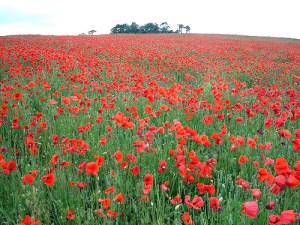
Poppies near the Connaught British cemetery on the western front

Poppies are an annual, summer-blooming wildflower whose seeds are carried on the wind.  They can lie dormant for a long time but will bloom if the earth is disturbed – as it was, of course, during the years of trench warfare.  In many parts of the line, in the summers of 1915, 1916, 1917, and 1918, the little poppies shone as the only symbol of life amid the devastation of no-mans land.

In May, 1915, Major John McCrae, a Canadian military doctor and artillery commander, noticed the poppies growing in the disturbed ground between the graves that surrounded his artillery position near Ypres.  When the chaplain was called away, McCrae was asked to conduct the burial service for a friend.  We think he began his famous poem that evening.

In Flanders fields the poppies blow
Between the crosses, row on row,
That mark our place; and in the sky
The larks, still bravely singing, fly
Scarce heard amid the guns below.

We are the Dead. Short days ago
We lived, felt dawn, saw sunset glow,
Loved and were loved, and now we lie
In Flanders fields.

Take up our quarrel with the foe:
To you from failing hands we throw
The torch; be yours to hold it high.
If ye break faith with us who die
We shall not sleep, though poppies grow
In Flanders fields.

***

***

Even more than McCrae’s poem, Armistice Day / Veterans’ Day brings to mind a song by the Scottish musician, Andy Stewart.  His song, “Young Jimmy in Flanders,” commemorates his uncle James who served as a piper during the war, and miraculously survived.  More than any other picture or poem or story, this ballad evokes for me the terrible sadness and anger at this conflict where boys playing bagpipes led troops against machine guns and poison gas:

He played his pipes to battle,
and the laddies died like cattle,
and the brandy was drunk in Whitehall,
a million miles away.

This song is recorded on Stewart’s fine album, “Fire in the Glen,” 1991.

http://www.youtube.com/watch?v=y-IhN7IVQdk

Interlude on the Oregon Coast

I first explored the Oregon coast as an undergrad when I was studying art and photography at the U of O.  I kept a 4×5 view camera, a sleeping bag, and a coleman stove in the trunk of my ’63 biscayne.  A box of mac and cheese, a few apples, and a jar of instant coffee, and I was ready to spend a weekend poking along the backroads up and down the coast.

One of my favorite spots was the south coast town of Bandon.  With a nice state park, miles of beaches to explore, and expresso and pizza available in town, it was a fairly posh spot for camping.  That was in the mid ’70’s.  Mary and I have travelled there at various times over the years since then, but had not been up for almost a decade.

We drove last week to Bandon, and blessed with mild weather, spent some memorable days enjoying the changing leaves and the autumn light on the ocean.

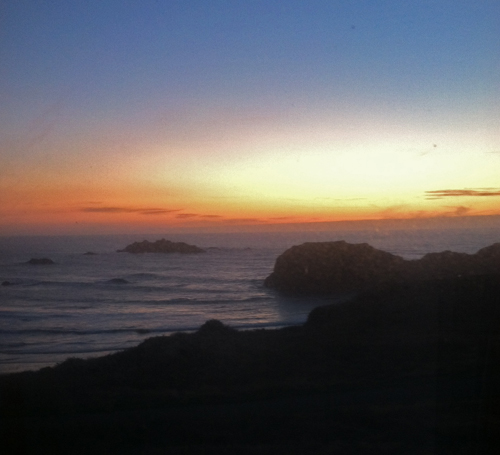
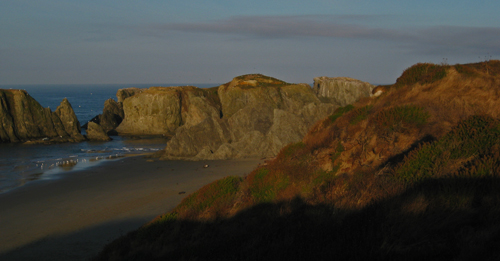
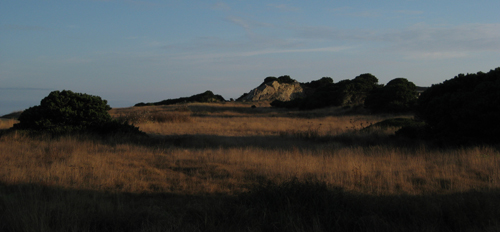
The sound of the waves and the foghorn at night, drifting through an open window, brought T.S. Eliot to mind.  Here are a few photographs, and some of Eliot’s lines from The Four Quartets.

The river is within us, the sea is all about us;
The sea is the land’s edge also, the granite
Into which it reaches, the beaches were it tosses
Its hints of earlier and other creation

It tosses up our losses, the torn seine,
The shattered lobsterpot, the broken oar
And the gear of foreign dead men. The sea has many voices
Many gods and many voices.
The salt is on the briar rose,
The fog is in the fir tree.

The tolling bell
Measures time not our time, rung by the unhurried
Ground swell, a time
Older than the time of chronometers, older
Than time counted by anxious worried women
Lying awake, calculating the future,

Between midnight and dawn, when the past is all deception,
The future futureless, before the morning watch
When time stops and time is never ending;
And the ground swell, that is and was from the beginning,
Clangs
The bell.

If you came this way,
Taking any route, starting from anywhere,
At any time or at any season,
It would always be the same; you would have to put off
Sense and notion. You are not here to verify,
Instruct yourself, or inform curiosity
Or carry report. You are here to kneel
Where prayer has been valid.

Contests for Short-Short Stories and Poetry

Fall seems to be the busy time for writing contests and here are details on two new ones from Writer’s Digest.  How does $3000 for a 1500 word story sound?  Nice work if you can get it, and someone will!

The 12th annual Writer’s Digest Short-Short Story Competition has top prizes of $3000, $1500, and $500, plus prizes of $100 for the next six selections, and $50 WD book credits for those who place 11-25.  Names and story titles of the top 10 winners will be published in the magazine and posted online.  The deadline is is Nov. 15 and you can read the details at  http://www.writersdigest.com/competitions/short-story?et_mid=515537&rid=3017168

The 7th annual Writer’s Digest Poetry Competition has a similar schedule of prizes though they are less, for the maximum length is 32 lines.  All styles are welcome and names of the top 10 winners will be published in the magazine and published on the WD web site.  The deadline is December, 1 and details are here:  http://www.writersdigest.com/competitions/poetry?et_mid=515537&rid=3017168

Finally, don’t forget the ongoing WD contest for longer stories in six categories. Entries are due in September and October, with details available here in an earlier post:  https://thefirstgates.com/2011/07/21/six-writers-digest-short-story-competitions/