Guest Post by Indie Author, Jayden Scott – Part 2

Yesterday, our guest blogger, Jayde Scott, spoke of what led her to publish her novels on Smashwords.  Today she describes all the work behind her growing success, (in addition to writing novels).  She cautions that:   Independent publishing isn’t an easy route to go and it’s certainly not a ‘get rich quickly’ scheme. Be prepared to invest more time than in a nine to five job.

She includes a link to her blog, Fiction and More, and I’ve added it to my blogroll, since her stated intent is to help writers promote and market their work.  

Also, If you have not already done so, please visit her Smashwords homepage to look at the full range of her books: http://www.smashwords.com/profile/view/JScott

My sincere thanks to Ms. Scott for sharing all she has done to champion her own work.  This is vital information to anyone thinking of following her path into print.

_______________________________________________________

So how did I do it? With lots and lots of marketing such as contacting blog hosts for reviews, giveaways, interviews and book spotlights. I don’t just copy and paste the information about my book into my emails to possible reviewers; I take the time to get to know their blogs and preferences and try to send them all information as requested in their review policies. Since they invest so much of their time and effort into reading my books, it’s only respectful that I at least try to make it easier for them to decide whether my book is something they might enjoy or not.

Independent publishing isn’t an easy route to go and it’s certainly not a ‘get rich quickly’ scheme. Be prepared to invest more time than in a nine to five job. Establishing a presence with all the fierce competition is tough work. Several times I changed the covers of my books, which involved days of searching sites like istockphoto.com and fotolia.com for the right digital art; once I changed the title, after which sales picked up. I also spend days on designing my print books and book trailers, and promoting those on various sites. As a very active Goodreads member, I devote a great amount of time to answering messages and updating my blog, http://jayde-scott.blogspot.com/, in case readers stop by to find out more about me and my books. And finally, I try to keep in touch with many author friends because, like in every job, connections matter. One of the most important tasks for any indie author, however, is writing and publishing a constant flow of well-edited quality work to keep up with fast moving trends. Even though I can’t afford paying a professional editor, I have two editor friends who proofread my work. My critique group helps with brainstorming and provides feedback on character development, story elements and pace. Even though my books are cheap, I try my best to give readers good quality for their money.

Writing has gifted me with a purpose in life, and nothing gives me more pleasure than hearing how much readers enjoyed my books. I’m a full time writer now who’s still sending out application forms to get a job, but the job market in the UK is shaky and doesn’t seem to want to recover any time soon. Independent publishing has at least helped ease my financial struggles and I know it’s helped many of my fellow authors, too.

Guest Post by Indie Author, Jayden Scott – Part 1

At the start of May, Jayde Scott, a young writer from England, invited me to review her eBook, A Job From Hell.  Based on the professional presentation of her Smashwords page,  http://www.smashwords.com/books/view/56864, I agreed, though with some trepidation:  vampire romance isn’t normally “my thing.”

To our mutual relief, I enjoyed A Job From Hell and posted my review here at the end of May:  https://thefirstgates.com/2011/05/25/a-job-from-hell-by-jayde-scott-book-review/.  During the process, we exchanged a few emails – enough for me to realize what a complex operation an ebook publishing and marketing venture can be.  I invited Ms. Scott to describe her process, and she found the time – despite publishing two new titles this summer – to send a very detailed reply.  So detailed, in fact, that I’ve split her post into two sections.

In this section, the author describes what led her to the world of Indie publishing.  The next section outlines the nuts and bolts of her procedure.  Anyone who is interested in ebook publishing will find a wealth of information in Ms. Scott’s account.

__________________________________________________

Jayde Scott

A year ago, I would never have thought I’d be an indie author one day. At that time, I was unemployed, like many people in the UK, and could barely afford paying the rent let alone meet the monthly repayments of my student loan. Even with two good degrees, I had been looking for a job for three years without much success. During breaks from filling out application forms and struggling to get freelance work, I kept myself sane by writing as much as I could. It was my way to deal with the stress and pressure of not having a regular job.

Writing had been a hobby of mine for more than ten years. I had six books ready for publication and was actively seeking an agent or publisher for my work. Several times I came very close to landing an agent and did the ‘suggested’ changes to my manuscripts, only to have my hopes dashed again. With publishers I had similar experiences, some rejected me because I wouldn’t cut down on a 94k manuscript, others because they didn’t like a particular character. There was a time when I just couldn’t afford the horrendous postage charges for sending a manuscript to the US, so I kept postponing sending off large parcels until I got a freelance gig and had some money left.

After reading about Amanda Hocking’s success, I realised publishing doesn’t start and end with landing an agent and selling one’s work to one of the big six publishers. Sure, that would be a nice accomplishment, but I figured I might be more likely to win the lottery. It took me a long time to take this step because I kept hoping someone might make an offer soon, but when the offer never came in and I was more and more struggling to get a job and pay the bills, I decided I had nothing to lose by going the independent route. At least I had tried my best.

So, instead of wasting yet more time, I spent two weeks getting my first manuscript, Alex Gonzo, Royal Spy, ready for publishing via Kindle. It took a few attempts (actually, more than I care to reveal), but I finally figured out how to format it correctly after which it became easier with every book published.

Needless to say, I knew next to nothing about self-publishing a book or the marketing involved. I had heard of authors using Twitter and Facebook to promote their work, but that about summed up my knowledge of social media. My first attempts at Tweeting were pretty much useless and Alex Gonzo, Royal Spy didn’t sell a single copy. Five months later, I had barely sold 100 copies of that book, but I wasn’t ready to give up and self published A Job From Hell, which is the first book in the Ancient Legends series. That book didn’t take off straight away. In fact, I only sold about 60 copies in the first month. However, the more time I spent researching on the Internet and reading as many blog on publishing as I could find, the more I was determined to succeed, not least because I still hadn’t found a job and it didn’t look like I would in the near future.

Three months and a few more books later, I sell a few thousand copies a month. My books aren’t doing as great on Amazon as those of some of my fellow authors and I’m thinking maybe my coverart isn’t that great, maybe my blurbs would benefit from a makeover. However, at a price of 99c a book, my earnings at least pay the monthly rent, which is more than I would’ve earned if I kept contacting agents and publishers only to have my confidence crushed.

TO BE CONTINUED

How Much is Too Much?

I have to thank Ceinwenn for this topic.  He or she (I can’t be sure, since the link takes me to a password protected forum) commented on my previous post, Three Requirements of a Book Review (?).  Ceinwenn felt I had given away too much plot info in my review of  David Baldacci’s First Family.  It’s entirely possible.  Several comments mentioned avoiding spoilers, something I have not considered as much as I will now.

In my own defense, I would cite the similarities of a synopsis, which you use as a design and advertising tool with your own fiction, and the plot exposition section of a book review.  In a synopsis, you must reveal what happens; you can’t leave an agent or editor guessing.  In a book review you must not.  Got it.  Thanks.

But that wasn’t what I really wanted to talk about here.  Ceinwenn’s comment spun me off thinking of several recent things I’ve said about blogging, and specifically my discovery that the public act of blogging is far more stimulating than the private act of writing in a journal.  The public nature of blogging makes it challenging in terms of deciding how much self-revelation is right.

My wife has commented on my tendency to get too academic and boring, which is an easy path for me to take.  On the other hand, I remember a psych teacher who was Mr. Sensitive-Self-Revelation, and it wasn’t a pretty sight!  A remember a very calm and poised young woman walking out of the class, shaking her head and making barfing noises.

You get what I’m saying.  As a blogger I want to be real and I enjoy the same quality in others, but I’ve used the delete key on posts that went to far.  I might write about an embarrassing moment, especially if there is humor involved, but I’m probably not going to post my most mortifying-ever experience.  You know the one – you’re driving along and it comes to mind and you slink down in your seat in case the nearby drivers can read your mind.

Some topics rouse caution immediately, notably politics and religion.  Mary and I have a couple of long-term friends that are long-term because we learned early on to stay off these topics.  Here on this blog I circle both politics and religion, but I keep more of a distance than I would personally like to.  Still, because I really dislike door to door religion or candidate salespeople, I don’t want to risk using this space to invade anyone’s right to decide for themselves.  Fortunately, tonight I get to quote someone brilliant on a political topic.

I’m traveling.  As a matter of fact, I’m attending a two day intensive teaching session let by a Tibetan Buddhist teacher of international renown (forbidden topic #1).  I got back to my room and flipped on the news just in time to see the President’s message that a compromise is in the works. (forbidden topic #2).  Whew!  No one with their head screwed on right could wish to see our country in default, and yet, the whole situation is icky!  Have you ever gone for a swim in a lake or river that was too full of alge?  You come out feeling slimy.

It’s far to easy to blame someone else, but none of us are innocent in this mess.  We elected these clowns, most of whom are doing what they think we want them to do in order to get re-elected.  It cuts a lot deeper than that, and once I get home, I may quote from an article I found that has a lot to say about this dance of the public and the politicians.

Meanwhile, here is the brilliant comment I promised, from Walt Kelly, creator of the wonderful comic strip, “Pogo.”  This particular panel was printed in 1971, on the occasion of the first Earth Day, but its message took on a life of its own that goes beyond any single issue.  If we could learn one thing from this latest crisis, this would be my vote.  We, as a nation, will not be destroyed from without, goes the common wisdom, often repeated over the last decade – but clearly we can do it to ourselves.

Three Requirements of a Book Review (?)

In a post entitled, “How Not to Write a Book Review,” Robert Pinsky, who has been writing reviews since typewriter days, discusses a famous and venomous book review a critic leveled at John Keats in 1818. http://www.slate.com/id/2299346/pagenum/all/#p2.  The review, by Irishman, John Wilson Croker, founder of modern political conservatism, became known as “the review that killed Keats.”  Croker really is nasty, but by himself,would not inspire me to write a blog post.

What I found noteworthy in the article are the basic principles Pinsky has used for decades to write his reviews.  In the 1970’s, when he wrote freelance for newspapers, one of them gave him a mimeographed style sheet with three rules  for every book review:

1. The review must tell what the book is about.
2. The review must tell what the book’s author says about that thing the book is about.
3. The review must tell what the reviewer thinks about what the book’s author says about that thing the book is about.

At first reading, the list seems to apply to non-fiction more than fiction.  Novelists don’t really say things about what their books are about except during interviews, but if we are less literal, do these criteria work?  As an experiment, let’s consider Harry Potter and the Sorcerer’s Stone, which I’m choosing because it’s pretty well known.

Criterion #1 is really the synopsis:  A lonely orphan discovers he is a wizard and finds allies as well as a deadly enemy at Hogwarts School of Witchcraft and Wizardry.  I like to set a story in context with (relatively) objective information.  For the first Potter, I might discuss characteristics of middle-grade fantasy – a magical world must be internally consistent, but does not require a detailed explanation:  some people are wizards and some are muggles, and that’s how it is.  This is common in middle grade, while adult fantasy needs more – a theory of mutant genes or something like that.  This first criterion, a summary of what the book is about, is essential for any review.

Criterion #2, is phrased in a strange manner.  An author writing a history of the Third Reich will have things to “say about that thing that the book is about,” but J.K. Rowling doesn’t.  For fiction, I interpret this as detailing what the author does to flesh out the plot and make it dynamic.  Rowling’s main characters, for instance, are so well drawn that they feel like people we’ve known.  You feel like you’ve met Hermione, Snape, and Hagrid, whether or not you have.  In addition, this is where I would speak of the richness of the world of Hogwarts, and maybe research a brief history of academies of magic in fiction and legend.

Criterion #3 is a tongue twister that boils down to my take on #1 and #2.  For Potter, I might talk about how it evokes the longing for connection; how sometimes we all feel like orphans longing for a virtual family  of kindred spirits like Ron, Harry, and Hermione.  How Hogwarts is an endless world our imaginations want to explore.  In other words, if I can find words for my deepest reactions, presumably – hopefully, others will know or echo what I am talking about.

I enjoy reading and writing book review as do a lot of bloggers I follow.  The exact phrasing of Pinsky’s rules seem a little too cutesy, but they got me thinking and I can come up with lots of ways to conceptualize the same thing. Here is one, off the top of my head:

1.  What is the story about?
2. How does the author make it uniquely their own?
3. Does it work for me?

Can you write an effective review with less than these basic criteria?  Are there others that will make it more effective?  Is it possible to do all of this and still wind up in left field?

Thank You

I usually think of summer as the laid back season, but not this year.  The last few weeks have been a blur of major construction projects around the home, remedial training for our two rescue dogs, and unwanted interuptions such as the seeming immanent failure of Mary’s hard drive.  There hasn’t been a lot of time for quiet reflection, so I was all the more surprised and grateful when the good people at WordPress chose a recent post of mine to be Freshly Pressed:  https://thefirstgates.com/2011/06/27/a-year-of-blogging/.  I appreciate everyone who stopped by to look and those who left a comment.  I spent some wonderful hours reading and responding to comments and looking at blogs I had never seen before.

The comments that moved me most came from other bloggers, some just starting out, who said they found encouragement in what I had written.  No feedback I have ever gotten for writing means more to me than that.  A few said they were dipping their toes in the water, afraid their writing wasn’t good enough.  I think every writer feels like that on occasion.  Here is what T.S. Eliot, my favorite 20th century poet, had to say on the matter:

So here I am, in the middle way, having had twenty-years –
Twenty years largely wasted, the years of
l’entre deux guerres
Trying to learn to use words, and every attempt
Is a wholly new start, and a different kind of failure
Because one has only learnt to get the better of words
For the thing one no longer has to say, or the way in which
One is no longer disposed to say it.

But Eliot doesn’t stop there, and neither should we.  He goes on to say,  For us, there is only the trying.  The rest is not our business.  Elsewhere he said, Take no thought for the harvest, but only for the proper sowing. 

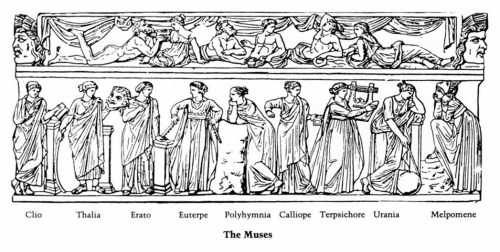
 At 18, in my first semester of college, I saw a phrase that has never left me:  the invocation at the start of Homer’s OdysseySing in me muse, and through me tell the story…  I remember and sometimes use that phrase because it reminds me that the ego, the small self of “me” and “mine” that worries about results is not the self that can bring them about.

Does anyone else find there is something impersonal about creativity?  It feels very much as if a muse or spirit of inspiration is there to take over the keyboard, if I can just get “me” out of the chair.  Carl Jung said it another way:  “I realized my thoughts were not really my own, but were more like animals I encountered on a walk through the forest.”

One summer when I did some freewriting every day I made a startling discovery – if I allow myself to be lousy, I seldom am.  This doesn’t mean there won’t be editing afterward if I find that one of my seed ideas is worth expanding.  It just means that while I am writing, everything goes better if I’m not looking over my own shoulder.

Several people who commented here said the same thing – their blogging took off when they realized they didn’t need to be perfect.  Thanks again to everyone who stopped by to encourage my imperfect progress!

Remember Real Money?

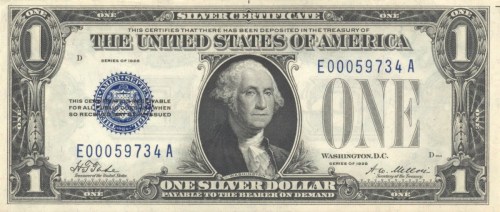
US Silver Certificate

In 1965, my father, who worked for IBM, was assigned to the south of France for two years, so the family packed up for Europe.  Back then, except for a few parodies in Pink Panther and James Bond movies, Americans in Europe got some respect.  Our money got a whole lot of respect – everyone wanted dollars.

My mother, who was an artist and appreciated fine drawing and engraving, drew the line at most European currencies.  “It looks like play money,” she said.  No wonder!  It was colorful and had big heads!  Real money, like good old yankee greenbacks, was sober and serious – it was monochrome and the heads were decently small.  I laughed the other day at a fast food restaurant.  I handed the clerk a twenty and he held it up to the light.  No one trusts a big-head!

Our coins contained silver through 1965

My father was involved in the early development of magnetic card readers.  I remember his mood of euphoria the day engineers succeeded in programming a “1” and a “0” on a magnetic strip.  He announced that someday none of us would carry money at all.

“That sucks,” I said – my usual answer to my father when I was a teenager.  I thought of him today as I used my iPhone to buy a frappacino and then glanced at the budget headlines as I carried it out the door.

Money has always been abstract:  the great Lakota medicine man, Black Elk, called gold, “the yellow metal that drives men crazy.”  To his people, gold was just a pretty stone in the river – nothing to get excited about.

Now money is virtual as well – I used a pattern of pixels to buy my drink.  That doesn’t mean it doesn’t have as much power as it ever did – you can’t see or touch the wind, but this year especially, we have seen what it can do.  Still, in some ways, the increasingly non-material nature of money makes it seem all the more open to abuse.  As I understand it, the Fed doesn’t even have to print big-heads to increase the money supply – a few keystrokes will do it.

Standing liberty quarter

In truth, I love the convenience of electronic money.  A decade ago, when I was managing our affairs and my fathers, I had to write out 30-40 checks a month, a task that took a lot of time and was always subject to error, for my mind wanders when it is bored.  One Friday evening I wrote a payee the entire amount of my paycheck.  Luckily, that honest woman called me a few days later and said, “Uh, sir, I think you made a mistake.”

Abstract or not, we use our money for concrete things – a meal, a car, a house, a movie ticket, a new pair of shoes.  One immediately thinks of bartering, but these days, that seem rather strange.  In the last elections, a conservative senate candidate from Nevada suggested people might think of barter if their medical costs were too high.  Her opponents jumped on that statement, and their slogan, “Chickens for checkups” was a factor in her loss.

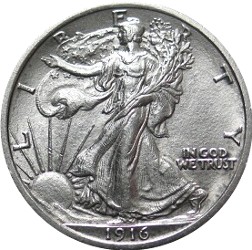
There is one aspect of money we do not think of often – in some of its forms, it is beautiful.  When I was a kid, I collected coins – just pennies for the most part.  I tended to spend anything bigger on baseball cards.  Now I have come to appreciate the sheer beauty of the two types of coins pictured here:  walking liberty halves, and standing liberty quarters.  These pictures show the amazing quality of the engraving.  Coins in this condition are premium, but fortunately, more heavily circulated specimens can be purchased for just a few dollars.  It’s quite an exercise in imagination to hold a coin that is 80 or 100 years old and wonder about its story.

It’s a lot more fun to think in these terms – of the beauty of money – than it is to think of our headlines or watch politicians on TV.  One thing “those European countries” did when we lived abroad, was periodically throw their governments out.  Even now, some nations hold votes of no confidence, which amount to a mass recall.  I remember feeling superior to that  – our system worked after all.  Now as I look at the big-heads in my wallet  – my mother’s old criterion for funny money – I doubt that I am alone in the fantasy of charging our leaders with high crimes of cluelessness and voting the rascals out.

The Letters of Georgia O’Keeffe and Alfred Stieglitz

In 1916, when they met, Alfred Stieglitz was 52, and an internationally known photographer whose avant-garde gallery in Manhattan made him one of the most influential men in early 20th century American art. Georgia O’Keeffe was 28, and an unknown schoolteacher from Texas.  Their professional and personal relationship spanned three decades and is documented in 25,000 pages of correspondence.  The first volume of these letters has just been published as, My Faraway One: Selected Letters of Georgia O’Keeffe and Alfred Stieglitz, Volume I, 1915-1933, edited and annotated by Sarah Greenough.

Georgia O'Keeffe and Alfred Stieglitz, 1944

Sarah Greenough discussed this correspondence recently on NPR:  http://www.npr.org/2011/07/21/138467808/stieglitz-and-okeeffe-their-love-and-life-in-letters.  Stieglitz and O’Keeffe were prolific correspondents, sometimes writing two or three letters a day, up to 40 pages long.  These documents “track their relationship from acquaintances to admirers to lovers to man and wife to exasperated — but still together — long-marrieds.”   

The two began living together soon after O’Keeffe moved to New York.  They were married in 1924.  Greenough notes that tensions began to appear between them almost immediately, but the deciding moment in their relationship came in 1929, when O’Keeffe visited New Mexico and discovered the landscape of her soul.  Stieglitz had promoted her work in New York, but in New Mexico, O’Keeffe found the subjects and colors that made her famous.  You cannot really think of her living anywhere else, just as you cannot think of Stieglitz outside of New York.  The two maintained their relationship at a distance, struggling to grow as individuals and as a couple, until Stieglitz’s death in 1946.

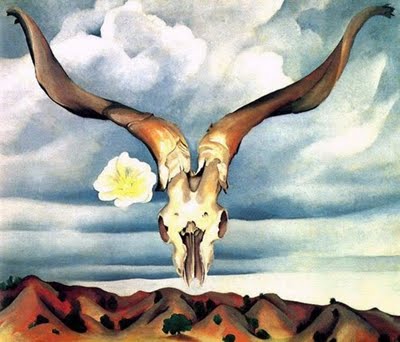
"Ram's Head," by Georgia O'Keefe

More is generally known about O’Keeffe than Stieglitz, for her powerful canvases have a distinct 20th century feel, and her life has become emblematic for generations of women struggling to champion their own personal and creative gifts.

"Light Iris" by Georgia O'Keeffe

Stieglitz is not as important to contemporary artists, but his influence on early 20th century American art and especially modern photography cannot be overstated.  He was an early and ardent champion the idea of photography as an art.  Later 20th century masters of the medium – Paul Strand, Edward Weston, Ansel Adams, and Minor White – all made the pilgrimage to New York to seek the “master’s blessing,” and those who won his approval never doubted themselves again.  In her NPR interview, Sarah Greenough notes that Stieglitz was “amazingly egotistical and narcissistic,” but he had the ability to establish “a deep communion with people.”

Stieglitz was also a “hinge” on which the transition to modern photography swung.  Prior to Stieglitz, most people made and saw photographs in terms of their literal subject matter.  Stieglitz used the medium of visible shapes to evoke states of awareness and feeling that move beyond the visible.  He named his efforts, “equivalents,” a term which Minor White later picked up, championed, and made known to subsequent generations of photographers.

No one before Stieglitz had made photographs as evocative of meaning beyond their literal subjects:

"New York Central Yard," by Alfred Stieglitz

Georgia O'Keeffe's Hands by Alfred Stieglitz

Equivalent, 1930, by Alfred Stieglitz

O’Keeffe and Stieglitz met almost 100 years ago, but their relationship seems utterly contemporary, laced as it was with tension between self-expression and commitment to the other.  Even so, their attitude might be summed up by what Minor White reported after his visit to Stieglitz’s gallery.  White wondered if he had what it took to become a serious photographer.

“Have you ever been in love?” Stieglitz asked.  White said he had.

“Then you can photograph,” was the reply.

Six Writer’s Digest Short Story Competitions

I just received a notice from Writer’s Digest, announcing six short story competitions in six different genres:  http://tinyurl.com/3bdoueq.

In each genre, the first prize is $1000, plus $100 worth of Writer’s Digest books, and the 2012 Novel & Short Story Market.  Second prize is $500, $100 worth of books and the Novel & Short Story Market.  Honorable Mentions receive the Novel & Short Story Market.  The three top entries in each genre will be published in “a Writer’s Digest outlet.”

Stories must be previously unpublished and not accepted by any other publication at the time of submission.  WD retains “one time publication rights” for the “outlet” mentioned above, their website or magazine, I imagine, though they are not specific.  Entries are $20 each, and the maximum length for all genres is 4000 words.  The genre competitions have different deadlines:

Science Fiction/Fantasy – Sept. 15, 2011
Thriller                                – Sept. 15, 2011
Young Adult                       – Oct. 1, 2011
Romance                             – Oct. 15, 2011
Crime                                    – Oct. 22, 2011
Horror                                  – Oct. 31, 2011

Short story competitions pick up in the fall, so here is a chance to explore something off your beaten track.  It was a dark and story night, y’all!